
Cape Verde vs Argentina Preview: World Cup Miracle Meets Messi's Champions
Introduction
A World Cup editorial package built around the final group-stage turning points and the start of the knockout narrative: Cape Verde's historic rise, Argentina's looming test, Iran's emotional qualification route, Uruguay's collapse, France's squad depth and the way VAR, red cards and goal difference have shaped the tournament.
Match Preview
Cape Verde vs Argentina Preview: A World Cup Miracle Meets the Champions
Cape Verde's reward is also their hardest examination
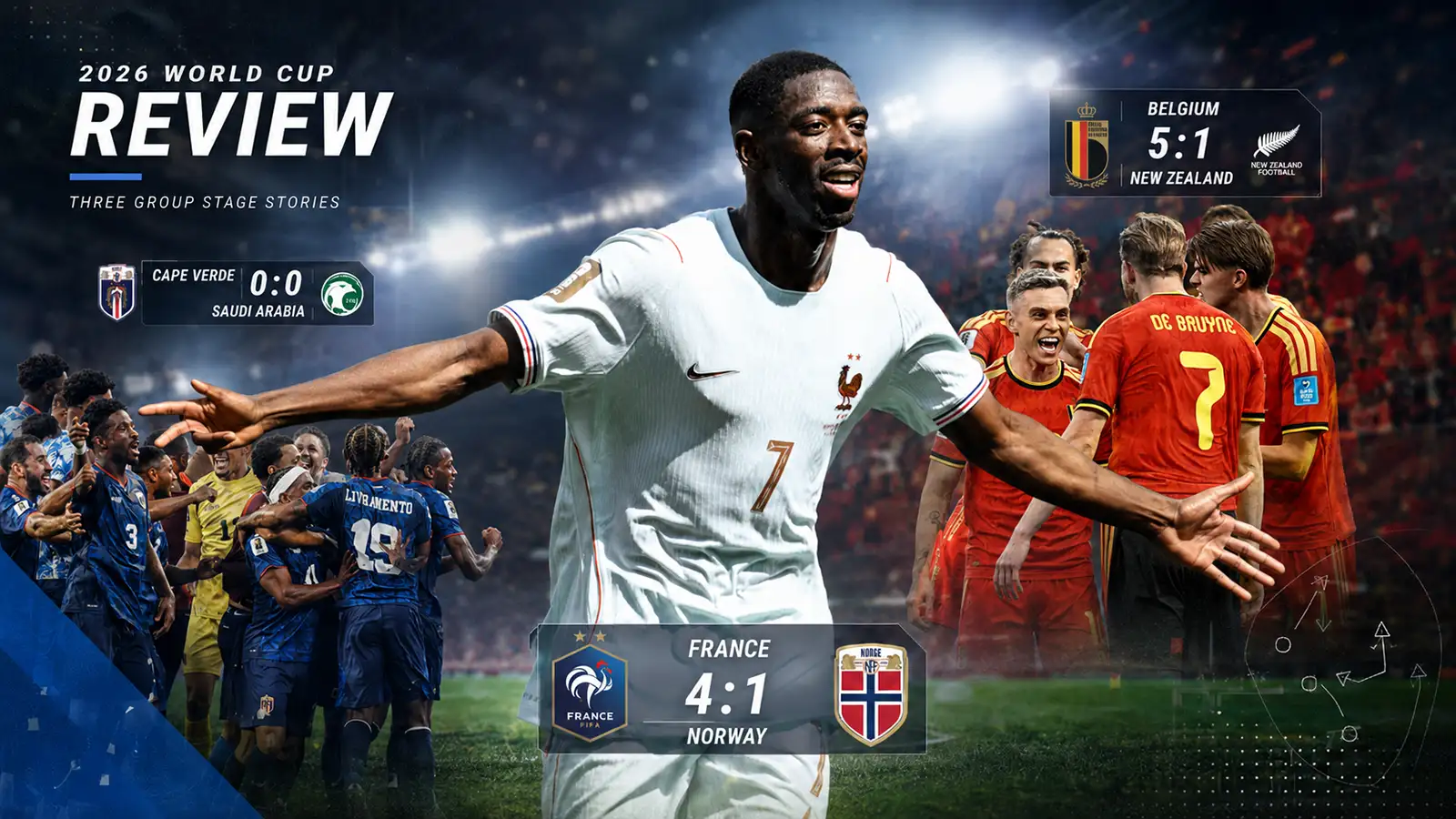
Cape Verde's first World Cup has already moved beyond participation. A 0-0 draw with Spain, a 2-2 draw with Uruguay and a 0-0 draw with Saudi Arabia left them on three points, level on goal difference and second in Group H — enough for direct qualification to the round of 32.
That alone is historic. Cape Verde arrived as debutants and emerged unbeaten from a group containing two established football powers. Their next opponent, however, changes the scale of the conversation. Argentina are not simply another heavyweight. They are the defending champions, a side carrying the aura of recent major-tournament success, and still built around Lionel Messi's ability to tilt knockout matches with one action.
What Cape Verde must protect
Cape Verde's route into the knockout stage has been built on compactness, concentration and emotional control. They have not played like a side interested only in survival; they have defended deep when required, absorbed pressure and found moments to counter, particularly through the right side.
Ryan Mendes has been important to that attacking outlet. Among Cape Verde's forward players, he stood out for involvement and threat, helping turn defensive resistance into actual transition moments. Wagner Pina also matters to the story: after not featuring against Spain or Uruguay, he came into the rotated starting side against Saudi Arabia and helped form the defensive platform that secured the decisive point.
Against Argentina, the question is whether those same mechanisms can hold under a different type of pressure. Argentina are unlikely to give Cape Verde the same transitional rhythm for long periods. Cape Verde may need to defend low, protect central spaces, force Argentina wide and make every counter-attack count.
Messi changes the emotional temperature
Messi enters the tie as the unavoidable reference point. His tournament scoring line already gives the match a record-chasing dimension, but Cape Verde cannot afford to treat this as a ceremonial meeting with a legend. If he plays, every defensive detail around the edge of the box becomes critical: second balls, fouls in dangerous areas, midfield cover and the timing of pressure.
The key for Cape Verde is not to stop Argentina from having possession. That is unlikely. The key is to stop possession from becoming clean central access. If Argentina score early, the match could quickly become a test of Cape Verde's emotional resilience. If Cape Verde survive the opening phase, the pressure may slowly move across to the champions.
The upset path is narrow, but not imaginary
Cape Verde's chance does not come from matching Argentina player for player. It comes from stretching the game into uncomfortable territory: a long 0-0, a set-piece chance, a counter-attack, a heroic goalkeeping performance from Vozinha, or one moment that makes Argentina feel the weight of expectation.
That is the beauty of knockout football. Over a season, depth and quality usually win. Over 90 minutes, discipline and belief can make the gap feel smaller. Cape Verde have already shown they are not tourists. Against Argentina, they now have the opportunity to prove their miracle was not just a group-stage story.
Post-Match Review
World Cup Group Stage Review: Cape Verde, Iran and Senegal Turn Fine Margins Into Tournament Drama
The group stage ended with emotion, not just arithmetic
The final round of World Cup group matches was supposed to settle tables. Instead, it produced a broader argument about what makes tournament football compelling. Cape Verde advanced from Group H as debutants. Iran reached the knockouts after three draws. Senegal transformed their position with a 5-0 win over Iraq. Uruguay, despite their history and talent, went out.
Those stories are very different, but they are connected by one theme: in a 48-team World Cup, margins matter more than reputations.
Cape Verde made history without losing their shape
Cape Verde's group-stage record was not spectacular in a conventional attacking sense: three draws, three points and a goal difference of zero. But the value lies in the context. They drew 0-0 with Spain, 2-2 with Uruguay and 0-0 with Saudi Arabia, finishing second in Group H and qualifying directly for the round of 32.
That is not a fluke dressed up as romance. It reflects structure: defensive discipline, collective running, physical resistance and enough counter-attacking threat to stop opponents from attacking without consequence. For a debutant nation, going unbeaten through the group is a statement.
Iran's qualification carried a different emotional weight
Iran's 1-1 draw with Egypt also led to qualification, but the tone was much more dramatic. After earlier draws with Belgium and New Zealand, another draw left Iran on three points and a goal difference of zero, strong enough to progress among the best third-placed teams.
The final minutes against Egypt were brutal. Iran pushed aggressively, created repeated danger in the Egyptian box, had a goal ruled out after a VAR review for a marginal toe offside, and then saw Mehdi Taremi head against the bar in the 97th minute. The cancelled goal was judged correctly under the law, but that does not make the emotional swing any less severe.
Senegal understood the mathematics
Senegal's 5-0 win over Iraq was not just a big scoreline. It was a strategic result. In a tournament format where third-placed teams are compared across groups, goal difference becomes a form of currency.
Iraq's early red card to Rebin Sulaka after a VAR review changed the match, and Senegal took full advantage. Their goal difference moved from negative territory into a much stronger position, a reminder that in this format teams are not only chasing points — they are chasing margins.
Uruguay's exit is the warning for bigger names
Uruguay's group campaign — a 1-1 draw with Saudi Arabia, a 2-2 draw with Cape Verde and a 1-0 defeat to Spain — left them out. That failure will inevitably bring scrutiny onto Marcelo Bielsa, the team's attacking structure and reported tensions around key players.
But the broader lesson is simple: tournament pedigree does not protect a side that cannot turn superiority into control. Cape Verde advanced because their collective level exceeded expectation. Uruguay went home because their resources did not translate into coherence.
Player Performance
Vozinha, Dembele and Messi: The Players Defining the World Cup's Next Phase
Vozinha: the human face of Cape Verde's run
Cape Verde's historic qualification has a collective explanation, but every World Cup story needs a face. For Cape Verde, that figure is Vozinha.
At 40, the goalkeeper has become more than a shot-stopper. His performances, especially in the draw with Spain, helped give Cape Verde the platform to survive in a group where few expected them to advance. His emotional post-match interview deepened the story: he spoke about being raised by grandparents who had passed away before seeing his biggest career moment, and about his mother, Ana Cândida Évora, being unable to attend because of visa security bond fees and travel costs.
That is why Cape Verde's run has resonated. It is not just about a table. It is about a player carrying family, country and late-career meaning into the biggest football stage.
He showed the world how an underdog can stage a stunning turnaround and how someone from the humblest of backgrounds can break free from life's hardships to emerge anew. What does it mean to truly love life and be passionate about what you love? What does it mean to never admit defeat and never give up? Come the 2026 World Cup, Cape Verde—and this 40-year-old man—will deserve the world's applause!
Dembele: France's reminder that depth wins tournaments
Ousmane Dembele's three-goal performance against Norway changed the tone around France's attack. Mbappe still matters enormously, and his assist underlined his influence, but Dembele's display made a different point: France do not need every match to follow the same script.
A two-footed, direct forward in form is extremely difficult to prepare for. If Dembele can continue to provide end product, France's attack becomes less predictable and more resistant to opponents who build their plan around limiting Mbappe.
Messi: Cape Verde's ultimate test
For Cape Verde, Messi is not just another opponent. He is the symbol of the gap they are trying to close for one night: experience, technique, pressure management and ruthless decision-making.
His tournament goal tally has already made the Argentina-Cape Verde tie part of a larger record conversation. But Cape Verde cannot approach the match as spectators to a Messi storyline. Their defensive distances, fouling discipline and concentration around zone 14 will decide whether Messi is forced away from danger or allowed to conduct the match.
The knockout stage needs all three types of player
Vozinha represents the underdog story. Dembele represents squad depth and form. Messi represents legacy and inevitability. Together, they explain why this stage of the World Cup works: it is not only about the strongest teams, but about the individuals who turn structure, emotion and pressure into defining moments.
Controversy and Talking Points
VAR, Rotation and Recovery: The World Cup Talking Points That Go Beyond the Scoreboard
Correct decisions can still feel brutal
Iran's disallowed goal against Egypt is the kind of moment that exposes the emotional cost of precision. After a VAR review of around three minutes, the goal was ruled out for a marginal toe offside. Under the law, the decision was correct. In human terms, it was devastating.
That distinction matters. The argument is not whether technology should ignore offside. It is whether football has fully accepted the emotional consequences of measuring attacking movement to such fine margins. A goal can be legally wrong by centimetres and still feel, to players and supporters, like an entire tournament has been ripped away.
Iran still qualified after a 1-1 draw, but the final minutes — the cancelled goal, the continued pressure and Mehdi Taremi's 97th-minute header against the bar — will remain one of the tournament's defining emotional sequences.
Recovery conditions are part of sporting fairness
Iran's tournament story also carries a wider concern. Reports around their movement between the United States and Mexico, restrictions on entry and post-match travel arrangements raise a legitimate sporting question: if a team is accepted into a tournament, should it not also be guaranteed reasonable preparation and recovery conditions?
This is not only a political issue. It is a football issue. Recovery affects training intensity, injury risk, tactical preparation and mental state. If one team repeatedly faces heavier logistical demands than others, competitive fairness becomes harder to separate from administration.
Norway's rotation was rational — and still debatable
Norway's decision to make sweeping changes against France, with Haaland and Odegaard rested, can be defended. A team that has already achieved its immediate objective has every right to protect its most important players before the knockout phase.
But tournaments are interconnected. When third-place rankings, goal difference and other teams' qualification routes depend on results across groups, heavy rotation can feel uncomfortable to rivals. That does not make Norway wrong. It does make the format more complicated.
Iraq's red card changed more than one match
Iraq's early red card against Senegal, upgraded after VAR review for denying a goalscoring opportunity, transformed the game. Senegal's 5-0 win did not only eliminate Iraq's hopes; it reshaped the third-place picture by improving Senegal's goal difference.
Again, the issue is not just one decision. It is the way modern tournament football links every decision to a wider ecosystem: VAR, goal difference, rotation and recovery all influence who advances.
The lesson: fairness is no longer just about the referee
Football still begins with 90 minutes and the same laws for both teams. But at World Cup level, fairness is also shaped by travel, squad depth, technology, scheduling and incentives. The best tournaments are not those without controversy. They are those willing to examine why the controversy exists.