
Champions League League Phase Preview: Real Madrid, Inter, Brugge and the Test of Paper...
Introduction
A broad European football analysis package built around one central idea: paper strength, model projections and star power only matter when they survive real match pressure. The strongest public angle is the Champions League league-phase preview, supported by Arsenal’s new champion identity, Real Madrid’s Mbappé-era scrutiny, Barcelona’s need for stronger evidence, Manchester United’s defensive doubts and the growing tension between data models and supporter instinct.
Match Preview
Champions League Opening Tests: Why Real Madrid, Inter, Brugge and Villa Must Prove More Than Paper Strength
The Champions League league phase does not allow Europe’s biggest clubs to treat the opening stretch as a formality. The format is simple in its consequences: 36 clubs sit in one table, each side plays eight different opponents, the top eight go straight into the round of 16, places nine to 24 enter a two-legged play-off, and the bottom 12 are eliminated.
That changes the psychology of the competition. A heavyweight can still recover from an uneven start, but dropping points early now carries a clearer cost: more fixtures, more rotation stress, and a greater chance of being dragged into an awkward play-off tie.
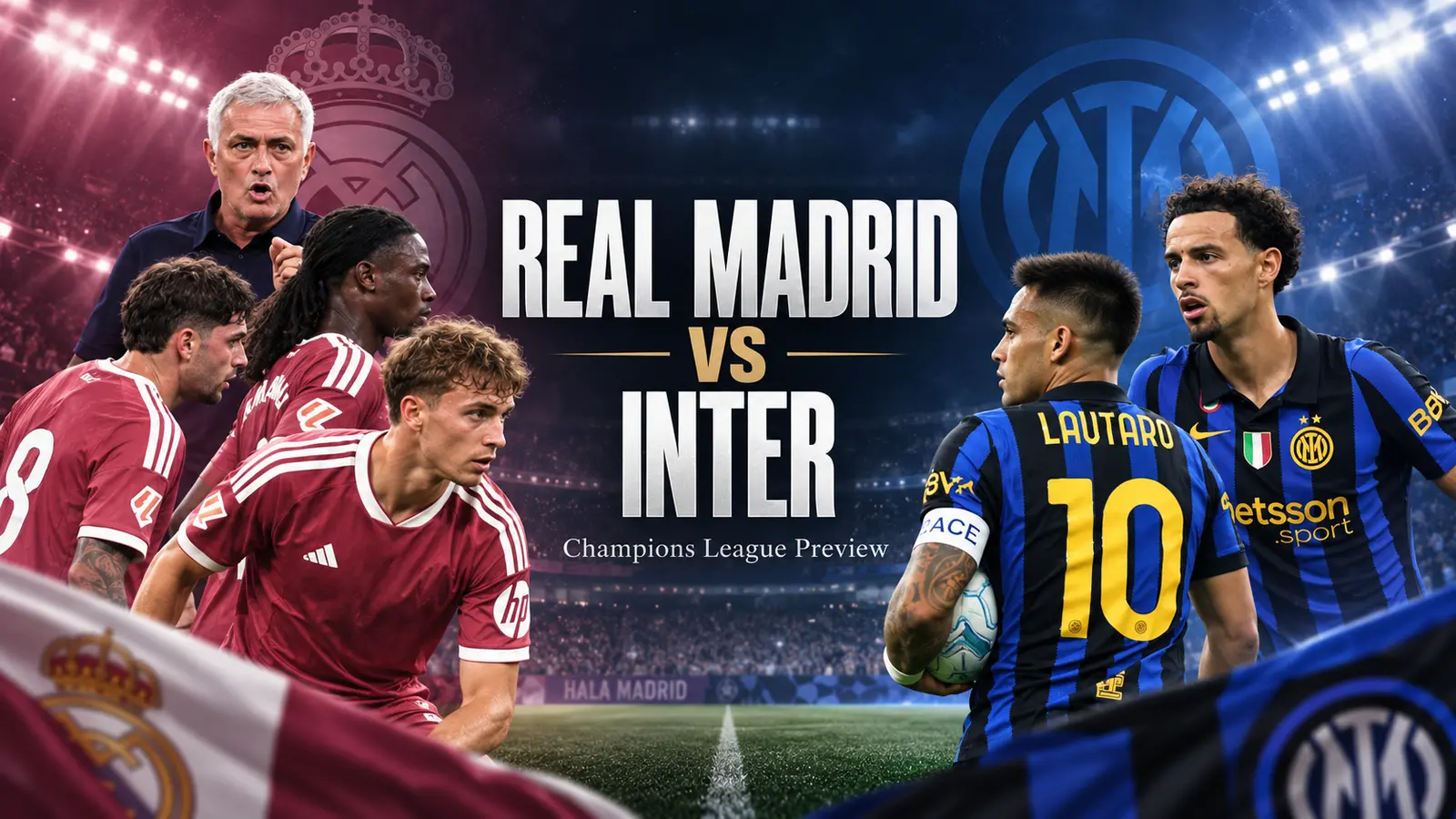
Real Madrid vs Inter: a glamour tie with real pressure
Real Madrid hosting Inter at the Santiago Bernabéu is the obvious headline fixture. It also arrives with Madrid under immediate scrutiny after a 1-0 La Liga defeat away to Real Betis, a match decided late and made more dramatic by Kylian Mbappé’s stoppage-time penalty being saved.
That single defeat should not be exaggerated into a crisis. League titles and European campaigns are built over months, not one missed penalty or one flat night. But this is Real Madrid, and Madrid’s margin for narrative patience is always thin. Every attacking sequence involving Mbappé, Vinicius Jr. and Rodrygo will be examined for chemistry, balance and defensive commitment.
Mbappé’s pre-match messaging has been notable for its composure. He has pushed back against attempts to frame Madrid’s dressing room through conflict, while also accepting that the whole team — himself included — can improve without the ball. That is the right tone before a fixture like Inter: confident, but not careless.
Inter’s challenge is different. Lautaro Martínez remains central to their attacking credibility, and any strong performance against Madrid would immediately strengthen his standing in the biggest-game conversation. Francesco Pio Esposito’s new long-term deal adds another layer to the forward-line storyline, though a contract extension alone does not prove what his immediate role will be.
There is also the José Mourinho dimension. The Madrid manager faces one of his former clubs, but the setting matters: this is not a return to San Siro. It is Mourinho leading Real Madrid at the Bernabéu against Inter, a narrative rich enough without rewriting the fixture.
Brugge vs Aston Villa: the article-versus-instinct match
Club Brugge against Aston Villa may be the more useful test for how we read European football in 2026. Brugge are not a traditional Champions League glamour pick, but their reputation for developing, refining and selling talent gives them a profile that data models often value more than casual fan perception does.
That reputation was reinforced by Christos Tzolis joining Arsenal from Brugge in July 2026 on a reported £34 million deal. The broader point is not one transfer fee; it is the production line. Brugge are a club that can turn recruitment and player development into competitive European performances.
Villa, meanwhile, represent a different type of proof. If the Premier League side win with authority, the argument will be that league intensity and squad quality still matter more than model-friendly structure. If Brugge impose themselves, the takeaway will be that data may be catching forms of strength that reputation still underrates.
The wider European frame
Opta’s supercomputer projections before the league phase placed Arsenal and Bayern Munich at the front of the title probability picture, followed by Manchester City, Barcelona, Paris Saint-Germain, Liverpool, Real Madrid, Manchester United, Inter and Aston Villa in the top ten by title probability.
Those projections are useful, but they are not a table of truth. They are a discussion starter. Arsenal’s place near the top reflects a club whose domestic status has risen sharply after ending a 22-year wait for a Premier League title in 2025-26. PSG enter as back-to-back European champions chasing a third straight crown. City remain a structural giant even if the conversation around them includes transition and squad renewal. Barcelona’s case is built on young talent and defensive growth, but they still need proof against elite Champions League pressure.
That is the theme of the opening week: not who looks strongest on paper, but who can make that strength visible when the level rises.
Post-Match Review
Arsenal 2 1 Chelsea Review: Rice, Rogers and the New Edge of a Champion Team
Arsenal’s 2-1 win over Chelsea on 6 September carried more meaning than a London rivalry result. The defining image was not simply tactical control or three points; it was the confrontation between Declan Rice and Morgan Rogers, a moment that quickly became a referendum on Arsenal’s new identity.
The incident followed Rogers taking exception to what was shown as an alleged trip by Rice, before the two players squared up and Rogers shoved him. Without a full public disciplinary explanation, it would be irresponsible to treat every detail of the officiating as settled. But as a football moment, it was revealing.
Arsenal are no longer being read as a soft contender
For years, Arsenal were often framed as technically elegant but emotionally vulnerable. That label was always too simple, but it stuck because football narratives are built as much on memory as evidence.
Winning the 2025-26 Premier League changed the lens. Arsenal are now defending champions, and that status alters how every clash is interpreted. A confrontation that might once have been filed away as minor needle now becomes a discussion about respect, authority and whether a champion side must make opponents feel its boundaries.
Rice sits at the centre of that shift. His value to Arsenal is not only in ball-winning, passing range or midfield coverage. He has increasingly become a symbol of a harder Arsenal: still technical, but less willing to absorb provocation quietly.
Rogers and the Henry-shaped flashpoint
Rogers’ celebration was interpreted by some observers as resembling Thierry Henry’s famous corner-flag pose. That interpretation matters because Henry is not just an Arsenal great; he is part of the club’s emotional architecture.
But there is an important distinction. A celebration can be read as homage, provocation, theatre or coincidence depending on the viewer’s allegiance. Without Rogers himself clearly defining the intent, it should not be presented as fact that he was deliberately mocking Arsenal.
That uncertainty is exactly why the moment travelled. Football culture thrives on symbols, and symbols become combustible when they touch club identity.
The champion’s dilemma
Arsenal’s new edge is useful. It can make them harder to play against, harder to intimidate and better equipped for title-race pressure. But it also brings risk. Champions get watched differently. Their body language, reactions and disciplinary moments are magnified.
That is the balance Mikel Arteta’s side must manage: keep the authority, avoid the emotional tax. If Arsenal can do both, this version of the team may be more dangerous than the more polite side of old.
Team Analysis
Why Paper Favourites Keep Getting Tested: Arsenal, Barcelona, Manchester United and the Champions League Reality Check
The most useful way to read Europe’s early-season football is not by asking which club looks strongest on paper. It is by asking which strengths have actually been tested.
That distinction matters because several major clubs are carrying narratives that may be true — but still need better evidence.
Arsenal: champions with a sharper edge
Arsenal’s transformation is as psychological as tactical. Ending a 22-year wait for the Premier League title in 2025-26 changed how opponents, fans and media interpret them. The Rice-Rogers confrontation against Chelsea became bigger than one flashpoint because Arsenal are now being judged as defending champions.
That status can help. A champion team needs authority. It needs players who draw lines. But it also creates a different pressure: every edge can be praised as leadership or criticised as overreaction.
Barcelona: convincing, but not fully proven
Barcelona’s recent domestic form gives supporters reason for optimism. Their 5-0 win away to Valencia featured another two goals from Lamine Yamal, and Pau Cubarsí’s growth remains central to the argument that Barça have become more balanced and more secure.
But context matters. Valencia were bottom of La Liga with one point after that defeat, and supporter protests reflected deeper structural frustration around the club. A big Barcelona win in that environment is still valuable, but it is not the same as surviving elite Champions League pressing, transition attacks and set-piece pressure.
Barcelona’s next level of proof is not whether they can overwhelm a wounded opponent. It is whether their defensive upgrade holds against a side strong enough to punish every spacing error.
Manchester United: reputation versus defensive evidence
Manchester United remain a perfect example of the gap between club name and current reliability. Their first three Premier League matches of 2026-27 all featured two goals conceded: 0-2 at Hull City, 5-2 against Ipswich Town, and 2-2 at Everton.
That pattern does not settle their season, but it does explain why some supporters resist any model or projection that treats United like a top-tier European contender. Until the defensive structure stabilises, name value will continue to run ahead of performance evidence.
Manchester City: still elite, but judged through transition
Manchester City began the league campaign with three wins from three, yet the conversation around them still includes renewal and recalibration. That is not a contradiction. A side can be winning and still evolving.
City’s European question is not whether they have quality. It is whether their structure is as automated, ruthless and durable as the best versions of Pep Guardiola’s teams. In the Champions League, the difference between a mature machine and a team still re-forming can appear in one transition, one press-break, one away game.
Brugge: the non-glamour test case
Club Brugge are useful because they force a different conversation. Their value is not celebrity. It is talent development, recruitment and repeatable club process. That is why a match against Aston Villa carries wider meaning: it pits an analytically respected European development model against Premier League intensity.
If Brugge compete well, the lesson will be that data sometimes identifies strength before mainstream opinion does. If Villa impose themselves, the lesson may be that model-friendly profiles still need to survive the physical and tactical stress of elite opposition.
The real lesson
Across Arsenal, Barcelona, United, City and Brugge, the point is the same: football does not reward theory. It rewards proof under pressure.
Player Performance
Mbappé, Yamal, Cubarsí and Lautaro: The Players Carrying Europe’s Biggest Early Narratives
Early-season European football often turns team questions into player questions. Real Madrid’s balance becomes a Kylian Mbappé discussion. Barcelona’s resurgence becomes a Lamine Yamal and Pau Cubarsí discussion. Inter’s ceiling becomes a Lautaro Martínez discussion.
That is not always fair, but it is how elite football is consumed.
Kylian Mbappé: confidence without surrendering the narrative
Mbappé enters Real Madrid’s Champions League meeting with Inter under the kind of scrutiny reserved for very few players. A missed stoppage-time penalty in Madrid’s 1-0 defeat to Real Betis sharpened the noise, but it should not define his condition.
What matters more is how he is handling the Madrid environment. In his pre-match comments, Mbappé presented the right blend of self-belief and responsibility. He maintained his view of himself as the world’s best while also acknowledging that defensive improvement is a team-wide responsibility, including his own.
That balance is important. If he denies every concern, he looks detached. If he accepts every media frame, he feeds the pressure. The smartest elite players know how to admit there is room to improve without letting the conversation become a crisis.
Vinicius Jr. and Rodrygo: chemistry will be judged by movement, not rumours
The Madrid attack will continue to be interpreted through the Mbappé-Vinicius-Rodrygo triangle. But chemistry should be judged on positioning, timing, pressing and chance creation — not on unsupported claims of personal conflict.
Against Inter, the key question is practical: can Madrid create clean occupation of the left side, central lanes and penalty area without compressing their own best players into the same spaces?
Lamine Yamal: production meets protection
Yamal’s talent no longer needs introduction. His two goals in Barcelona’s 5-0 win at Valencia followed another two-goal display against Rayo Vallecano, giving Barça a strong attacking storyline heading into European tests.
The challenge for Barcelona is managing the difference between elevation and overexposure. Young stars need freedom, but they also need structure around them. Yamal’s form is a major reason for optimism; it should not become an excuse to place an entire European argument on a teenager.
Pau Cubarsí: the defender behind the Barcelona case
Cubarsí’s importance is less viral but just as significant. After being named Best Young Player at the 2026 World Cup as Spain won the tournament, he represents the defensive maturity Barcelona need if they are to be treated as serious Champions League contenders.
For Barça, the question is not whether they can score. It is whether their defensive line and rest defence can survive elite counter-pressure. Cubarsí is central to that answer.
Lautaro Martínez: a big-game narrative that needs careful wording
Lautaro remains Inter’s attacking reference point, and his European record includes significant knockout-stage goals in previous campaigns. That matters because lazy criticism often reduces strikers to vague labels like “big-game player” or “goes missing” without defining the sample.
Against Real Madrid, the fair question is not whether Lautaro has ever delivered at the top level — he has. The fair question is whether he can again be decisive in one of the hardest away fixtures in European football.
Controversy and Talking Points
Respect, Data and Media Noise: The Talking Points That Are Warping Early Season Football Debate
The best football controversies are rarely about one clean fact. They live in the gap between what happened and what people believe it meant.
That is why the current debate around Arsenal, Champions League projections and Real Madrid’s media narratives is so revealing.
Rice, Rogers and the politics of respect
Declan Rice and Morgan Rogers gave the Premier League its first major identity debate of the season. The confrontation itself was visible; the meaning attached to it was far more contested.
Was Rogers’ celebration a tribute, a provocation or simply a celebration that invited interpretation? Was Rice showing leadership and edge, or flirting with unnecessary risk? Those are legitimate questions. What is not legitimate is presenting motive as fact without the player clearly stating it.
Arsenal’s new status as defending Premier League champions makes the issue more sensitive. Champions are expected to command respect, but they are also expected to stay in control. That is the contradiction at the heart of the debate.
Data models are not insults — but they are not gospel either
The Champions League prediction conversation has produced another familiar argument: supporters want models to respect what they see every week, while models often reward underlying profiles that are less emotionally obvious.
Opta’s supercomputer had Arsenal, Bayern Munich and Manchester City among the leading title-probability sides before the league phase, with Barcelona, PSG, Liverpool, Real Madrid, Manchester United, Inter and Aston Villa also in the top ten. Some of those placements feel intuitive; others provoke resistance.
That resistance is healthy if it asks better questions. Why does a model trust a team? Is it squad quality, historical performance, opponent difficulty, recent results, market value, chance creation or simulation logic? The mistake is treating a projection as either perfect truth or complete nonsense.
Mbappé and the manufactured dressing-room storyline
Real Madrid always generate noise, and Mbappé magnifies it. His relationship with Vinicius Jr. and the wider attacking structure will be watched closely, but there is a difference between tactical fit and confirmed personal conflict.
Mbappé’s public stance has been to keep the focus on shared objectives, improvement and performance. That does not prove every private dynamic is perfect — no press conference can do that — but it does mean public analysis should stay close to what can be supported.
The standard should be simple
Football debate is at its best when it allows uncertainty. Rogers’ intent can remain open. Rice’s edge can be praised and scrutinised. Models can be useful without becoming holy texts. Mbappé’s Madrid fit can be analysed without inventing dressing-room drama.
The game gives us enough tension without adding facts that are not there.