
Barcelona’s Striker Question and Mourinho’s Real Madrid: Why Need, Fit and Control Are Not the Same Thing
At a Glance
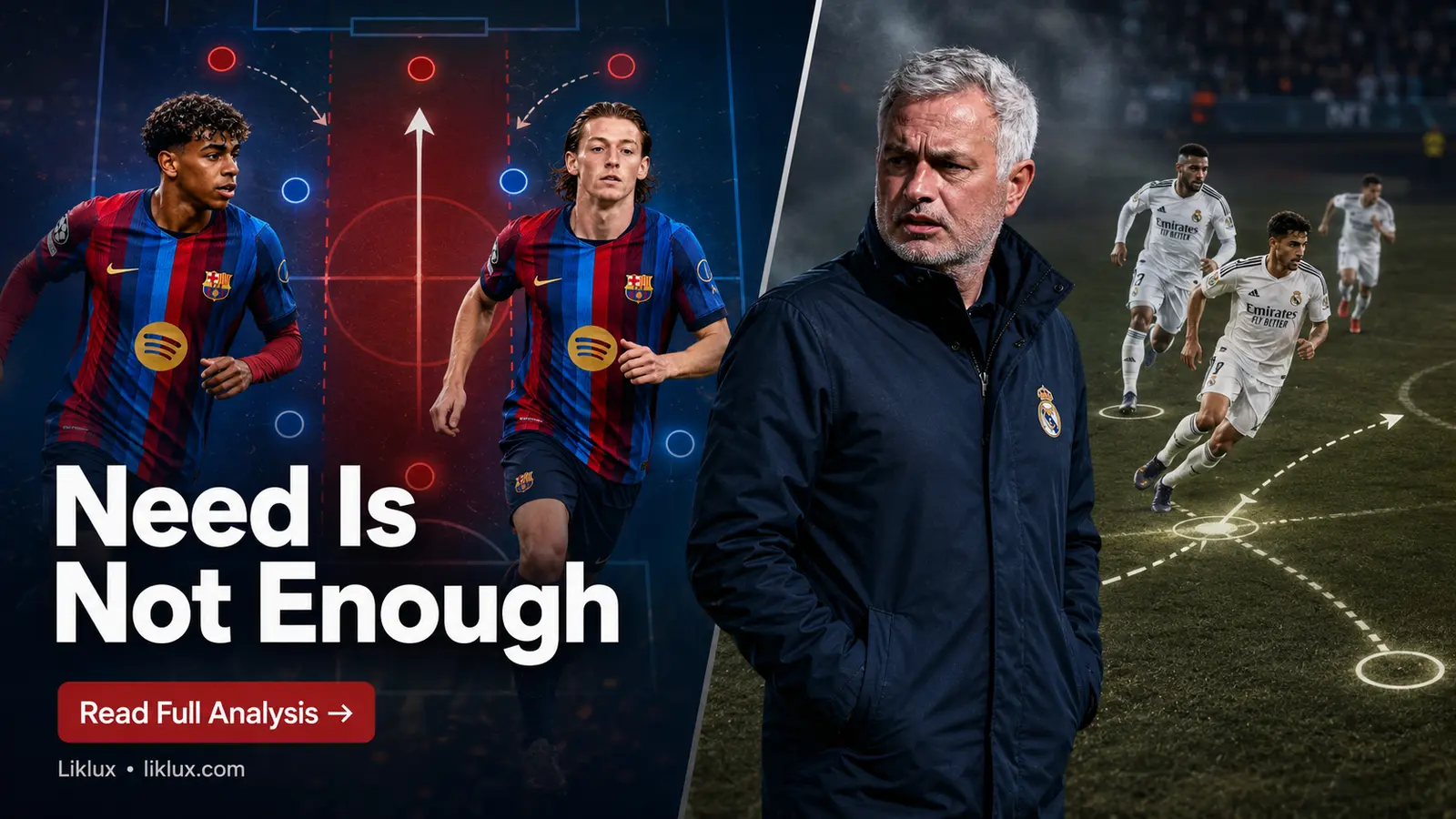
What happened: Barcelona are dealing with a changed forward picture, while José Mourinho has been officially appointed Real Madrid’s first-team coach from 2026/27. The two discussions meet in a broader debate about squad need, tactical fit and the cost of managing elite talent.
Why it matters: A shortage in one position does not make every expensive solution sensible. Equally, a fast attacking group does not by itself prove that Mourinho’s football—or his management style—will work without friction at Real Madrid.
Liklux view: The useful question is not whether Barcelona need a striker or whether Mourinho can organise a winning team. It is whether the available solution fits the financial, tactical and human constraints around it.
What to watch next: Barcelona’s choice between recruitment and internal adaptation; Real Madrid’s midfield supply line in transition; and whether Mourinho can turn short-term authority into durable alignment across a high-status squad.
The common mistake: treating an obvious need as an answer
Barcelona’s forward discussion and José Mourinho’s Real Madrid appointment can appear to belong in separate conversations. One concerns recruitment; the other concerns a manager and an elite squad. Yet both expose the same analytical error: confusing an obvious need with a complete solution.
Barcelona’s official squad picture has changed. Robert Lewandowski and Ferran Torres have both left the club, while Barcelona’s website currently lists six forwards. That does not officially designate central striker as the club’s most urgent vacancy, but it gives weight to the Liklux view that the middle of the attack is the area most likely to demand a clear answer.
At Real Madrid, Mourinho’s appointment is confirmed for 2026/27. It is easy to see the first layer of the fit: a squad with pace and attacking threat can make rapid transition football immediately legible. But the more important work begins after that first impression. Who releases the runners? Who accepts a reduced role? Who mediates when competitive urgency collides with a professional boundary?
That is the thread running through this roundup. Squad gaps, market valuation, tactical design and managerial control are not isolated issues. They are different forms of the same problem: football plans fail when their hidden costs are ignored.
Barcelona’s striker gap is a problem, not a transfer conclusion
Liklux’s starting point is reasonable: if Barcelona do not strengthen through the middle, they may have to reshape the attack around other available options. But a need at centre-forward does not establish that a particular target is attainable, suitable or worth the premium required.
That distinction matters because transfer debate is often driven by urgency. Once a team is judged short at a position, supporters and commentators can begin to treat the market as though it has a duty to provide the right player at the right price. It does not. A club may need a striker and still be right to reject a deal because of age profile, injury history, contract position, tactical dependence or the simple question of whether the player wants to force the move.
The most transferable point is the valuation framework. Liklux’s commentary argues that a proposed €80m-level price should not be assessed through Barcelona’s finances alone. The relevant variables are cumulative: how much contract remains, what physical risk a buyer would be accepting, how the player’s age changes the resale horizon, and whether his game requires a particular possession structure or supporting cast.
A competing buyer withdrawing would not automatically make a high fee more logical. Nor would Barcelona’s shortage automatically make it logical. Demand explains why a club is looking; it does not settle what it should pay.
The same discipline applies to the discussion around Frenkie de Jong. De Jong has suffered a knee-ligament injury and opted for conservative treatment. Reports about Barcelona’s preference for surgery must remain reports, rather than becoming a claim that he simply refused a club instruction. Liklux’s estimate that he could still command roughly €40m–€50m is an opinion about transfer value, not a market offer or an official valuation.
That is precisely why it belongs in the broader argument. Player sales are often discussed as if they create a clean funding line for the next signing. In reality, valuation is conditional, timing is uncertain and a player’s fit within a system affects what another club will risk paying. Barcelona’s challenge is not merely to identify a missing role. It is to avoid letting the absence of that role distort every subsequent decision.
Barcelona’s recent success does not remove the structural question
Barcelona won La Liga and the Spanish Super Cup in 2025/26. Those two trophies matter because they prevent an overly simplistic diagnosis: this is not a case of a club with no competitive foundation.
But success in one season does not erase the need to examine the structure that follows it. A team can win while carrying a vulnerability, especially if that vulnerability is masked by form, availability or the flexibility of other attackers. The correct response is neither panic nor complacency. It is to ask whether the next version of the side can still create, occupy the box and finish attacks when the existing balance changes.
Liklux’s other useful contrast is with Real Madrid. Barcelona may have a shortage in a particular function; Real Madrid may have abundance in several. Neither condition is automatically comfortable. A thinner squad can force improvisation. A star-heavy squad can make selection, authority and role allocation harder. Depth is not the same as harmony, just as a shortage is not proof that any proposed signing is sensible.
Mourinho’s Real Madrid fit begins with speed—but cannot end there
Mourinho has officially returned to Real Madrid after spells with Tottenham Hotspur, Roma, Fenerbahçe and Benfica. Liklux characterises the intervening years as more uneven; that is an assessment, not a factual verdict on his career. What is clear is that he now returns to an environment built for immediate expectation rather than a long, quiet rebuild.
The argument for the appointment begins with a familiar tactical intuition. Liklux sees quick transitions and defensive-to-attacking breaks as major features of Mourinho’s classic periods. With fast attackers, Real Madrid should possess the raw material to make vertical football dangerous quickly. Kylian Mbappé has also spoken positively of Mourinho in a Real Madrid interview, describing him in essence as a coach who understands how to win and lead teams towards victory.
That makes the fit plausible. It does not make it complete.
Real Madrid’s personnel changes underline both the scale and the complexity of the project. Vinícius Júnior has extended his contract to 2032. Nineteen-year-old winger Yan Diomande has joined from RB Leipzig, although the club did not disclose a fee; media reports of a potential package approaching €140m should not be confused with a confirmed fixed cost. Franco Mastantuono has joined Fiorentina on loan until 30 June 2027. Alaba has left, while Ibrahima Konaté joined after his Liverpool contract expired; Denzel Dumfries arrived from Inter, Carlos Espí from Levante, and Gonzalo García completed a permanent transfer to Fulham.
Those moves offer material for tactical imagination, but lists of names are weak evidence on their own. Liklux’s conclusion is more cautious and more useful: much of the squad may suit Mourinho’s preferred profile, but midfield creation is the structural reservation. Reports continue to suggest Real Madrid could add in midfield or defence, though there is no official confirmation of a particular additional signing.
The decisive pass matters more than the fast runner
The sharpest tactical point in this debate is that counter-attacking football is not powered by speed alone. It is powered by the first pass that makes the speed relevant.
Liklux uses Mourinho’s 2014/15 Chelsea as a reference point. Diego Costa, Eden Hazard and Cesc Fàbregas were indeed key attacking figures, while the reduction of that side to a simple three-man attacking formula is properly understood as a tactical shorthand rather than a complete description of the team. The broader lesson is valid: transition attacks become repeatable only when someone can identify the moment, evade the first pressure and deliver the ball into space or into the next attacking action.
Liklux’s view is that Real Madrid have ample pace in the frontline but may lack a reliably defined first-pass or creative reference point. That is not a declaration that the team has no creativity. It is a question for the eventual shape, starting selections and division of responsibility.
The management cost follows naturally. If several elite forwards expect central roles and Jude Bellingham’s role is also difficult to reduce, selection ceases to be a whiteboard issue. It becomes a hierarchy issue. A coach may be able to create a devastating transition pattern, but only if he can decide which player provides balance, which player waits, and which player accepts a less glamorous task.
This is why Mourinho’s appointment should not be judged only through the slogan that he suits a mature, winning squad. There is a strong case for that description: he has already shown at Chelsea that he can significantly strengthen a title-challenging side built around established leaders, winning the Premier League in 2004/05, 2005/06 and 2014/15. But that history does not prove he only works with finished teams, nor does it resolve the daily politics of a modern super-squad.
Liklux’s more nuanced conclusion is preferable. Mourinho may be able to unify elite players quickly, redirect scrutiny and turn a shared external target into competitive focus. The first season can therefore look especially promising. The unresolved question is whether that initial force can be sustained when status, minutes, positions and disappointments accumulate.
A league title is consequently a more grounded prediction than an automatic European triumph. Liklux predicts that, if Real Madrid improve while Barcelona weaken relatively, Madrid have a strong chance of reclaiming the league. That remains a forecast, not a result. The value of the claim lies in its calibration: a domestic campaign rewards repeatable organisation, whereas Europe introduces a different concentration of high-variance, elite-level tests.
Eva Carneiro and the limit of competitive control
The discussion of Mourinho’s management reaches beyond formations when it returns to the 2015 Chelsea-Swansea match and Eva Carneiro.
In stoppage time, Carneiro and Jon Fearn entered the field to treat Hazard after referee Michael Oliver indicated that the medical team should come on. Mourinho reacted angrily. With Thibaut Courtois already sent off and Hazard required to leave the pitch after treatment, Chelsea were temporarily reduced to nine players—not 10.
The aftermath was not a simple story of a staff member being sacked. Carneiro was first removed from first-team duties, later left Chelsea and brought legal action including a constructive-dismissal claim. The case ended in a confidential settlement in 2016, accompanied by a public Chelsea apology. She has since continued clinical sports-medicine work in London at The Sports Medical Group on Harley Street.
Carneiro later said publicly that Oliver called the medical team on twice and that Hazard confirmed he required medical assistance twice. Her position, therefore, was that professional duty required her to enter the field. Mourinho’s own position at the time was rooted in his assessment that the injury was not serious—his judgement, not a medical diagnosis.
The strongest analysis does not flatten this into a contest in which only one role can be legitimate. Liklux argues that both sides had a rational claim within their own duties. A manager sees time, numerical disadvantage and the possibility of losing control of a match. Medical staff must act under professional standards when a player requests treatment and the referee calls them on.
The conflict emerges because those standards meet in a single, immediate decision. Competitive management wants every participant in the match environment to understand the consequences of an intervention. Medical independence cannot be subordinated to a coach’s desired game state.
Liklux also considers Mourinho’s language in the episode to have carried a gender-inequality implication. That must remain a commentator’s value judgement, not a legal finding: there was no public court ruling establishing that assessment as fact.
Can high-control management still work?
The Carneiro episode matters now because it sharpens the question around Mourinho’s return to Real Madrid. Liklux sees continuity in his core temperament, while allowing that later experiences at Tottenham and Roma may have brought some restraint. Again, that is a judgement about management style, not a measurable fact.
The commentary’s central claim is that Mourinho’s attention to detail is not merely a personality trait. It is a philosophy of competitive control: training, match preparation, substitutions, player behaviour and the wider staff operation are all part of the same effort to gain marginal advantage.
That philosophy can work. Liklux explicitly believes high-control leadership remains viable in modern football and notes that elite managers, including Pep Guardiola as a comparison, require substantial control over their environments. But viability is not immunity from consequence.
At Real Madrid, control will be tested less by whether Mourinho can demand intensity than by where he draws the boundary. Can he insist on tactical sacrifice without turning every selection into a grievance? Can he build an immediate collective mission without assuming that early unity guarantees long-term stability? Can he pursue match advantage without encroaching on areas that require independent professional judgement?
Those are not abstract ethical add-ons. They are part of sporting performance. The team that finds the decisive first pass, accepts role changes and retains trust across its staff will have a more durable advantage than one that simply begins the season with the loudest authority.
The real test is whether the plan survives its constraints
Barcelona should resist allowing a centre-forward need to dictate an irrational purchase. Real Madrid should resist allowing an attractive Mourinho-and-speed narrative to obscure questions of midfield supply and squad hierarchy.
Both clubs have reasons for confidence. Barcelona’s 2025/26 trophies show a live competitive base. Real Madrid have appointed a coach with a proven record of winning and a squad profile that can plausibly suit direct transition football. But both cases contain the same warning: a plan is only as strong as the constraint it can absorb.
For Barcelona, that constraint is the market. For Mourinho’s Real Madrid, it is the first pass, the distribution of roles and the limits of control. The next season will not be decided by which problem looks easiest in a headline. It will be decided by which club recognises that football’s most obvious answers are often only the beginning of the question.
Liklux Verdict
Barcelona’s centre-forward shortage is real enough to demand planning, but it does not validate a high-cost move by itself. Mourinho’s Real Madrid has a credible short-term fit—especially in transition—but the decisive issues are midfield creation, role allocation and whether control can remain effective without overrunning necessary boundaries.
Sources and Verification
View sources and verification notes
- Robert Lewandowski leaving FC Barcelona at the end of the season”: official club notice confirms his departure at the close of the 2025/26 season. — FC Barcelona
- Agreement with Paris Saint-Germain for the transfer of Ferran Torres”: official club notice confirms his permanent transfer to Paris Saint-Germain. — FC Barcelona
- Barcelona midfielder Frenkie de Jong out for weeks with serious right injury”: confirms a knee-ligament injury and quotes De Jong saying that, at that stage, surgery was not needed. — Reuters
- report on Frenkie de Jong’s ligament injury: reports Barcelona preferred surgery while the player favoured conservative treatment, with surgery not presented as definitively ruled out. — El País
- Official Announcement: José Mourinho”: confirms Mourinho was appointed first-team head coach for three seasons through 30 June 2029 and would join on 13 July 2026. — Real Madrid
- PL30: Chelsea’s special 2004/05 title win”: describes Mourinho’s 2004/05 Chelsea using a 4-3-3, soaking up pressure and attacking quickly on transitions and breakaways. — Premier League
- Chelsea’s route one to success”: contemporary tactical coverage describes Chelsea’s direct and rapid attacking route during Mourinho’s first spell. — UEFA
- Real Madrid manager Jose Mourinho”: provides a dated career chronology, date of birth and major honours for Mourinho through his 2026 Real Madrid return. — Reuters
- José Mourinho” coach profile: gives his date of birth as 26 January 1963 and lists his coaching career from Benfica through Real Madrid in 2026. — Real Madrid
- FC Barcelona Official Channel”: current first-team roster lists Lamine Yamal, Raphinha, Roony Bardghji, Anthony Gordon, Karim Adeyemi and Jesse Bisiwu as forwards, without an official sub-classification as an orthodox centre-forward. — FC Barcelona
- Barça Campeón de La Liga 2025-2026”: official club page confirms Barça won the 2025/26 La Liga title. — FC Barcelona
- Mbappé: ‘We are going to win titles’”: official club interview records Mbappé’s positive assessment of Mourinho as a coach who knows how to win and guide the team. — Real Madrid
- Official Announcement: Vini Jr. renewed until 2032”: confirms Vinícius Jr.’s contract extension through 30 June 2032. — Real Madrid
- Official Announcement: Diomande”: confirms the transfer of Yan Diomande from RB Leipzig through 2033. — Real Madrid
- PL30: Chelsea’s special 2004/05 title win”: confirms Mourinho won the Premier League in his first Chelsea season and details the roles of Terry and Lampard in that title side. — Premier League
- Lampard: Mourinho is best manager I’ve played for”: confirms Lampard joined Chelsea in 2001, before Mourinho, and credits Mourinho with strengthening the team’s winning belief in 2004/05. — Premier League
- Real Madrid agree deal to sign Diomande until 2033”: identifies Yan Diomande as a 19-year-old Ivory Coast winger; the club did not disclose the fee, while MARCA was cited as reporting up to €125m plus €10–15m in add-ons. — Reuters
- Official Announcement: Mastantuono”: confirms Franco Mastantuono’s loan to Fiorentina through 30 June 2027. — Real Madrid
- Official Statement: Alaba”: confirms David Alaba’s Real Madrid playing tenure ended at the conclusion of the 2025/26 season. — Real Madrid
- Official Announcement: Konaté”: confirms Ibrahima Konaté joined Real Madrid through 2030. — Real Madrid
- Official Announcement: Gonzalo”: confirms Gonzalo García moved to Fulham by transfer, not by loan. — Real Madrid
- Fulham sign Gonzalo”: receiving-club announcement confirms Gonzalo García joined Fulham. — Fulham FC
- El Real Madrid no cierra la puerta al mercado de fichajes…”: reports that Madrid still considered possible midfield/defensive reinforcement; it does not confirm a specific unnamed signing. — Cadena SER
- 2014/15 Season Review”: confirms Mourinho’s second-spell Chelsea won the league in 2014/15 after he returned in 2013, with Costa, Fàbregas and Hazard central to the campaign. — Premier League
- Costa and Fabregas turned Chelsea into champions”: describes Costa as Chelsea’s spearhead, Fàbregas as the link/creator and Hazard as a key attacking inspiration in 2014/15. — Reuters
- Eva Carneiro: Ex-Chelsea doctor hits back at José Mourinho, John Terry over documentary as row revisited”: reports the 2015 incident, the temporary nine-player situation, documentary remarks by Mourinho/Terry, Carneiro’s response, the legal settlement and the absence of a public Mourinho apology. — ESPN
- Eva Carneiro to claim for constructive dismissal against Chelsea”: contemporaneous reporting says Carneiro and Jon Fearn legitimately entered after the referee called them on and records her removal from first-team duties and constructive-dismissal action. — The Guardian
- Chelsea and Mourinho settle with former doctor Carneiro”: confirms a confidential settlement, constructive-dismissal/sex-discrimination claims and Chelsea’s unreserved apology; an earlier £1.2m offer was rejected, not the final award. — Reuters (via The Straits Times)
- Former Chelsea doctor Eva Carneiro urges authorities to offer medics more protection in sport”: reports she left after being demoted and later settled her dismissal claim. — ITV News
- official clinic site: identifies Dr Eva Carneiro and her team at a clinic at 25 Harley Street, London. — The Sports Medical Group
Liklux distinguishes verified facts, attributed reporting and editorial analysis. Interpretation and verdict remain Liklux editorial analysis.