
Football Analysis: Manchester Derby Pressure, Schalke’s Rise and the Modern Forward Debate
Introduction
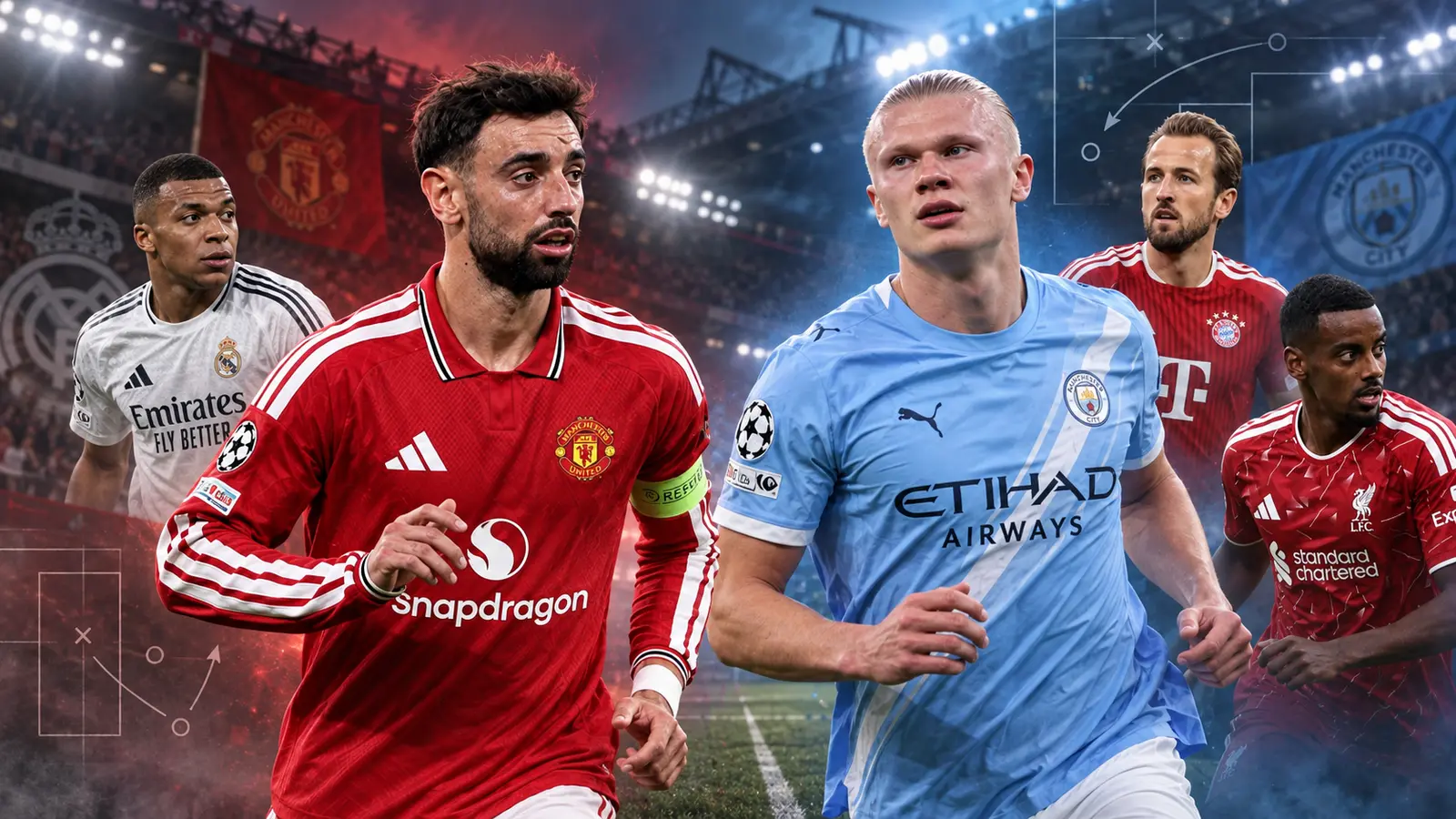
A football analysis package focused on how to judge teams and players beyond headline labels: the Manchester derby as a test of status versus substance, Schalke 04 as a case study in early-season evidence, Inter’s cycle questions in Europe, and the modern forward debate around Kylian Mbappé, Harry Kane and Alexander Isak.
Match Preview
Manchester Derby Preview: Status Raises the Stakes, but Execution Will Decide United vs City
Manchester United host Manchester City on 13 September at 16:30 BST in a derby that arrives with a familiar emotional charge but a slightly different analytical frame. This is not only about territory, pride or noise. It is about whether two clubs carrying major expectations can translate identity into performance.
City’s public posture is simple enough: a club built to compete at the top should speak and play like a contender. That is not provocation; it is the minimum standard for a side of their profile. The harder question is whether contender language is matched by rhythm, control and sharpness over 90 minutes.
United’s challenge is different. The club’s return to a higher European platform raises the bar for domestic judgment as well. Progress is no longer measured only by isolated positive results. It is measured by whether the team can absorb pressure, manage momentum swings and produce repeatable performances against opponents with title-level demands.
The tactical question: control or transition?
The derby is likely to be shaped by who can impose the game state. City’s best versions tend to reduce chaos: territorial control, patient possession, counter-pressing after loss and sustained pressure around the opposition box. But personnel availability alone does not recreate a peak structure. The decisive issue is whether the coaching staff can turn available players into a functioning collective, not merely a stronger team sheet.
United, meanwhile, must avoid confusing intensity with control. Derby emotion can lift pressing aggression and duel commitment, but it can also open spaces if the first line is bypassed. Against City, the cost of a disconnected press is usually severe.
The psychological layer
This fixture often rewards the side that handles expectation better. City will be judged against a title-contender standard. United will be judged against the sharper demands of a club expected to compete on multiple fronts. That makes the opening phase important: not because an early goal is inevitable, but because composure in the first 20 minutes can reveal whether either side is playing the occasion or the match plan.
What to watch
For City, watch whether possession actually creates control or merely circulates without penetration. For United, watch the distance between the forward press and midfield cover. If United can stay compact while still threatening in transition, the derby becomes a more balanced contest. If those lines stretch, City’s technical quality can turn territory into sustained pressure.
The badge, rivalry and history will frame the broadcast. The match itself will be decided by structure, decision-making and whether ambition survives contact with an opponent capable of exposing every loose detail.
Team Analysis
Status Is Not Form: What City, United and Inter Tell Us About Judging Big Clubs
Football analysis often gives too much credit to names. A club’s status can explain expectation, but it cannot prove current strength. Manchester City, Manchester United and Inter each sit in that gap between identity and evidence.
City’s status demands a title-contender mindset. When a club has been built to dominate domestic and European conversations, confidence is not arrogance by default. It is part of the institutional standard. The analytical trap is assuming that confidence equals automatic fluency. A stronger or healthier squad only matters if it becomes structure: coordinated pressing, clean rest defence, reliable chance creation and clarity in key moments.
United face a different pressure. European involvement raises the level of scrutiny. A club can improve and still not yet be stable enough for the expectations that arrive with Champions League football. The question is no longer only whether United can produce statement performances. It is whether those performances can survive a denser calendar and higher-quality opponents.
Inter provide the European-cycle version of the same lesson. Their history is substantial: three European Cup or Champions League titles, and a 21st Italian league title secured in 2025/26. That gives them pedigree and competitive credibility. But pedigree is not the same as renewal.
Inter’s current squad profile is better described as mixed-age rather than simply old. There are senior pillars and younger players in the registered European picture. The issue, then, is not age as a lazy label. It is whether the core still carries enough sharpness, hunger and physical reliability to keep the ceiling high against elite opposition.
Real Madrid’s 2-1 win over Inter on 8 September gives that debate an immediate European reference point, but the broader question is seasonal. Inter can still have a strong competitive floor through discipline, experience and tactical memory. The concern is whether those qualities are enough when a match demands acceleration, risk and decisive attacking edge.
The lesson across all three clubs is straightforward: elite identity raises the target, but present evidence decides whether the target is realistic. City must turn ambition into control. United must turn progress into repeatability. Inter must turn experience into renewed edge.
Player Performance
Mbappé, Kane and Isak: Why Elite Forwards Cannot Be Judged by One Metric Alone
The argument over elite forwards often becomes too moralistic. One side insists goals are everything. The other demands pressing, link play and defensive effort as if every team asks the same job from its centre-forward or wide attacker. The better question is not whether a forward should “do more” in the abstract. It is what the team has been built to require.
Kylian Mbappé remains the clearest case for the goal-first argument. His 2025/26 output included 25 goals in La Liga and 15 in the Champions League, and his World Cup record has pushed him to historic territory. When a player produces at that level, goals are not a footnote. They are the central value proposition.
But even with a scorer of that level, the tactical cost has to be measured. If a team gives a forward freedom from certain defensive or connecting tasks, someone else must cover the space, press the trigger, provide the passing link or absorb the running load. That does not make the forward lazy or incomplete by default. It means the system must be honest about the trade-off.
Harry Kane represents a different model. His recent Bayern and England numbers — 73 goals and eight assists across 65 appearances from August 2025 through July 2026 — show that the multi-function forward debate is not about choosing link play over scoring. Kane’s appeal is that he can finish, drop in, connect attacks and give structure to possession without surrendering elite production.
That profile is especially valuable for teams trying to control high-level European matches. A forward who can both end attacks and improve the attacks before they reach the box gives a coach more tactical solutions.
Alexander Isak adds a third layer: durability and continuity. Now Liverpool’s No. 9, he returned from a serious ankle injury that included a fibula fracture and surgery in December 2025. By 11 September 2026, he had started Liverpool’s first four matches of the season and scored three goals, while publicly describing himself as feeling good.
For Isak, the key performance question is not only whether the finishing is sharp. It is whether the availability becomes sustainable. A system can concentrate supply around a high-quality forward, but that model becomes fragile if the player cannot build rhythm across weeks and months.
The conclusion is not that one model is superior in every context. Mbappé shows the irreplaceable value of elite finishing. Kane shows why all-round contribution matters at the highest tactical level. Isak shows why health and continuity can be as important as technique when a club builds attacking responsibility around one player.
Goals remain the forward’s bottom line. But at elite level, the real evaluation begins after that.
Controversy and Talking Points
Do Forwards Have to Defend? The Mbappé Kane Debate Is Really About System Cost
Few football arguments become as emotional as the question of whether forwards should defend. It is usually framed as attitude: does the star work hard enough, or does he leave the dirty work to others? That framing is too shallow.
A forward’s first responsibility is still to affect the scoreline. For some players, especially rare finishers, a team may rationally decide that their energy is best spent attacking space, receiving in dangerous zones and converting chances. That is not automatically a flaw. It can be the centrepiece of an elite plan.
But freedom is never free. If one forward presses less, tracks less or spends less time connecting midfield to attack, the team must compensate somewhere. A full-back may have to be more conservative. A midfielder may cover wider distances. Another forward may press more aggressively. The centre-backs may defend larger spaces if the first line is bypassed.
That is why the comparison between Kylian Mbappé and Harry Kane is useful but often misused. Mbappé strengthens the case for prioritising goals because his output is extraordinary. Kane strengthens the counterargument because he combines elite scoring with connection, hold-up play and team structure.
The answer is not that every forward should become Kane, or that every scorer should be excused from collective work. The answer is that the team must know what it is buying tactically.
For a dominant side with enough runners, passers and defensive cover, a goal-first forward can be devastating. For a team that needs its striker to help control possession, relieve pressure and set pressing cues, a more complete profile may be worth more than a marginal scoring edge.
Modern football does not ask every forward to do the same job. But it does ask every system to pay its bills. If a star is given attacking freedom, the rest of the structure must be strong enough to carry the cost.