
Premier League Roundup
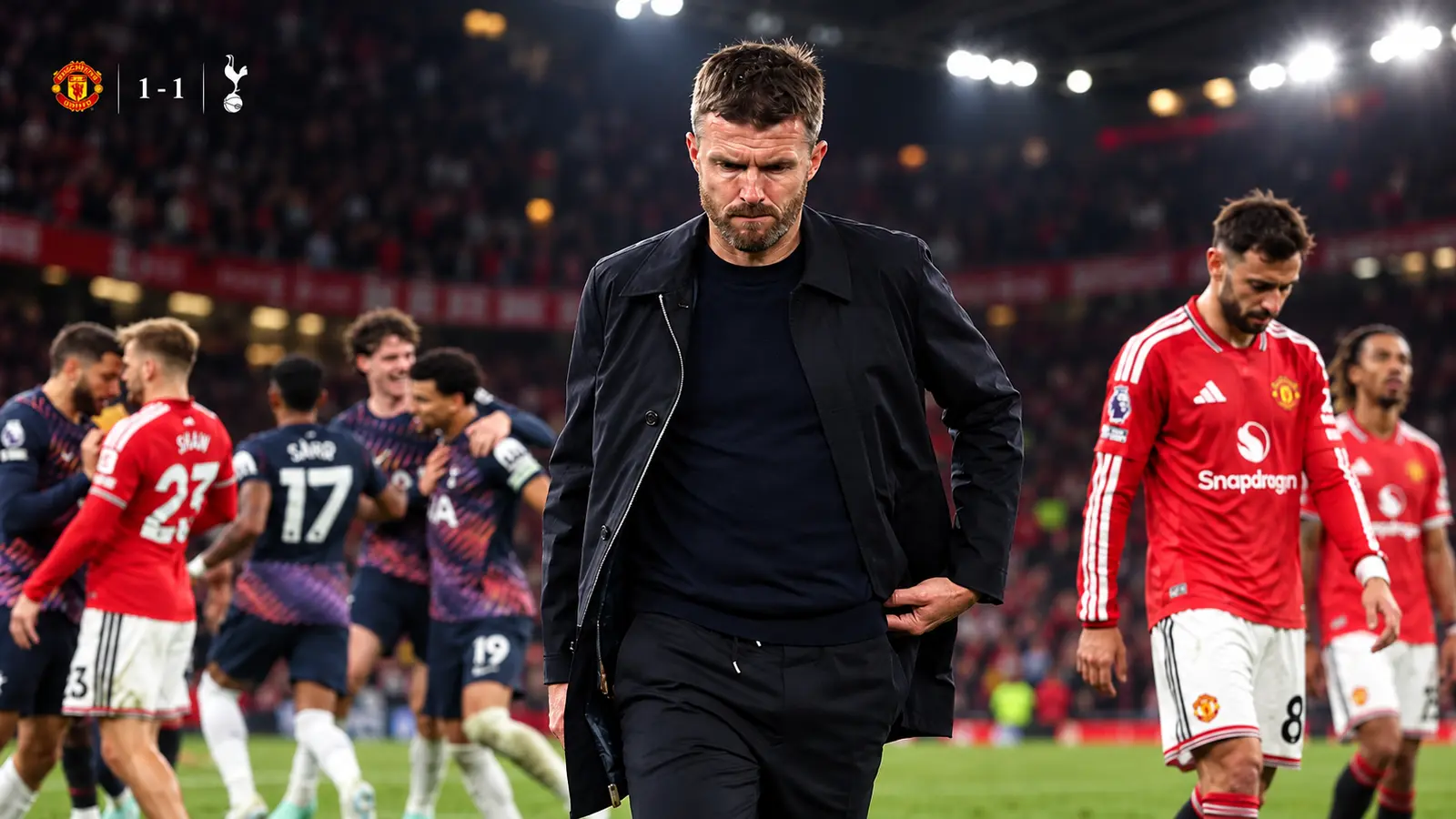
Manchester United drew 1–1 with Tottenham, Arsenal came from behind to beat Leeds 2–1, and Chelsea defeated Bournemouth 5–1 in the Premier League on 10 October 2026. This review follows the connections behind United's performance, Arsenal's decisive spell and Chelsea's scoring, then considers the responsibilities those performances leave for the next tests.
Manchester United 1–1 Tottenham: repair followed by disappointment
The first half at Old Trafford was goalless, but not evenly productive. FotMob's half-time figures recorded seven Tottenham shots to United's one, with expected goals of 0.96 against 0.05. Possession was 57% to Spurs and 43% to United. The sharper imbalance was in attacking output, not possession alone.
Michael Carrick made three changes in the 59th minute: Carlos Baleba replaced Youri Tielemans, Diogo Dalot replaced Leny Yoro, and Joshua Zirkzee replaced Amad. Bryan Mbeumo put United ahead in the 73rd minute. Five minutes later, Rodrigo Bentancur was sent off, leaving Tottenham a goal down and a player short.
Dominic Solanke's equaliser in the second minute of added time changed the assessment of United's afternoon. The adjustments came before the lead; the numerical advantage came afterwards. United therefore had two distinct tasks: improve a poor attacking connection, then convert a favourable position into victory. Success in the first task cannot excuse failure in the second.
Two midfield diagnoses, two different remedies
The Mainoo–Tielemans partnership can be questioned in two ways, and the distinction matters.
The first interpretation is functional overlap. If both midfielders gravitate towards similar receiving and distribution duties, other work can remain insufficiently assigned: protecting the space behind possession, carrying through pressure, or providing the next passing angle. On that reading, the remedy is a more complementary division of labour.
The alternative is compensatory work. If Tielemans' execution falls below the required level, Mainoo may have to devote more attention to covering the consequences. That can reduce his freedom to carry forward even if the partnership is not inherently incompatible. The remedy would then be dependable protection and better execution, rather than simply declaring the two players too similar.
Neither explanation requires a claim about Mainoo's confidence or willingness. A player can make fewer progressive actions because the surrounding responsibilities make those actions costly.
Bruno Fernandes connects both arguments. Asking him to come closer to the build-up can provide an outlet when the first pass stalls. But that solution carries a trade-off: the more often he repairs the lower connection, the less consistently he can occupy advanced areas. United need midfielders who can receive under pressure and help the ball travel forward without requiring Fernandes to bridge every gap.
Baleba's introduction offers a positive avenue to explore. It does not, by itself, establish that one substitution solved the whole structure or that Fernandes adopted a fixed deeper position from a particular minute.
Execution, effort and individual contributions
United's late concession is more usefully discussed through execution and control than through an accusation that the players did not care. Public pressure might affect decisions, but it is not a sufficient explanation for the performance.
Tottenham deserve separate credit for producing the stronger first-half attacking output and finding an equaliser with ten men. Their 0.96 first-half xG does not mean they were owed a goal, just as the eventual equaliser does not retrospectively prove complete control. Chance creation, conversion and competitive response are related but different achievements.
Tielemans' workload also needs perspective. He missed Belgium's final international of the window on 5 October, but had played 90 minutes in each of the preceding three matches. One absence cannot be treated as evidence of a load-free return, nor does that workload establish a medical explanation for his United display.
Yoro started at right-back before Dalot replaced him. I would keep Yoro firmly in the discussion for that role rather than assume the more familiar positional option must always be preferable. That is a selection judgment, not an absolute ranking.
Zirkzee's relevance is the receiving-and-turning function United need from their attacking connections. The useful question is whether his involvement helps possession continue through pressure, not how many isolated highlights can be attributed to him. Baleba similarly deserves consideration through the balance he might provide, rather than through praise detached from the team's remaining problems.
The dismissal and the separate contact questions
Bentancur's red card followed a confrontation with Luke Shaw. The official account describes an initial challenge, Shaw pushing Bentancur away, and Bentancur then making a head movement towards Shaw. Bentancur received a direct red; Shaw was cautioned.
Responsibility for initiating contact and responsibility for retaliation should not be collapsed into one judgment. Shaw's involvement matters, but it does not erase the subsequent action for which Bentancur was dismissed.
Roberto De Zerbi's response also needs its full meaning. He said he kissed Bentancur and thanked him, while describing the red-card reaction as a mistake. Publicly backing a player and criticising his conduct can coexist.
Ordinary-contact decisions and interrupted counterattacks are a different question from that disciplinary confrontation. If a whistle stops a viable attacking transition, its consequence concerns the lost opportunity as well as the contact itself. But a preference for a more physical interpretation cannot establish that a particular foul decision was wrong, or supply an explanation for United's failure to win.
United at Leeds: define what a Baleba start would change
United's next league match is away to Leeds on 18 October. Starting Baleba is a reasonable proposal, provided the proposed responsibilities are explicit.
With Mainoo alongside him, the intended benefit would be protection that allows Mainoo to progress the ball without leaving the midfield exposed. With Tielemans, the question would be whether the partnership produces a clearer balance between distribution and cover. These are alternative selection arguments, not confirmed combinations.
Fernandes' support must remain part of the arrangement. A deeper midfielder needs a forward outlet; an advanced creator needs a reliable supply. Moving Fernandes closer to possession should improve that relationship, not become a permanent workaround for disconnected units.
The test is therefore not simply whether Baleba starts. It is whether United can allocate protection, progression and reception without asking the same player to compensate for every missing function.
United at Atlético Madrid: how much change at once?
Before the Leeds fixture, United visit Atlético Madrid in the Champions League on 13 October. The European match creates a separate adjustment question without requiring a predicted line-up.
Changing midfield personnel, spacing and Fernandes' responsibilities simultaneously would introduce several moving parts. A narrower intervention could preserve more familiarity while targeting the weakest connection. Conversely, retaining an arrangement merely because it is familiar would be difficult to justify if the same responsibilities remain unclear.
The distinction is between changing names and changing the division of work. Carrick need not make an overhaul to address the problem, but a limited change still needs a coherent purpose. There is no basis for treating this as a declared managerial plan or a prediction that he will avoid alteration.
Arsenal 2–1 Leeds: a decisive response, not effortless control
Arsenal and Leeds reached half-time at 0–0. James Justin put Leeds ahead in the 55th minute, Riccardo Calafiori equalised in the 62nd, and Bruno Guimarães scored Arsenal's winner in the 70th after entering in the 63rd.
The timing is revealing. Arsenal's equaliser preceded Guimarães' introduction, while the substitute supplied the decisive second goal. The comeback belongs to both the team's response and the intervention from the bench; neither should absorb all the credit.
Revisiting the first-half expectation
The pre-match prediction that Arsenal could settle Leeds before half-time underestimated the difficulty of the assignment. Arsenal were due to host Lille in the Champions League on 13 October, three days later. That made an efficient league performance desirable, not inevitable.
A congested schedule cannot turn an opponent into a convenient warm-up. Leeds took the lead after the break, forcing Arsenal to solve a live competitive problem rather than simply complete a planned early finish.
Pressure in a phase is not proof of a full-match script
The comeback can reasonably be read as an effective spell of increased pressure and intervention around the hour. It should not be elevated into proof that Arsenal deliberately controlled the entire match's intensity.
Increasing pressure on an opponent's build-up can shorten the time available for the next pass and keep attacks returning towards their goal. Yet the mechanism depends on support behind the first challenge. If that support is missing, greater aggression can offer the opponent an escape route rather than sustained pressure.
That trade-off distinguishes a productive spell from effortless command. Arsenal's two goals between the 62nd and 70th minutes demonstrate a decisive scoring phase. They do not establish an exact pressing sequence, a ten-minute shot total, or a prearranged plan to wait until the second half.
For the defending champions, the recovery is an encouraging response. It still began with the need to chase the score. Confidence can be restored without pretending the preceding difficulty never existed.
Guimarães' winner and the opportunity debate
Guimarães deserves direct credit: he entered in the 63rd minute and scored seven minutes later. Viktor Gyökeres also came on in the 63rd minute, but was not the winning scorer.
Gyökeres' contribution to Arsenal's 2025/26 title-winning season gives the opportunity debate context. It does not establish that his minutes have declined by a particular amount this season, or that one substitute appearance constitutes unfair treatment.
The criticism of Arteta's cautious selection should remain separate from praise for this intervention. A coach can make effective changes during a match while distributing starts conservatively. Equally, a successful substitute is not evidence that every player has an open route into the team.
The same separation applies to identity. Framing the comeback as a recovery of Arsenal's competitive character is defensible commentary. It becomes less persuasive if it is used to remove the awkward passages from the assessment.
Brighton 3–0 Arsenal: the setback remains relevant
The earlier defeat was at Brighton on 19 September, three weeks before the Leeds victory. It was a separate Premier League match, not a different description of the comeback game.
The narrow comparison is about response. Arsenal followed a 3–0 league defeat with a match in which they fell behind but recovered to win. That supports praise for their ability to respond in the later contest; it does not establish that the causes of the Brighton defeat have all been resolved.
A champions' identity can provide a useful standard: the team expects to find solutions under pressure. It should not become a shield against scrutiny. The stronger reading is that Arsenal delivered a response worth recognising while still needing more convincing control of the process.
Chelsea 5–1 Bournemouth: separate the goals from the forecast
Jordan Henderson scored after 68 seconds to give Chelsea an immediate advantage. He finished with two goals and an assist in the 5–1 victory.
The statistical contrast was striking. Sky Sports and Opta Analyst recorded Chelsea's full-match xG at 1.08 and Bournemouth's at 1.46. Chelsea had ten shots, six on target; Bournemouth had nine, four on target.
The score establishes an emphatic Chelsea win. The chance model describes a different dimension of the match. Neither should be used to erase the other.
Can the scoring output be repeated?
Chelsea converted their chances into goals at a level far above the recorded expectation. That deserves recognition, but five goals cannot simply become the forecast for another match with similar chance production.
The sustainability question is whether Chelsea can generate enough useful opportunities without depending on such a large gap between expected and actual goals. My reservation about their maturity concerns consistency between productive spells, not whether this result counts.
A team can be devastating in a phase and still need a more dependable baseline. The distinction matters because finishing can magnify the scoreboard more dramatically than it changes the underlying supply of chances.
Henderson's impact and the centre-back assessment
Henderson's output is concrete: two goals and an assist, including the opening strike and a 70th-minute free-kick. At 36 years and 115 days, he became Chelsea's oldest player to register at least three direct goal involvements in a Premier League match. That is a Chelsea record, not the Premier League's oldest English goalscorer distinction.
Chelsea started in a listed 3-4-2-1 under Xabi Alonso, with Josh Acheampong, Maxence Lacroix and Levi Colwill in the back three. Their defensive assessment should remain independent of Henderson's scoring.
Bournemouth's 1.46 xG makes the single goal conceded an insufficient answer to every defensive question. It does not, however, assign individual fault to those centre-backs. Collective protection, the chances allowed and the actions within those chances matter more than assuming either that five goals prove defensive maturity or that an opposition xG total proves every defender played badly.
I would therefore leave the centre-back quality debate open. This victory is strong evidence of scoring output, but not a complete demonstration of defensive assurance.
What the article can and cannot explain
Shot-based xG generally estimates historical scoring probabilities from features such as location, angle, body part and chance type. Broad judgments about a defence's quality are not interchangeable with those inputs. Pressure and goalkeeper information may feature in some model designs, but their use cannot be assumed for a particular figure.
Nor can all five Chelsea goals automatically be attributed to Bournemouth's defensive errors. A defensive-error explanation must account for the particular opportunities and finishes, rather than merely attach a negative label to the opposition.
The opposite shortcut is equally weak: calling the result luck because Chelsea's xG was lower. Expected goals are not an alternative scoreboard. They are useful here because they ask how repeatable the output might be, not because they overturn what happened.
Beyond the matches
International windows and training continuity
The extended international window ran from 21 September to 6 October, combining the traditional September and October windows and allowing up to four national-team matches. November's window remained separate.
That 16-day international period should be distinguished from the roughly three-week interruption between Premier League rounds. A longer interval without club matches does not necessarily mean more training time with the full squad available.
Disrupted continuity can make rehearsing new combinations harder. It is a plausible constraint on adjustment, not an automatic explanation for poor execution or a reason to dismiss the problems exposed after the restart.
Team-building plans and public management
A Marbella training camp was reported as a plan for Tottenham's gap between the United game and their next league fixture. A proposed trip is a management response, not evidence that the camp has already happened or that dressing-room cohesion has been secured.
Public backing has similar limits. De Zerbi's support for Bentancur can reinforce belonging while still acknowledging unacceptable conduct.
The distinction also applies to the discussion surrounding Kylian Mbappé's cycling. Real Madrid coach José Mourinho described the activity on 9 October as ordinary transport within hotel facilities, rather than extreme sport. He explained that a player who violated the relevant obligations would not be selected, and Mbappé subsequently started against Villarreal on 10 October.
That was a statement of Mourinho's selection standard and his assessment of the player. It was not evidence of a contract breach, a punishment, or a perfectly harmonious dressing room. A public message and the underlying management question remain different things.
Patience and the influence of team context
Carrick's case for patience has a concrete reference point: United finished third in the 2025/26 Premier League. That achievement supplies context, not immunity from criticism of the current performance.
The Arteta comparison also needs its proper timescale. Arsenal's 14 points after 14 league games belonged to 2020/21; their title came in 2025/26. The years between those outcomes make this a long-term patience argument, not a story of a poor start turning directly into a championship in the same season.
Gabriel Jesus offers a separate illustration of team context. For Barcelona, he entered against Feyenoord in the 83rd minute on 9 September and scored in the 85th. Against Getafe on 10 October, he started and scored in the 30th minute. Those are two different situations, not one combined appearance.
They illustrate how an effective supply of chances may help an individual contribute from different roles. They do not prove that team fluency alone explains his scoring, or support the claim that he never had opportunities throughout his Arsenal career.
Availability and squad resources
United's 9 October update placed Benjamin Šeško some way from returning after withdrawing from Slovenia duty. It did not confirm surgery. Selection should respond to the available players, without turning an uncertain medical claim into a fixed explanation for the next match.
At Arsenal, meaningful squad depth concerns opportunities across a run of comparable matches, not just whether one substitute scores. The wider debate over Gyökeres and other squad players cannot be settled by assigning an entire season's opportunity pattern to one team sheet.
De Zerbi's six changes to Tottenham's starting XI against United offer a different kind of intervention: opportunities redistributed before kick-off, rather than substitutions during the match. That contrast clarifies the selection debate without proving that one coach is fairer or that another player has been singled out.
Chelsea's defensive resources have also changed. Trevoh Chalobah completed a permanent move to Como on 9 August. Rating his Chelsea contribution highly is a legitimate football judgment; the sale itself does not prove that his successors failed against Bournemouth. It belongs in the resource assessment, not in the match's event sequence.
What connects the three performances?
United changed the game before taking the lead, then failed to protect that advantage against ten men. Arsenal equalised before their decisive substitute entered, then received a winning contribution from him. Chelsea produced a score far more emphatic than the recorded balance of chance quality.
These differences resist a single verdict about coaching competence or team quality. An intervention can help without completing the repair. A substitute can decide a match without establishing an open rotation policy. Exceptional scoring can secure a convincing win without proving the same output is sustainable.
The connecting question is whether the successful part of each performance can become dependable. For United, that means clear responsibilities through midfield and after taking a lead. For Arsenal, it means making pressure and intervention less dependent on first encountering difficulty. For Chelsea, it means strengthening the baseline of chance creation and defensive protection alongside their finishing.
Liklux Verdict
Credit Carrick's intervention, but keep United's failure to convert a lead and numerical advantage central to the review. Credit Arsenal's response and Guimarães' winner, without treating them as proof of effortless control or unrestricted opportunity. Credit Chelsea's finishing and Henderson's contribution, while resisting both scoreboard complacency and an xG-based dismissal of the victory. The next standard is repeatable performance, not a more flattering explanation of one result.