
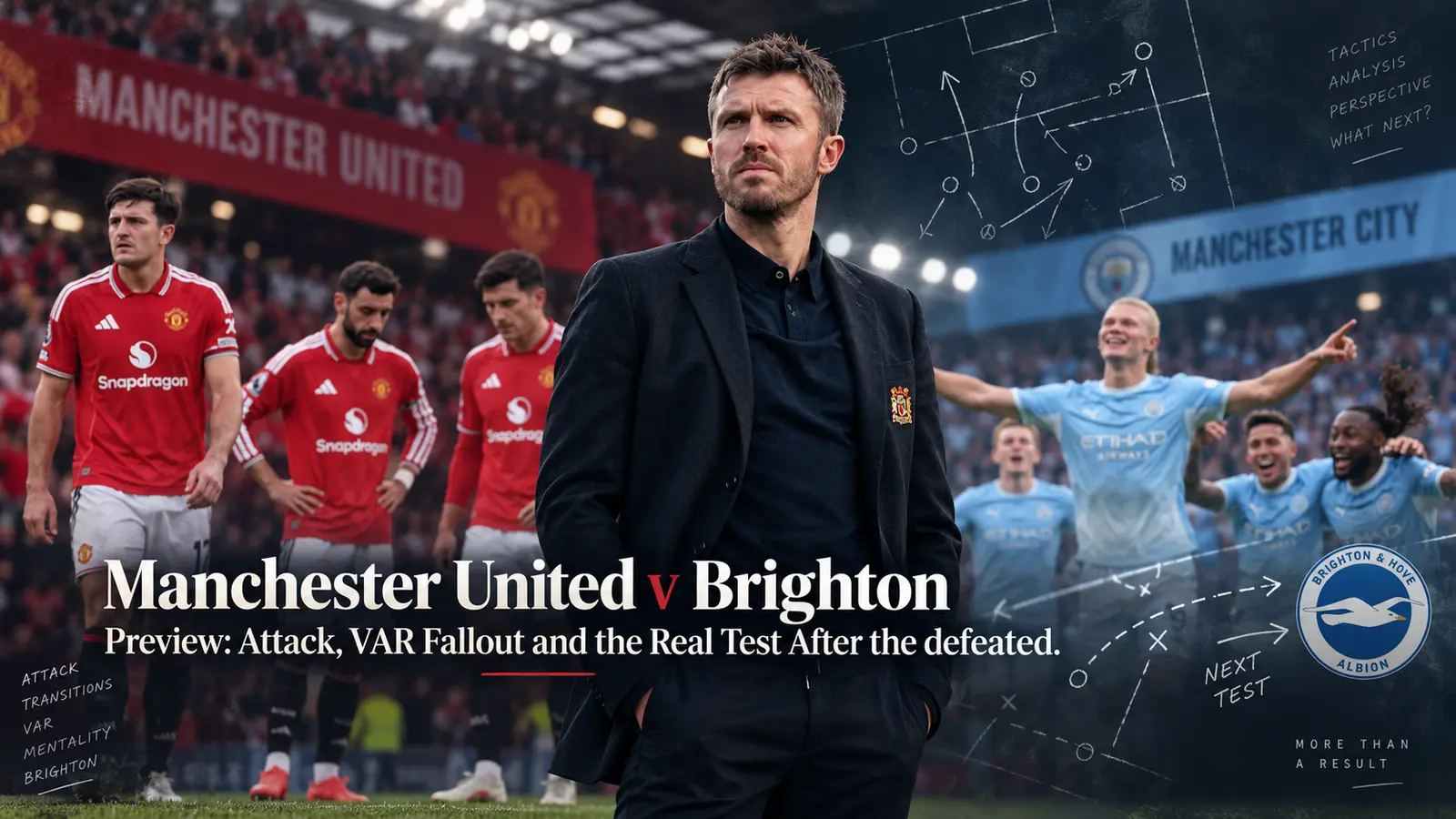
Manchester United v Brighton Preview: Attack, VAR Fallout and the Real Test After the defeated
Introduction
A football analysis package built around three connected themes: Manchester United’s attacking response against Brighton, Manchester City’s 10-man derby management, and Coventry City’s early Premier League adaptation problem after a heavy defeat to Brighton. The strongest editorial thread is that controversy can dominate the conversation, but the deeper football questions remain structure, discipline, chance quality and decision-making under pressure.
Match Preview
Manchester United v Brighton Preview: After the Derby Noise, United Must Answer the Football Question
Manchester United’s next test comes quickly: Brighton & Hove Albion visit Old Trafford in the Carabao Cup third round on Wednesday 16 September 2026, with kick-off scheduled for 20:00 BST.
The timing matters. United come into the tie after a Manchester derby in which the post-match discussion was inevitably pulled toward the red card, the VAR process and the controversy around Erling Haaland’s winning goal. Those issues matter, and they deserve proper scrutiny. But for United, the Brighton match should also force the conversation back onto the pitch.
The clearest football question is whether United can convert territory, possession or momentum into better attacking output.
The derby left a tactical question, not just a refereeing argument
Against Manchester City, United played with a numerical advantage for more than an hour after Phil Foden’s 23rd-minute red card, yet still lost 1-0 at Old Trafford. That fact cannot be explained away solely by controversy. Even allowing for City’s quality and discipline, United had enough time to impose more pressure, stretch the pitch more consistently and ask harder questions of a 10-man opponent.
That is why Brighton is such an important follow-up. A cup tie can reset mood, but it can also expose whether the previous match’s problems were emotional, structural or both.
United need more than sterile possession. They need width that actually moves defenders, central occupation that pins Brighton’s back line, and quicker reactions around second balls. If attacks slow into predictable circulation, Brighton will be comfortable enough to defend forward, press selected triggers and attack the spaces United leave behind.
Brighton arrive with confidence and clarity
Brighton’s recent 5-0 win away to Coventry City showed a side capable of punishing opponents when games open up. That result should warn United against treating this as a routine home cup assignment. Brighton are not simply a team to be overwhelmed by venue or reputation; they are comfortable turning opposition mistakes into momentum.
For United, the key is balance. They must play with enough aggression to show a response, but without making the match chaotic. Brighton are dangerous when opponents become stretched, impatient or emotionally loose.
What United must improve
Three areas stand out.
First, the speed of circulation. United cannot allow Brighton’s defensive block to settle after every sideways pass. The ball needs to move quickly enough to shift Brighton’s midfield line before the final pass is played.
Second, penalty-box presence. If United cross from wide areas, they need more than one isolated target. The far-post runner, the cut-back option and the edge-of-box receiver all matter.
Third, emotional control. The derby created frustration, and the VAR debate will remain part of the build-up. But United cannot let the match become a referendum on refereeing. The response has to be seen in their pressing, their decision-making and their finishing.
Key players and selection themes
Formal starting XIs were not available at the time of writing, so any predicted line-up should be treated cautiously. What is clear is the type of performance United require: more tempo between the lines, better support around the striker, and fewer attacks ending in low-value deliveries.
Brighton’s selection will also shape the tie. Their squad situation has included players at varying stages of recovery and availability, so the final team sheet will matter. But tactically, United should prepare for a side that can play through pressure and exploit loose defensive spacing.
Possible match scenarios
If United score early, the evening can become a controlled response to derby disappointment. Their challenge then would be to manage the game rather than chase emotional validation.
If Brighton settle and frustrate them, Old Trafford could become tense. In that scenario, United’s attacking structure will be tested: can they create clear chances without forcing speculative shots or leaving themselves open in transition?
If Brighton strike first, the match becomes a sharper examination of United’s composure. The derby debate gave them external talking points; Brighton can remove that cover by making the problem purely footballing.
The verdict
This is a cup tie, but it carries league-level significance for United’s identity. The question is not whether they can talk about what went against them in the derby. The question is whether they can show, against Brighton, that they have the attacking mechanisms to decide a match on their own terms.
Post-Match Review
Manchester Derby Review: City’s 10 Man Control Exposed United’s Bigger Problem
Manchester City’s 1-0 win over Manchester United at Old Trafford will be remembered for the decisions: Phil Foden’s red card, Erling Haaland’s VAR-awarded goal and the post-match acknowledgement that the VAR process around the goal should have been handled differently.
But the football story should not be lost inside the controversy. From the 23rd minute, City played with 10 men after Foden was sent off for violent conduct following an incident with Bruno Fernandes. United had more than 67 minutes with a numerical advantage. They still did not score.
That is the uncomfortable part for United.
A red card changes resources, not automatically control
One of football’s most misleading assumptions is that an extra player equals dominance. It can, but only if the team with 11 uses the extra man intelligently.
United needed to stretch City horizontally, move the ball quickly enough to disrupt the 10-man block, and increase their presence in the box. Instead, the match became a study in the difference between having an advantage and knowing how to use one.
City, by contrast, treated the red card as a tactical problem to solve rather than an emotional disaster. Their shape became more compact. Their attacks became more selective. They accepted that they would not control every phase, but they continued to control enough of the rhythm to keep United from turning pressure into panic.
City’s discipline after the red card was the real achievement
The best 10-man performances are rarely heroic in a chaotic sense. They are organised, repetitive and emotionally restrained. City’s response belonged in that category.
They protected central areas, narrowed the spaces United wanted to play through, and forced the home side to search for lower-percentage routes. The longer United went without scoring, the more the numerical advantage became a psychological burden.
City’s winner arrived in the 60th minute, when Haaland finished after a Joško Gvardiol delivery from the left, via a deflection off Patrick Dorgu. The goal was initially ruled out for offside before VAR intervened and awarded it. The controversy around Enzo Fernández’s position and possible influence on defenders would dominate the debate afterwards, but City still had to produce the moment — and United still had to respond.
They did not.
United’s problem was chance construction
United’s issue was not simply effort. It was structure. Against 10 men, the best attacking sides create overloads that force defenders to choose between two bad options. Too often, United’s attacks allowed City to defend what was in front of them.
The key questions are familiar:
- Was the ball moved quickly enough from side to side?
- Did United occupy the far post and cut-back zones consistently?
- Did midfield runners arrive at the right moments?
- Did United counter-press aggressively enough to sustain attacks?
- Did the team’s emotional response to the red card and later VAR controversy distract from the basic task of building better chances?
The answer, on the evidence of the result, was not convincing enough.
Controversy should not hide the tactical gap
United have legitimate reasons to examine the major decisions, especially after the refereeing body later acknowledged an error of judgement in the VAR handling of Haaland’s goal. But a team with an extra player for that length of time cannot allow the entire review to become external.
City’s 10-man performance showed a side with clear emergency mechanisms: compactness, patience, selective forward play and collective discipline.
United’s performance showed a side still searching for the same clarity when the game state should favour them.
That is why the derby matters beyond the scoreline. It was not only a defeat. It was a reminder that advantage is only useful when a team has the structure to turn it into consequence.
Team Analysis
Coventry City’s Premier League Problem: Ambition Without Enough Control
Coventry City’s 5-0 home defeat to Brighton & Hove Albion on 13 September 2026 was the kind of result that can distort a discussion. A scoreline that heavy invites sweeping conclusions: not good enough, out of their depth, doomed by quality.
The more useful reading is narrower and more tactical. Coventry’s problem is not that they want to attack. It is that their attacking ambition has not yet been matched by Premier League-level risk control.
Through their opening four Premier League matches of 2026/27, Coventry had lost all four and had not scored in the league. That league-specific context matters. They had scored in cup competition, so the issue is not a blanket inability to find the net in every setting. It is the sharper difficulty of carrying chance creation, defensive security and emotional discipline into the Premier League.
The promoted-team identity trap
Many promoted teams face the same dilemma. The style that helped them rise can become the style that exposes them.
In the Championship, proactive football can establish dominance: press high, commit runners, play on the front foot, and trust that repeated pressure will eventually produce goals. In the Premier League, the same approach can become more expensive. Opponents punish open spaces faster. Loose turnovers become defensive emergencies. Missed chances hurt more because the next phase may immediately become a counter-attack.
Coventry therefore face a strategic question: can they adjust without abandoning themselves?
A total retreat would risk removing the qualities that made them competitive. But continuing to play open football without better protection may keep producing the same pattern: moments of promise, followed by damaging collapses.
Chance creation is not the same as attacking efficiency
Reports around the Brighton match indicated Coventry did create openings before the game ran away from them. But that makes the broader issue more complex, not less.
A team can create chances and still be inefficient. A team can show bravery and still be structurally vulnerable. A team can produce pressure and still fail to control the match.
That is the line Coventry must now walk. The goal is not simply to shoot more. It is to improve the quality of the final action while making sure failed attacks do not leave the back line exposed.
Brighton punished the lack of control
Brighton led 1-0 at half-time through Babis Kostoulas and then moved 2-0 ahead early in the second half through Malick Yalcouyé. The match tilted even further after Taiwo Awoniyi was sent off, with Coventry already two goals down.
That sequence matters. Falling behind is difficult; losing discipline while chasing the game is worse. For teams likely to spend parts of the season under pressure, emotional control is not a soft quality. It is survival infrastructure.
What Coventry should change first
The immediate answer should not be panic. Coventry do not need to erase their attacking identity overnight. They do, however, need clearer safeguards.
That means more compact rest defence when attacks break down. It means smarter pressing triggers rather than constant front-foot chasing. It means midfield distances that allow second balls to be contested rather than conceded. It also means accepting that some Premier League matches require phases of lower risk before the next attacking wave.
Finishing remains part of the problem, but it cannot be isolated from structure. Better chances usually come from better spacing, better timing and better decision-making before the shot.
The bigger picture
Coventry’s early league record is worrying, but the season’s defining question is still open. Can they become a more controlled Premier League side without losing the confidence that brought them up?
If they can, the attacking ambition may yet become an asset. If they cannot, it will keep functioning as a risk multiplier.
Player Performance
Taiwo Awoniyi’s Red Card Shows Why Discipline Is a Performance Skill
Taiwo Awoniyi’s red card in Coventry City’s 5-0 defeat to Brighton should not be treated as an isolated disciplinary footnote. It was a performance moment, a tactical moment and a psychological moment all at once.
Coventry were already 2-0 down when Awoniyi was sent off after elbowing Maxim De Cuyper in the face. The dismissal was treated as violent conduct, with the standard automatic sanction for such an offence being a three-match suspension unless altered by appeal or further disciplinary action.
For Coventry, the damage was immediate and longer-term.
The cost of one reaction
A forward in a struggling team carries a particular burden. He is expected to hold the ball, relieve pressure, give defenders a target, occupy centre-backs and turn half-chances into belief. When that player is removed from the game, especially with the team chasing, the match becomes even harder to rescue.
But the bigger issue is what the moment represented. Coventry’s early Premier League problem has not been effort alone. It has been the combination of missed attacking opportunities, defensive exposure and fragile game-state management. Awoniyi’s red card sat directly inside that pattern.
At 2-0 down, the match was difficult but not emotionally over. At 10 men, it became close to impossible.
Discipline is not separate from tactics
Football often talks about discipline as morality: keep calm, do not retaliate, avoid silly cards. For teams near the bottom or trying to adapt to a higher level, discipline is more practical than that.
It protects the tactical plan.
A red card changes pressing angles. It changes rest defence. It changes substitution logic. It drains energy from players who now have to cover larger spaces. It can also damage the next match, because suspensions reduce options and force further reshuffling.
That is why Awoniyi’s dismissal matters beyond the incident itself. Coventry cannot afford to turn difficult afternoons into unwinnable ones.
The striker’s role in a promoted side
Awoniyi’s profile should matter to Coventry. A promoted team needs a forward who can make imperfect possession useful: receive under pressure, contest aerial balls, run channels and give midfielders time to join attacks.
When a striker’s frustration spills into violent conduct, the side loses one of its few ways to manage pressure. The emotional reaction becomes a structural problem.
What Coventry need from Awoniyi next
The response must be more than apology or punishment. Coventry need Awoniyi to become a stabilising presence in difficult matches. That means competing physically without crossing the disciplinary line, maintaining concentration when service is limited, and understanding that survival football often turns on avoiding the next mistake.
For a team still looking for its first Premier League goal of the campaign, finishing will dominate the discussion. But Coventry’s next step also depends on players keeping the team in matches long enough for those chances to matter.
Controversy and Talking Points
The Manchester Derby VAR Debate: The Problem Wasn’t Just the Decision, It Was the Missing Chain of Explanation
The Manchester derby gave everyone what modern football discourse feeds on: a red card, a VAR-awarded goal, an offside debate and enough slow-motion fragments to fuel arguments for days.
But the most important point is not tribal. It is procedural.
Football’s VAR problem is rarely just that one side dislikes the decision. It is that too many major decisions still feel difficult to follow in real time. Fans see the outcome, but not always the full reasoning chain.
Foden’s red card: the final action and the full incident
Phil Foden was sent off in the 23rd minute for violent conduct after a clash involving Bruno Fernandes. The official explanation focused on Foden’s retaliatory action. Fernandes was not booked in that sequence.
That creates a familiar debate: should officials only punish the most obvious final action, or should the whole confrontation be assessed as one chain?
The answer matters because consistency is central to credibility. A retaliatory action can clearly deserve a red card while supporters still ask whether an earlier action was properly assessed. Those two ideas are not contradictory.
What should be avoided is turning uncertainty into accusation. Without a published explanation covering every element of the exchange, it is safer to say the public was given a clear basis for Foden’s dismissal, but not a full public account of every possible disciplinary branch in the incident.
Haaland’s goal: offside position, involvement and the defender’s problem
Erling Haaland’s 60th-minute goal was initially ruled out for offside before VAR recommended that it should stand. Joško Gvardiol delivered from the left, the ball deflected off Patrick Dorgu and Haaland finished at the back post.
The controversial part concerned Enzo Fernández, who was in an offside position. VAR judged that he had not touched the ball. Later, the refereeing body acknowledged an error of judgement: VAR had not sufficiently considered whether Fernández’s position and challenge for the ball affected the defenders, and an on-field review should have been recommended.
That distinction is crucial.
Offside is not only about touching the ball. Under the laws, a player in an offside position can commit an offence by interfering with an opponent — for example, by clearly attempting to play the ball in a way that affects an opponent’s ability to play it. That is why the debate around Fernández could not be reduced to a single question of contact.
Why the explanation gap damages trust
VAR is supposed to correct clear errors. But when the visible process does not explain the decision tree, supporters fill the gaps themselves.
The key questions in an offside review are layered:
- When was the relevant touch or pass?
- Who was in an offside position at that moment?
- Did the player touch the ball?
- If not, did he interfere with an opponent?
- Did any defensive touch reset the phase, or was it only a deflection?
- Should the referee have been sent to the monitor?
If those questions are not clearly communicated, a long review can actually reduce confidence rather than increase it.
Handball confusion adds to the wider problem
The debate was also muddied by discussion of a Harry Maguire handball and own-goal sequence that belonged to a different Manchester United match against Ipswich Town, not this derby. In that earlier incident, the goal stood because Maguire’s handball was deemed accidental and he was not the player who immediately scored.
That matters because it shows how quickly separate controversies merge into one general feeling that “nobody understands the rules.” Once that happens, even correct decisions struggle to win trust.
The right conclusion
The derby should not be used as proof of conspiracy, bias or manufactured drama. Those claims require evidence. The stronger, fairer criticism is that football still does not explain major decisions well enough for the speed and intensity of modern coverage.
VAR does not need to be perfect to be credible. But it does need to be intelligible.
The Manchester derby showed again that the battle for trust is not won by drawing lines on a screen. It is won by showing the whole chain of reasoning from incident to outcome.