
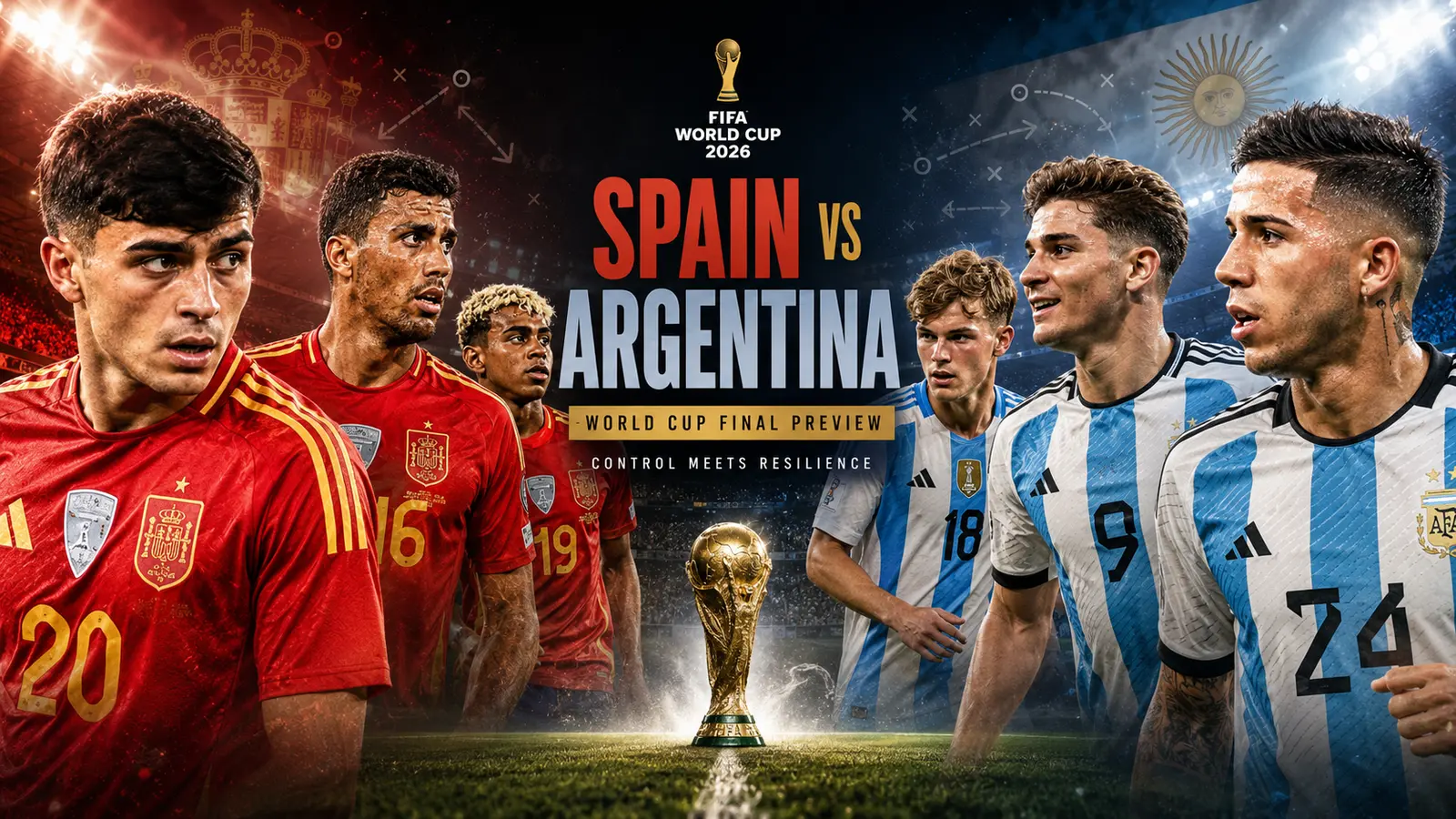
Argentina vs Spain World Cup Final Preview: Control Meets Resilience
Introduction
A tactical World Cup final preview contrasting Spain's control and defensive order with Argentina's resilience under pressure, supported by analysis of the tournament's leading players, coaching legacies and major talking points.
Match Preview
Argentina vs Spain: Control Meets Resilience in the World Cup Final
The 2026 FIFA World Cup concludes with Argentina facing Spain at New York New Jersey Stadium in East Rutherford on July 19. Kick-off is scheduled for 15:00 EDT, with Argentina attempting to retain the title they won in 2022 and Spain seeking their second men's world championship.
This is not simply a contrast between possession and counter-attacking football. It is a meeting between two teams whose authority has emerged in different circumstances. Spain have been the tournament's model of order. Argentina have repeatedly demonstrated that they can survive when order breaks down.
Spain's platform: control without vulnerability
Spain enter the final having scored 13 goals and conceded only once across seven matches. They have not trailed at any stage of the tournament. Their route included knockout victories over Austria, Portugal, Belgium and France, with the 2-1 quarter-final against Belgium producing their only goal conceded.
Those numbers reflect more than defensive caution. Spain's structure has allowed them to control territory, protect the ball and limit the amount of broken play their opponents can create. Their semi-final victory over France reinforced the impression of a side capable of combining possession with decisive attacking execution.
The unanswered question is how Spain will respond if they fall behind. Going an entire tournament without trailing is evidence of strength, but it also means the final could present a match state they have not yet been required to solve.
Argentina's advantage when the match becomes unstable
Argentina's knockout campaign has been far less orderly. They recovered from two goals down to defeat Egypt 3-2 in the round of 16, required extra time to beat Switzerland 3-1 in the quarter-finals and overturned a second-half deficit against England in the semi-final.
Those recoveries do not give Argentina a mystical immunity to defeat. They do, however, provide evidence of a team accustomed to making decisions under extreme pressure. Argentina have already experienced late chases, extra time and matches in which their original plan had to be abandoned.
That experience could become increasingly valuable if the final remains level deep into the second half. Spain may possess the cleaner structure, but Argentina have spent more time navigating the emotional and tactical disorder that often defines major finals.
Why possession alone may not be enough for Spain
Argentina are unlikely to be disturbed by possession that remains in front of their defensive block. A slow circulation game could allow them to conserve energy, protect central spaces and wait for counter-attacking or set-piece opportunities.
Spain's more damaging route may therefore be acceleration rather than accumulation. Quick switches, direct runs behind the defence and repeated one-against-one attacks from wide areas can force Argentina to turn, retreat and defend across greater distances.
Lamine Yamal is central to that possibility. The Barcelona winger turned 19 during the tournament and is expected to be available after precautionary individual training related to a minor knock and soreness. His ability to change the speed of an attack could matter as much as his final pass or shot.
Nico Williams offers another source of width and penetration. He returned from a right adductor injury to appear from the bench against France, although his role in the final will depend on the official team selection.
Argentina's attacking balance around Messi
Lionel Messi remains Argentina's creative and emotional reference point, but their strongest route is unlikely to involve asking him to solve every phase alone. They need to defend compactly around him, recover the ball cleanly and create situations in which his decisions can determine attacks near Spain's penalty area rather than far from goal.
Messi enters the final with eight goals and four assists in the tournament. He also has 21 career World Cup goals, one behind Kylian Mbappe's current record of 22. Mbappe leads the Golden Boot race with 10 goals and four assists, meaning the final carries a significant individual subplot alongside the championship itself.
Three possible match scenarios
Spain establish control and add vertical speed
If Spain combine their normal possession game with runs behind Argentina's defensive line, they can turn territorial dominance into sustained pressure. This is the scenario most likely to expose Argentina's capacity to recover repeatedly over long distances.
Argentina absorb pressure and extend the contest
Argentina may accept long periods without the ball if they can protect central areas and prevent Spain from accelerating. A close score entering the final stages would increase the value of Argentina's experience in tense, unstable matches.
An early goal changes the entire tactical balance
A Spain goal would test whether Argentina can recover against the tournament's most secure defensive structure. An Argentina goal would force Spain into their first losing position of the competition and provide the clearest examination yet of their ability to attack without losing structural control.
The central question
Spain have produced the more controlled tournament. Argentina have demonstrated the greater familiarity with adversity. The final may be decided not by which quality is inherently superior, but by which team dictates the emotional and tactical conditions of the match.
If Spain make the game fast, wide and physically demanding, their collective structure can become an attacking weapon. If Argentina keep it close and carry the contest into its most pressurised stages, their experience of surviving disorder could become just as influential as Spain's command of the ball.
Post-Match Review
England 6 4 France: What the Third Place Thriller Can—and Cannot—Tell Us
England secured third place at the 2026 World Cup with a remarkable 6-4 victory over France, having led 4-0 at half-time. It was an extraordinary spectacle, but it should not be treated as a normal measure of either team's defensive quality.
Third-place matches occupy an unusual competitive space. A medal remains at stake, yet the emotional and tactical restraints associated with a semi-final or final are often reduced. Teams may rotate, attack with greater freedom and accept risks that would be considered unacceptable earlier in the knockout stage.
That context helps explain a match in which both teams produced 19 attempts. England held a narrow possession advantage and recorded slightly more shots on target, but the defining feature was the unusually high rate at which attacking situations became goals.
England found an immediate attacking reward
The 4-0 half-time lead allowed England to play the remainder of the match from a position of apparent security. France's response then turned the contest into a much more open exchange, producing a scoreline that reflected both attacking quality and diminished defensive control.
For England, the bronze medal provides a tangible return from the tournament. It does not settle every question about selection, workload or long-term development, but it gives Thomas Tuchel a result around which the team's progress can be assessed.
Mbappe turned the match into a historical event
Kylian Mbappe scored twice and assisted Bradley Barcola, ending his tournament with 10 goals and four assists. Those goals took him to 22 across his World Cup career, moving him to the top of the competition's all-time scoring chart before the final.
His output ensured France's defeat did not erase the individual significance of the occasion. Mbappe also finished the third-place match with a two-goal lead over Lionel Messi in the Golden Boot race, although Messi still had the final against Spain to play.
Why the scoreline needs context
A 6-4 result does not establish that England are two goals better than France, nor does it prove that either side approached the match casually. It shows that the combination of early scoring, altered incentives and increasing tactical openness created conditions unlike those found in most knockout matches.
The appropriate conclusion is narrower: England were more effective in a highly open game, while France retained enough attacking force to make the second half competitive. The match offered entertainment and individual milestones, but only limited evidence about how either team would perform in a more controlled elimination contest.
Team Analysis
Didier Deschamps Leaves France with a Legacy of Stability—and Unanswered Questions
Didier Deschamps' final match as France head coach ended in a 6-4 defeat to England in the World Cup third-place play-off. It was an unusually chaotic conclusion to a tenure defined primarily by stability, competitive discipline and repeated appearances in the latter stages of major tournaments.
Deschamps took charge in July 2012. Over approximately 14 years, France reached the 2014 World Cup quarter-finals, finished as runners-up at Euro 2016, won the 2018 World Cup and added the 2021 Nations League. They were World Cup runners-up again in 2022, reached the Euro 2024 semi-finals and finished fourth at the 2026 World Cup.
That record makes any attempt to describe his reign as a failure unsustainable.
The value of repeatable tournament performance
International football offers limited preparation time and little room to recover from one poor knockout match. Deschamps repeatedly built teams that could survive those conditions. France were generally difficult to eliminate, comfortable without dominating possession and capable of adapting their attacking approach around changing personnel.
His greatest achievement was not merely winning in 2018. It was keeping France within the group of realistic contenders across several tournament cycles while managing transitions between generations.
Why the talent debate will persist
France's depth also raises the standard against which Deschamps is judged. The country has produced elite players across virtually every position, creating the expectation that a good tournament is not always enough. Critics can reasonably ask whether a more expansive approach might have converted that talent into additional trophies.
That question does not invalidate the results. It reflects the unusual tension created when a coach combines exceptional resources with exceptional consistency. Deschamps delivered more than most international managers ever achieve, yet France's player pool makes it possible to wonder whether even more was available.
What the successor inherits
The next France coach will not be taking over a broken programme. The squad retains elite attacking talent and a deep development system. The challenge will be to preserve Deschamps' competitive reliability while finding new ways to control matches and make fuller use of the team's technical range.
That is a more demanding task than simply promising attacking football. Any stylistic expansion must survive the same knockout pressure that Deschamps managed so effectively for more than a decade.
His legacy should therefore remain balanced: a world champion who established France as a permanent tournament force, and a coach whose success was so sustained that the remaining debate concerns how much higher an already elite team might have climbed.
Player Performance
Mbappe's 22 World Cup Goals Redefine the Scale of His Career
Kylian Mbappe left the 2026 World Cup without a team medal, but his performance in France's 6-4 defeat to England added another historic chapter to his individual tournament record.
Mbappe scored twice and supplied the assist for Bradley Barcola, taking his 2026 total to 10 goals and four assists. More significantly, he reached 22 career World Cup goals, moving one ahead of Lionel Messi before Argentina's final against Spain.
Production even in defeat
The third-place match was unusually open, and its ten-goal scoreline requires tactical context. Mbappe's output should nevertheless be recognised for what it was: another demonstration of his ability to turn space into decisive actions at the highest level.
His two goals extended his Golden Boot advantage over Messi to two. Both players had four assists going into the final, although the award is decided first by goals, then assists and then fewer minutes played if the first two categories remain level.
Individual ambition is not a rejection of the team
Scoring records are sometimes framed as selfish pursuits, but the distinction is often artificial. Mbappe's attempts to score served France's immediate objective of recovering from a four-goal half-time deficit. The same actions that advanced his personal standing also gave his team a chance to change the match.
World Cups arrive only once every four years, and even the greatest players have a limited number of opportunities to shape the competition's historical record. For Mbappe, maximising those opportunities is a rational part of elite performance rather than evidence that individual ambition has displaced collective responsibility.
A record still exposed to the final
Mbappe ended France's campaign with the lead in both the 2026 Golden Boot race and the all-time World Cup scoring chart. Those positions were not yet final because Messi entered the Argentina-Spain final with eight tournament goals and 21 across his World Cup career.
Whatever happens in the final, reaching 22 World Cup goals has already changed the scale of Mbappe's career. He is no longer merely tracking the competition's historical leaders. He has become the benchmark against which the next generation will be measured.
Controversy and Talking Points
The Balogun Decision Was Unusual, but the Red Card Was Never Rescinded
Folarin Balogun's red card during the United States' 2-0 round-of-32 victory over Bosnia and Herzegovina became one of the World Cup's most disputed disciplinary stories.
The Monaco striker was dismissed in the 64th minute for serious foul play. A direct red card would normally trigger an automatic one-match suspension, but FIFA placed that suspension under a one-year probationary arrangement. Balogun was therefore permitted to face Belgium in the round of 16, where the United States lost 4-1.
The first important distinction is that the red card was not erased. The disciplinary record remained; it was the implementation of the suspension that was deferred.
Why the optics became politically sensitive
US President Donald Trump publicly said that he had asked FIFA president Gianni Infantino to review the case. FIFA maintained that the disciplinary decision was made through an independent process.
That sequence inevitably created suspicion among supporters. When a powerful political figure expresses an interest in a disciplinary case and the player subsequently becomes eligible, questions about influence are predictable.
Questions, however, are not proof. The proximity of the events does not establish that political pressure determined the outcome. Any stronger allegation would require evidence about the decision-makers, the applicable regulation and the reasoning used in the case.
The real issue is consistency and transparency
The most useful scrutiny concerns whether comparable cases receive comparable treatment. A probationary suspension may exist within the disciplinary framework, but supporters need a clear explanation of why it was considered appropriate for serious foul play in this instance.
Transparent reasoning matters because disciplinary credibility depends on more than technical legality. It also depends on fans and teams being able to understand how a rule will be applied before the next controversial incident occurs.
The responsible conclusion is therefore neither that nothing unusual happened nor that the competition was manipulated. The red card stood, the ban was deferred and the surrounding political attention made a clear public explanation especially important.