
Japan’s System Test, Germany’s Grit and Sweden’s Survival Maths
Introduction
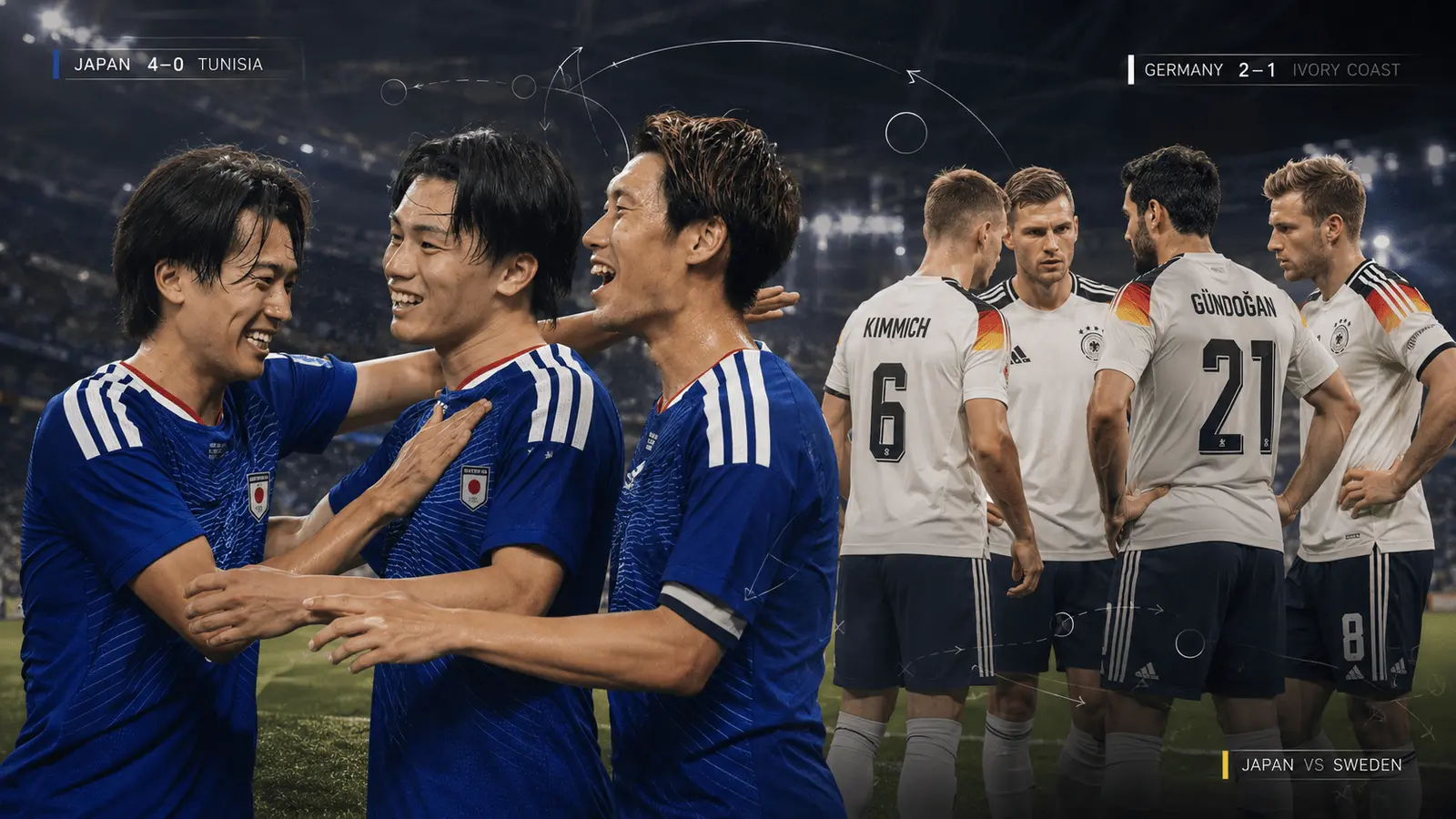
A multi-angle football package built around World Cup group-stage trends: Japan’s system-first rise, Sweden’s damaged qualification maths, Germany’s harder-edged win over Ivory Coast, and the contrast between Ecuador’s attacking frustration and Curaçao’s underdog resistance.
Match Preview
Japan vs Sweden Preview: A System Team Meets a Side Playing the Numbers
Japan’s final group match against Sweden is not just a meeting of two contrasting football identities. It is a test of how much we should trust Japan’s current surge — and whether Sweden can turn a damaged group position into a controlled survival job.
Japan’s 4-0 win over Tunisia was convincing in the way modern tournament wins are supposed to be convincing: pressure, structure, multiple attacking routes and no visible collapse after the absence of a star player. Takefusa Kubo missed the match through injury, yet Japan did not look like a side waiting for one creator to rescue them.
That is the major story around Hajime Moriyasu’s team. Japan increasingly look less like a side built around one or two premium technicians and more like a side where good players are being placed inside a stable collective mechanism. The question is whether that mechanism still looks this clean when the opponent has more power, more aerial threat and more ability to disrupt rhythm.
Sweden’s problem: the table, not only the pitch
Sweden’s 5-1 defeat to the Netherlands has changed the mood around their final match. The performance was not necessarily as empty as the scoreline suggests, but tournament football can be brutal: once goal difference is damaged, the next match becomes a calculation as much as a contest.
With Sweden on three points and a goal difference of zero, and with the best eight third-placed teams from 12 groups progressing, the realistic brief may shift. Against Japan, Sweden may not be able to play only for an ideal result. They may also have to protect the scoreboard.
That creates the uncomfortable idea that a narrow defeat could be more useful than an open, reckless push for victory that turns into another heavy loss. It is not romantic, but it is tournament realism.
Japan’s key question: system strength or opponent level?
Japan deserve credit for functioning without Kubo. Daichi Kamada has provided end product in consecutive matches, Ayase Ueda responded to criticism with a two-goal performance against Tunisia, and the bench options give Moriyasu tactical flexibility.
But the next layer of analysis is important: Japan’s defensive structure has not yet been placed under the kind of pressure that reveals everything. Sweden may be uneven, and their back line has been questioned, but they still bring physical presence and direct threat.
If Japan dominate Sweden with the same control they showed against Tunisia, the conversation changes. It would no longer be enough to say Japan are organised. We would have to start talking about them as one of the most tactically mature sides in the tournament.
The Netherlands factor
The other match in the group matters. The Netherlands face Tunisia on June 25, and if Ronald Koeman’s side win heavily, Japan may feel pressure to continue chasing goal difference rather than manage the match conservatively.
That could make Sweden’s task even harder. If Japan need margin, Sweden will face a side with every reason to keep attacking. If the Netherlands do not run up the score, Japan may have more room to control tempo and protect their position.
Tactical themes to watch
Sweden’s defensive spacing will be the first major theme. If Japan can press high and rotate their attacking midfielders between the lines, Sweden’s back line could be pulled into uncomfortable areas.
Japan’s own defensive test is the second. A match that looks comfortable in possession can change quickly if Sweden win second balls, attack crosses and force Japan into repeated duels.
The third theme is Japan’s squad depth. Kubo’s absence did not break the team, which is exactly the point. If Moriyasu can continue to get output from Kamada, Ueda and his substitutes, Japan’s ceiling becomes less dependent on one selection call.
Prediction angle
The most likely shape is Japan controlling longer spells while Sweden choose their moments carefully. Sweden’s danger is that caution can become passivity. Japan’s danger is that confidence can become overextension.
For Sweden, this may be a match where the scoreboard is as important as the performance. For Japan, it is a chance to prove their football is not just clean against weaker opposition, but robust against a side with real tournament pressure.
Post-Match Review
World Cup Group Review: Germany’s Grit, Japan’s Structure and Ecuador’s Warning Sign
The second round of group-stage matches offered a useful reminder: not every big score tells the deepest story, and not every narrow win should be treated as a warning sign.
Germany’s 2-1 win over Ivory Coast may be more encouraging than their earlier 7-1 victory over Curaçao. Japan’s 4-0 win over Tunisia reinforced a growing tactical identity. The Netherlands’ 5-1 win over Sweden reshaped the group maths. Ecuador’s continued failure to score raised a different kind of alarm.
Germany: the value of an uncomfortable win
Germany have spent years searching for the balance between technical quality and competitive bite. A 7-1 win can show attacking range, but it does not always answer whether a team can solve a difficult match.
The 2-1 victory over Ivory Coast did more in that regard. Ivory Coast changed five starters and produced a much stronger performance, forcing Germany into a contest that required resilience rather than rhythm alone.
That is why the result matters. Germany did not simply flow through an opponent. They had to stay attached to the match, survive pressure and find a way through.
Deniz Undav’s two goals were central to that reading. The significance is not only the finishing. It is what he represents: a more direct solution in and around the box, the kind of presence Germany have often lacked when possession alone has not been enough.
Jamal Musiala also looked sharper in an attacking midfield role, while Florian Wirtz’s influence from the left-sided attacking midfield zone remains an important subplot. Germany still have refinement to do, but this win made them look more serious, not less.
Japan: no Kubo, no collapse
Japan’s 4-0 win over Tunisia was impressive because Takefusa Kubo was absent through injury and the team still looked coherent. That matters more than the margin.
The best national teams are not hostage to one missing player. Japan looked like a side where the system gives players clarity. Daichi Kamada’s scoring form, Ayase Ueda’s response with a brace and the availability of impact options such as Koki Ogawa and Keito Nakamura all feed into the same theme: Japan now have layers.
There should still be caution. Tunisia did not fully test Japan’s defensive limits, and the next match against Sweden should tell us more. But the direction is clear. Japan’s identity is increasingly collective rather than star-dependent.
Netherlands: a heavy win with tactical meaning
The Netherlands’ 5-1 win over Sweden was not just a scoreboard event. It also hinted at a more convincing front-line structure.
Brian Brobbey operating centrally, with Donyell Malen used away from the centre-forward role, gives Ronald Koeman a different balance. The Dutch attack looked more naturally arranged, even if some newer pieces are still learning the demands of the system.
That is the tension with the Netherlands: short-term output is arriving, but full tactical fluency may still be developing.
Sweden: the scoreline changes everything
Sweden’s problem is not simply that they lost. It is that they lost heavily. A 5-1 defeat damages goal difference and changes the final group match against Japan into a strategic puzzle.
They may still be alive on three points, but the margin against the Netherlands means their approach cannot be naive. If Sweden chase too aggressively and concede heavily again, their third-place hopes may evaporate.
Ecuador: paper strength, attacking weakness
Ecuador entered the tournament with enough individual quality to be viewed as a dark-horse candidate by some analysts. Yet two matches without a goal is a major warning sign.
The frustration is that the squad contains strong defensive and midfield names, including Willian Pacho, Piero Hincapié and Moisés Caicedo. But strong parts do not automatically create a functioning whole.
Against Curaçao, the attacking failure became especially damaging. Curaçao had their own heroes, particularly goalkeeper Eloy Room, whose 15-save performance became one of the group-stage stories, and Tahith Chong, who continued to stand out as a key attacking outlet.
For Ecuador, this is now less about reputation and more about structure. The question is no longer whether they have talent. It is whether they have a working attacking plan.
The bigger lesson
This round separated teams with systems from teams with names. Japan and Germany strengthened their cases in different ways. The Netherlands clarified part of their attack. Sweden were punished by tournament maths. Ecuador discovered that paper strength does not score goals by itself.
Team Analysis
Japan Are Becoming a System Team — and That Changes Their Tournament Ceiling
Japan’s most important statement in the 4-0 win over Tunisia was not the scoreline. It was the way they won without Takefusa Kubo.
Kubo’s injury absence could have become the headline that explained a more disjointed performance. Instead, Japan looked organised, balanced and comfortable in their roles. That is the sign of a team whose tactical structure is starting to outweigh individual dependency.
From star reliance to collective stability
Japan have had eras where a missing creative figure could change the entire feel of the side. The current team looks different. Hajime Moriyasu has built a framework in which multiple players can step into responsibility without the whole model collapsing.
That does not mean Kubo is unimportant. He remains one of Japan’s most gifted attacking players. But the point is that Japan no longer appear structurally fragile when one high-level technician is unavailable.
Daichi Kamada’s scoring form gives Japan a central attacking reference. Ayase Ueda’s two-goal response against Tunisia gives them renewed confidence at centre-forward. Wide and bench options such as Keito Nakamura and Koki Ogawa add depth to the match plan.
This is what mature tournament teams need: not only a best XI, but a best idea.
The tactical benefit of clarity
Japan’s strength is clarity. Their pressing triggers, midfield occupation and attacking rotations look rehearsed rather than improvised. Players seem to understand where support should arrive and how the next pass should be created.
That kind of clarity is especially valuable in international football, where coaching time is limited and individual chemistry is harder to build than at club level.
Japan’s improvement is not simply about producing more European-based players. It is about connecting those players inside a recognisable plan.
The caution: have they been tested enough?
There is still a legitimate counterargument. Tunisia may not have been strong enough to reveal Japan’s weaknesses. A clean attacking display can exaggerate confidence when the opponent cannot apply sustained pressure.
Japan’s defence, in particular, still needs a more revealing examination. Sweden may provide part of that test through physicality, direct play and set-piece threat. Stronger opponents later in the tournament would provide an even clearer answer.
Why Sweden matters
The Sweden match is useful because it combines tactical and psychological pressure. Japan may be chasing group position and goal difference depending on the Netherlands’ result against Tunisia. Sweden, meanwhile, may be forced to protect their own qualification chances by managing the scoreline.
That could lead to a match where Japan dominate the ball but must avoid impatience. A system team should be able to keep attacking without losing its defensive rest positions. That is the next test.
The ceiling has moved
Japan should not be overpraised after one comfortable win. But the broader trend is meaningful.
When a team can lose a player of Kubo’s quality and still look coordinated, its tournament ceiling changes. It becomes harder to prepare for, harder to disrupt and less vulnerable to one piece of bad news.
Japan are not just collecting talented players anymore. They are starting to look like a complete football team.
Player Performance
Undav, Kamada, Ueda and Room: The Players Who Reframed the Group Stage
The most interesting player performances of this group-stage round were not just about goals or saves. They changed how we understand their teams.
Deniz Undav made Germany look more practical. Daichi Kamada and Ayase Ueda strengthened Japan’s system story. Eloy Room and Tahith Chong gave Curaçao the kind of underdog identity that can define a tournament, even without a deep run.
Deniz Undav: Germany’s missing type of solution
Undav’s two goals in Germany’s 2-1 win over Ivory Coast mattered because of the match context. This was not a free-flowing rout. Germany had to solve a resistant opponent that made them work.
For Germany, that is valuable. They have often had technical quality, creators and possession, but not always the penalty-box certainty or rugged problem-solving that defines successful tournament sides.
Undav gives them a different route. He does not have to be the most glamorous player in the attack to be one of the most useful. If he can help Germany win games that do not suit their rhythm, his importance rises sharply.
Daichi Kamada: output inside the system
Kamada’s consecutive scoring form is another sign that Japan’s attacking structure is spreading responsibility. With Takefusa Kubo absent through injury against Tunisia, Japan needed others to carry creative and finishing weight.
Kamada did that while also giving the team a human story through his telephone celebration, dedicated to Crystal Palace teammate Eddie Nketiah. Those moments matter because they add emotional texture, but the football point is more important: Kamada is producing within a team that looks increasingly coherent.
Ayase Ueda: the right answer after criticism
Ueda’s brace against Tunisia was a classic tournament response. After criticism following the first match, the best answer for a forward is not explanation. It is goals.
His performance gives Japan more balance. If Ueda can provide a reliable finishing presence, Japan’s attacking midfielders can play with more freedom and less pressure to force every action themselves.
Eloy Room: the underdog goalkeeper narrative
Curaçao’s resistance against Ecuador was built around goalkeeper Eloy Room, whose 15-save performance became one of the standout individual stories of the round.
For underdogs, a goalkeeper can become both tactical foundation and emotional symbol. Room gave Curaçao belief, bought time and turned Ecuador’s attacking frustration into a major tournament talking point.
Tahith Chong: Curaçao’s outlet
Tahith Chong has also emerged as a key Curaçao figure. His value is not only in individual quality, but in giving the team a recognisable attacking outlet when they spend long spells defending.
That contrast is powerful: Ecuador had the reputation and the stronger paper profile, but Curaçao had the clearer heroes on the day.
Why these performances matter
A tournament is often remembered through team arcs, but those arcs need individual triggers. Undav may have changed how Germany win tight games. Kamada and Ueda showed Japan’s depth. Room and Chong gave Curaçao identity.
That is why this round felt bigger than the results. Several players did not just perform; they redirected the conversation around their teams.
Controversy and Talking Points
Is Japan Really That Good — or Have the Opponents Made Them Look Better?
Japan have earned praise, but the most useful football discussion is not blind celebration. It is pressure-testing the claim.
After a 4-0 win over Tunisia without Takefusa Kubo, Japan look like one of the most organised sides in the group stage. Their pressing is coordinated, their attacking roles are clear and their depth appears stronger than in previous eras.
But the question remains: are Japan already operating at elite tournament level, or have they looked especially clean because the opponent could not expose the weak points?
The case for Japan
The pro-Japan argument is strong. A team that loses Kubo to injury and still functions well is not a fragile team. Hajime Moriyasu’s side appear to have moved beyond the old model of relying on one or two elite creators.
Daichi Kamada has delivered goals. Ayase Ueda has responded. The supporting cast gives Japan ways to change the game without changing the identity.
That is what high-level international football demands. The best teams do not simply have stars; they have mechanisms.
The case for caution
The caution is equally fair. Japan’s defensive structure has not yet been stressed enough to remove all doubt. A comfortable win can hide transition problems, aerial vulnerability or issues defending second balls.
Sweden are flawed, especially after the 5-1 defeat to the Netherlands, but they can still bring a different physical profile. If Japan dominate that match too, the argument becomes much stronger.
If they struggle, the Tunisia result may need to be reclassified as an excellent performance against an opponent that allowed Japan to show their favourite version of themselves.
The Sweden dilemma
Sweden’s own situation complicates the match. Because goal difference matters in the race for third-place qualification, Sweden may decide that avoiding another heavy defeat is more realistic than chasing an open win.
That kind of approach can frustrate Japan. It may reduce space, slow rhythm and force Japan to solve a more cautious block.
So the match becomes a useful test in two ways: can Japan handle Sweden’s physical threat, and can they remain patient if Sweden prioritise damage limitation?
The right conclusion for now
Japan look genuinely well coached. They also still need a more severe examination.
Both things can be true. The hype is understandable, but the best analysis lives between extremes. Japan’s system is real. The next matches will tell us how far it travels.