
Arsenal’s Title Challenge: Can a Stable Structure Offset the Variables Posed by Rivals?
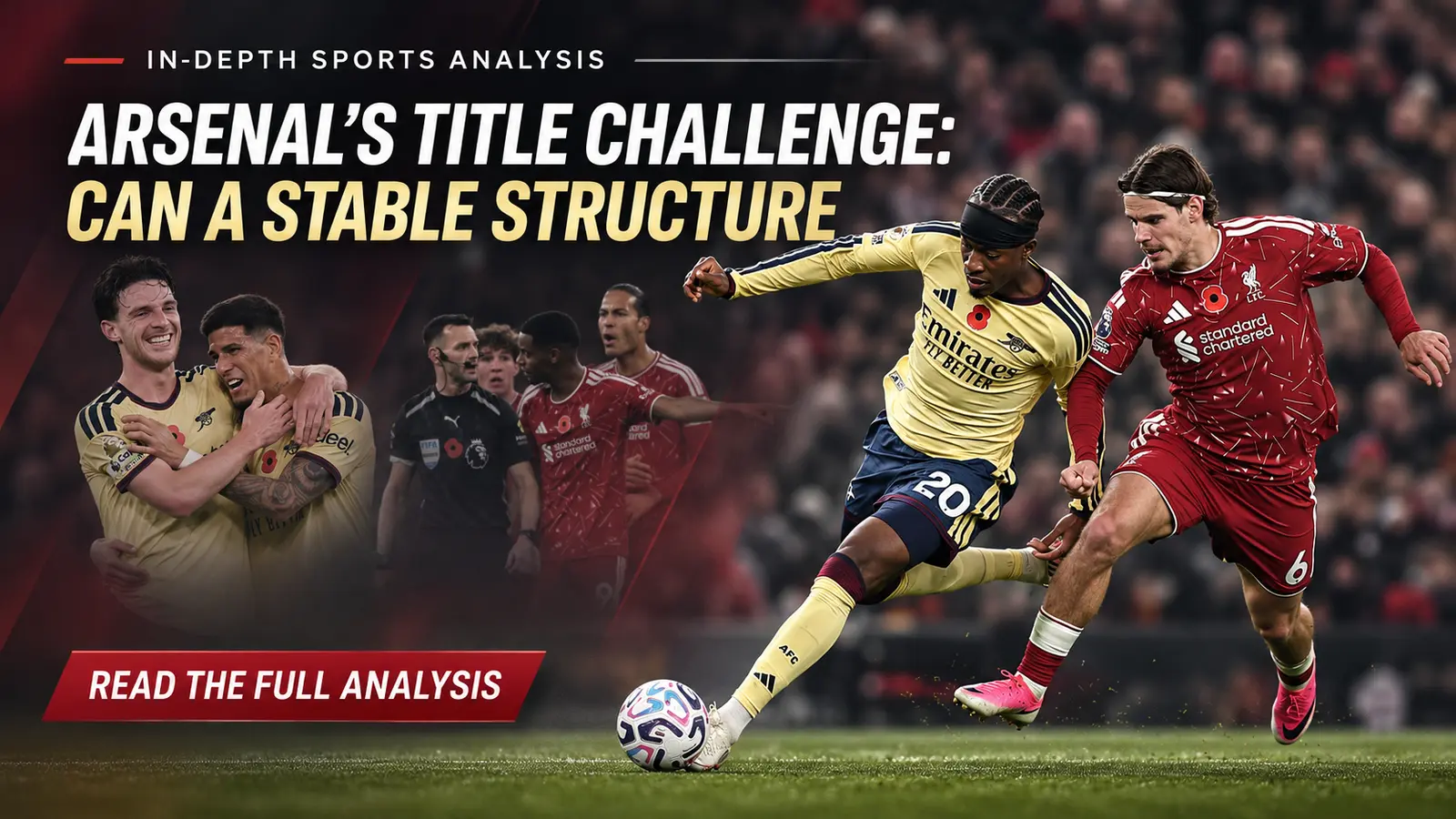
Arsenal’s visit to Anfield raises a wider question about the 2026/27 title race: how should a contender be judged when defensive protection, attacking pressure and the final score describe different aspects of the same contest? The answer starts with the match’s decisive actions and two separate refereeing flashpoints, before turning to the surrounding league results.
Liverpool 0–1 Arsenal: Havertz supplies the decisive moment
Arsenal won at Anfield on 1 November 2026 through Kai Havertz’s 16th-minute goal, securing their first Premier League away victory over Liverpool since 2012.
The winning move began with Arsenal regaining possession as Liverpool attempted to build from a goal kick. Declan Rice overlapped on the right and sent a low delivery towards the far post, where Havertz finished from close range. As Liverpool’s official report records, the decisive sequence connected a regain with an immediate attacking action—not simply a long spell of possession.
Liverpool had an important opening before half-time. In the 43rd minute, Milos Kerkez crossed from the left and Alexis Mac Allister headed over from around eight yards. Arsenal also threatened after the interval: Alisson saved Christos Tzolis’s first-time effort in the 73rd minute, keeping the deficit at one.
What the substitution sequence actually shows
Around the 80-minute mark, Liverpool had introduced two substitutes and Arsenal one. Liverpool had replaced Trey Nyoni with Dominik Szoboszlai around the hour and introduced Rio Ngumoha in the 67th minute. They completed their changes around the 82nd minute, bringing on Kostas Tsimikas, Victor Munoz and Lewis Koumas together.
Arsenal introduced Myles Lewis-Skelly in the 62nd minute, followed by Piero Hincapie and Viktor Gyokeres in the 84th, then Mikel Merino in the 88th.
That chronology limits the conclusions that can be drawn about fresh legs. Tzolis’s chance came before either side’s final cluster of changes. It cannot be explained as a reward for Arsenal reacting to Liverpool having already used all five substitutes.
Holding changes back can preserve options for protecting a lead or providing an outlet. Making them earlier can refresh a team’s pressure. Neither approach becomes correct merely because of the eventual result; the useful question is what each replacement changed in the next phase of play.
Tactical balance: protecting space versus escaping pressure
Arsenal’s goal provides a clear example of active control without prolonged possession: disrupt the opponent’s build-up, then turn the recovery into a dangerous delivery before the defence can settle.
Their subsequent retreat poses a different question. Defending deeper can be a choice intended to protect central space. It can also be a consequence of an opponent making it difficult to retain the ball and move upfield. Liverpool’s pressure deserves consideration in explaining why Arsenal could not always turn defensive work into sustained attacks.
The distinction matters. A compact block may deny clean shooting opportunities while still leaving its team short of an effective exit. That is a defensive achievement with an attacking limitation—not necessarily evidence of either total control or tactical failure.
Liverpool’s full-back arrangements sharpened the trade-off. Kerkez’s crossing offered a route to a meaningful chance on the left. On the right, using Ronald Araujo, a centre-back by trade, potentially added aerial protection but demanded the movement and recovery work associated with defending a wider channel.
Arsenal’s protection and Liverpool’s territorial threat
Liverpool’s official match centre recorded no David Raya saves. FotMob recorded Liverpool leading opposition-box touches 48–23. Those measures can coexist because they describe different things: access to the penalty area is not the same as making the goalkeeper work.
For Arsenal, the positive reading is that their defending helped prevent territorial pressure from becoming a succession of saves. But Mac Allister’s close-range header over the bar remains important. A missed opportunity does not become harmless simply because it never tests the goalkeeper.
For Liverpool, repeated attacking access and the restriction of Arsenal’s exits are reasons not to dismiss the performance solely through the defeat. Yet territory cannot substitute for the quality of the final action. Pressure becomes more persuasive when it repeatedly produces chances that force the defence or goalkeeper into difficult interventions.
Judge players by the action, not the result
Havertz’s finish and Rice’s delivery form a precise basis for praise. Alisson’s intervention against Tzolis offers an equally concrete basis for assessing his contribution, despite playing for the losing side.
Kerkez’s cross for Mac Allister also prevents an overly dismissive verdict on his attacking involvement. It produced a header from a dangerous position. That is more than activity for its own sake. Equally, one productive delivery cannot establish that his progression, inward movement and decision-making were consistently effective across the match.
Nyoni’s replacement raises a narrower question than whether Liverpool ultimately scored. The argument for retaining him is an argument for midfield continuity; the argument for changing him is that a different balance might help unlock the game. A favourable assessment of his performance does not automatically prove the substitution wrong, just as the introduction of a different player does not prove the original midfield had failed.
Araujo’s deployment should be assessed through its trade-offs rather than his usual position alone. A centre-back at right-back may strengthen aerial defending, but wide duties bring different demands. Joe Gomez’s presence on the bench also cautions against treating that selection as proof that Liverpool had no defensive alternatives.
Timber–Isak: staying upright does not rule out a penalty
Around the 21st minute, Bradley Barcola crossed towards Alexander Isak, whose shirt was pulled by Jurrien Timber inside the penalty area. Isak stayed upright and did not reach the header. Referee Andy Madley awarded no penalty, and VAR Stuart Attwell did not overturn the decision.
The relevant starting point is IFAB Law 12. Holding that constitutes a direct-free-kick offence inside the defender’s penalty area warrants a penalty. The attacker does not have to fall.
That does not make every visible shirt pull an automatic penalty. The action and its effect must be assessed, while VAR applies its separate threshold for a clear and obvious error or serious missed incident. But Isak remaining on his feet is not, by itself, a reason to reject the appeal.
Liverpool manager Andoni Iraola’s post-match response—that he would tell players to go down in future—expressed frustration with that distinction. The wider concern is the incentive: if players believe staying upright makes an infringement less likely to be recognised, exaggerating the effect may appear advantageous. Officials should judge the hold, not reward the fall.
Madueke–Mac Allister: contact is not an automatic red card
The later confrontation was a separate incident. Around the 79th–80th minute, Noni Madueke and Mac Allister made forehead contact during an argument, after which Mac Allister went down. VAR did not identify a direct-red-card offence, and Mac Allister was booked.
There is no universal rule making all forehead contact an automatic dismissal regardless of its nature or force. Violent conduct requires an assessment of excessive force or brutality outside a challenge for the ball. The action, intensity and context therefore matter.
Madueke’s involvement can reasonably be criticised as a needless disciplinary risk without declaring that a mandatory dismissal was missed. Slow motion can establish contact; contact alone does not settle its disciplinary category.
Liverpool 2–0 Brighton: a useful result, not a shortcut to ranking teams
Liverpool beat Brighton 2–0 at Anfield on 25 October, one week before Arsenal’s visit. That result supplies recent context, but it cannot resolve the interpretation of the Arsenal match.
A team can win one contest and encounter different problems in the next. Liverpool’s Brighton victory neither guarantees effective finishing against Arsenal nor becomes irrelevant because Liverpool subsequently lost. The useful comparison concerns how performances translate into results, not a chain of assumptions about who must therefore be stronger.
Arsenal 2–0 Everton: another clean sheet, a different examination
Arsenal’s preceding league match was a 2–0 home victory over Everton on 24 October, with Ezri Konsa and Gabriel scoring, as confirmed by Everton’s match report.
The Everton win offers a modest comparison rather than another claim of effortless superiority. Arsenal finished with two goals and a clean sheet, but those outcomes do not establish that every phase was comfortable.
The tempo question remains useful: controlling a game can mean denying forward options and choosing when to accelerate, not simply keeping the ball. Spending time without possession can also reflect pressure that a team would prefer to escape. The clean sheets against Everton and Liverpool invite that comparison; they do not prove the two matches unfolded in the same way.
Aston Villa 2–1 Manchester City: a winning run meets resistance
Manchester City’s seven successive league victories were followed by a 2–1 defeat at Aston Villa on 24 October. A 1–0 home loss to Brighton on 31 October then made it consecutive league defeats.
Those results introduce uncertainty into the title comparison, but they do not establish a permanent decline. Seven wins should not be dismissed as meaningless because the next two matches were lost. Equally, a winning sequence is not proof that a team has solved every problem it will face against different opposition.
For Arsenal, City’s interruption is relevant as a change in a rival’s results—not as evidence that the title race has been decided.
Beyond the incidents: referee development and appointment safeguards
The Anfield decisions also lead to a legitimate institutional discussion, provided it remains separate from judgments about the incidents themselves.
The FA announced the refereeing body’s transition to Professional Game Referees, or Pro Ref, on 29 June 2026. Its announcement addressed investment and development. The broader challenge is how officials acquire experience in demanding matches without being exposed to responsibilities before they are ready.
Never appointing a developing referee to a difficult fixture cannot build that experience. Appointing one without sufficient preparation creates a different risk. Support, assessment and a progression in responsibility are more useful principles than treating either inexperience or seniority as a complete answer.
Appointment safeguards should also be transparent about potential conflicts. A referee’s birthplace or residence is not, by itself, evidence of bias. Nor does disagreement with a VAR outcome demonstrate that officials were protecting a colleague. A disputed decision can justify scrutiny without establishing an institutional motive.
Arsenal’s title defence: depth must preserve the structure
As the 2025/26 Premier League champions, Arsenal have a title to defend. Their Anfield victory left them top after nine rounds, but the stronger argument for their prospects concerns repeatability rather than the symbolism of one away win.
Konsa’s involvement against Everton and Liverpool, together with the options used from the bench at Anfield, provides a starting point for discussing personnel management. Useful depth is not simply the number of recognisable names available. It is the ability to change personnel without losing defensive relationships, progression or an attacking outlet.
Merino’s 88th-minute introduction offers one example of an option Arteta could use. It does not establish that he is being deliberately reserved for the second half of the season. Likewise, potential alternatives across the left side should be assessed according to their availability and the functions they can perform, rather than assumed to be interchangeable.
There is a counterweight to any sweeping claim of stability: Arsenal were eliminated from the League Cup on penalties by Fleetwood Town on 28 October. Strong league results do not make every selection or competition immune to disruption.
The comparison with Liverpool and City is therefore relative. Arsenal’s structure may offer an advantage if it remains dependable while opponents struggle to turn pressure or winning runs into sustained returns. That advantage can narrow as rivals improve, or as Arsenal’s own personnel demands change.
Synthesis: repeatable structure is not the same as total control
The matches point towards a distinction between protecting a result and controlling every dimension of a contest. Arsenal’s clean sheets against Everton and Liverpool are positive outcomes. Liverpool’s attacking access at Anfield, Mac Allister’s missed header and Alisson’s save show why the second of those wins should not be reduced to an account of effortless containment.
The same discipline improves individual judgments. A productive cross matters even when the header misses; a save matters even when the goalkeeper’s team loses. Substitutions must be judged against their timing and intended trade-offs, not credited with chances that occurred before them.
The refereeing analysis follows a parallel logic: establish the action, apply the relevant rule, then distinguish criticism of a decision from claims about the system. Neither Isak staying upright nor the existence of forehead contact supplies an automatic verdict.
For the title race, stability is most valuable when it survives different opponents and changes of personnel. City’s consecutive defeats and Liverpool’s contrasting results make the comparison fluid. They strengthen the case for valuing Arsenal’s repeatability without proving permanent superiority.
Liklux Verdict
Arsenal’s Anfield win deserves a positive title assessment, not a declaration of supremacy. They combined a decisive attacking sequence with successful protection of their lead, while Liverpool supplied enough pressure and opportunity to keep the performance open to serious examination.
A stable structure can offset rivals’ fluctuations if Arsenal preserve it through rotation and retain credible ways to escape pressure. That is a persuasive foundation for a title defence. It is not a championship guarantee—and it is a stronger argument than claiming one narrow victory proved domination.