
Manchester United and Tottenham Cannot Solve Structural Problems With One Result or One Signing
At a Glance
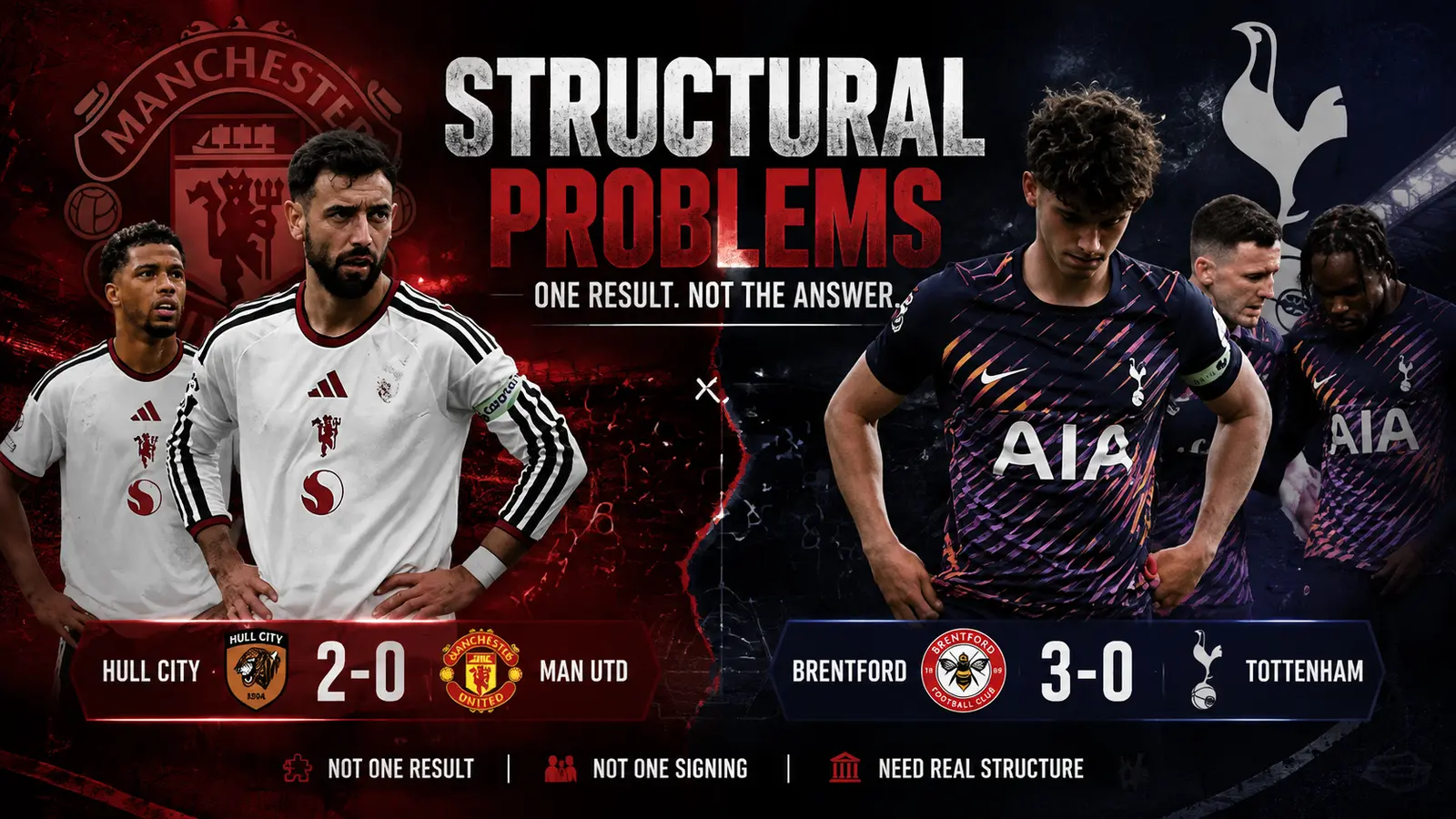
What happened: Hull City beat Manchester United 2-0 on 22 August, while Brentford beat Tottenham 3-0. Around those results, the strongest discussion was not about one-off tactical mistakes, but about whether both clubs have enough continuity, functional balance and decision-making clarity to make rebuilding work.
Why it matters: Manchester United are trying to meet immediate Champions League-level expectations while still addressing squad gaps. Tottenham are attempting a more disruptive reset, with questions over leadership, player integration and how long Roberto De Zerbi should be judged on short-term results.
Liklux view: A new signing, a change of shape or one encouraging performance cannot repair a club whose connections are weak across the pitch and above it. The decisive issue is whether recruitment, coaching and leadership are working to the same timeline.
What to watch next: Watch whether Manchester United create width and midfield protection rather than simply accumulating possession, and whether Tottenham establish a stable spine before the pressure around De Zerbi’s job turns every result into a referendum.
The result is the trigger, not the whole diagnosis
The Premier League’s opening weekend supplied the kind of results that invite instant, sweeping judgment. Hull City beat Manchester United 2-0 at the MKM Stadium on 22 August. Brentford beat Tottenham 3-0, with Igor Thiago missing a penalty in a match one commentator said could otherwise have become even more emphatic. Arsenal won 3-0 at promoted Coventry; Ipswich Town beat Sunderland 2-1 through Jack Clarke’s 90th-minute winner; and Everton defeated Crystal Palace 2-0, despite Palace arriving as the 2025/26 UEFA Conference League winners.
Those facts are useful context, but they do not automatically form a league thesis. Nor should a rapid score roundup be inflated into one. A commentator’s view that Daniel Farke’s Leeds United could become the season’s surprise package is a prediction, not an early conclusion. The same restraint applies to broad questions posed around the title race: whether Arsenal can pull clear, or whether two of the traditional Big Six will drift into trouble, remains an open proposition rather than a forecast with enough evidence behind it.
The more productive thread is structural. Manchester United and Tottenham were beaten, but the significance lies in what the defeats appeared to revive: concerns about how a team is built, not merely how it played for 90 minutes. One match cannot settle those arguments. It can, however, show where the arguments begin.
Manchester United: possession needs purpose, and recruitment needs a plan
Hull City’s win carried its own historic note. Sergej Jakirović, born in Bosnia and Herzegovina, was reported before the season as set to become the Premier League’s first Bosnian head coach. But the meaningful Manchester United discussion after Hull was less about the opposition manager’s identity than about a familiar concern: whether United’s attacking personnel create the right spaces for one another.
The commentator’s tactical diagnosis was clear. United, in this view, have too many important attackers who gravitate towards central zones. Against a compact opponent that crowds its penalty area and blocks the middle, the lack of natural width can make the attack predictable. The point is not that every central creator is a problem, or that introducing one wide player automatically fixes everything. It is that a team needs repeatable mechanisms to stretch the pitch before its central talent can exploit the gaps that stretch creates.
That is why the criticism of empty possession deserves attention. The commentator argued that United’s control of the ball and use of crosses against Hull did not create sufficient substance, and that a substitute appearance from Marcus Rashford did not noticeably alter the pattern. This remains analysis, not a complete statistical verdict on the match. Yet it identifies a mechanism worth watching: possession is only control when it forces a defensive line to make damaging choices. If the opponent can stay compact, protect the middle and accept crosses without losing its shape, territorial dominance can become cosmetic.
The deeper concern is squad construction. Michael Carrick publicly said before the season that Manchester United still needed further reinforcement. That statement should not be reinterpreted as a public attack on the club’s recruitment department. Still, it gives weight to the broader question: are the gaps in the squad isolated, or interconnected?
A commentator argued that the defeat reflected shortcomings in mentality, attitude and recruitment, while also questioning how many United players should be considered automatic starters at Big Six level. That is plainly a subjective benchmark, and should be treated as one. The more useful underlying idea is that a team’s ceiling is not set by its best-known names alone. It is set by the quality and fit of the starting XI, the alternatives available when a match demands a different profile, and the ability to carry injuries, fatigue and fixture pressure without collapsing into improvisation.
Luke Shaw started all 38 of Manchester United’s 2025/26 Premier League matches, and United finished third to qualify for the 2026/27 Champions League. Those are solid reference points, not proof that the squad is complete. Qualifying for Europe raises the immediate standard. It means that a rebuild cannot be discussed only in abstract future terms; the team must also compete now.
That is the tension around Carrick. He was initially appointed in January 2026 until the end of the 2025/26 season, lifted United from seventh to third and then signed a permanent contract through 2028 on 22 May. Success understandably raises the expectation attached to his permanent role. But the commentator’s central warning is sound as a framework: chasing short-term results through established players can delay the renewal of key areas, especially midfield.
Casemiro is no longer a future decision for United. The club confirmed in January 2026 that he would leave when his contract expired at the end of 2025/26, and he has since joined Inter Miami as a free agent. The relevant question is therefore not whether United should plan for a post-Casemiro midfield, but whether that planning has produced the right balance of coverage, protection and ball-winning.
The commentator’s view is that United need a sweeping defensive midfielder, and that one recruit’s past numbers or reputation cannot solve a structural problem in isolation. That is an important distinction. A midfielder’s value is relational: who is protected, who is released higher up the pitch, how transitions are managed, and whether the side can defend the spaces it creates when it attacks. Recruitment discussion is often reduced to names. The better question is what function a signing enables across the rest of the team.
Manchester United’s summer activity should be discussed carefully. Youri Tielemans and Andrey Santos joined the club, while reliable reporting described Carlos Baleba’s move in terms of a £65m initial fee plus £5m in add-ons. Meanwhile, the £185m in club financial documents was undrawn availability under a revolving credit facility as of 17 February 2026, not a confirmed transfer budget. Treating a credit line as a spending ceiling obscures more than it explains.
The Old Trafford question is about priority, not a false choice
The same precision is needed in the debate around Old Trafford Regeneration. Manchester United confirmed in June 2026 that it had secured most of the land required for a proposed 100,000-seat new stadium, including a roughly 25-acre acquisition from Indurent. That is substantial progress, but it is not confirmation that every land issue is complete or that a separate public financing drive has formally begun.
Jim Ratcliffe is an important driver of the stadium vision. The wider regeneration framework, however, should not be simplified into a project personally led by one club figure; the relevant public body is the Old Trafford Regeneration Mayoral Development Corporation.
The commentator’s criticism is not that a stadium project and football investment are inherently incompatible. It is that competitive performance must remain the asset underneath the commercial project. That is an opinion, but it is a serious one. A club can develop infrastructure, expand revenue and modernise its estate while still accepting that its commercial appeal depends, over time, on compelling football, European relevance and the sense that its best years are not merely inherited from a previous era.
This does not establish that stadium planning caused recruitment shortcomings. There is no basis for such a direct causal claim. It does establish a legitimate hierarchy of questions: if the first team lacks balance or depth, how convincingly is the club aligning its football decisions with its business ambition? The danger is not commercial development itself. The danger is allowing commercial scale to become a substitute for sporting renewal.
Tottenham’s problem is continuity before it is a verdict on De Zerbi
Tottenham’s 3-0 defeat to Brentford sharpened a different version of the same theme. The verified team structure from that match showed Conor Gallagher operating centrally behind the striker in a 4-2-3-1, with Sandro Tonali and Lucas Bergvall deeper in the double pivot. Gallagher was replaced at half-time by Mateus Fernandes.
That arrangement does not, by itself, prove a positional mistake. It does provide the background to the commentator’s argument that Tottenham are trying to rebuild without enough established connections. In this account, the problem is not simply that new players have arrived or that results have been poor. It is that the old spine has been broken up across defence, midfield and attack at once, leaving the coach without a settled tactical skeleton capable of carrying the cost of adaptation.
That is a more useful explanation than blaming every loss on the manager’s ideas. New combinations require shared references: who covers when a full-back advances, how the midfield protects a new goalkeeper, where the first pressing trigger comes from, and which attackers can be trusted to preserve shape when possession is lost. If too many of those answers are changing simultaneously, instability becomes predictable rather than surprising.
The commentator believes that putting Kinský in as the main goalkeeper adds to the difficulty of that transition. There is a concrete reminder of how quickly that pressure can become severe: in Tottenham’s 5-2 Champions League defeat away to Atlético Madrid on 10 March 2026, Antonín Kinský made two clear early errors that led directly to goals and was substituted in the 17th minute. Calling it a “black 15 minutes” is commentary shorthand; the recorded substitution time matters because it prevents drama replacing detail.
The broader governance critique is also explicitly an opinion. The commentator says Tottenham currently look like a club without a sufficiently forceful decision-making centre, contrasting the present with the authority he associates with Daniel Levy after defeats. Whether that characterisation is fair cannot be established by metaphor. But the question it raises is real: who defines the threshold for acceptable performance, the purpose of the rebuild and the timeframe in which a coach will be assessed?
A managerial debate that is really about time
That is why the discussion around Roberto De Zerbi should not be reduced to a sack-race prediction. One commentator forecast that he would not survive until Christmas. Another argued the opposite: that the scale of Tottenham’s task means the club could give him a second transfer window. The disagreement is valuable precisely because it does not have a settled answer.
One view is that recurring heavy defeats quickly make a coach’s position untenable. The other is that replacing a manager before the squad has enough Champions League- or Big Six-level starters merely restarts the cycle. Both positions rest on opinion. The editorial value lies in recognising the timescale conflict: should the board judge immediate outcomes, or should it judge whether the team is moving towards a coherent long-term structure?
The commentator also argues that De Zerbi should not have accepted the job, despite the attractiveness of the offer, and credits Xavi Simons rather than De Zerbi alone for Tottenham’s successful survival last season. Those are contestable opinions, not established accounts of responsibility. They underline, however, how quickly a coach can become the symbol of a club’s uncertainty when leadership has not clearly set the project’s terms.
Transfer talk should be handled with the same restraint. At the time reflected in the reporting, Tottenham had reportedly agreed a deal with Manchester City for Savinho worth around £75m plus add-ons, though neither club had formally announced it, while Omar Marmoush remained in negotiations. The commentator’s point was not that either player lacks quality. It was that neither should be cast as an instant, transformative cure for a side undergoing wholesale reconstruction. Savinho’s inability to find a consistent rhythm in England is also the commentator’s assessment, not an official verdict on the player.
That distinction matters. Good players can improve a squad. They cannot automatically create the partnerships, hierarchy and tactical certainty that a broken spine lacks. The more unstable the system, the less reasonable it is to ask two arrivals to become its entire repair strategy.
Arsenal look steady; the rest still need proof
Arsenal’s 3-0 win at Coventry gave the commentator a different reason for confidence. The argument was not based on one large scoreline, but on a perceived ability to control games and remain composed after taking the lead. That is a better lens than simply counting goals: title contenders often separate themselves by reducing the number of plausible routes back into matches for their opponents.
Still, it is an assessment and a prediction that Arsenal are the likeliest side to lead the race, not a settled title conclusion. Promoted sides are not automatic points, as the opening results illustrated. Hull beat United, Ipswich beat Sunderland, while Coventry lost to Arsenal. Manchester City, Liverpool and Chelsea also remain, in the commentator’s words, uncertain quantities. Chelsea do at least arrive with recent silverware, having won the UEFA Conference League in 2025 and then the expanded FIFA Club World Cup, but trophies alone do not resolve a new season’s competitive hierarchy.
The initial fixture chatter also needed correction. The official first-round schedule listed Manchester City at home to Bournemouth and Newcastle United at home to Liverpool on 23 August, with Fulham versus Chelsea at 20:00 BST on 24 August. There was no Manchester City-Liverpool match that night. The calendar is a reminder of a wider principle for this whole roundup: attention-grabbing framing is not analysis, and analysis is not improved by forcing certainty where the evidence is still thin.
A brief European comparison reinforces that restraint. Real Madrid won 2-1 away to Espanyol on 22 August: Jude Bellingham scored in the ninth minute, Álex Calatrava equalised in the 30th, and Carlos Espí scored the 90th-minute winner. A commentator linked Vinícius Júnior’s below-par display to a later return after the World Cup and a lack of early-season rhythm. That may be a plausible interpretation, but it is not a full diagnosis of Real Madrid. It is context, not a separate case study.
What the early noise is really asking
The opening results have not proved that Manchester United or Tottenham are doomed, just as they have not proved Arsenal will run away with the title. They have, however, made the right questions more urgent.
For United, the challenge is to turn possession into penetration by building width, midfield protection and a recruitment plan that treats profiles as connected parts rather than standalone acquisitions. Carrick’s contract and Champions League qualification make that a current responsibility, not a distant project.
For Tottenham, continuity is the central issue. If the club has dismantled too much of its old structure at once, it must decide whether it is prepared to give De Zerbi the time and support required to build new connections—or whether it will judge him primarily through the next sequence of results.
The strongest conclusion is not dramatic. Football clubs cannot purchase their way out of incoherence with one signing, nor coach their way out of it with one tactical adjustment. They improve when the pitch, the squad plan and the leadership structure tell the same story.
Liklux Verdict
Manchester United and Tottenham are not defined by a single August defeat. But Hull City’s 2-0 win and Brentford’s 3-0 victory exposed why both clubs need more than a quick fix: United need functional balance between width, midfield protection and recruitment, while Tottenham need continuity and a clear governance timeline for their rebuild. Arsenal may look the steadiest early contender in the commentator’s view, but the title race—and the fate of either rebuild—remains open.
Sources and Verification
View sources and verification notes
- All 380 fixtures for 2026/27 Premier League season”: the official opening-weekend schedule lists Manchester City v Bournemouth and Newcastle v Liverpool on 23 August, followed by Fulham v Chelsea on 24 August. — Premier League
- Spurs reported to have agreed £75 million deal for City’s Savinho”: reports a £75m agreement plus up to £10m in add-ons while noting that neither club had officially commented; separate talks for Omar Marmoush were continuing. — Reuters
- Tottenham transfer reporting: identified Savinho and Omar Marmoush as the two Manchester City attackers under discussion with Spurs, with negotiations still requiring completion. — BBC Sport
- Sergej Jakirovic”: the league’s official manager profile confirms that Hull City’s head coach was born in Bosnia and Herzegovina and led Hull to promotion. — Premier League
- Hull promotion feature: stated before the season that Jakirović would become the first Bosnian manager in the Premier League. — The Guardian
- Premier League opening-day roundup: confirms Hull City 2-0 Manchester United and Everton 2-0 Crystal Palace on 22 August 2026. — Reuters
- 2025/26 Conference League: All the results”: confirms Crystal Palace beat Rayo Vallecano 1-0 in the 27 May 2026 final. — UEFA
- official 2026/27 fixture list: identifies Coventry City, Hull City and Ipswich Town in the opening round. — Premier League
- Premier League opening-day roundup: confirms Hull’s 2-0 win and Ipswich’s 2-1 win over Sunderland; Arsenal’s opener was a 3-0 win over Coventry. — Reuters
- Premier League opening-day roundup: confirms Leeds United won 1-0 at Nottingham Forest and that the result spoiled Oliver Glasner’s Forest debut. — Reuters
- opening-day clockwatch: records Nottingham Forest 0-1 Leeds United and identifies the late winner. — The Guardian
- Tottenham’s expensive rebuild begins with familiar collapse”: confirms Brentford’s 3-0 win over Spurs. — Reuters
- opening-day report: records Brentford’s 3-0 win and Igor Thiago’s missed penalty. — The Times
- we have to improve”: reports Carrick saying United still needed further additions, particularly around midfield and left-back. — The Times
- Luke Shaw player profile: states that Shaw was ever-present in the 2025/26 Premier League campaign and started all 38 matches. — Manchester United
- Luke Shaw career statistics: records 38 appearances and 0 substitute appearances in 2025/26. — Premier League
- Chelsea win the 2024/25 Conference League: Meet the champions”: confirms Chelsea beat Real Betis in the 2025 final. — UEFA
- Chelsea men’s standout stats and records from 2025”: confirms the club won both the Conference League and Club World Cup in 2025. — Chelsea FC
- Michael Carrick”: states that he was initially appointed until the end of 2025/26, won 11 of 16 league matches, lifted United from seventh to third and secured Champions League qualification. — Premier League
- Michael Carrick Continues as Head Coach”: confirms his new contract through 2028 after securing Champions League qualification. — Manchester United
- Man Utd midfielder Casemiro to leave at end of season”: reports Manchester United’s January confirmation that his contract would expire and the one-year option would not be activated. — Reuters
- Inter Miami CF Signs Five-Time UEFA Champions League-Winning Midfielder Casemiro”: confirms he signed as a free agent through the 2027 MLS Sprint Season, with an extension option. — Inter Miami CF
- June 2026 Form 6-K: states that the club had secured the majority of the land required for the proposed new 100,000-capacity stadium, including a 25-acre site northwest of Old Trafford. — Manchester United plc / SEC
- Old Trafford Regeneration project hub: presents a world-class 100,000-capacity stadium as the club’s stated ambition within the wider regeneration programme. — Manchester United
- Q2 FY2026 interim report: reports £400m of total available facilities after financing actions, including £185.0m of undrawn revolving-facility capacity; it does not label that amount as a transfer budget. — Manchester United plc
- Manchester United/Carlos Baleba transfer report: reports an agreement for Baleba at an initial £65m plus £5m in add-ons and identifies him as another midfield acquisition after Youri Tielemans and Andrey Santos. — Reuters
- Premier League opening-day roundup: confirms Hull City 2-0 Manchester United and Ipswich Town 2-1 Sunderland on 22 August 2026. — Reuters
- All you need to know as Hull City are promoted to Premier League”: confirms Hull won the 2025/26 Championship play-off final 1-0 against Middlesbrough and returned after nine years. — Premier League
- Old Trafford Regeneration project hub: sets out the club’s ambition for a new 100,000-capacity stadium and the wider regeneration vision. — Manchester United
- Old Trafford Regeneration Mayoral Development Corporation documentation: establishes the formal public-sector regeneration vehicle for the area. — Greater Manchester Combined Authority
- official Atlético de Madrid v Tottenham match documentation: records Kinský as Tottenham’s starting goalkeeper and his substitution in the 17th minute of the 5-2 match. — UEFA
- Atlético-Tottenham match report: reports that Kinský was substituted after 17 minutes after three early concessions, with two goals following his errors. — Reuters
- Brentford 3-0 Tottenham: lists Tottenham in a 4-2-3-1 with Tonali and Bergvall as the deeper pair and Conor Gallagher in the central attacking-midfield line; Mateus Fernandes replaced Gallagher at half-time. — BBC Sport match line-up
- Tottenham’s expensive rebuild begins with familiar collapse”: confirms the 3-0 match context and the use of new midfield signings. — Reuters
- Spurs reported to have agreed £75 million deal for City’s Savinho”: reports an agreement for Savinho and continuing Tottenham talks for Omar Marmoush, while noting that clubs had not officially confirmed the Savinho deal at publication time. — Reuters
- Omar Marmoush player profile: still listed Marmoush as a Manchester City forward ahead of the 23 August match, illustrating that a Spurs move was not yet an official completed registration at that point. — Premier League
- Espí engalana el debut de Mourinho con el Real Madrid ante el Espanyol”: confirms Espanyol 1-2 Real Madrid and Carlos Espí’s 90th-minute winner. — EFE
- Espanyol 1-2 Real Madrid match report: confirms Bellingham’s opener, Calatrava’s equaliser and Espí’s late winner. — Cadena SER
- Manchester United agree deal for Brighton midfielder Baleba”: identifies Carlos Baleba as Manchester United’s August 2026 midfield target and reports the agreed transfer terms. — Reuters
Liklux distinguishes verified facts, attributed reporting and editorial analysis. Interpretation and verdict remain Liklux editorial analysis.