
World Cup Knockout Analysis: Brazil’s Fall, England’s Shift and Portugal vs Spain Preview
Introduction
A World Cup knockout-stage editorial package focused on how elite national teams handle pressure: Brazil’s structural failure against Norway, England’s more pragmatic identity under Thomas Tuchel, Portugal versus Spain as a tactical and generational clash, and the Balogun suspension controversy before United States versus Belgium.
Match Preview
Portugal vs Spain Preview: Speed, Control and the Battle to Make Stars Serve the System
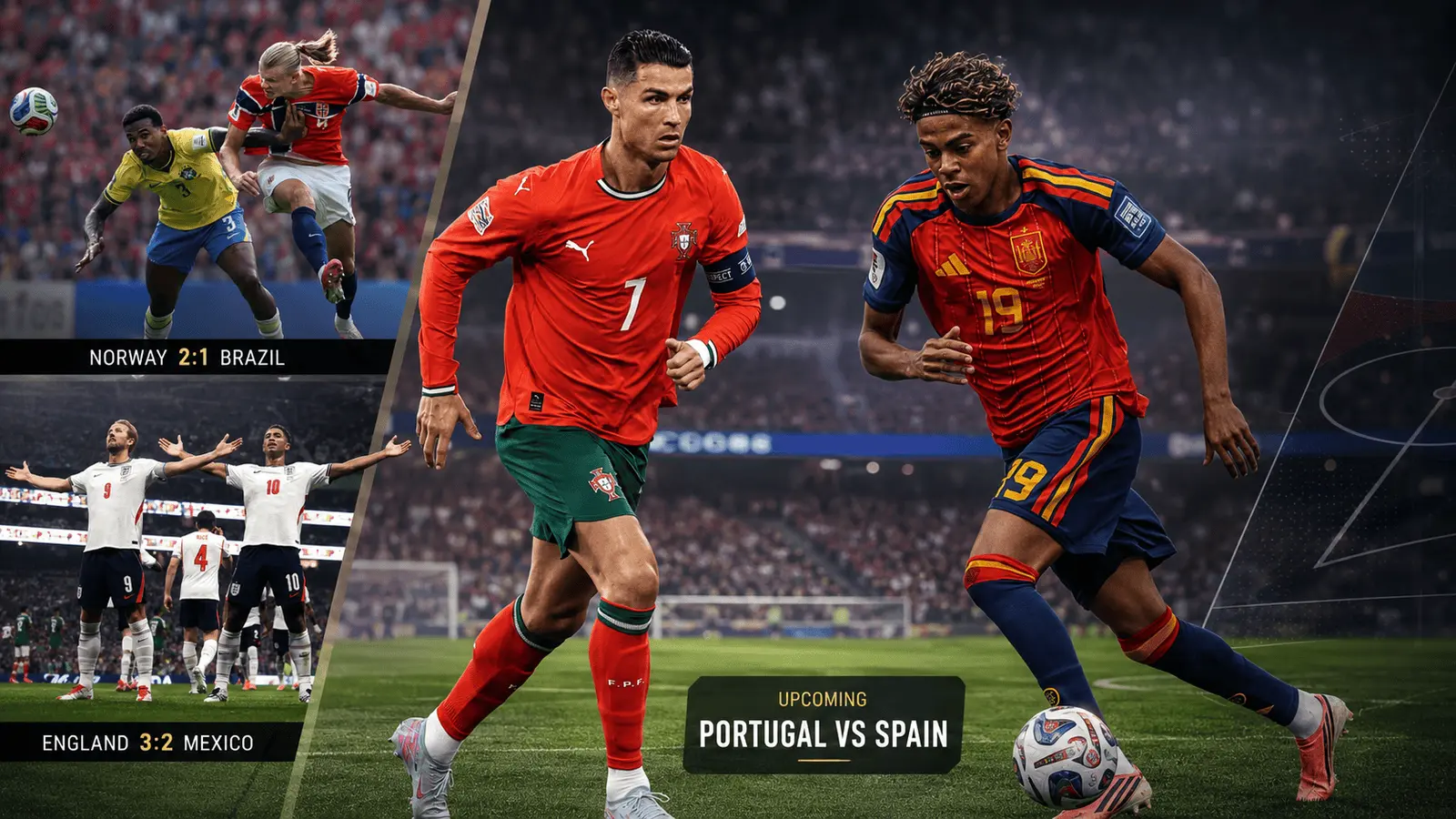
Portugal versus Spain has the obvious headline: Cristiano Ronaldo against Lamine Yamal, old era against new, legacy against acceleration. But that framing is only the doorway into the match. The real contest is more practical and more tactical: can Portugal become a genuinely connected team, and can Spain turn possession into speed before Portugal settle into their defensive shape?
This World Cup last-16 tie in Arlington is not simply about who has the more gifted forwards. Both sides have enough individual quality to win a knockout match. The question is whether that quality is arranged in a way that survives pressure.
Spain’s keyword: speed
Spain’s best version is not sterile circulation. It is possession with tempo, wide threat and sudden acceleration. If Spain can stretch Portugal on both flanks, they can make the match feel wider than Portugal want it to be.
That is why the right-sided duel involving Lamine Yamal is such an important subplot. Yamal is already one of Spain’s main sources of imbalance, but Portugal have a credible counterweight in Nuno Mendes. Mendes has the recovery pace and one-v-one defensive profile to make that flank less comfortable for Spain than it usually is.
If Mendes limits Yamal’s influence, Spain cannot allow the attack to become predictable. They will need alternative routes: Pedri finding pockets, Mikel Oyarzabal attacking central spaces, the opposite flank offering real penetration, and Rodri receiving enough support that he is not left to solve pressure alone.
Portugal’s keyword: unity
Portugal’s issue is not a lack of names. It is whether those names fit together under knockout pressure.
Bruno Fernandes and Vitinha are both natural rhythm-setters. That can be a strength, but only if the division of responsibility is clear. If one dictates tempo while the other connects and balances, Portugal can build through midfield with authority. If both want to control the same zones and the same moments, the midfield can become crowded rather than creative.
That same question applies further forward. Ronaldo remains an enormous reference point, but Portugal must decide what type of match best suits them. If they defend deeper and attack space, players such as Rafael Leao or Goncalo Ramos may become vital in transition. If Portugal try to match Spain pass for pass, they risk allowing the game to be played on Spain’s terms.
The key duel: Nuno Mendes vs Lamine Yamal
This is the cleanest tactical matchup in the game. Spain want Yamal isolated against defenders. Portugal want Mendes close enough to contest the first action and quick enough to prevent the second.
The duel will shape more than one flank. If Yamal dominates, Spain can tilt the pitch and force Portugal’s midfield to slide constantly. If Mendes holds his ground, Spain must prove they can create through other channels.
Where the match could turn
Portugal may be tempted to keep the game tight, absorb pressure and wait for transition chances. Spain will try to avoid that rhythm by moving the ball quickly enough to disorganise Portugal before the defensive block is set.
An early goal would change everything. Both teams have attacking talent, but both also have defensive questions that can be exposed when the match opens up. If the first hour stays level, the game could become a test of patience, substitutions and nerve.
The headline says Ronaldo versus Yamal. The match may be decided by something less romantic: midfield spacing, full-back duels and which team gets its stars to work for the structure rather than outside it.
Post-Match Review
Brazil’s 2 1 Defeat to Norway Was Not Just a Shock — It Was a Structural Warning
Brazil losing to Norway in a World Cup knockout match sounds like a classic upset. Watch the shape of the game, though, and it becomes harder to call it random.
Norway won 2-1 in the last 16 at MetLife Stadium, with Erling Haaland scoring in the 79th and 90th minutes before Neymar converted a stoppage-time penalty. The scoreline carried drama, but the deeper story was structural: Norway knew what it wanted the match to become, while Brazil never quite made their stars feel like part of one functioning machine.
Norway waited, then accelerated
Stale Solbakken’s side did not need to dominate possession to control the emotional rhythm of the match. Norway stayed patient, accepted long stretches without glamour and trusted that the game would eventually offer spaces.
The decisive change came after substitutions added energy and directness. Antonio Nusa and Andreas Schjelderup helped alter the tempo, with Schjelderup supplying the deliveries for Haaland’s goals. That was the kind of bench impact knockout teams dream of: simple, clear and connected to a plan.
Haaland then did what elite finishers do. He turned limited windows into a result. By the end, his two goals had taken him to seven for the tournament, level with Lionel Messi and Kylian Mbappe at the top of the Golden Boot race at that point.
Brazil’s penalty miss changed the emotional tone
Brazil had an early chance to tilt the match when Bruno Guimaraes stepped up for a penalty, only for Orjan Nyland to save it. The miss was not just a lost goal; it became the centre of a wider debate about responsibility.
With Vinicius Junior in strong tournament form and Brazil’s attack already leaning heavily on his ability to create separation, the decision to have Bruno take the penalty naturally became a talking point. Without confirmed internal details on Brazil’s penalty hierarchy, it should not be treated as a scandal. But it was undeniably one of the match’s defining moments.
Neymar’s late goal could not hide the transition problem
Neymar’s stoppage-time penalty gave Brazil a final emotional note, but it did not solve the larger question. His introduction around the second half’s later stages carried the feeling of a team caught between eras: still attached to an old source of identity, yet not fully organised around its current attacking core.
That is Brazil’s uncomfortable reality. Vinicius is a present-tense threat. Neymar is history, talent and emotion. But the team did not fully clarify how those forces should coexist.
This is bigger than Ancelotti
Carlo Ancelotti will inevitably face criticism. Brazil’s midfield structure, full-back depth, attacking balance and in-game adjustments all deserve scrutiny. But reducing this defeat to one manager’s failure would be too easy.
Brazil’s issue is not that they lack talent. It is that their talent too often appears in fragments: a winger asked to solve too much, a midfield that does not consistently connect phases, full-backs who do not provide the old Brazilian authority, and a team identity that feels less instinctive than its reputation suggests.
Norway did not have more famous names. They had clearer jobs. In knockout football, clarity can beat mythology.
Team Analysis
England Under Tuchel Look Less Romantic — and More Like a Knockout Team
England’s 3-2 win over Mexico in the World Cup last 16 was not a clean performance. It had a storm-delayed start, altitude, penalties, a red card, 13 minutes of added time and long spells of pressure. But that is exactly why it matters.
Tournament football rarely rewards teams for looking polished for 90 minutes. It rewards teams that can survive momentum swings, protect a lead, suffer without collapsing and turn key moments into goals. Under Thomas Tuchel, England are beginning to look more comfortable with that version of the game.
Efficiency over control
England’s decisive spell came quickly. Jude Bellingham scored in the 36th and 38th minutes, turning a tense match into one England briefly appeared to control. Mexico responded through Julian Quinones before half-time, and the game never truly settled again.
The second half brought more chaos: Jarell Quansah was sent off in the 54th minute after a VAR-reviewed dangerous challenge on Jesus Gallardo, Harry Kane scored from the penalty spot in the 60th minute, and Raul Jimenez converted a Mexico penalty in the 69th.
What stood out was not England’s ability to dominate possession. It was their ability to make decisive actions count.
Bellingham gives England a different kind of threat
Bellingham’s value is not only in the goals. It is in timing. He pauses when defenders expect him to run, arrives when midfielders lose sight of him and gives England a vertical threat from areas that are hard to mark.
That kind of movement suits knockout football because it does not require endless control. One good transition, one hesitation from a centre-back, one well-timed run — that can be enough.
Kane’s role remains central too, even when he is not the highlight-reel player. His presence occupies defenders, creates space for runners and gives England a penalty-box reference point when matches become scrappy.
The defensive details mattered
England’s win also depended on the less glamorous moments: Jordan Pickford’s goalkeeping, John Stones’ emergency defending, and the collective willingness to retreat when the match demanded it.
This is where Tuchel’s England may differ from the more cautious possession debates of previous years. They are not necessarily more expansive. They may not always be more entertaining. But they look increasingly built for survival.
Norway will test whether this is real
The quarter-final against Norway in Miami gives England a different kind of examination. Norway have just eliminated Brazil by combining patience, substitutions and Haaland’s finishing. England cannot treat that as a one-off upset.
If Tuchel’s side are to keep moving, they will need the same qualities they showed against Mexico: efficiency, discipline, emotional control and the ability to defend uncomfortable periods without losing their shape.
England may not look romantic. That might be the point.
Player Performance
Haaland and Bellingham Are Defining the Knockouts in Different Ways
Tournament football often reduces greatness to goals, but the knockout stage is already giving us two different models of influence.
Erling Haaland’s impact against Brazil was brutally direct. Jude Bellingham’s against Mexico was more layered. One decided the game through finishing power. The other bent the game through timing, movement and control of decisive moments.
Haaland: the final action
Norway’s 2-1 win over Brazil was a perfect Haaland match in the sense that he did not need constant service to dominate the outcome. He scored in the 79th and 90th minutes, turning Norway’s patience into a historic result.
That is the terrifying part of Haaland in knockout football. Opponents can survive him for long stretches and still lose the match in two actions. Norway’s substitutions helped create the openings, but Haaland supplied the certainty.
By the end of the match, he had reached seven goals for the tournament, level with Lionel Messi and Kylian Mbappe at the top of the Golden Boot race at that stage. The number matters, but the context matters more: he delivered against Brazil when the match was there to be seized.
Bellingham: the action before the action
Bellingham’s two goals against Mexico came in a very different kind of performance. England’s match was chaotic and physically demanding, but Bellingham’s best quality was clarity.
He does not simply arrive in the box. He chooses when to delay, when to accelerate and when to appear behind the line of attention. That makes him exceptionally hard to track. Defenders see the ball, then suddenly Bellingham is the problem.
His influence also extended beyond scoring. England needed defensive recovery, emotional control and bodies in pressure zones after Quansah’s red card. Bellingham’s value in those moments is why his performance felt bigger than a brace.
Two types of knockout dominance
Haaland is the punishment for one lapse. Bellingham is the player who creates the lapse.
Norway’s system becomes more dangerous because Haaland gives every cross and transition a final destination. England’s system becomes more dangerous because Bellingham adds a second wave of attack without abandoning midfield responsibility.
That contrast is what makes the coming England-Norway quarter-final so compelling. England must defend the most ruthless finisher in the tournament. Norway must deal with a midfielder who can turn structure into surprise.
Different players, different methods, same message: in knockout football, elite timing is everything.
Controversy and Talking Points
Balogun’s Suspension Controversy Is Bigger Than One United States Team Sheet
Folarin Balogun’s availability for the United States’ last-16 match against Belgium has become one of the most sensitive talking points of the World Cup knockout stage.
The football consequence is obvious: Balogun is an important forward for the United States. But the larger issue is not just tactical. It is about trust in process, consistency of punishment and the perception of host-nation advantage.
What is known
Balogun was sent off in the United States’ earlier knockout match against Bosnia and Herzegovina. A red card would normally be expected to bring an automatic suspension for the next match. However, FIFA’s disciplinary process allowed the one-match suspension to be suspended for a probationary period, making him available to face Belgium.
That distinction matters. Saying a decision is controversial is not the same as saying it is automatically illegitimate. Disciplinary rules can include discretion. Suspended sanctions can exist within a formal framework.
But football is not judged only in legal language. It is judged in public credibility.
Why the optics are difficult
When a host nation benefits from a discretionary ruling, the burden of explanation becomes higher. Supporters do not only ask, “Was there a rule?” They ask, “Would this have happened for everyone?”
That is where the Balogun case becomes dangerous for FIFA. Even if the decision can be defended procedurally, it risks being interpreted as special treatment unless the reasoning is clearly explained.
Reports of political attention around the case only sharpen that perception. In a tournament already full of debates about refereeing standards and disciplinary consistency, this is exactly the kind of issue that can follow a team through the bracket.
The match impact
If Balogun starts and plays a decisive role against Belgium, the conversation will intensify. A goal or assist would not just be a football moment. It would become part of the controversy’s afterlife.
For Belgium, the challenge is to avoid letting the debate become emotional fuel in the wrong direction. For the United States, the challenge is to win in a way that does not leave every major moment filtered through the suspension decision.
The broader principle
Football rules need flexibility, but flexibility without transparency creates suspicion. The danger is not only that one player becomes available. The danger is that fans stop believing disciplinary outcomes are predictable.
That is why Balogun’s case matters. It is about a striker, a suspension and a last-16 tie — but also about whether knockout football feels governed by rules or by influence.