
World Cup Knockout Analysis: Brazil vs Norway, England vs Mexico and the Tests Facing Environmental Factor
Introduction
A World Cup knockout-stage package built around why elite teams are being dragged into uncomfortable games: environment, refereeing thresholds, emotional control, tactical structure and individual match-winners are narrowing margins without erasing the gap in quality.
Match Preview
World Cup Knockout Preview: Brazil Face Haaland’s Test, England Walk Into Mexico’s Storm
The knockout stage is changing the question
At this stage of a World Cup, the gap between the strongest teams and the rest has not disappeared. It has simply changed form. Favourites still have more quality, more depth and more ways to win. But knockout football allows opponents to compress the game into a few decisive moments: a set-piece, a transition, a penalty, a refereeing threshold, a hostile stadium, or one elite finisher.
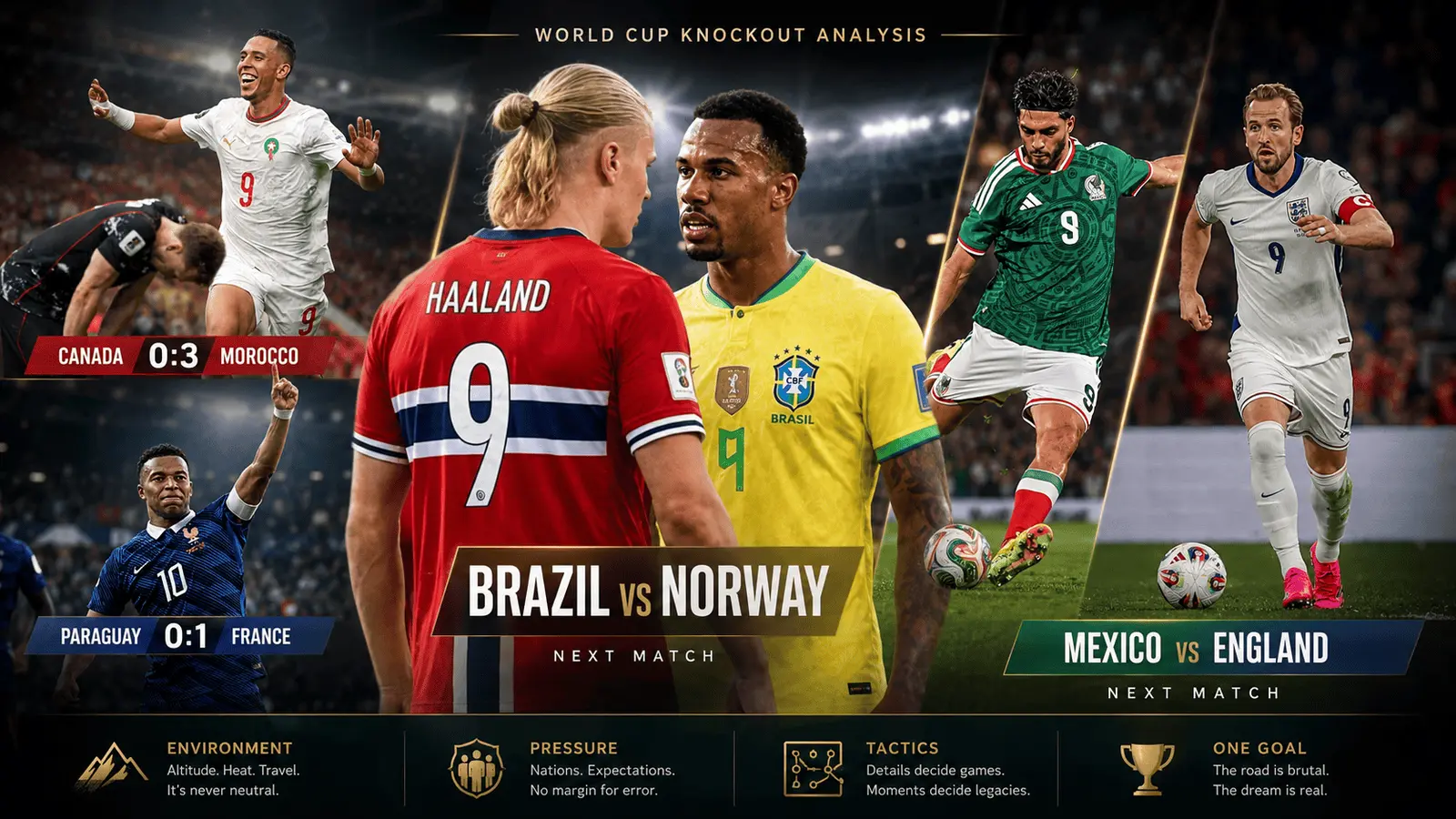
That is why Brazil vs Norway and England vs Mexico are so compelling. Brazil’s issue is not whether they have enough attacking talent. It is whether their defensive structure can survive Erling Haaland’s most dangerous moments. England’s issue is not whether they have a better squad than Mexico on paper. It is whether that squad can impose itself in Mexico City, at altitude, in a stadium loaded with history and noise.
Brazil vs Norway: collective control against one-man disruption
Brazil meet Norway in the Round of 16 at New York New Jersey Stadium, with Brazil having come through a 2-1 comeback win over Japan in the previous round and Norway having eliminated Côte d’Ivoire. The central tactical question is obvious: can Brazil prevent Norway from turning a game of Brazilian control into a game of Haaland moments?
Haaland does not need Norway to dominate territory for 90 minutes. He needs one clean delivery, one second ball, one centre-back caught on the wrong side, one misjudged bounce in the box. That is why Gabriel Magalhães becomes such an important figure. Brazil’s title credentials will be judged not only by Vinícius Júnior, Neymar or the attacking combinations, but by whether the Gabriel-Marquinhos-Casemiro axis can remove panic from the penalty area.
Brazil’s wider advantage is structure. Under Carlo Ancelotti, the appeal is less about romantic ideas of beautiful football and more about balance: knowing when to slow the game, when to accept a pragmatic phase, and when to use speed in transition. Brazil’s win over Japan, sealed late by Gabriel Martinelli after Casemiro had equalised, reinforced the idea that this side can solve problems without looking perfect.
That may matter against Norway. If Brazil score first, Norway will have to open space behind their midfield and defensive line. That is where Vinícius becomes devastating. If Norway score first, the match becomes a much sterner examination of Brazil’s patience and game management.
Lucas Paquetá’s reported thigh or hamstring issue is an important selection concern, while Raphinha’s readiness and Neymar’s role should be treated cautiously until the team sheet confirms the picture. What can be said is that Brazil’s balance will matter more than their star count.
England vs Mexico: a football match and an environment test
England’s Round of 16 meeting with Mexico at Mexico City Stadium, the World Cup name for the Azteca, is a different kind of exam. Mexico enter with four wins from four and no goals conceded, a run widely framed as the first such World Cup start since Italy in 1990. Add altitude of roughly 2,200 metres, around 80,000-plus home supporters and one of the sport’s great historical venues, and England’s theoretical superiority becomes less straightforward.
The first 20 to 30 minutes could shape everything. Mexico’s best route is intensity: start fast, press aggressively, force England to defend facing their own goal, and make the crowd feel like a tactical weapon. If England survive that phase cleanly, Harry Kane, Jude Bellingham and England’s set-piece threat can begin to tilt the match back toward control.
The danger area for England is the right side. Reece James has had hamstring concerns, Jarell Quansah has been reported as available again, and other defensive options have carried fitness questions. Declan Rice is expected to be available despite physical management issues, but England need him in midfield far more than as an emergency solution elsewhere. If Rice is dragged out of his best role, England’s transition defence weakens.
Mexico do not need to be more talented than England to make this tie awkward. They need to keep the match emotionally charged, physically demanding and low-scoring for long enough that England’s anxiety grows.
Argentina vs Egypt: control, pressure and the psychology of survival
Argentina’s upcoming meeting with Egypt in Atlanta carries a different tone. Argentina advanced after a 3-2 extra-time win over Cape Verde, a match that offered both survival and warning signs. The concern is not Argentina’s talent. It is whether they can manage leads, slow momentum shifts and avoid the kind of chaotic phases that give an underdog belief.
Egypt, meanwhile, came through Australia on penalties after a 1-1 draw. Mohamed Hany’s own goal in that match has become one of the tournament’s strongest talking points, especially after reports confirmed he became the first player in World Cup history to score two own goals in the same tournament. Egypt’s challenge is to protect the player psychologically while maintaining defensive aggression.
If Egypt can keep Argentina in a low-scoring game, they will believe in the route to extra time or penalties. If Argentina score early and control possession with maturity, the tie may look very different.
The broader theme: favourites must win more than the ball
Brazil must manage Haaland. England must manage Mexico City. Argentina must manage themselves. That is the knockout stage in one sentence.
The favourites remain favourites. But the teams that go deepest will not simply be the most talented. They will be the ones that turn pressure into control rather than chaos.
Post-Match Review
France and Morocco Show Two Different Ways to Win a Knockout Tie
Two wins, two versions of maturity
France and Morocco reached the quarter-finals in very different ways. France beat Paraguay 1-0 in a tense Round of 16 match decided by Kylian Mbappé’s penalty around the 70th minute. Morocco defeated Canada 3-0 in Houston, with Azzedine Ounahi scoring twice and Soufiane Rahimi adding a late third.
The scorelines tell only part of the story. France’s win was about emotional control under pressure. Morocco’s was about rhythm control against a team built on speed.
France beat Paraguay by winning the emotional match
France’s victory over Paraguay was not an exhibition of attacking fluency. It was a survival test played in severe heat, with reports placing the temperature in Philadelphia around 39°C and the heat index above 41°C.
Paraguay made the game physical and uncomfortable. The major controversy came from the officiating threshold: France received three yellow cards while Paraguay received none, despite Paraguay committing more fouls. The decisive penalty also came only after VAR intervention, with Diego Gómez adjudged to have fouled Désiré Doué after the referee had initially allowed play to continue.
That context matters because France did not lose emotional control. Mbappé converted the penalty, but the more important point was the team’s collective discipline. In a match where frustration could easily have turned into retaliation, France stayed inside the game. That is often the difference between a talented side and a tournament side.
France now move on to face Morocco in the quarter-finals, and the tone of that match will be fascinating. France have already passed a test of heat, contact and patience. Morocco will test their rhythm in a different way.
Morocco’s 3-0 win was not as simple as the scoreline
Canada started with pace and ambition. They pressed, ran vertically and tried to turn the game into a track meet. But speed is not the same as control. Canada finished with 10 shots, three on target, while Morocco had five shots and four on target. The efficiency gap was brutal.
Morocco’s first goal came through Ounahi in the 50th minute. The second, also from Ounahi, arrived in the 82nd minute, before Rahimi made it 3-0 in stoppage time after having entered earlier following Ismael Saibari’s first-half injury.
The tactical lesson was clear. Morocco did not chase Canada’s tempo early. They absorbed it, allowed Canada’s physical edge to fade, then accelerated when the match opened. Brahim Díaz’s involvement in the later goals underlined Morocco’s ability to use technical quality once the game state turned in their favour.
Canada exit, but not without a framework to build from
Canada became the first of the three 2026 co-hosts to be eliminated. That should not erase the progress in their tournament. Their issue against Morocco was not effort. It was variety. When early pressure did not become a goal, Canada lacked enough alternative routes: a different attacking rhythm, a stronger penalty-box reference point, or bench solutions capable of changing the match.
That is the next stage of growth for a team with athleticism and ambition.
The common thread
France and Morocco both won because they understood timing. France knew when not to react. Morocco knew when not to rush.
In knockout football, that kind of restraint can be as decisive as a spectacular goal.
Team Analysis
Why the Knockout Stage Is Exposing Team Maturity More Than Team Talent
Talent gets you into the conversation. Maturity keeps you alive.
The knockout stage has offered a reminder that football’s strongest teams are not always the teams that look most comfortable. Sometimes the mark of a contender is not domination, but the ability to stay rational when domination is impossible.
France, Brazil, England, Argentina and Morocco are all useful case studies because each faces a different question.
Brazil: Ancelotti’s job is to make Brazil less romantic and more ruthless
Brazil’s biggest strength is no longer just attacking talent. It is the possibility of balance. Carlo Ancelotti’s value lies in making Brazil less dependent on emotional waves and more capable of managing game states.
Against Norway, that matters enormously. Brazil will expect to control more of the ball and create more attacking situations, but Haaland compresses the risk. One poorly defended cross can undermine 20 minutes of control.
That is why Brazil’s title case runs through the spine as much as the front line: Gabriel Magalhães, Marquinhos, Casemiro and the midfield structure around them. If Brazil can combine defensive calm with Vinícius Júnior’s ability to punish space, they look like a team built for the later rounds.
England: the squad is strong, but the structure still needs answers
England’s problem is different. They have a high-level squad, but Mexico will test whether the system has enough clarity under pressure.
The right side is the key concern. Fitness questions around defensive options, the need to keep Declan Rice central, and the defensive workload of wide players all feed into the same issue: can England stop Mexico from repeatedly attacking one channel?
Thomas Tuchel’s England cannot rely only on Kane as the emergency solution. Kane remains elite, but knockout football punishes teams that become predictable when the match tightens.
Argentina: survival is not the same as control
Argentina’s 3-2 extra-time win over Cape Verde kept them alive, but it did not fully reassure. The concern is their management of unstable phases. If a team with less individual quality can drag Argentina into a chaotic match, Egypt will see a path.
That path is simple: defend with discipline, keep the score low, turn pressure into frustration, and use the memory of a penalty shootout win over Australia as psychological fuel.
Argentina’s next step must be cleaner possession and better lead management.
France: composure can be a championship trait
France’s 1-0 win over Paraguay was not pretty, but it was revealing. The game placed them under heat, contact and controversy, yet they stayed composed. That matters. Tournament winners often need one match where they learn how to win ugly without losing themselves.
Mbappé’s penalty was the decisive action, but the wider story was collective emotional discipline.
Morocco: the art of not playing the opponent’s game
Morocco’s 3-0 win over Canada was a model of controlled patience. Canada wanted speed. Morocco refused to panic, absorbed the first wave and then punished the drop-off.
That maturity is not accidental. Morocco are now back in the quarter-finals for a second consecutive World Cup, after reaching the semi-finals in 2022. They have a clear knockout identity: manage risk, protect structure, accelerate at the right time.
The verdict
The best teams in this tournament are not necessarily the ones who win every phase. They are the ones who know which phases not to lose.
That is the difference between talent and tournament maturity.
Player Performance
Mbappé, Haaland, Gabriel and Hany: Four Players Carrying Four Very Different Knockout Narratives
The knockout stage turns players into symbols
At this point of a World Cup, individual performances become larger than individual statistics. A player can become the image of a team’s maturity, its fear, its weakness or its misfortune.
Kylian Mbappé, Erling Haaland, Gabriel Magalhães and Mohamed Hany are four very different examples.
Mbappé: leadership through restraint
Mbappé’s penalty against Paraguay sent France into the quarter-finals, but the bigger statement was his composure. In a game shaped by heat, physical contact and disputed officiating thresholds, Mbappé did not allow the match to become a personal argument.
That matters for France. When a star player is repeatedly central to pressure moments, the team often follows his emotional temperature. Mbappé stayed cold. France stayed functional.
His leadership here was not theatrical. It was practical: take the ball, take the penalty, take the team through.
Haaland: the player who can bend a match without controlling it
Haaland’s threat against Brazil is unique because he does not need Norway to dominate. He only needs a few moments that suit him: a cross, a duel, a second ball, a defender losing contact for half a second.
That is what makes him so dangerous in knockout football. He can turn a match Brazil are managing into a match Brazil are suddenly chasing.
Norway’s challenge is service. If they cannot feed him cleanly, Brazil’s overall quality should tell. But no team can treat Haaland as just another striker.
Gabriel: Brazil’s title test in human form
Gabriel Magalhães may be the most important Brazilian in the Norway match without being the most glamorous. His duel with Haaland is not only physical; it is psychological.
If Gabriel wins early headers, blocks Haaland’s preferred body position and keeps his first pass clean under pressure, Brazil will feel stable. If Haaland unsettles him, the entire match changes tone.
Brazil’s attacking stars may decide the score. Gabriel may decide whether Brazil ever lose control.
Hany: the cruelty of being a defender near your own goal
Mohamed Hany’s tournament has become one of the most painful individual stories. His own goal against Australia, after an earlier own goal in the group stage against Belgium, made him the first player in World Cup history to score two own goals in the same edition.
The easy reaction is ridicule. The fairer reaction is analysis. Own goals often come from defenders doing the job they are required to do: attacking dangerous balls, covering space, reacting to deflections and trying to prevent a striker from finishing freely.
Hany’s situation is now a psychological challenge for Egypt. They must protect the player without making him timid. A defender afraid of mistakes is often more vulnerable than one who has just made one.
Four players, four pressures
Mbappé carries expectation. Haaland carries danger. Gabriel carries responsibility. Hany carries public pressure.
That is why knockout football is so compelling. It does not just test ability. It tests the weight each player can bear.
Controversy and Talking Points
Referees, Own Goals and Extreme Conditions: The Knockout Stage Is Being Decided in the Margins
The margins are no longer background noise
In knockout football, controversy is not a side story. It can shape tactics, emotions and public memory.
The current World Cup knockout stage has already produced several major talking points: the refereeing threshold in France vs Paraguay, the VAR-awarded penalty converted by Kylian Mbappé, Mohamed Hany’s own-goal record, extreme heat in Philadelphia and the altitude factor before England’s meeting with Mexico.
Each issue is different. Together, they show how matches are being decided by more than just formation diagrams.
France vs Paraguay: when the card threshold becomes the story
France’s 1-0 win over Paraguay featured one of the clearest officiating debates of the round. Paraguay committed more fouls, yet France finished with three yellow cards and Paraguay none. That imbalance inevitably shaped how the match was viewed.
The decisive moment also came through VAR. The referee initially did not award a penalty, but after review Diego Gómez was judged to have fouled Désiré Doué, and Mbappé scored from the spot.
The question is not whether physical football should be allowed. Football needs contact. The question is where the line sits. If that line is too high, the team using physical disruption gains tactical value from risk. If the line is too low, the match loses rhythm and becomes over-officiated.
The best refereeing gives players a clear map. The worst leaves both sides guessing.
Hany and the own-goal conversation
Mohamed Hany’s second own goal of the tournament has generated a different kind of debate. Own goals are brutal because they attach one name to a collective defensive emergency.
Hany’s case is historically notable, but the discussion should not become humiliation. Defenders operate in the most dangerous zones of the pitch. They make emergency decisions at speed, often while facing their own goal and trying to stop an opponent from scoring.
A forward who misses a chance may be forgiven as unlucky. A defender who diverts a dangerous ball into the net becomes the headline. That imbalance is part of football’s cruelty.
Heat, altitude and the tactical environment
France played Paraguay in conditions reported at around 39°C, with the heat index above 41°C. That kind of environment changes pressing, recovery runs and decision-making. It rewards teams that manage tempo and punishes those who rely on constant intensity.
Mexico City presents a different challenge. England face Mexico at altitude, in a stadium with enormous historical and emotional weight. The altitude does not win the match by itself, but it can change the rhythm of running, breathing and recovery. It can also turn the crowd into a genuine tactical factor if the away team starts slowly.
The real lesson
The knockout stage is not only a contest of stars. It is a contest of adaptation.
Can a team handle a referee’s threshold? Can it survive a hostile crowd? Can it avoid panic in heat? Can it protect a player who has become a public target?
The teams that answer those questions best are usually the ones still standing at the end.