
World Cup Knockout Preview: England, Belgium and USA Face the Low Block Test
Introduction
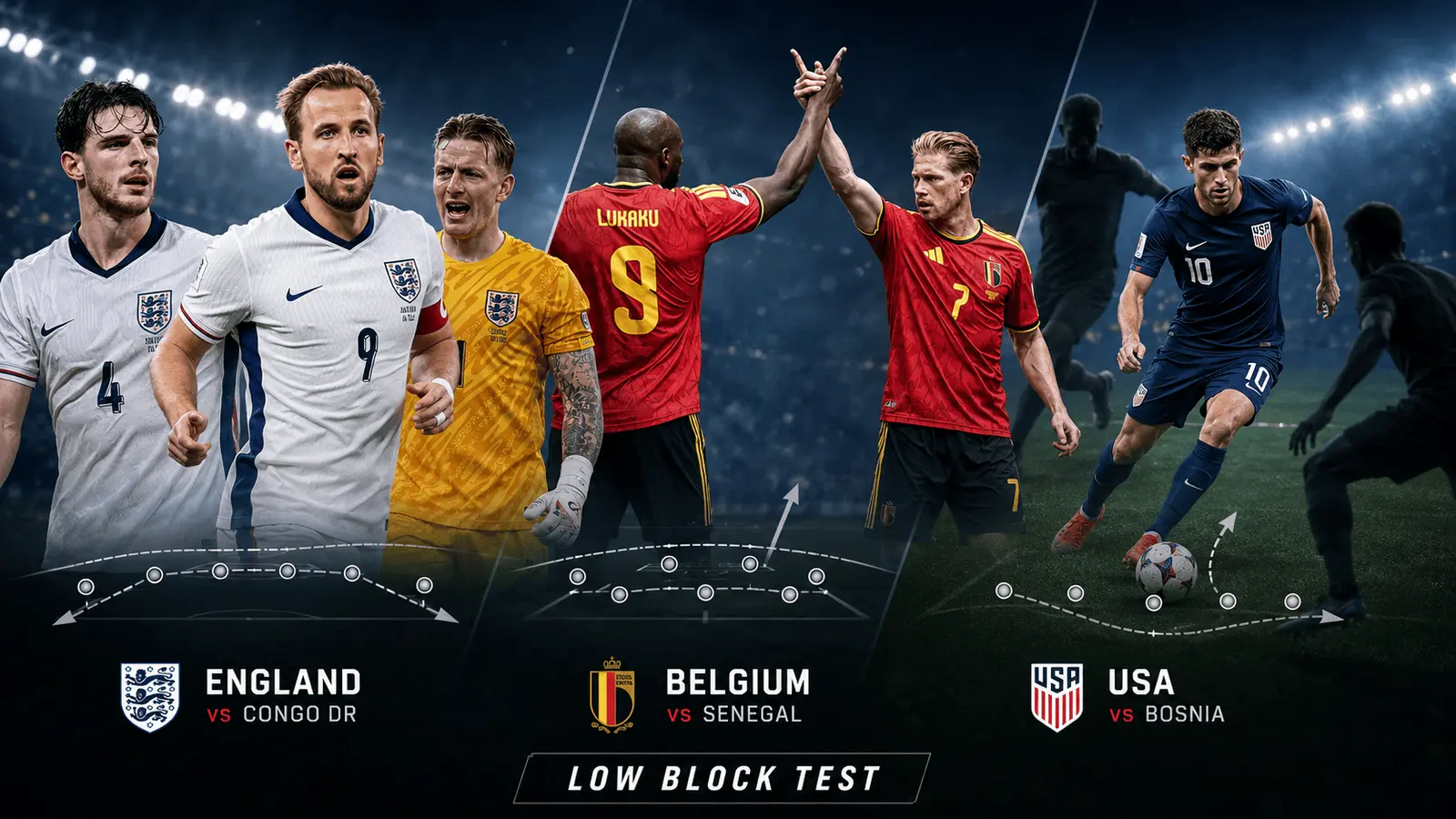
A World Cup knockout-stage package built around one central question: why paper favourites are being forced to prove they can break compact, physical, emotionally charged opponents. England, Belgium and the United States face different versions of that test, while France and Mexico are emerging as examples of how structure, clarity and tournament rhythm can matter as much as star power.
Match Preview
World Cup Knockout Preview: England, Belgium and USA Must Solve the Same Problem in Different Ways
The knockout-stage question: can the favourites break resistance?
The World Cup has reached the phase where reputation matters less than problem-solving. England, Belgium and the United States enter their next tests with very different identities, but their tactical challenge is similar: they are likely to see more of the ball, and they must turn possession into pressure before the match becomes a grind.
That is the danger of knockout football. A favourite can dominate territory and still become anxious if the first goal does not arrive. The underdog does not need to be better for 90 minutes; it only needs to make the game awkward, stretch it into the final half-hour, and drag the favourite toward extra time or penalties.
England vs DR Congo: quality, pressure and the right-side problem
England face DR Congo at Mercedes-Benz Stadium in Atlanta, with a noon local kickoff and warm conditions expected. The setting alone matters: heat, knockout pressure and an opponent built for contact can turn a technically superior side into a tense one.
Thomas Tuchel’s England have enough match-winners to control the tie, but the balance of the side is still under scrutiny. The right-back and centre-back picture has been complicated by availability concerns around several defensive options, and any makeshift solution could affect the whole back line. Against a DR Congo side with physicality, resilience and several players familiar with British football culture, that is not a detail — it is a potential pressure point.
England’s attacking question is just as important. Harry Kane can be both the finisher and the connector. If he stays high, England need reliable supply from wide areas and midfield runners. If he drops deep, he improves the build-up but risks leaving the penalty area short of a fixed target. Jude Bellingham, already a key goal threat in this tournament, gives England the vertical power to change that equation, but the front line still needs rhythm around him.
The wide positions may decide the tone of the match. Noni Madueke has looked like one of the sharper direct options, while Bukayo Saka, Marcus Rashford and Anthony Gordon offer different types of threat but still need consistent end product. If England cannot win one-v-one duels or force DR Congo’s block to turn, the match may drift toward set pieces — where Declan Rice’s delivery and presence become especially valuable.
DR Congo’s route to trouble England is not mysterious. Sébastien Desabre’s side can defend deep, compete physically, slow the rhythm and counter into spaces left by England’s full-backs. With players such as Yoane Wissa, Cédric Bakambu, Arthur Masuaku, Aaron Wan-Bissaka and Axel Tuanzebe in the wider squad picture, there is enough English football familiarity to make the matchup uncomfortable.
England should still be favoured. But this does not look like a match that can be won on reputation alone.
Belgium vs Senegal: a name-brand team meets a sharper physical test
Belgium’s 5-1 win over New Zealand was emphatic, but it should not erase the broader concern. Before that result, Belgium had drawn with Egypt and Iran, and the deeper question remains whether this team has genuinely refreshed itself or simply found a favourable matchup.
The familiar stars still matter. Kevin De Bruyne can still create passing lanes others do not see, Romelu Lukaku can still be useful as a late penalty-box weapon, and the wide threat of Jérémy Doku and Leandro Trossard can stretch any defence. Charles De Ketelaere gives another technical option. But Belgium’s issue is structural: if the wings are contained and the midfield has to defend large spaces, the ageing of the golden generation becomes more visible.
Senegal are dangerous because they can make Belgium work at a higher physical and emotional tempo. Their group-stage route included defeats to France and Norway before a 5-0 win over Iraq, and that exposure to high-level intensity could help them in a knockout match. If Senegal keep their discipline and turn the game into duels, transitions and second balls, Belgium’s famous names may not be enough.
USA vs Bosnia: speed against height, energy against patience
The United States bring pace, running power and home momentum into their meeting with Bosnia and Herzegovina. They won two of their three group games, scored eight goals, and have the kind of direct wing play that can make a knockout game feel open very quickly.
Christian Pulisic’s full return to training is therefore significant. The US can run, press and attack space, but against a deep block they still need a player who can receive between lines, commit defenders and create the final pass. Folarin Balogun’s role as the central forward depends heavily on the quality of that service.
Bosnia’s route is different: defend compactly, use size, attack set pieces and keep the match alive. Their dead-ball threat has already produced three goals, and if they can take the game beyond the 70-minute mark without conceding, pressure may start to move from the underdog to the host nation.
For the United States, running more is not automatically the same as running better. The key is effective movement: coordinated pressing, wide rotations, cutbacks, back-post runs and enough patience to avoid turning attacks into careless transitions.
The bigger trend
These matches fit the wider pattern of the tournament. France have looked convincing not only because Kylian Mbappé is decisive, but because the hierarchy around him appears clear. Mexico have become a serious dark-horse conversation because home energy, aggression and balance have lifted their level. Germany and the Netherlands have already shown how quickly elite football nations can be punished when leadership, finishing or penalty composure breaks down.
The knockout stage is asking a simple question in ruthless fashion: can you solve the match in front of you, or are you just carrying a bigger name?
Post-Match Review
World Cup Knockout Review: France Show Control, Mexico Make a Statement, and Giants Learn the Cost of Hesitation
France win like a team that knows who it is
France’s 3-0 win over Sweden was not just another reminder of Kylian Mbappé’s knockout-stage value. It was a wider statement about order. France lined up in a 4-2-3-1, but in possession the front line often carried the feel of a near 4-2-4, with the attacking players trusted to decide actions quickly once the ball reached the final third.
Mbappé scored twice, reinforcing his status as France’s defining player in World Cup knockout football. Yet the performance was not built on isolation. Michael Olise supplied two assists and gave France another layer of calm, creative timing. Ousmane Dembélé’s role also matters: when a squad of stars accepts a clear attacking hierarchy, the team becomes far harder to destabilise.
Didier Deschamps’ management added to the sense of control. His substitutions came in waves rather than panic: fresh legs at full-back, attacking rotation and a late removal of Mbappé once the match had been settled. That is tournament management, not merely match management.
Mexico’s 2-0 win was a black-horse warning
Mexico’s 2-0 victory over Ecuador, delayed by thunderstorms, carried a different kind of force. This was not about overwhelming star power. It was about tempo, crowd energy, aggression and conviction.
The opening goal arrived in the 22nd minute when Julián Quiñones drove from the left and finished high after being released by a clever pass from Edson Álvarez. Nine minutes later, Mexico doubled the lead after a loose Ecuador clearance allowed Raúl Jiménez and Quiñones to combine, with Jiménez finishing from close range into the top corner.
Mexico’s case as a dark horse is becoming harder to dismiss. They defend with intensity, attack with purpose and appear to draw emotional fuel from the setting. Against more famous opponents, that combination can be deeply uncomfortable.
Belgium’s big scoreline needs context
Belgium’s 5-1 win over New Zealand was important, particularly after draws against Egypt and Iran, but it should be read carefully. The result proves Belgium still have attacking quality. It does not automatically prove that the older core can handle a faster, more physically demanding knockout opponent.
That is why the Senegal match matters so much. It will tell us whether Belgium are recovering rhythm or merely enjoyed a favourable matchup.
Germany and the Netherlands pay for penalty uncertainty
Germany and the Netherlands both exited after 1-1 draws through 120 minutes and penalty shootout defeats. The details were different, but the wider theme was similar: in knockout football, hesitation becomes a footballing fact.
Germany’s shootout against Paraguay included saved and missed attempts from major names, and reporting around reluctance to take penalties has sharpened criticism of the team’s mentality. For a football culture historically associated with composure in these moments, that reaction is unsurprising.
The Netherlands’ exit against Morocco has focused attention on Ronald Koeman, who has resigned, and Virgil van Dijk. Van Dijk’s defensive positioning came under criticism, and his absence from the penalty list due to cramp has intensified the debate over captaincy responsibility. It is a harsh debate, but knockout football often reduces leadership to moments that cannot be replayed.
Japan and Norway show different ceilings
Japan’s 2-1 defeat to Brazil reopened a familiar discussion: technical progress is real, but physical matchups, aerial pressure and squad diversity still define the ceiling at the highest level. Hajime Moriyasu’s substitutions — two at 66 minutes, two at 78 and one deep into stoppage time — will be debated, but the broader issue is structural rather than purely managerial.
Norway’s 2-1 win over Ivory Coast, meanwhile, kept Erling Haaland’s tournament moving. With five goals in the competition and a remarkable recent national-team scoring run, Haaland’s story is no longer only about club dominance. It is about whether he can drag a national team deep into a World Cup through efficiency, physicality and responsibility.
Team Analysis
Why France Look Like a Champion: Hierarchy, Rotation and the Mbappé Effect
Talent is obvious. Order is rarer.
France have never lacked footballers. The more important question in tournament football is whether a squad full of elite attackers can avoid becoming a collection of competing agendas. Right now, France look dangerous because they have both talent and order.
Kylian Mbappé is the reference point. That is not merely a branding statement; it shapes how France attack. When the ball is won, the first thought is often vertical. When the opposition line is unbalanced, Mbappé becomes the route to goal. When the match needs a decisive action, the hierarchy is clear.
Olise changes the texture of the attack
Michael Olise’s two assists against Sweden were significant because they showed France do not need every attack to become a Mbappé sprint. Olise gives the side pause, disguise and timing. He can play the pass before the obvious pass, and that matters when opponents defend deep.
In a knockout tournament, variety is protection. If France can threaten through Mbappé’s acceleration, Dembélé’s unpredictability, Olise’s delivery and midfield recovery behind them, opponents cannot focus on one defensive solution.
Dembélé’s role lowers the risk of internal friction
Ousmane Dembélé’s importance is not only tactical. In teams packed with major attacking names, acceptance of role can be as valuable as a dribble. France look calmer because the front line appears to know where the centre of gravity sits.
That does not mean Dembélé becomes secondary in quality. It means his explosiveness is placed inside a clearer collective design. For France, that is the difference between being talented and being trustworthy.
Deschamps is managing minutes, not just matches
Didier Deschamps’ substitutions against Sweden reflected the logic of a coach thinking beyond one result. Rotating after control has been established keeps legs fresh, keeps substitutes involved and reduces unnecessary exposure for core players.
That is the mark of a tournament team. The best sides do not simply win; they preserve options for the next match.
The remaining question
France’s 4-2-3-1 can become very aggressive, almost a four-forward structure at times. Against stronger transition teams, the balance behind the attack will matter. Aurélien Tchouaméni’s defensive coverage and Adrien Rabiot’s linking work are therefore essential, not decorative.
But compared with other contenders still searching for rhythm, France currently have something more valuable than momentum: they have a working identity. In knockout football, that may be the closest thing to a champion’s profile.
Player Performance
Mbappé, Haaland and Kane: Three Ways to Define a World Cup Match Winner
Mbappé: the player who turns structure into fear
Kylian Mbappé’s two-goal performance against Sweden was another reminder that a tactical plan changes when one player can break the geometry of a match. France’s structure gives him the platform, but Mbappé gives it menace.
His value is not only that he scores. It is that defenders begin to protect against the sprint before it happens. That opens lanes for others, including Michael Olise, whose two assists showed how dangerous France become when their creative players operate with time and clarity around Mbappé’s gravity.
Haaland: efficiency as leadership
Erling Haaland’s tournament with Norway is building a different kind of superstar narrative. He has five goals in this World Cup and a recent national-team record of 25 goals in 13 matches. Those numbers are extraordinary, but the more interesting development is how his role is being interpreted.
Haaland is not being discussed only as a finishing machine. His defensive presence and willingness to work without the ball have broadened the image. For Norway, that matters. A national team built around a generational striker needs goals, but it also needs the star to set the competitive tone.
Kane: England’s solution and England’s dilemma
Harry Kane’s value is more complicated. If England struggle to supply him, he can look isolated. If he drops deep, he can become the best passer in England’s attack — but then the penalty area may lack his finishing presence.
That is the tactical tension Thomas Tuchel must manage. Kane can connect midfield to attack, create space for Jude Bellingham and help wide players come inside. But every yard he moves away from goal changes the shape of England’s threat.
The ideal version is not Kane as a pure poacher or Kane as a full-time midfielder. It is Kane choosing moments: dropping when England need control, arriving when England need the final touch.
Three stars, three questions
Mbappé asks opponents: can you survive the moment I run at you?
Haaland asks: can you stop the finish even when you know where it is coming from?
Kane asks England: can you build a structure that lets me do everything without asking me to do too much?
That last question may define England’s knockout path as much as any individual duel.
Controversy and Talking Points
Penalty Nerve and Captaincy Pressure: Why Germany and the Netherlands Became Knockout Cautionary Tales
Shootouts expose more than technique
Penalty shootouts are often described as lotteries, but that phrase can hide what they reveal. They test preparation, nerve, hierarchy and responsibility. Germany and the Netherlands both exited after 1-1 draws through 120 minutes and shootout defeats, and both have been left with questions that go beyond a single kick.
Germany and the burden of identity
Germany’s elimination against Paraguay has been received with particular sharpness because of what German football has historically represented: control under pressure, penalty confidence and a collective willingness to take responsibility.
The shootout itself was painful enough. Kai Havertz had an effort saved, Joshua Kimmich and Jamal Musiala scored, Nick Woltemade was denied, Nadiem Amiri converted, and Jonathan Tah missed in sudden death before Paraguay advanced. Reports that some players were reluctant to take penalties have intensified the reaction.
That criticism may sound emotional, but national-team football is emotional. When a team loses in a way that appears to contradict its historic identity, the debate naturally becomes cultural as much as tactical.
The Netherlands: Koeman, Van Dijk and the captaincy debate
The Netherlands’ exit against Morocco has produced a different argument. Ronald Koeman has resigned, and much of the public criticism has centred on his management. Yet Virgil van Dijk’s role has also become a major talking point.
Van Dijk was criticised for defensive positioning during the match, and his absence from the penalty list because of cramp has sparked a harsher captaincy debate. Is it fair to demand that a player struggling physically still take a penalty? Not always. But is it understandable that supporters expect the captain to be visibly central in the decisive moment? Absolutely.
That is the brutal standard of knockout football. Leadership is judged not only by what a player says before the match, but by what the public sees when the match is slipping away.
Ecuador and the danger of crossing from criticism into accusation
Ecuador’s late-match scenes against Mexico also generated criticism, particularly around frustration, confrontation and disciplinary action. There is a legitimate football discussion to be had about how teams respond when chasing a match.
But there is a line between criticising poor game management and making unsupported claims about intent or integrity. The better approach is to judge visible decisions — tempo, urgency, discipline, body language — without turning frustration into accusation.
The real lesson
The knockout stage punishes hesitation. It punishes teams that cannot define their penalty hierarchy, cannot manage emotional pressure, or cannot keep discipline when the match turns against them.
Germany and the Netherlands remain major football nations. But in this tournament, their exits have become reminders that pedigree does not take penalties for you.