
World Cup Knockout Preview & Analysis: Portugal, Spain, England and Belgium Face Different Pressure
Introduction
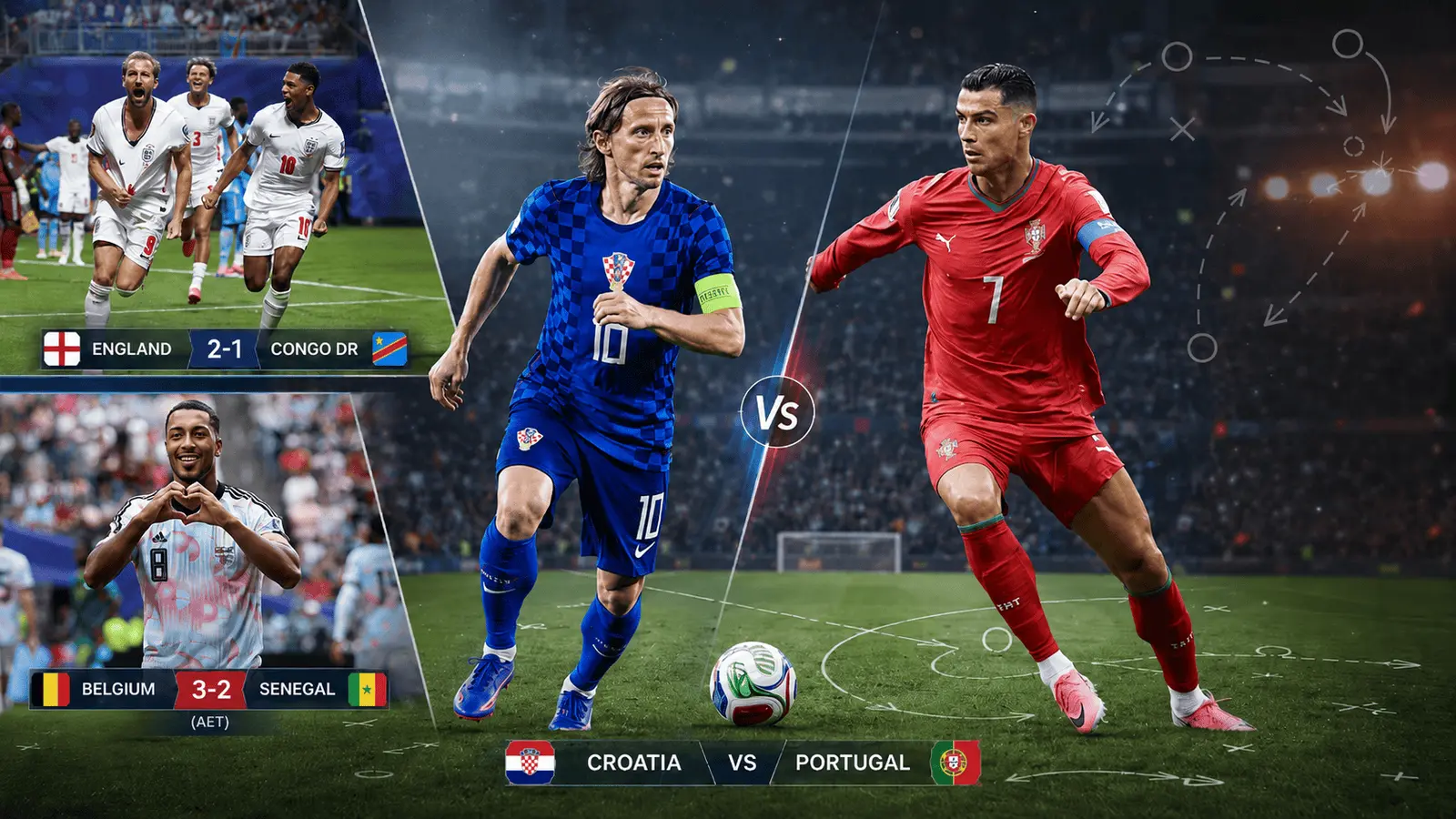
A World Cup knockout-stage analysis package focused on why elite teams are being dragged into uncomfortable matches: Portugal must turn possession into penalty-box threat against Croatia, Spain need their wingers to restore tempo against Austria, England survived a serious warning against DR Congo, and Belgium’s comeback over Senegal raised both tactical and refereeing questions.
Match Preview
World Cup Knockout Preview: Portugal, Spain and Switzerland Face Three Very Different Traps
Knockout football rarely punishes teams for being weak in a general sense. It punishes them for being weak in one specific area at the wrong time.
That is why Portugal against Croatia, Spain against Austria and Switzerland against Algeria are more than routine favourite-versus-underdog fixtures. Each favourite has a clear route through. Each also has a trap waiting for them.
Portugal vs Croatia: the problem is not possession, it is what comes after it
Portugal’s issue is not an inability to control matches. Their group-stage profile pointed toward a side comfortable with the ball, and their possession share has been strong. The concern is what happens when the ball reaches the final third.
Too often, Portugal can look fluent until the decisive action is required: the final run, the third-man movement, the disguised pass, the cutback, the penalty-box occupation. Against Croatia, that matters because Croatia are not built to panic. They are built to slow the match, survive long spells without the ball and make the opponent feel the clock.
That makes Roberto Martínez’s use of Cristiano Ronaldo one of the defining questions of the tie. The debate should not be reduced to whether Ronaldo starts or sits. The real issue is whether Portugal can create the right conditions around him. If Bruno Fernandes, Vitinha, João Félix, João Neves and Rafael Leão are connected in rhythm, Ronaldo can still be a penalty-box weapon. If Portugal become a team waiting for Ronaldo to solve the emotional burden of the match, Croatia will welcome the predictability.
There is also the generational theatre. Ronaldo and Luka Modrić represent an era of international football that is now much closer to its closing chapters than its beginning. But nostalgia will not win this match. Game management might.
Croatia’s ageing profile reduces their speed, but not their intelligence. Their best path is to drag Portugal into a slower contest, protect central zones, frustrate the first wave of attacks and make the match feel increasingly uncomfortable. If Portugal score early, the game can open. If they do not, this could become exactly the kind of emotional, attritional knockout tie Croatia know how to live in.
Spain vs Austria: Austria’s pressure could help Spain — or hurt them
Spain’s biggest strength is not possession for possession’s sake. Their most dangerous version is the one that uses possession to accelerate: wide isolation, quick switches, one-v-one pressure and sudden changes of rhythm.
That puts the fitness and sharpness of Lamine Yamal and Nico Williams near the centre of the preview. Both have been dealing with issues that could affect speed and involvement. If Spain have both wide threats operating near full sharpness, Austria’s high defensive line and pressing ambition can become an invitation. Space behind pressure is exactly what Spain’s wingers want.
Austria under Ralf Rangnick are not passive. They press, they run, they try to turn matches into intensity contests. The question is whether they can execute the first pass after the regain. Pressing Spain is one thing; turning that pressure into clean, fast attacks is another. If Austria win the ball and immediately give it back, they will have done the hard part only to expose the space behind them.
The more pragmatic upset route would be a lower block, selective pressing and rapid transitions into the channels. Whether Austria are willing to move away from their high-pressure instinct may decide how long the match stays uncomfortable for Spain.
Switzerland vs Algeria: stability meets a familiar opponent
Switzerland are built for knockout football in a different way. They are not necessarily the flashiest side, but their defensive organisation, low-error structure and dressing-room stability make them difficult to break in a one-off tie.
Algeria’s route into the match is complexity. Vladimir Petković’s connection with Swiss football adds a tactical familiarity layer, and Algeria have already shown they can survive wild match states. Their 3-3 draw with Austria became a major talking point and helped reshape the qualification picture, even if there is no public basis for treating the result as anything beyond a controversial football outcome.
For Switzerland, the priority is to keep the game clean: avoid cheap turnovers, deny transitions and make Algeria chase long possessions. For Algeria, the match changes if they can strike early or force Switzerland into a less controlled tempo.
The wider pattern: favourites are not equal
Portugal, Spain and Switzerland may all be favoured, but their risks are different.
Portugal’s danger is emotional and structural: possession without final-third clarity, plus the Ronaldo question. Spain’s danger is physical and rhythmic: if their wingers cannot accelerate, they risk becoming too slow. Switzerland’s danger is situational: they may be stable, but familiarity and a one-game format can narrow the gap.
That is the beauty and cruelty of knockout football. The best team on paper usually has the answers. The match only needs one question it cannot solve.
Post-Match Review
England and Belgium Survive, But Their Wins Felt More Like Warnings Than Statements
The knockout stage has a way of stripping away reputations. England and Belgium both advanced, but neither walked away with the kind of performance that allows a contender to relax.
England’s 2-1 win over DR Congo and Belgium’s 3-2 victory over Senegal were very different matches. One was a tactical recovery built around Harry Kane, Anthony Gordon and Thomas Tuchel’s adjustments. The other was a late Belgian escape act shaped by Romelu Lukaku, Youri Tielemans and a decisive penalty deep into extra time.
The common thread is uncomfortable: both teams needed their big players to rescue them from problems their structures had created.
England 2-1 DR Congo: a useful scare
England trailed early to Brian Cipenga’s seventh-minute goal, assisted by Chancel Mbemba. That alone changed the emotional temperature of the match. DR Congo were not simply sitting deep and hoping to survive; they attacked with conviction and forced England to defend live situations rather than just circulate against a low block.
England eventually recovered through Harry Kane, who scored in the 75th and 86th minutes. Anthony Gordon assisted both goals, giving England exactly the kind of direct, late-game wide threat they needed.
The numbers underline the tension. England finished with 60% possession, 16 shots, seven on target and 2.16 expected goals. DR Congo produced seven shots, two on target and 0.77 xG. England also created seven big chances, but missed six. That is both encouraging and alarming: the chances came, but the wastefulness kept the upset alive.
Tuchel deserves credit for correcting the match. His changes on the flanks, the decision to drop Declan Rice deeper and the move to add more numbers ahead of the ball helped England increase pressure. This was a manager leaning into the urgency of knockout football: first survive, then refine.
But the warning remains. England’s forward line can solve a lot. Kane remains the reference point, Jude Bellingham gives the midfield-to-attack link elite gravity, and Gordon’s impact was decisive. The defensive structure, however, is not beyond question. The right side, centre-back depth and Jordan Pickford’s volatility remain areas opponents will target.
A heavy win can create false comfort. This narrow win may be more valuable because it forced England to confront their weaknesses before a stronger opponent does.
DR Congo were not a footnote
Lionel Mpasi’s performance deserves its own recognition. The DR Congo goalkeeper, listed with Le Havre AC, conceded twice but made five saves from seven shots on target, with three big-chance saves and a goals-prevented figure of 0.44. He kept the match alive long enough for belief to become real.
DR Congo’s wider tournament story should not be reduced to “brave underdogs”. They had a route, a goalkeeper in form and enough attacking courage to make England uncomfortable. That matters because it explains why England’s win felt earned rather than routine.
Belgium 3-2 Senegal: comeback, chaos and controversy
Belgium’s match against Senegal was even more dramatic. Senegal led through Habib Diarra in the 24th minute and Ismaïla Sarr in the 51st. Belgium looked close to the end of an era before Lukaku pulled one back in the 86th minute with a sharp first-time finish after the move stayed alive on the right.
Three minutes later, Belgium were level. Leandro Trossard’s looping cross found Tielemans at the far post, and the midfielder headed in to make it 2-2.
Then came the defining moment: a late VAR-reviewed penalty after Camara’s challenge on Tielemans as the Belgian midfielder moved to meet a low cross. Referee Héctor Martínez was sent to the monitor and awarded the spot kick. Tielemans converted in the 120th minute plus five.
For Belgium, this was survival through experience. Lukaku’s body use and penalty-box instinct mattered. Tielemans showed leadership under extreme pressure. For Senegal, the ending will be brutal: a lead lost, momentum gone, and a late decision that effectively ended the contest.
Two contenders, two kinds of concern
England’s concern is tactical balance. They have match-winners, but the defensive platform still looks vulnerable.
Belgium’s concern is control. Their senior players can still bend a match, but the wider picture around leadership, dressing-room authority and the relationship between the squad’s experienced core and the coaching structure remains a significant storyline.
Both teams advanced. Both also handed future opponents a scouting report.
Team Analysis
Why the Favourites Are Struggling: Portugal, Spain, England and Belgium Have Four Different Problems
The lazy reading of a major tournament is that the strongest squads should simply overpower everyone else. The knockout stage is rarely that simple.
Portugal, Spain, England and Belgium all have elite players. They all have enough individual quality to beat almost anyone. Yet the pressure points around them are not the same, and that is what makes this phase of the tournament so compelling.
Portugal: control without enough cutting edge
Portugal can dominate the ball and still leave the match feeling unresolved. Their key issue is the connection between possession and genuine penalty-box threat.
When Portugal reach the final third, the tempo can flatten. The ball arrives, the defence is set, and the next action is not always sharp enough to break the line. That problem becomes more delicate with Cristiano Ronaldo involved because the team must balance two truths: he remains a historic penalty-box finisher, but at 41 he cannot be treated as the same all-action physical force he once was.
The solution is not to erase Ronaldo. It is to make the structure around him more dynamic. João Félix’s movement, Bruno Fernandes’ timing, Vitinha’s rhythm and the vertical threat of Rafael Leão all matter because Ronaldo needs service created by collective movement, not just hopeful delivery.
Against Croatia, slow possession can become a trap. Croatia are comfortable when the match becomes old, narrow and emotional.
Spain: the wingers are the accelerator
Spain’s best version is not slow circulation. It is circulation with sudden violence.
That is why Lamine Yamal and Nico Williams are so important. Their ability to beat a man, stretch the pitch and alter the speed of attack is what stops Spain from becoming sterile. If either is limited physically, Spain can drift back toward a familiar problem: long possession, little penetration and too many attacks in front of the block.
Austria’s high press gives Spain a tactical opportunity, but only if Spain can access the spaces behind it. Without wide acceleration, Austria’s pressure becomes a genuine weapon. With it, the same pressure can become a liability.
England: the stars can rescue the structure
England’s 2-1 win over DR Congo showed both their ceiling and their warning signs.
Harry Kane remains the stabiliser. Jude Bellingham gives England presence between midfield and attack. Anthony Gordon’s two assists demonstrated the value of having a direct wide threat who can change the rhythm of a match.
But England also conceded early, allowed the tie to become emotionally unstable and relied on late attacking execution to turn the match. Tuchel’s adjustments were important — especially dropping Declan Rice deeper and increasing the attacking presence — but the defensive concerns did not disappear.
The right side, centre-back depth and Pickford’s range of outcomes are still questions. England can beat strong teams if their front line keeps delivering. Whether they can control strong teams is a different question.
Belgium: experience is saving them, but control is fragile
Belgium’s comeback against Senegal was a reminder that veteran teams can find solutions late. Lukaku’s finish, Tielemans’ header and penalty, and the emotional resilience of the group all mattered.
But Belgium’s deeper issue is not whether their best players still have quality. They do. The issue is whether the team has a stable authority structure and a repeatable way of controlling difficult matches.
Reports around senior-player influence and dressing-room leadership make Belgium one of the tournament’s most interesting psychological case studies. A strong senior core can be a blessing in knockout football. It can also become a problem if it leaves the coach without clear authority or the system without consistency.
The lesson: paper strength is only the beginning
These teams are not struggling because they lack talent. They are struggling because knockout football targets specific weaknesses.
Croatia can make Portugal slow. Austria can test Spain’s ability to accelerate. DR Congo forced England to defend transition and emotion. Senegal exposed how close Belgium can come to losing control.
The best team is not always the one with the most famous players. It is the one that solves the exact problem placed in front of it.
Player Performance
Kane, Lukaku, Ronaldo, Modrić and the Weight of Knockout Football
Knockout football has a habit of reducing complex tactical debates to individual moments. A run. A finish. A save. A decision under pressure.
That does not mean tactics disappear. It means the best players have to execute inside the smallest margins.
Harry Kane: England’s pressure valve
Harry Kane’s two goals against DR Congo were not just statistical contributions. They were pressure releases.
England had trailed early, created chances and missed several big ones. The longer the game stayed alive, the heavier it became. Kane’s 75th- and 86th-minute goals restored order in the most Kane-like way: through timing, presence and ruthless finishing.
Anthony Gordon’s role should not be underplayed. Two assists in a knockout match is a decisive impact, and his directness changed England’s rhythm. If Marcus Rashford can stretch and wear down defenders before Gordon arrives as a sharper late threat, England may have found a useful left-side sequencing option.
Romelu Lukaku: still built for the decisive touch
Belgium’s comeback against Senegal needed belief, but it also needed a striker who understood the moment.
Lukaku’s 86th-minute goal was not a spectacular solo act. It was striker craft: stay alive, use the body, read the loose ball, finish first time. That kind of action is why veteran forwards retain value even when a team around them looks unstable.
Youri Tielemans then became the emotional centre of the match. His far-post header in the 89th minute made it 2-2, and his penalty deep into extra time completed the comeback. Whatever questions remain around Belgium’s hierarchy, Tielemans took responsibility when the match demanded it.
Lionel Mpasi: the goalkeeper who made England earn it
DR Congo goalkeeper Lionel Mpasi gave his side a real chance. Against England, he faced seven shots on target, made five saves and produced three big-chance saves.
Goalkeepers in these matches do more than stop shots. They change belief. Mpasi’s saves gave DR Congo time to imagine the upset and forced England to keep solving the game rather than waiting for it to fall their way.
Cristiano Ronaldo: not the whole problem, not the whole solution
The Ronaldo debate around Portugal is too often framed in absolutes. He is either the reason everything works or the reason everything fails. The truth is more tactical.
Ronaldo can still be dangerous if Portugal create the right service patterns around him. He needs runners, rotations and players willing to attack the spaces that pull defenders away. João Félix’s movement, Bruno Fernandes’ delivery and Vitinha’s control all become more important when Ronaldo is the reference point.
But Portugal also have to be honest about the cost of overloading the match emotionally around him. If the team becomes static while waiting for the iconic finish, opponents such as Croatia will happily slow the game and squeeze the spaces.
Luka Modrić: control as resistance
Croatia’s danger is not based on overwhelming speed. It is based on game intelligence.
Modrić remains the symbol of that. He can slow a match, speed it up, draw pressure and make younger teams feel impatient. In a knockout tie against Portugal, that matters as much psychologically as technically.
Ronaldo versus Modrić is a nostalgia-rich storyline, but the football question is sharper: which ageing superstar can bend the rhythm of the match toward his team’s needs?
Lamine Yamal and Nico Williams: Spain’s tempo test
For Spain, the most important individual question may be physical sharpness. Lamine Yamal and Nico Williams give Spain width, acceleration and one-v-one threat. If they are not fully explosive, Spain risk becoming easier to contain.
Yamal can create from the weak side and attack inside lanes. Nico offers more direct strong-side penetration. Together, they make Spain unpredictable. Limited, they leave Spain more dependent on slower circulation.
In this tournament, the biggest names are not just carrying narratives. They are carrying tactical functions.