
World Cup Knockout Preview and Review: Argentina, Egypt, Spain, Portugal and the Tactical Foresee
Introduction
World Cup knockout-stage coverage built around tactical contrasts: defensive underdogs trying to compress games, elite sides looking to impose structure, and superstar narratives involving Lionel Messi, Cristiano Ronaldo, Mohamed Salah and James Rodríguez. The strongest editorial angle is that knockout football is not simply about superior talent; it is about which teams can control rhythm, territory and risk when the margin for error disappears.
Match Preview
World Cup Knockout Preview: Defensive Underdogs, Superstar Pressure and the Games That Could Turn Ugly
Knockout football is where style becomes survival
The 2026 World Cup has reached the stage where the group table no longer matters and every tactical weakness becomes louder. Australia vs Egypt, Argentina vs Cape Verde and Colombia vs Ghana are very different match-ups, but they share a theme: the favourite must solve a defensive problem before the game becomes emotionally dangerous.
That is what makes this round compelling. The gap in individual quality may be obvious in some ties, yet knockout football rewards teams that can reduce the number of clean chances, slow the rhythm and drag superior opponents into uncomfortable decisions.
Australia vs Egypt: can stability break stubbornness?
Australia arrive as one of the awkward opponents nobody should want in a knockout tie. Their route through the group included a 0-2 defeat to the United States, a 0-0 draw with Paraguay and a 2-0 win over Turkey, enough for four points and second place. Just as importantly, they rotated six starters against Paraguay, giving Tony Popovic a squad that should be physically prepared for a long, attritional match.
Their identity is clear: defensive height, penalty-area protection, compact layers and enough speed through Nestory Irankunda and Tete Yengi to threaten space when the opponent overcommits. This is not a side built to dominate possession for long spells. It is a side built to make the match narrow, physical and low-scoring.
Egypt, by contrast, have been stable without being spectacular. They drew 1-1 with Belgium, beat New Zealand 3-1 and drew 1-1 with Iran to finish second in their group on five points. Their problem is not competence; it is whether they have enough incision against a defence that will not offer easy central access.
Mohamed Salah remains the obvious swing factor. His recovery and training involvement have been moving in a positive direction, and he has a chance to start against Australia. If he is sharp, Egypt have a different level of threat in transition, around the box and in finishing moments. If he is limited, the burden increases on Omar Marmoush and the collective attacking structure.
The tactical question is simple: Egypt may need to play as the proactive side, while Australia would be comfortable if the match becomes a test of patience. If Australia score first through a set piece or transition, Egypt could be forced into exactly the kind of open game Popovic’s team would welcome.
Argentina vs Cape Verde: Messi’s system against the smallest knockout nation
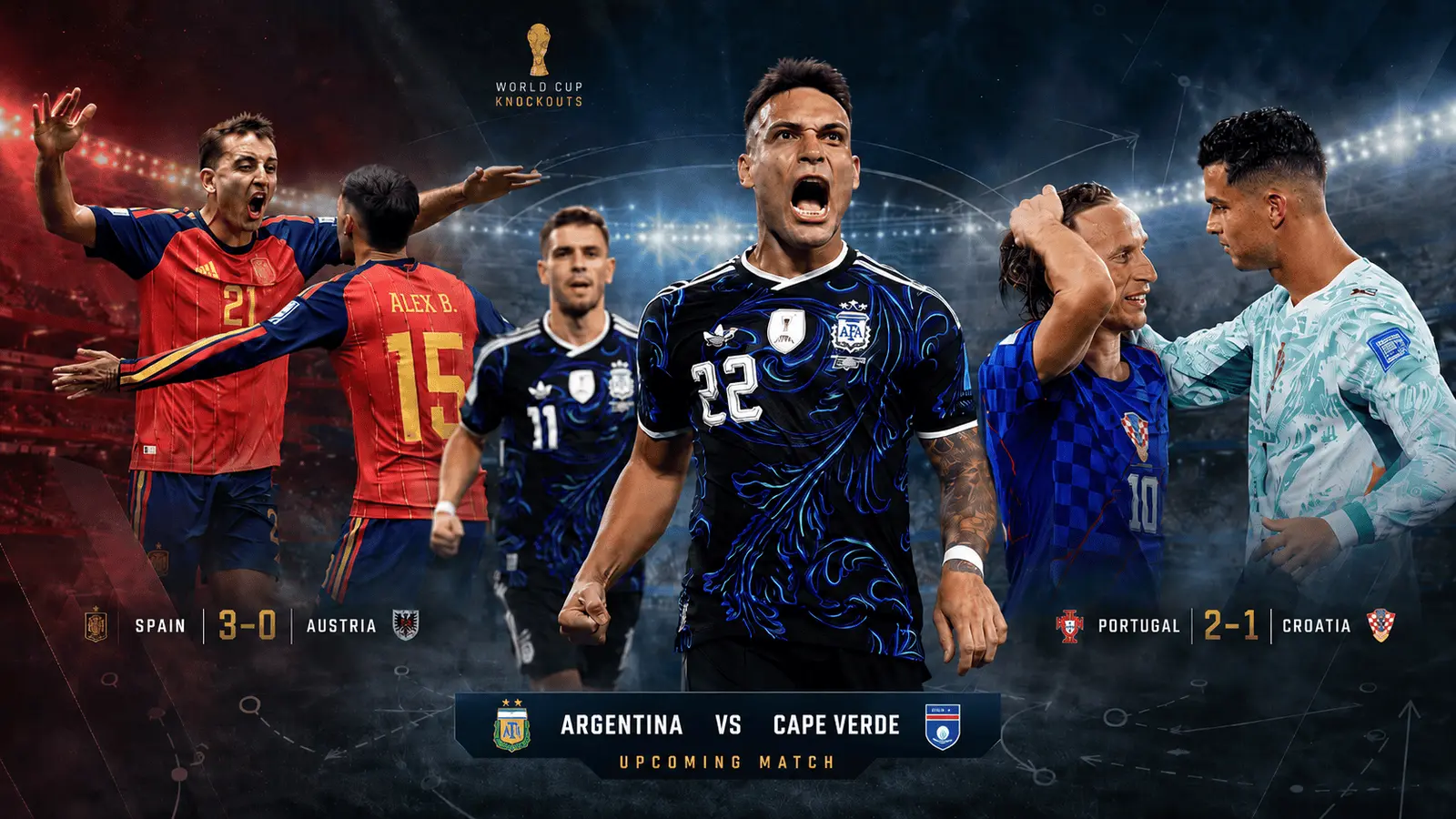
Argentina’s meeting with Cape Verde in Miami is the tie with the biggest narrative contrast. Argentina rotated nine starters in their previous match and still carry the aura of a side with enough experience, control and attacking variety to handle deep defensive blocks. Cape Verde, meanwhile, have become one of the tournament’s emotional stories: a nation of roughly 530,000 people, the smallest population represented in the knockout stage, reaching this point after draws with Spain, Saudi Arabia and Uruguay.
The romance is real. But the football reality is harsher.
Cape Verde’s best route is not to trade attacks with Argentina. It is to defend low, compress the central spaces, reduce the number of dangerous possessions and extend the game as long as possible. If goalkeeper Vozinha can turn the opening period into a story of saves and frustration, Cape Verde can make the tie feel less like a mismatch and more like a psychological test.
Argentina, though, are unusually well equipped to break this type of resistance. Lionel Messi changes the geometry of low-block matches: free-kicks, shots from the edge of the area, disguised final passes and the ability to draw defenders out of their line. Around him, Argentina have runners who attack second balls and broken moments inside the box.
The key is the first goal. If Argentina score early, Cape Verde may have to abandon the one script that gives them a realistic chance. If they reach half-time level, the emotional pressure shifts. That is when an underdog stops being only an underdog and starts becoming a problem.
Colombia vs Ghana: creativity against midfield density
Colombia’s group-stage campaign, including a 0-0 draw with Portugal and seven points to top the group, has put them in a strong position entering the knockout rounds. They have balance, defensive confidence and multiple creative outlets. James Rodríguez remains central to that: not because of nostalgia, but because his passing range and ability to identify the next dangerous zone still give Colombia a clear attacking reference.
Ghana are a different kind of obstacle. Their group-stage path — a 1-0 win over Panama, a 0-0 draw with England and a 1-2 defeat to Croatia — reflects a low-margin team comfortable defending with midfield density. Under Carlos Queiroz, Ghana can use three defensive-minded midfielders to deny central access and force opponents into slower, wider attacks.
That makes James the tactical target. If Ghana can prevent him from receiving cleanly between the lines, Colombia may have to rely more heavily on wide acceleration, rotations and substitute impact. If Colombia score early, Ghana’s limited attacking volume becomes a major concern. If they do not, the match can become exactly what Ghana want: narrow, tense and decided by one mistake.
The bigger trend: outsiders do not need to be better — they need to change the game
Australia, Cape Verde and Ghana are not identical teams. Australia lean on height and defensive organization. Cape Verde lean on emotional freedom and extreme low-block survival. Ghana lean on midfield density and counter-attacking restraint.
But their shared knockout logic is powerful: reduce the match, delay the favorite's breakthrough and force a technically superior team to play with doubt. That does not make an upset likely in every case. It does make the round more dangerous than the fixture list first suggests.
Team Analysis
Spain vs Portugal Preview: One Team Has a Holding Midfield Test, the Other Has a Ball Ownership Problem
The best tie is not always the simplest story
Spain vs Portugal offers the obvious star appeal, but the most important questions are structural. Spain arrive with attacking confidence and a convincing win behind them. Portugal arrive with momentum, controversy and a midfield puzzle that still feels unresolved.
The winner may be the side that makes its midfield look less complicated.
Spain: brilliant numbers, one lingering doubt
Spain’s 3-0 win over Austria gave them a powerful statistical platform: 64% possession, 23 shots, 10 on target and another clean sheet. Unai Simón’s shutout run has reached 519 minutes. On paper, that looks like control.
But knockout football punishes false certainty. Austria’s high press left Spain space to attack. Portugal may not offer the same kind of repeated invitation. If Spain face more selective pressure and sharper counter-attacks, the defensive questions become more relevant.
Rodri’s return from injury has been encouraging, but Spain’s balance still depends on how well the spaces around him are protected. If he is forced to cover too much ground, Spain’s strongest zone can become a stress point. The centre-backs and goalkeeper will also face a different test if Portugal press with more coordination or use runners to attack the channels.
Spain’s attack is not the concern. Their risk management is.
Portugal: the issue is not just Cristiano Ronaldo
Portugal’s public debate often collapses into one name: Cristiano Ronaldo. That is understandable, especially after his first World Cup knockout-stage goal and his substitution against Croatia. But Portugal’s biggest tactical issue is broader than one forward.
Vitinha and Bruno Fernandes both operate like tempo-setters. Both want touches. Both look to define rhythm. Both can be decisive when the game is built around their strengths. The problem comes when they share the same spaces without a clear hierarchy.
If Vitinha drops to dictate and Bruno also comes toward the ball, Portugal can become crowded in the middle but disconnected from the front line. If neither player fully owns the rhythm, the team’s progression becomes stop-start. The forwards then receive the ball late, under pressure or in areas where they have to create from nothing.
That affects every attacking option: Ronaldo, Gonçalo Ramos, Rafael Leão and João Félix. The debate should not be who is famous enough to start. It should be which combination gives Portugal pressing, movement, penalty-area presence and clean service.
The decisive zone
Spain will want long control, territorial pressure and repeated attacks. Portugal will want enough midfield clarity to play through pressure and enough forward energy to trouble Spain’s build-up.
If Spain pin Portugal back and Rodri plays facing forward, Portugal may spend the game reacting. If Portugal disrupt Spain’s first phase and force Unai Simón and the centre-backs into hurried decisions, Spain’s clean-sheet numbers will face their first real stress test.
This is not just a derby of Iberian talent. It is a tactical exam: Spain’s defensive base against Portugal’s midfield identity.
Player Performance
Messi, Salah, Ronaldo and James Rodríguez: Four Stars, Four Very Different Knockout Roles
Star power is not one thing
The knockout stage naturally becomes a stage for names. Lionel Messi, Mohamed Salah, Cristiano Ronaldo and James Rodríguez all carry enormous narrative weight. But treating them simply as icons misses the tactical reality.
Each one changes his team in a different way.
Messi: the system’s freedom point
Argentina’s relationship with Messi is often described as dependence, but that can be misleading. The more accurate reading is optimisation. Argentina are built to let Messi’s strengths increase the value of everyone around him.
Against Cape Verde, that matters because Argentina may face long periods of low-block defending. Messi gives them solutions that do not rely on one route: free-kicks, shots from the edge of the area, disguised passes, tempo changes and the gravity that opens lanes for runners.
This is not individualism replacing team structure. It is individual freedom inside a team structure that understands why the freedom exists.
Salah: Egypt’s ceiling raiser
Egypt’s base is stable. Their group-stage results showed control and resilience: draws with Belgium and Iran, plus a win over New Zealand. But against Australia’s defensive height and compactness, stability may not be enough.
That is why Salah’s condition is so important. His recovery has progressed well enough for him to have a chance to start, and if he is close to his best, Egypt become far more dangerous in transition and around the penalty area. If he is limited, Egypt’s attacking ceiling drops and more responsibility shifts to Marmoush and the collective movement around him.
For Egypt, Salah is not just a star name. He is the difference between possession that circulates and possession that threatens.
Ronaldo: the debate should be functional, not emotional
Ronaldo’s penalty against Croatia carried major personal significance: his first goal in a World Cup knockout match. Yet Portugal’s tactical discussion should not be trapped in hero worship or blame.
He still offers penalty-area instinct, experience and emotional authority. But Portugal also need pressing, running depth and clean connections from midfield. That is where Gonçalo Ramos can offer a different profile, and why Roberto Martínez’s decision to replace Ronaldo in the 81st minute should be viewed as a functional adjustment rather than a symbolic rejection.
Portugal’s problem is not simply Ronaldo’s age. It is whether the team around him has a clear attacking structure.
James Rodríguez: Colombia’s old reference still matters
James Rodríguez is no longer a surprise package, but he remains Colombia’s most important creative reference. Against Ghana, his task is to receive, turn and find the pass before the defensive block fully resets.
Ghana can make that difficult with midfield density and defensive discipline. If James is denied central access, Colombia may have to lean on wide players and substitutions. If he finds rhythm early, Ghana will be forced to defend multiple threats at once.
That is the difference between a tight knockout match and a controlled Colombian performance.
Reputation starts the conversation; role decides the match
Messi, Salah, Ronaldo and James all bring history into the knockout stage. But history does not win the next duel by itself. Their value will be measured by how specifically they solve the problems in front of them: a low block, a physical defense, a pressing structure or a crowded midfield.
Controversy and Talking Points
Are World Cup Rule Changes Helping the Stronger Teams? Why Water Breaks and Added Time Matter
The best rule changes still change competitive incentives
Football’s law and competition-management changes are usually framed around fairness: more effective playing time, less time-wasting, smoother restarts and clearer enforcement. In principle, that is good for the game.
But every rule change also changes the type of football that is rewarded.
More effective time helps quality rise to the surface
When delays are reduced and matches contain more actual football, the stronger technical team usually benefits. More possessions mean more chances for structure, passing quality and superior decision-making to show. For neutral viewers, that can make the product better. For underdogs, it can make survival harder.
A team trying to defend deep, slow the rhythm and compress the match wants fewer dangerous sequences. The longer the ball is in play, the more often that team has to survive defensive rotations, second balls and fatigue.
That does not make the rules unfair. It does mean they may reduce one of the classic underdog tools: turning a football match into a fragmented contest of moments.
Water breaks can become tactical timeouts
Water breaks are necessary in demanding conditions, but they also function like brief tactical timeouts. Coaches can correct pressing distances, adjust marking responsibilities, slow emotional momentum and re-centre players who are beginning to lose shape.
That can be especially useful for stronger teams. If a favorite is becoming frustrated by a low block, the pause allows a reset. If an underdog has created a chaotic spell, the pause can cool the match down.
In knockout football, rhythm is everything. A scheduled interruption can protect the side with more rehearsed patterns and a deeper bench.
This is analysis, not conspiracy
There is a difference between saying rule changes influence match dynamics and claiming results are engineered. The first is a football discussion. The second requires evidence and should not be treated as fact.
The more responsible question is this: as the World Cup evolves, are we creating matches with more football and fewer loopholes, while also making it harder for weaker teams to win through disruption?
That tension is worth discussing because it affects how teams prepare. Defensive outsiders such as Australia, Ghana or Cape Verde do not just need to defend well. They need to manage the match’s rhythm — and modern tournament football may be giving them fewer places to hide.