
World Cup Round of 16 Preview: Portugal vs Spain, Mexico vs England and the Tactical Foresee
Introduction
A tactical and narrative guide to the World Cup Round of 16, focused on why reputation alone is no longer enough: traditional powers face structural problems, while Morocco, Mexico, the United States, Paraguay and other non-traditional contenders bring specific tactical, environmental or organizational weapons into the knockout phase.
Match Preview
World Cup Round of 16 Preview: Reputation Is No Longer Enough
The Round of 16 is a test of structure, not reputation
The most interesting thing about this World Cup knockout phase is that the old vocabulary feels too small. Calling Morocco a “dark horse” no longer explains the level of their organisation. Calling Mexico an underdog against England ignores the power of venue, altitude and rhythm. Calling the United States inexperienced misses the possibility that a coherent positional structure can trouble a Belgium side leaning heavily on individual solutions.
This is the real theme of the Round of 16: the famous teams still have the bigger names, but the gap between name value and match control is narrowing.
Portugal vs Spain: the headline tie
Portugal vs Spain is the obvious glamour fixture. It has the weight of a match that feels bigger than its place in the bracket, and it also carries one of the tournament’s most delicate selection questions: how Portugal use Cristiano Ronaldo.
The issue is not whether Ronaldo remains a major figure. He does. The question is functional. In a knockout match against Spain, Portugal cannot afford long spells where their press, defensive distances and counter-pressing shape are compromised. A high-intensity, clearly defined role may offer more value than simply stretching his minutes for symbolic reasons.
Roberto Martínez also adds another layer to the occasion: a Spanish coach leading Portugal against Spain. But the tactical question is more important than the narrative. Portugal must decide whether they want emotional gravity or collective rhythm to guide the game.
Mexico vs England: the most complicated tie
On paper, England may look like the cleaner favourite. On the pitch, this could be far less simple.
Mexico’s advantage is not only emotional. The match environment in Mexico City matters: altitude, home noise, travel adaptation, disrupted routines and the possibility of weather complications all turn this into a test of control. England’s task is to prevent the match becoming a high-tempo, stop-start, physically draining contest that favours Mexico’s bursts.
For England, the key may be patience. They may need to slow the game, manage possession carefully and avoid wasting energy in emotional phases. The 60-to-70-minute window could become decisive if altitude and tempo begin to bite. Substitutions, Harry Kane’s workload and the stability of England’s wide defensive zones are all major variables.
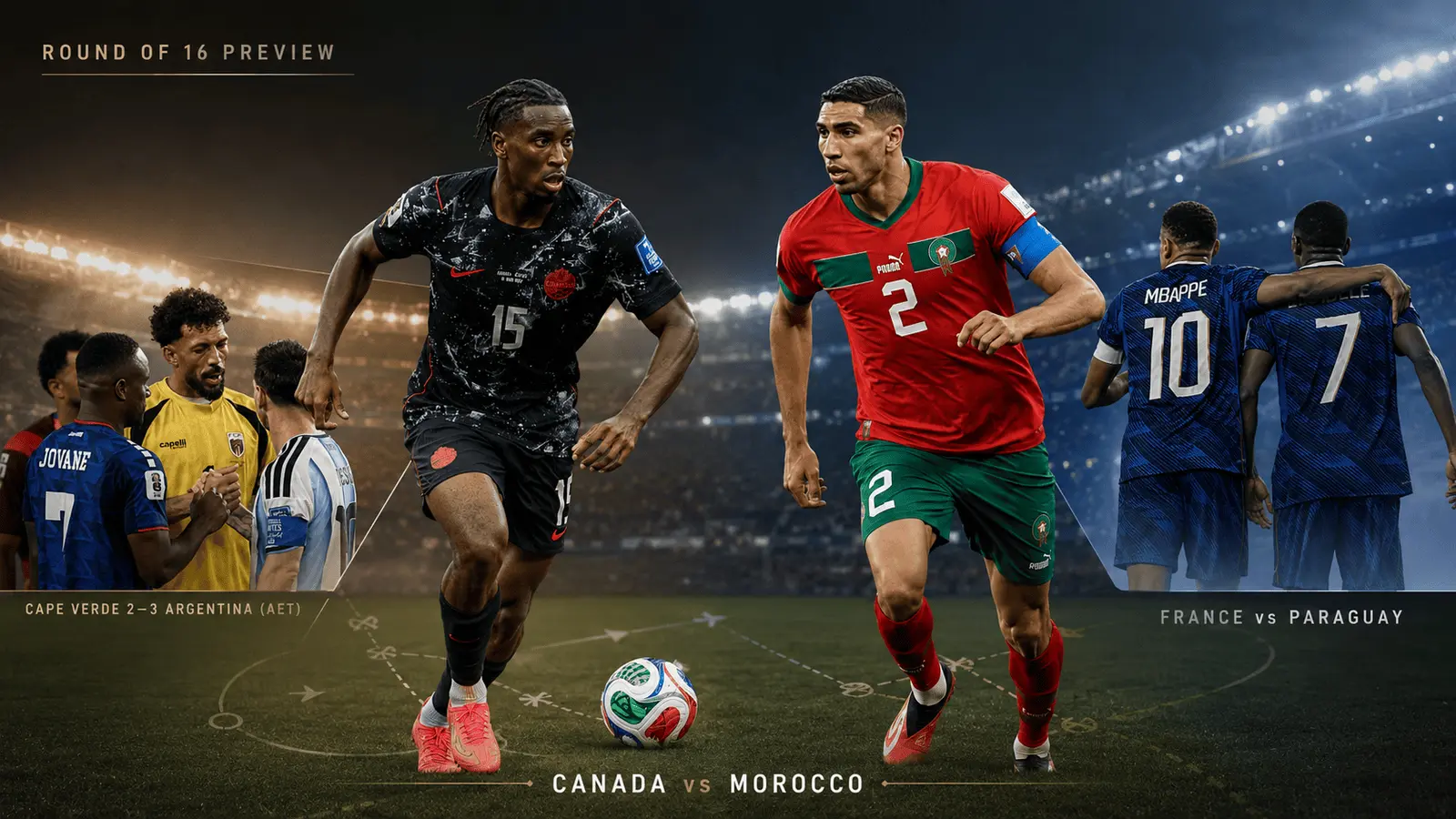
Canada vs Morocco: Davies changes the equation
Canada’s match against Morocco is shaped by one player more than any other: Alphonso Davies.
Davies has returned from a hamstring injury and made a substitute appearance in Canada’s Round of 32 win over South Africa. If he starts and is physically ready for repeated high-intensity actions, Canada become a very different team. Their first pass out of pressure, left-sided carrying, transition speed and final-third delivery all improve.
If Davies is limited, Canada may have to live in a lower block, slow the match and look toward extra time or penalties. That is a narrow route against Morocco, because Morocco are no longer a surprise package. They have the defensive structure, midfield balance and transition quality of a serious tournament side.
France vs Paraguay: the danger of one-goal control
France enter their tie with Paraguay as the stronger side, but knockout football punishes comfort. The important question is not whether France can dominate territory. It is whether they can turn dominance into a second goal.
Kylian Mbappé, Ousmane Dembélé and Michael Olise give France several routes through a compact defence. Paraguay, however, have counter-attacking players capable of turning one loose pass or one delayed recovery into a genuine threat. Miguel Almirón and Julio Enciso give them enough transition quality to make France uncomfortable if the match stays close.
France’s real opponent may be the illusion of control. A 1-0 lead in the final 20 minutes is not control; it is an invitation for chaos.
USA vs Belgium: system against rescue mode
The United States may be underestimated because their tournament profile is harder to measure without a qualifying campaign. But on home soil, with a squad containing players used to high-level European football and a clearer positional-play identity, they have the tools to stretch Belgium.
Belgium’s concern is different. Romelu Lukaku remains a decisive reference point, but dependence on him can become a warning sign as much as a strength. If Belgium need individual rescue moments again, the United States will believe their collective movement can expose the older side’s structural gaps.
Argentina vs Egypt: the Messi question never goes away
Argentina’s win over Cape Verde kept them alive, but it also sharpened a familiar concern: the attack is still heavily concentrated around Lionel Messi. That remains a luxury and a risk at the same time.
At 39, Messi can still decide matches, but every opponent now knows where Argentina want the ball to go. Egypt’s defensive task is obvious: reduce Messi’s receiving zones, force Argentina away from their preferred rhythm and ask whether anyone else can become a consistent second creator.
In knockout football, the best teams are not always the ones with the biggest star. They are the ones with a second solution when the first one is blocked.
Post-Match Review
Argentina Survive Cape Verde, But the Warning Signs Are Real
Argentina advanced, but Cape Verde changed the tone
Argentina’s 3-2 extra-time win over Cape Verde should not be read as a routine survival story. It was a match that reinforced Argentina’s resilience, but it also forced a more uncomfortable discussion about how much of their attacking life still runs through Lionel Messi.
Cape Verde’s tournament was already more than a novelty before this match. They had held Spain and Uruguay to goalless draws and then pushed Argentina into extra time. That sequence matters. It shows a side capable of defending with commitment, staying emotionally present against elite opponents and turning limited moments into real danger.
The result sent Argentina through. The performance made Cape Verde one of the tournament’s most compelling stories.
Messi remains the solution — and the risk
Messi was directly or indirectly involved in Argentina’s three goals, and that tells the story of both their strength and their vulnerability. When the match becomes tight, Argentina still look instinctively for him: to receive between lines, to slow the game, to accelerate it, to deliver from set pieces and to shape the final action.
That is understandable. Messi remains their most reliable decision-maker. But the deeper Argentina go, the more opponents will treat the match as a problem of containment: reduce Messi’s touches, surround his receiving zones and ask Argentina’s other attackers to win the game without him as the central reference.
The absence of Ángel Di María as the old second attacking route remains significant. Rodrigo De Paul offers protection, energy and connection, but he is not the same kind of creative counterweight. Argentina need more than loyalty around Messi; they need another repeatable source of danger.
Cape Verde were not an inspirational sideshow
The lazy version of this story would call Cape Verde a romantic underdog and move on. That misses the point.
Their competitiveness reflects a broader trend in international football. Smaller nations can now build serious squads through diaspora pathways, European club development, disciplined tactical work and unusually high emotional commitment to national-team football. Cape Verde did not simply “try hard.” They made elite teams uncomfortable.
Against Argentina, they forced the favourite into a match of stress, time, fatigue and problem-solving. That is exactly what knockout football is designed to reveal.
Argentina’s next question is not talent — it is distribution
Argentina still have enough quality to beat anyone. But the way their attacking responsibility is distributed remains a concern. If every decisive move must pass through Messi, the team becomes easier to scout and harder to sustain physically.
The warning is not that Messi is declining beyond use. The warning is that Argentina may be asking too much of him, too often, in too many phases of the game.
Winning the match was essential. Solving the dependency may be what decides how long the title defence lasts.
Don't forget that Messi is 39+ and played 4 matches in recent 18 days. Yes his form is good and scored 7. Could he continues in upcoming 4 matches ?
Team Analysis
Why the World Cup Knockouts Are Exposing Football’s New Power Map
The old labels are failing
The knockout stage is making one thing clear: “favourite” and “underdog” are no longer enough as analytical categories.
Morocco are not a cute surprise. They are a mature collective with defensive organization, transition quality and players comfortable at elite speed. Mexico are not simply a passionate host nation; they have an environmental and rhythmic advantage in Mexico City. The United States are not just a developing football country; they have a clearer positional-play base than many casual observers assume. Cape Verde were not a feel-good sideshow; their results against major opponents showed genuine tournament competitiveness.
The modern international game is increasingly about whether a team’s structure is believable. Reputation still matters, but it no longer wins the tactical argument by itself.
Morocco are beyond the black-horse stage
Morocco’s recent body of work supports a stronger description than “dark horse.” They have shown over multiple major-tournament cycles that they can defend with compactness, attack with purpose and keep matches within their preferred emotional range.
Against Canada, the question is not whether Morocco can compete. It is whether Canada can create enough transition danger to disrupt Morocco’s balance. Achraf Hakimi, Sofyan Amrabat, Azzedine Ounahi, Brahim Díaz and Youssef En-Nesyri give Morocco a spine that combines athleticism, experience and technical security.
That is not a miracle formula. It is a serious football team.
Mexico’s advantage is not just passion
Mexico’s meeting with England is the best example of football’s non-tactical variables becoming tactical variables.
Altitude affects tempo. Weather uncertainty affects preparation. Home noise affects communication. Travel affects routine. None of those things guarantees a result, but they all change the match conditions. Mexico’s task is to make England play at uncomfortable speeds and in uncomfortable emotional states.
England’s task is to make the game ordinary.
If England control possession calmly, avoid transitional chaos and manage substitutions well, their quality can still tell. If the match becomes stretched, emotional and physically expensive, Mexico will believe the environment has become part of their game plan.
The United States may be more complete than their reputation
The United States enter the Belgium tie with an interesting profile: a host nation with enough European-level experience and enough tactical clarity to create a real test. Their movement, positional spacing and wide progression give them a framework that can stress Belgium’s defensive distances.
Belgium remain dangerous because Lukaku can still change a match. But relying on rescue moments is not the same as controlling a knockout tie. If the U.S. can keep Belgium moving laterally and deny easy service into Lukaku, the match could become a referendum on system versus individual solution.
Traditional powers have different problems
The biggest teams are not all vulnerable in the same way.
Argentina’s issue is creative concentration around Messi. Portugal’s is the balance between Cristiano Ronaldo’s finishing value and the pressing demands of elite knockout football. England’s is environmental adaptation and game-state management. Belgium’s is structural ageing and dependency. France’s risk is different: they may be so dominant that they underestimate the danger of leading by only one goal.
That distinction matters. “Big team under pressure” is not an analysis. The real question is what kind of pressure each team is facing.
The new tournament lesson
The tournament is not saying that the favourites are finished. It is saying that the favourites need more than famous shirts.
They need mechanisms. They need second plans. They need control when the stadium, weather, altitude, referee, fatigue and opponent all pull the match away from the expected script.
That is why this knockout stage feels so alive.
Controversy and Talking Points
VAR, Altitude and the Expanded Format: Why This World Cup Feels So Hard to Control
Football has more technology, but not fewer arguments
One of the great misunderstandings about VAR and tracking technology is the belief that more precision automatically means less controversy. This World Cup is proving the opposite.
Technology can identify a touch, draw a line, slow down contact or locate a ball with extraordinary accuracy. But it cannot remove interpretation. Handball still depends on context. Offside still feels different when a decision is microscopic. A technically correct call can still collide with a fan’s sense of sporting justice.
The authority may now be more informed, but the final explanation still belongs to people.
The problem is not only whether a decision is right
The real tension is between three different ideas of fairness.
There is technical fairness: what the system can measure. There is legal fairness: how the laws are written and interpreted. And there is emotional fairness: what viewers feel the game should reward or punish.
When those three do not align, controversy survives. That is why VAR can make football more accurate while still making fans angrier.
Match conditions are becoming tactical arguments
The Mexico vs England tie shows another type of controversy: the conditions around the match.
Altitude, travel, hotel preparation, crowd noise, road access and thunderstorm warnings are not traditional tactical categories, but they influence the tactical reality. FIFA’s confirmation that the scheduled kickoff would not be changed despite weather concerns puts the focus back on preparation and adaptability.
That does not mean Mexico are guaranteed an advantage or England have an excuse. It means the match is not being played in a neutral laboratory. Knockout football never is.
Expanded formats create emotional contradictions
The expanded tournament structure also creates talking points. A format that allows the best third-placed teams to advance can produce situations that feel counterintuitive: one team can go unbeaten and still exit, while another can survive despite multiple defeats if the results and goal difference work in their favour.
That may be legal within the competition rules, but legality does not always equal public acceptance. Tournament formats are judged not only by mathematical consistency, but by whether fans feel they reward performance fairly.
The modern game is controlled — until it is not
This is the paradox of the current World Cup. Football has more data, more cameras, more medical monitoring, more logistical planning and more refereeing technology than ever. Yet the game still turns on interpretation, weather, pressure, fatigue, crowd emotion and the human response to chaos.
That is not a flaw in football. It is part of why the knockout stage remains compelling.