
World Cup Round of 32 Preview: Japan Challenge Brazil as USA, Netherlands and Germany are Facing Formidable Opponents
Introduction
A World Cup knockout-stage content package built around the tactical meaning of the final group matches: why third-round games change team behaviour, which sides look structurally ready for the Round of 32, and why Japan vs Brazil, Netherlands vs Morocco and USA vs Bosnia are more than simple name-value matchups.
Match Preview
World Cup Round of 32 Preview: Japan No Longer Look Like a Team Hoping to Avoid Brazil
The final round of World Cup group matches has done more than complete the knockout bracket. It has revealed which teams are managing risk, which are still searching for structure, and which have built habits that can survive the pressure of elimination football.
The confirmed Round of 32 ties include USA vs Bosnia, Brazil vs Japan, Netherlands vs Morocco and Canada vs South Africa. Among them, Brazil vs Japan carries the strongest tactical and narrative weight.
Japan vs Brazil: a different kind of underdog story
Japan are no longer best described as a dangerous Asian outsider. Their recent tournament profile points to something more mature: a team comfortable playing with ambition, capable of pressing, running, rotating and competing physically against stronger opponents.
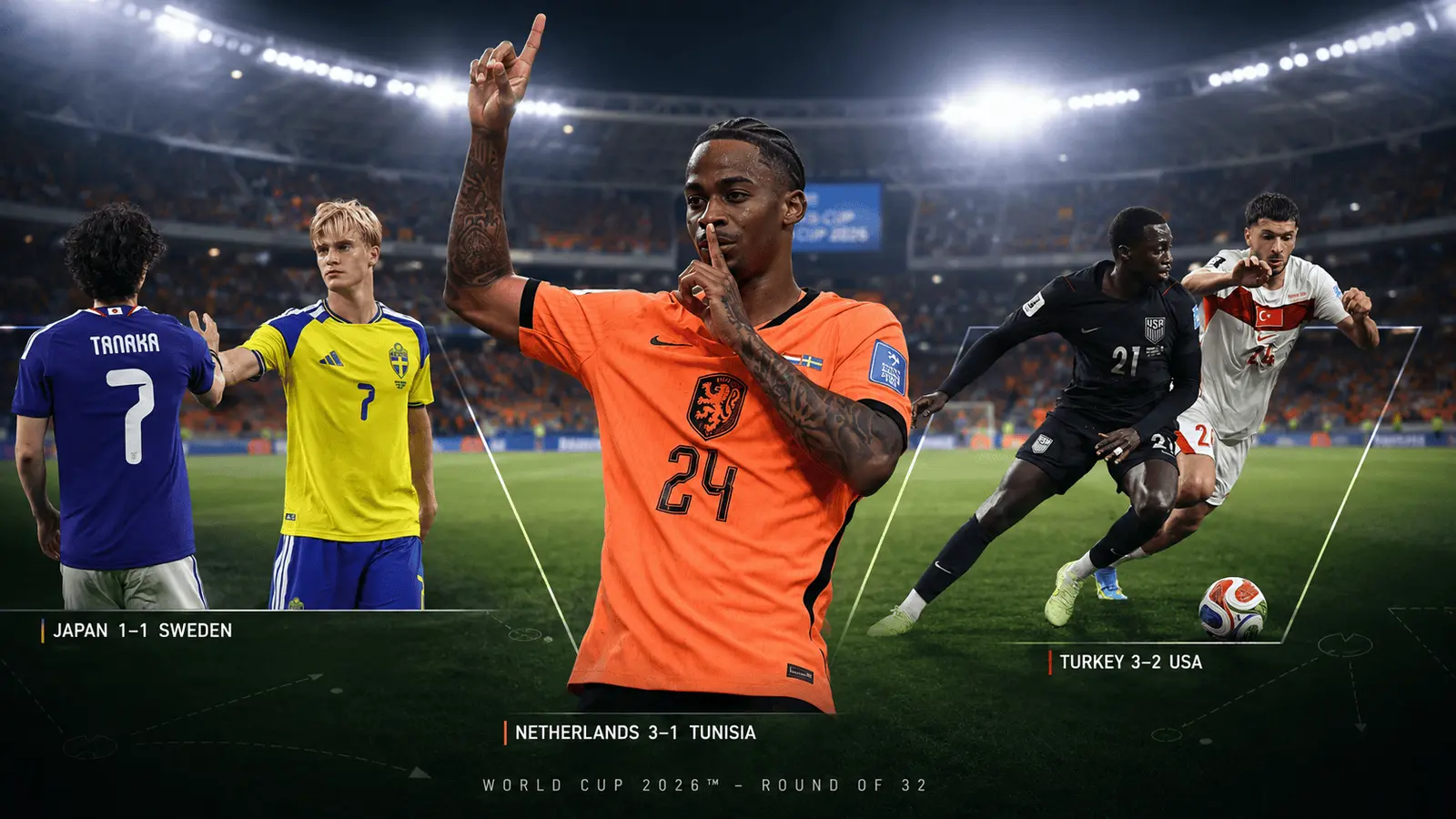
Their 1-1 draw with Sweden was not a passive survival job. Japan had 52% possession, produced 8 shots with 3 on target, and generated 1.21 xG to Sweden’s 0.64. Sweden still carried a real threat, with 11 shots and 5 on target, but the match showed Japan can live in a competitive, physical game without abandoning their own identity.
Against Brazil, the question changes. Can Japan’s collective organisation survive the individual quality, transition speed and one-v-one threat that Brazil bring? Japan can make the match uncomfortable through pressing and midfield rhythm, but they cannot afford open-field chaos for long stretches.
If Japan start quickly and force Brazil into rushed build-up, the game can become a genuine contest. If Brazil find space behind Japan’s defensive line, the tie could tilt sharply toward the South Americans.
USA vs Bosnia: rotation is over, the real test begins
The USA had already secured top spot before their 3-2 defeat to Turkey, a match shaped heavily by major rotation. That context matters. The result should not be treated as proof of collapse.
But the performance still exposed a real issue: the gap between the first-choice group and the bench remains a knockout-stage concern. The USA have started games well throughout the tournament, and Mauricio Pochettino’s early-match approach has produced quick momentum. The problem is what happens after the first wave.
Against Bosnia, the USA will likely need their best tempo-setters back. Christian Pulisic remains central to their ability to stretch the left side, carry the ball and change the speed of attack. The bigger issue is whether the team can maintain that intensity beyond the opening phase.
Netherlands vs Morocco: has Brian Brobbey changed the Dutch ceiling?
The Netherlands’ 3-1 win over Tunisia strengthened the idea that Ronald Koeman’s side may finally have found a clearer attacking reference point. Brian Brobbey’s impact against Sweden and Tunisia has mattered because he gives the Dutch front line something it previously lacked: penalty-box movement, central occupation and a target for wide progression.
That changes the function of players around him. Cody Gakpo, Donyell Malen and Denzel Dumfries all benefit when there is a real central presence to attack crosses and occupy defenders.
Morocco, though, are a dangerous knockout opponent. Their recent World Cup pedigree is real, and their transition threat can test even elite defensive units. If the Netherlands’ front-line structure holds, they should be more balanced than they were earlier in the tournament. If it disappears, Morocco can drag them into a low-margin contest.
The wider knockout lesson
The group-stage finale reminded everyone that tournament football is not only about who looks strongest on paper. It is about incentives, squad depth, fatigue, tactical clarity and whether a team knows what kind of match it wants to play.
Japan want to prove they belong in the conversation with the traditional powers. The USA need to show their first-choice intensity can last. The Netherlands may have found their missing attacking piece. Brazil, meanwhile, remain the benchmark Japan must now confront directly.
That is what makes this Round of 32 so compelling: the bracket has not simply produced matchups. It has produced identity tests.
Post-Match Review
World Cup Final Group Round Review: Rotation, Risk and Reality Checks Before the Knockouts
The final round of World Cup group matches often looks strange from the outside. Some teams rotate heavily. Some protect a draw. Some attack only when the live table forces them to. That does not automatically mean a lack of ambition. It means the tournament has entered the stage where risk is calculated in real time.
This round gave us several clear examples.
USA 2-3 Turkey: a defeat that revealed more than it decided
The USA had already secured first place in the group before facing Turkey, and Mauricio Pochettino made major rotations. That context is essential to understanding the 3-2 defeat.
Auston Trusty gave the USA a rapid start in the third minute, continuing their pattern of early impact. Turkey responded through Arda Güler in the 10th minute and Baris Alper Yilmaz in the 31st. Sebastian Berhalter levelled for the USA after half-time, but Kaan Ayhan’s 90+8’ goal gave Turkey a stoppage-time victory.
For the USA, the result is less important than the warning signs. Their first-choice team has shown clear early-game structure, but the rotated side exposed concerns over depth, speed on the flanks and late-game control. Christian Pulisic’s influence remains central because he changes the pace and threat level of the attack almost immediately.
For Turkey, the win offered release but not redemption. They had already been eliminated, and the victory came in a match where the USA were under no table pressure and had changed heavily. The bigger Turkish question remains why a generation containing players such as Arda Güler and Kenan Yildiz did not function more consistently earlier in the tournament.
Germany 1-2 Ecuador: not just a goalkeeper debate
Germany’s defeat to Ecuador was one of the most significant results of the round. Leroy Sané put Germany ahead in the second minute, but Ecuador turned the match through Nilson Angulo in the ninth minute and Gonzalo Plata in the 77th.
The result extended Germany’s run without a World Cup clean sheet to nine matches. More worryingly, it reopened several structural debates: Manuel Neuer’s level at 40, the defensive stability in front of him, and whether Germany’s attacking midfield can function with so many ball-dominant players operating in similar zones.
This was not merely a story of one mistake. Germany led early, then became too conservative. Ecuador, with greater urgency and physical commitment, grew into the game. Kevin Rodríguez’s substitute appearance also changed the duel profile up front, giving Ecuador more aerial presence and a different way to stress Germany’s centre-backs.
Ecuador’s win was historic too: they reached the World Cup knockout phase for the first time since 2006 and only the second time in their history.
Netherlands 3-1 Tunisia: stability and a clearer front line
The Netherlands beat Tunisia 3-1 without major disruption to their starting structure. The only defensive change noted was Nathan Aké replacing Virgil van Dijk.
The bigger story is attacking clarity. Brian Brobbey has visibly improved the Dutch front-line structure across the Sweden and Tunisia matches, earning official man-of-the-match recognition. His presence gives the Netherlands a central runner, a penalty-box target and a point of reference for wide players.
For a side that has often looked defensively strong but blunt in attack, that matters.
Japan 1-1 Sweden: a competitive draw, not a lazy conclusion
Japan and Sweden drew 1-1, with Daizen Maeda scoring for Japan in the 56th minute and Anthony Elanga equalising for Sweden in the 62nd. Sweden’s point helped them qualify as one of the best third-placed teams.
The numbers do not support a simple accusation of passivity. Japan had 52% possession and 1.21 xG; Sweden had 11 shots, 5 on target and 0.64 xG. The duel data was also close, with Japan winning 47 duels and Sweden 44.
The match became less open later, but that is exactly what final group games often do. Fatigue, qualification maths and the cost of conceding all reshape decisions. A mutually useful result is not automatically collusion.
The lesson before the knockouts
The final group round clarified the tournament’s tactical map. The USA have an intensity-and-depth question. Germany have a structure-and-selection question. The Netherlands may have found a forward solution. Japan look increasingly like a mature tournament side. Ecuador have earned the right to be treated as more than a surprise.
From here, there is no more table management. The knockout stage will separate calculated risk from real resilience.
Team Analysis
World Cup Team Trends: Japan Mature, Netherlands Adjust, Germany Wobble and Ecuador Rise
The group stage has finished, but its final round left a clear tactical picture. Some teams used it to manage energy. Some used it to test structure. Some were exposed. Others announced themselves as more serious than their pre-tournament labels suggested.
Japan: from dangerous outsider to serious tournament team
Japan’s profile has changed. They are no longer merely a team capable of one upset. Their organisation, pressing and confidence suggest a side that expects to compete with elite opponents.
The draw with Sweden was a useful example. Japan did not dominate every phase, but they competed across possession, duels and chance quality. Their physical profile has improved, their running power remains central, and their tactical identity is stable enough to survive rotation and match-state changes.
That is why the Brazil tie feels so important. It is not just about whether Japan can produce a shock. It is about whether their rise has reached the point where traditional powers can no longer assume control by reputation alone.
USA: a strong opening plan, but depth remains the question
The USA have shown one of the clearest early-game patterns in the tournament. Their starts have been aggressive and productive, and Pochettino’s structure appears designed to seize rhythm quickly.
But the defeat to Turkey, even with rotation and first place already secured, exposed a concern. The bench did not reproduce the speed, directness or control of the strongest XI. The dependency on Pulisic for left-sided acceleration is obvious, and the team’s late-game level needs to be more secure in knockout football.
The USA do not look broken. They look like a team whose first-choice version can trouble opponents, but whose margin shrinks if the match becomes stretched or attritional.
Netherlands: one centre-forward can change an entire attack
The Dutch problem has rarely been defensive credibility. It has been whether the front line had a clear point of reference.
Brian Brobbey’s recent performances have altered that conversation. He gives the Netherlands central movement, occupation of centre-backs and a destination for wide deliveries. That makes Gakpo, Malen and Dumfries more useful because their actions now have a target.
This does not guarantee the Netherlands will suddenly become fluent in every match, but it gives them a more coherent attacking model before facing Morocco.
Germany: too many issues for one easy explanation
Germany’s defeat to Ecuador should not be reduced to a single player or incident. Neuer’s form and age are legitimate talking points, but Germany’s issues run deeper.
The defence has not looked secure. The midfield and attacking line include several players who want to receive, carry and decide in similar areas. Florian Wirtz, Jamal Musiala and Leroy Sané are all gifted, but their coexistence needs sharper role definition.
Germany also looked psychologically vulnerable after taking an early lead. Instead of controlling the match with authority, they allowed Ecuador’s urgency to grow.
Ecuador: a black-horse profile with real substance
Ecuador’s win over Germany was not just a one-off emotional surge. Their physicality, courage and ability to change the game from the bench suggest a team improving as the tournament develops.
Kevin Rodríguez’s introduction gave them height and aerial pressure. Enner Valencia’s record-setting World Cup appearance for Ecuador added historical weight, but the tactical lesson was broader: Ecuador are not dependent on only one attacking pattern.
They now deserve to be discussed as a live knockout threat.
Turkey: a win that does not erase the campaign
Turkey’s stoppage-time victory over the USA showed quality, especially in transition. But because they were already eliminated and faced a heavily rotated opponent, the match should not be allowed to rewrite the whole tournament.
The bigger concern remains tactical. A squad with Güler and Yildiz should be producing more consistent attacking structure, not relying on late freedom once the pressure is gone.
The conclusion
The final group round separated names from systems. Japan and Ecuador look like teams growing into the tournament. The Netherlands may have solved a long-standing attacking problem. The USA have a strong first plan but need depth. Germany still look unresolved.
In knockout football, reputation buys nothing. Structure travels further.
Player Performance
World Cup Player Watch: Brobbey’s Dutch Impact, Pulisic’s Importance and Neuer’s Germany Debate
Tournament football often elevates players who solve specific problems. The final group round offered several examples: a centre-forward who gives shape to an attack, a winger whose absence exposes dependency, a goalkeeper under scrutiny, and substitutes who change the physical terms of a match.
Brian Brobbey: the missing Dutch reference point
Brian Brobbey’s value to the Netherlands is not only about goals or individual highlights. His recent performances against Sweden and Tunisia have improved the entire front-line structure.
The Netherlands needed a central player who could run across defenders, occupy the box and give wide players a target. Brobbey has provided that. With him in the middle, Cody Gakpo and Donyell Malen have clearer passing and crossing options, while Denzel Dumfries’ forward runs become more dangerous.
His official man-of-the-match recognition underlined what the tactical picture already suggested: the Dutch attack looks more functional with him as its focal point.
Christian Pulisic: the USA’s accelerator
The USA’s 3-2 defeat to Turkey came in a heavily rotated context, but it also showed why Christian Pulisic remains so important.
When Pulisic enters or starts, the American left side immediately carries more pace, dribbling threat and vertical intent. That is a strength, but it also reveals a dependency. If the USA cannot reproduce that threat through other players, opponents can plan around reducing his space.
Pulisic’s fitness and workload management will therefore be central to the USA’s knockout outlook.
Manuel Neuer: a legendary name facing a modern question
Manuel Neuer’s status is beyond dispute, but Germany’s current problem is not about legacy. It is about whether the national team can afford uncertainty in goal during knockout football.
At 40, Neuer is no longer the same explosive goalkeeper who redefined the position. After Germany’s 2-1 defeat to Ecuador, scrutiny has naturally focused on reaction speed, decision-making and coordination with the defensive line.
The fair version of the debate is not disrespectful. It is simple: Germany must decide whether experience still outweighs the visible risk.
Anthony Elanga: one finish that changed Sweden’s path
Anthony Elanga’s equaliser against Japan in the 62nd minute was more than a good strike. It changed Sweden’s tournament situation, helping them qualify as one of the best third-placed sides.
In a match where Japan had strong possession and xG numbers, Sweden needed a moment of direct quality. Elanga provided it.
Kevin Rodríguez: Ecuador’s bench weapon
Ecuador’s comeback against Germany gained a different dimension when Kevin Rodríguez came on. His aerial presence and ability to challenge German centre-backs gave Ecuador a more direct outlet and changed the physical profile of the match.
That matters in tournament football. The best knockout teams are not always those with the most famous starters; they are the ones with substitutes who can change the type of contest.
Arda Güler and Kenan Yildiz: talent still waiting for a system
Arda Güler scored against the USA, and Turkey’s attacking quality was visible in flashes. But the wider campaign remains frustrating because players such as Güler and Kenan Yildiz have not been consistently activated by the national-team structure.
Turkey’s problem has not been a lack of talent. It has been the absence of a reliable attacking mechanism.
The takeaway
The group-stage finale reminded us that player performance is tactical as much as individual. Brobbey changes the Netherlands’ geometry. Pulisic changes the USA’s speed. Neuer changes Germany’s risk calculation. Rodríguez changes Ecuador’s duel profile.
Those details may decide who survives the first knockout round.
Controversy and Talking Points
Logical Football or Collusion? Why World Cup Final Group Games Demand Better Analysis
Every World Cup final group round produces suspicion. A draw helps both teams. A leader slows the game down. A qualified side rotates. Suddenly the language turns to collusion, conspiracy and lack of ambition.
But serious analysis has to be more careful.
There is a difference between a fixed or collusive match and what can be called logical football: teams responding rationally to the incentives created by the table, the format and the live qualification picture.
Why the final group round changes behaviour
By the third match, teams are no longer playing in a vacuum. They know whether four points are likely to be enough. They know whether goal difference matters. They know whether finishing first, second or third changes their route. They also know that one injury, one suspension or one needless late concession can damage the knockout stage.
That changes risk appetite.
A team that needed three points in the opening match may protect one point in the final match. A team that has already won the group may rotate. A team that sees another result moving in its favour may stop sending full-backs forward recklessly.
That is not automatically immoral. It is built into the competition structure.
Japan vs Sweden: useful result, real contest
Japan’s 1-1 draw with Sweden is a good example of why accusations should not be lazy. Japan scored first through Daizen Maeda; Sweden equalised through Anthony Elanga. The match included real shot volume, duels and measurable competitive balance.
Japan had 52% possession and 1.21 xG. Sweden had 11 shots, 5 on target and 0.64 xG. Those are not the fingerprints of a match where nothing happened.
The later reduction in risk can be explained by fatigue, tournament maths and the cost of conceding. That is different from proving collusion.
Rotation is not surrender
The USA’s defeat to Turkey also needs context. The USA had already secured first place and made major rotations. That does not mean the match had no meaning; it did reveal American depth concerns. But it does mean the result cannot be read in the same way as a full-strength elimination match.
Tournament teams manage resources. Supporters may dislike it, but coaches are paid to think beyond 90 minutes.
Germany conspiracy claims miss the point
Germany’s defeat to Ecuador triggered predictable overreactions, including attempts to frame the result through outside narratives rather than football. That is a poor reading of the match.
Germany lost because Ecuador played with urgency, Germany failed to control the game after taking an early lead, and structural problems in goal, defence and midfield remain unresolved. The football explanation is already strong enough. It does not need a conspiracy.
VAR debates should be framed carefully
Germany vs Ecuador also brought discussion around high-foot incidents and the cancelled Sané penalty. The key point is that controversial moments should be analysed through the laws and VAR process, not treated as proof of hidden intent.
There is room to debate consistency. There is no need to claim certainty where the evidence does not support it.
The real issue is the format
If supporters dislike final-round risk management, the debate should focus on the format. Expanded tournaments, best third-placed teams and simultaneous kick-offs all shape behaviour. Even simultaneous starts cannot remove every strategic calculation, especially when live information moves quickly.
Football does not become suspicious simply because teams understand the table.
The better question is not, “Did they want to win badly enough?” It is, “What did the rules reward them for doing?”