
World Cup Tactical Trends: Japan’s System, Germany’s No.9 Debate and the Netherlands’ Control
Introduction
A World Cup tactical analysis package built around one clear theme: the teams looking most convincing are not simply collecting talent, they are giving that talent a structure. Japan’s rotation strength, the Netherlands’ midfield control, Germany’s return to a clearer centre-forward reference point and Curaçao’s goalkeeper-led resistance all point to different versions of the same tournament truth.
Match Preview
Spain vs Saudi Arabia Preview: If Yamal Starts, Spain’s Width Becomes the First Question
Spain’s Group H second-round match against Saudi Arabia on June 21 comes with one obvious tactical storyline: Lamine Yamal is expected to start, and that changes the way opponents have to defend Spain.
Spain are often discussed through their midfielders and their ability to control rhythm. That remains the foundation. But control without width can become sterile. A player such as Yamal gives Spain a different problem to pose: not simply circulation across midfield, but acceleration on the outside, one-v-one pressure and the ability to force defensive lines to shift earlier than they want.
The Yamal effect
If Yamal starts, Saudi Arabia’s first task is not just to stop a winger. It is to stop the chain reaction created by a winger who holds width and threatens to beat his marker. When that happens, Spain’s midfielders receive cleaner passing lanes inside. The full-back on that side has decisions to make. The far-side defenders must decide whether to stay compact or protect against switches.
That is why Yamal’s value is bigger than dribbling highlights. His presence can stretch the pitch and make Spain’s possession less predictable.
Spain must avoid slow dominance
The danger for Spain is familiar: having the ball without moving the opponent enough. Against teams that protect central spaces, Spain need their wide players to create movement before the final pass. If the tempo becomes too comfortable, Saudi Arabia can keep the game narrower and reduce the match to Spain probing around the box.
Spain’s best scenario is early width, quick switches and enough vertical running to stop Saudi Arabia from settling into a compact defensive rhythm.
What Saudi Arabia need to manage
Saudi Arabia’s route into the match likely depends on discipline without passivity. Sitting deep can protect the penalty area, but if Spain are allowed to attack in waves without pressure on the ball, the game can become one long defensive exercise.
Their challenge is to choose pressing moments carefully: aggressive enough to disrupt Spain’s build-up, but not reckless enough to leave space for Yamal and Spain’s midfield runners to exploit.
Key tactical question
The match may come down to whether Spain can turn technical superiority into repeated wide breakthroughs. If Yamal starts and Spain use him early, Saudi Arabia will have to solve the width problem before they can even think about controlling the match.
Post-Match Review
World Cup Review: Structure, Not Star Power, Is Separating the Convincing Teams
A set of very different World Cup matches produced one common lesson: the best teams are not simply the teams with the most recognisable names. They are the teams with the clearest structure.
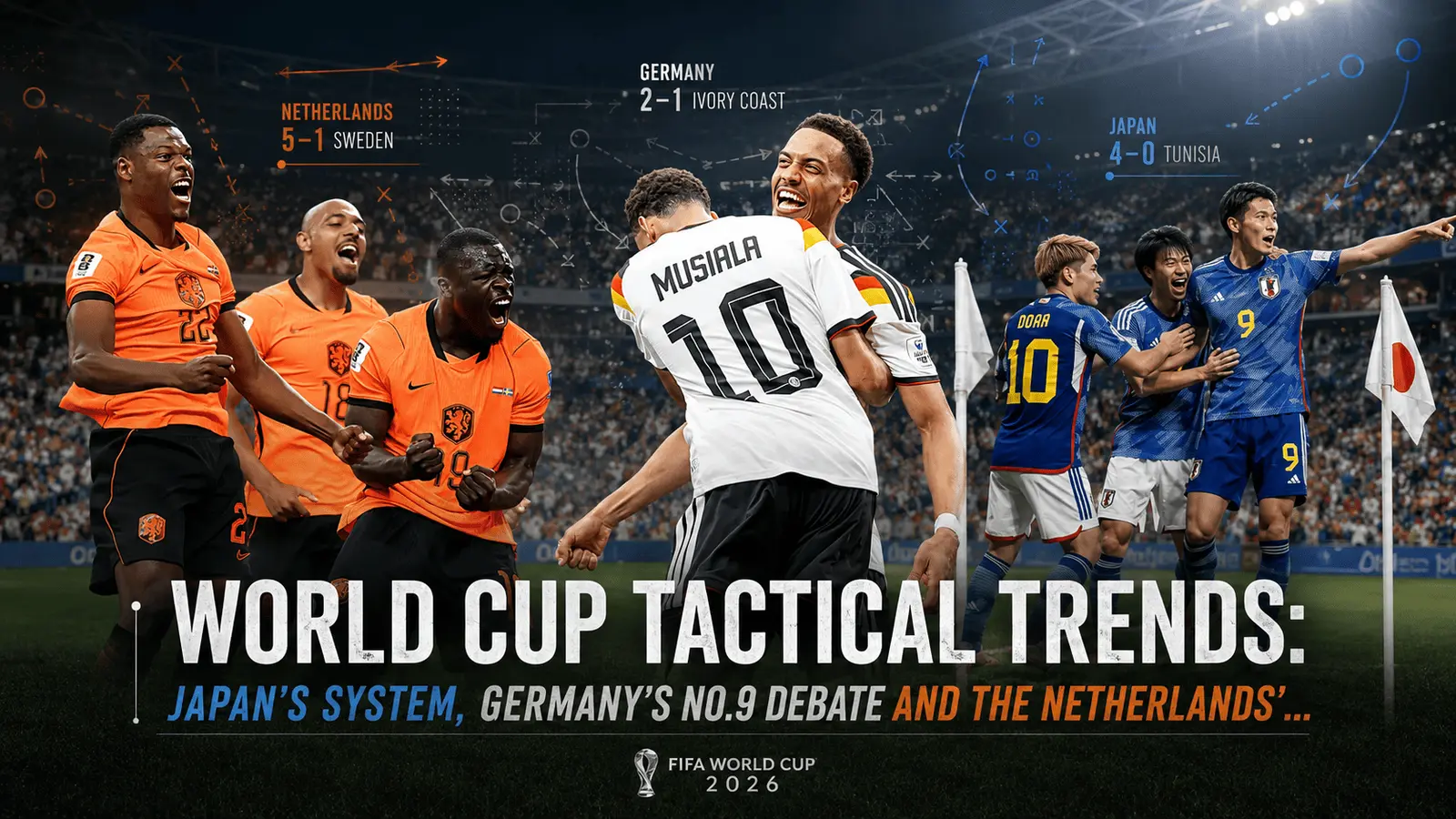
Japan’s 4-0 win over Tunisia, the Netherlands’ 5-1 win over Sweden, Germany’s 2-1 comeback against Côte d’Ivoire and Curaçao’s 0-0 draw with Ecuador all told different stories. But each match was really about whether a team had a stable way to play when pressure arrived.
Japan looked like a system, not a surprise
Japan’s 4-0 victory over Tunisia should not be treated as a one-off statement. The more important detail was that Japan rotated significantly and still played with control, execution and attacking clarity. Ayase Ueda scored twice, including a long-range strike and a header, but the wider message was about the team around him.
Japan drew 2-2 with the Netherlands in their opening match and then handled Tunisia with the composure of a side that understands its own automatisms. That is not the profile of a traditional dark horse. It is the profile of a team whose player pool, European experience and national-team habits are beginning to look deeply embedded.
The Netherlands had control before the goals
The Netherlands’ 5-1 win over Sweden will naturally be remembered through the final-third numbers. Cody Gakpo produced two goals and an assist and was named player of the match. Brian Brobbey scored in the 5th and 17th minutes from the centre-forward role.
But the deeper reason the Netherlands looked comfortable was Frenkie de Jong. His early low-error control gave the Dutch a clean rhythm in possession and reduced the transition risks that can make attacking football fragile. With De Jong connecting phases and the Dutch back line strong in individual duels, Sweden’s direct attacking plan struggled to become sustained pressure.
Sweden still have dangerous forwards, but this match exposed the gap between having elite front-line weapons and having a full-team structure capable of supporting them.
Germany found clarity late
Germany’s 2-1 win over Côte d’Ivoire was the tournament’s clearest example of a team correcting itself mid-match. Franck Kessié put Côte d’Ivoire ahead in the 30th minute, but Germany changed the shape of the contest after the interval, including four changes across the 45th and 60th-minute windows.
Deniz Undav entered around the hour mark and scored twice, first in the 68th minute and then again in stoppage time at 90+4. His impact was not only about finishing. He gave Germany a more direct reference point: someone to find earlier, someone to attack the box, someone to simplify a front line that can otherwise become too technical and too crowded with dribblers.
That does not mean Germany must abandon technical football. It means the technical players need a clear endpoint.
Curaçao’s draw was a goalkeeper story
Curaçao’s 0-0 draw with Ecuador was the emotional counterweight to the bigger-team narratives. Ecuador produced 27 shots, 15 on target and 2.84 xG, while Curaçao had 10 shots, three on target and 0.5 xG. Yet Eloy Room made 15 saves, equalling the World Cup single-match saves record.
For a country of roughly 150,000 people, a point in that kind of match is not just a result. It is exactly the kind of underdog moment that makes the World Cup feel larger than the favourites.
The tournament trend
Japan, the Netherlands and Germany all looked convincing for different reasons. Japan showed system depth. The Netherlands showed control and role balance. Germany showed the value of simplifying when talent becomes congested.
The lesson is simple: star power matters, but tournament football rewards teams that know what every star is supposed to do.
Team Analysis
Japan Are No Longer Just a Dark Horse: Their Strength Is Now Structural
Calling Japan a “dark horse” is starting to feel outdated.
The 4-0 win over Tunisia was emphatic, and Ayase Ueda’s two goals gave the match its finishing touch. But the real story was not simply the scoreline. It was the way Japan could rotate, maintain rhythm and still look like a team with clear collective habits.
Rotation without collapse
Japan made several changes to the starting side, with players such as Shogo Taniguchi, Ao Tanaka, Junya Ito, Takefusa Kubo and Takehiro Tomiyasu among the rotation picture. The key point is not just who came in. It is that the team still functioned.
That is often what separates a tournament team with a good starting XI from a tournament team with genuine depth. Rotation normally introduces hesitation: different timing, different passing angles, different pressing triggers. Japan’s performance suggested those mechanisms are now shared across the squad.
The European-player shift matters
Japan’s growth can also be seen through the number of players developed or hardened in European football. The comparison is striking: Japan had no Europe-based players at the 1998 World Cup, four in 2002, 12 in 2014 and 19 in the current squad.
That does not automatically create a strong national team. But it does raise the technical and tactical floor. Players arrive with experience of different pressing systems, higher match tempo and more varied tactical demands. When that club-level experience meets a coherent national-team structure, the result is a side that can play with maturity against different types of opponents.
Why pressing Japan is dangerous
The biggest tactical question for future opponents is whether to press Japan high. In theory, pressing denies them rhythm. In practice, a poorly coordinated press may be exactly what Japan want.
Japan are comfortable with quick combinations, rotations between lines and attacks into the space behind an aggressive defensive line. If opponents press without controlling central lanes and covering the second ball, they risk being played through rather than forcing mistakes.
That does not mean Japan are impossible to press. It means pressing them requires detail. Casual aggression can become self-harm.
From upset team to system team
Japan’s opening 2-2 draw with the Netherlands and the 4-0 win over Tunisia show two different sides of their profile: they can compete against elite European quality and they can dispatch a weaker opponent without drama.
That is why the conversation should move beyond novelty. Japan are not interesting because an Asian team won heavily. They are interesting because their football now looks repeatable.
The strongest teams at international tournaments usually have two things: enough individual quality to decide moments and enough structure to keep producing those moments. Japan increasingly look like they have both.
Player Performance
Undav, De Jong and Room: Three Very Different Ways to Decide a World Cup Match
World Cup matches are often reduced to scorers and scorelines, but the latest round of games offered three very different models of individual influence.
Deniz Undav changed Germany by simplifying them. Frenkie de Jong made the Netherlands look comfortable before the scoreboard got out of hand. Eloy Room gave Curaçao a point by turning Ecuador’s statistical dominance into frustration.
Deniz Undav: the simple solution Germany needed
Germany’s 2-1 comeback against Côte d’Ivoire turned when Undav entered around the hour mark. He scored in the 68th minute and again in the 90+4th minute, completing the comeback after Franck Kessié had put Côte d’Ivoire ahead in the first half.
The argument for Undav is not that Germany should become crude. It is that a team filled with gifted technicians still needs a clear target. With players such as Florian Wirtz, Jamal Musiala, Leroy Sané and Kai Havertz, Germany have creativity and ball-carrying quality. But too much similar movement can make the attack crowded and indirect.
Undav gave them a reference point. He attacked spaces that others could serve. Havertz’s off-ball movement to create room for Undav around the first German goal was the kind of detail that shows how a centre-forward can make technical players more useful, not less.
Frenkie de Jong: control before recognition
Cody Gakpo’s two goals and one assist made him the official player of the match in the Netherlands’ 5-1 win over Sweden, and understandably so. But the deeper control came from De Jong.
FIFA data credited De Jong with 26 touches in the first 30 minutes without losing possession, and only two losses across 56 first-half touches or passes. That kind of security is not decorative. It changes the whole match environment.
When De Jong keeps the ball under pressure, the Netherlands can push numbers forward with less fear of transition. Their defenders can hold a higher line. Their forwards receive the ball in rhythm rather than in rescue mode. Gakpo delivered the end product, but De Jong helped create the conditions.
Eloy Room: the goalkeeper who bent the match
Curaçao’s 0-0 draw with Ecuador was a reminder that a goalkeeper can rewrite the story of a game. Ecuador had 27 shots, 15 on target and 2.84 xG. Curaçao had far less of the ball and far fewer high-value moments.
Room made 15 saves, equalling the World Cup single-match saves record. That performance turned what could have been a routine Ecuador win into one of the tournament’s great underdog results.
For Curaçao, the point mattered. For the tournament, the image mattered even more: a small nation surviving because one player produced a performance that statistical models could measure but not fully capture.
Different roles, same importance
Undav decided a match by giving Germany a centre. De Jong decided a match by keeping the Netherlands connected. Room decided a match by denying everything Ecuador put on target.
That is the beauty of tournament football. Influence is not one thing. Sometimes it is a brace. Sometimes it is a clean first touch under pressure. Sometimes it is 15 saves and a point nobody expected.