
Belgium, Croatia and England: Why Football Structure Matters More Than the Scoreline
Introduction
A football tactics and opinion package built around one central idea: results matter, but structure explains them. The strongest public angles are Belgium’s friendly win over Croatia, England’s tactical uncertainty under Tuchel, and the wider argument that defensive football can be active, intelligent and worthy of respect.
Match Preview
England’s Tuchel Question: Stability or a Higher Risk Back Three?
England’s Tuchel Question: Stability or a Higher-Risk Back Three?
England’s tactical debate under Thomas Tuchel is already more interesting than a simple argument about who starts. The deeper question is structural: should England lean into a stable back four, or use a three-centre-back system that may offer a higher ceiling but demands more collective understanding?
The latest squad-number discussion has encouraged speculation about possible roles, including Elliot Anderson wearing the No. 8 and the familiar questions around England’s right side. But shirt numbers are clues, not confirmations. Modern football has made the link between number and position far less rigid than it once was.
The case for a back four
A back four gives England the cleanest route to stability. In international football, where training time is limited, simplicity matters. A four-defender structure usually makes pressing triggers, covering angles and midfield spacing easier to understand quickly.
That is especially important for a side with elite attacking players who do not all play the same club system. A clearer base allows England’s forwards and midfielders to focus on timing, combinations and final-third decision-making rather than constantly recalibrating their defensive responsibilities.
The case for a back three
A three-centre-back system could give Tuchel more tactical flexibility. It can create extra security in build-up, allow wing-backs to hold width and open different lanes for the No. 8s and No. 10s.
But the trade-off is obvious: a back three needs synchronisation. Centre-backs must know when to step out, wing-backs must judge when to press or recover, and midfielders must cover the spaces that open outside them. Club teams can drill those habits over months. National teams often have days.
That is why the back-three idea is attractive but risky. It may raise England’s ceiling, but it also raises the cost of misunderstanding.
The Saka wing-back debate
Bukayo Saka is central to the discussion because he offers rare intelligence on the right side. He understands width, timing, combination play and when to attack the inside channel. That makes him theoretically usable as a wing-back.
But using Saka deeper also asks England to sacrifice some of his most familiar attacking value. Reece James brings a more natural full-back or wing-back profile, including crossing range and defensive experience. Noni Madueke offers more direct forward running. Saka may be the most complete footballer of the three in possession, but completeness is not the same as best fit for every role.
That is the heart of Tuchel’s dilemma: do England use their most intelligent wide attacker to solve a structural problem, or keep him closer to goal where he has done his best work?
Rashford and the left-side question
Marcus Rashford’s possible role adds another layer. If England want vertical threat on the left, Rashford remains one of the most direct options. But his inclusion would affect balance on the opposite flank, the midfield’s covering responsibilities and the team’s pressing shape.
Tuchel’s history suggests he is comfortable with tactical variation. The danger is not flexibility itself. The danger is overloading a national-team group with too many moving parts at once.
The preview verdict
England’s safest route is a back four with clear roles. The more ambitious route is a back three that tries to maximise width, build-up angles and tactical disguise.
Tuchel’s challenge is to decide how much complexity this team can absorb. England have enough individual quality to look dangerous in either shape. The question is whether the structure makes those players sharper — or leaves them thinking for half a second too long.
Post-Match Review
Belgium 2 0 Croatia: The Scoreline Was Clear, but Croatia’s Build Up Problem Was Clearer
Belgium 2-0 Croatia: The Scoreline Was Clear, but Croatia’s Build-Up Problem Was Clearer
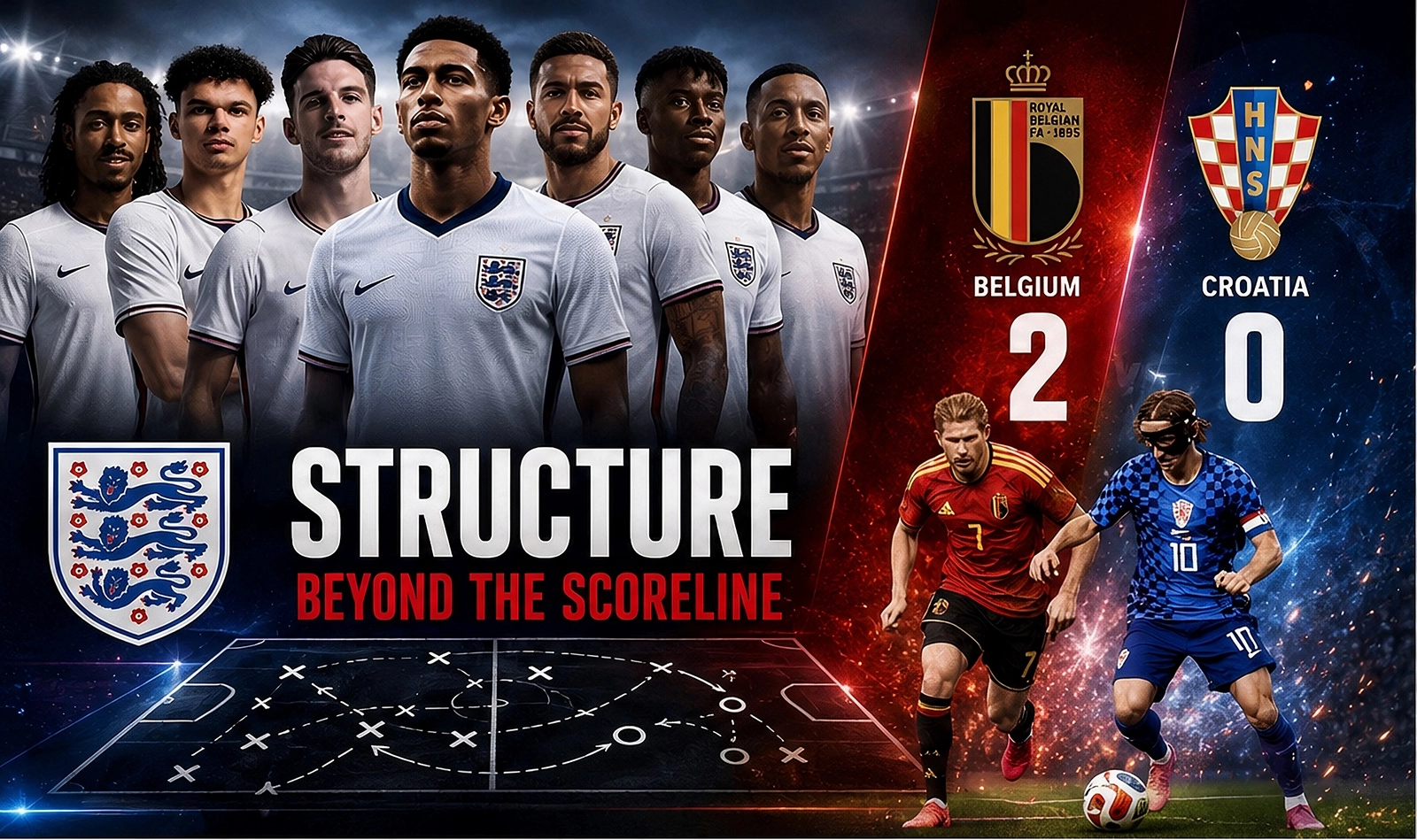
Belgium’s 2-0 win over Croatia in the June 3 international friendly was a useful reminder that possession does not always equal control.
Croatia had 57% of the ball, but produced only four shots and one on target. Belgium, with 43% possession, managed nine shots and four on target. That contrast tells the story: Croatia circulated the ball, but Belgium created more threat and forced the more meaningful moments.
Croatia’s issue is not just age — it is connection
It is too easy to reduce Croatia’s problem to age. Luka Modric, Mateo Kovacic and Ivan Perisic still bring experience, technique and competitive intelligence. The issue is that the team no longer looks able to sustain the same full-pitch rhythm that defined its best years.
The midfield still has class, but the energy around it is thinner. The front line does not consistently stretch opponents with speed or elite one-v-one threat. The back line, apart from its stronger ball-players, appears vulnerable when asked to receive and progress under pressure.
That creates a structural problem. If the defence struggles to play through pressure and the attack does not punish opponents for stepping high, the midfield gets trapped in a losing equation: too much responsibility, too little support.
Belgium did not need to dominate the ball
Belgium’s performance was not defined by long spells of possession. It was defined by making Croatia uncomfortable. Even relatively simple pressure from Belgium’s front players was enough to disturb Croatia’s build-up.
That is often the most revealing sign in a friendly. The result matters, but the repeatable pattern matters more. If a team repeatedly looks uncertain playing out from the back, stronger opponents will notice.
Belgium’s own warning sign
Belgium should not treat the win as proof of total health. The concern around Zeno Debast’s injury matters because it may affect more than one position. If Belgium are forced to use a midfielder such as Amadou Onana or Aster Vranckx-type profiles in central defence, the team may solve one problem while weakening another.
That is the hidden cost of defensive injuries: they can break midfield balance as well as defensive depth.
What this friendly really told us
Croatia’s golden generation has not lost its football intelligence. But the team’s structure is less forgiving than before. Belgium did enough to win, and did it without needing to monopolise the ball.
For Croatia, the warning is obvious: against opponents who press with greater intensity, build-up errors could become the main source of danger. For Belgium, the lesson is more cautious: winning comfortably is valuable, but the centre of the team still needs protection if injuries force positional reshuffles.
Team Analysis
Control Is Not Always Possession: What Arsenal, Belgium and Croatia Reveal About Modern Football
Control Is Not Always Possession: What Arsenal, Belgium and Croatia Reveal About Modern Football
Football analysis often starts in the wrong place. It asks who had more of the ball, who looked more adventurous, who fitted the cleaner aesthetic. But the more important question is usually this: which team made the match feel uncomfortable for the opponent?
That idea links several recent football discussions — Arsenal’s approach against Paris Saint-Germain, Belgium’s 2-0 friendly win over Croatia, and England’s tactical uncertainty under Thomas Tuchel.
Defensive football is not automatically passive
Arsenal’s Champions League final against PSG, which ended with Paris winning 5-4 overall after a 1-1 draw and a 4-3 penalty shootout, became part of a wider debate about defensive football and taste.
The useful point is not whether everyone enjoyed Arsenal’s approach. The useful point is that defending can be active. A team can control space, deny rhythm, reduce the influence of key attackers and force an opponent into lower-quality actions.
That is not anti-football. It is football.
A side does not have to dominate possession to shape the match. Jose Mourinho built part of his reputation on that principle: make the game happen on your terms, even if those terms are not visually expansive.
Belgium showed another version of control
Belgium’s win over Croatia offered a different example. Belgium had less possession, but created the more efficient attacking output. Croatia’s 57% possession produced only four shots and one on target, while Belgium’s 43% produced nine shots and four on target.
That does not mean possession is irrelevant. It means possession without progression, threat or security can become cosmetic.
Belgium’s pressure exposed Croatia’s build-up discomfort. Croatia could have the ball, but Belgium controlled where the danger appeared.
Croatia’s structural decline is the bigger story
Croatia still have players of serious quality. Modric, Kovacic and Perisic are not suddenly without value. But the support system around them looks less complete than during Croatia’s peak years.
The back line is not always secure under pressure. The forward line does not consistently offer enough speed or technical threat to punish teams who squeeze the pitch. That leaves the midfield asked to do too much.
This is what a generational transition really looks like. It is not simply that older players decline. It is that the distances between units become harder to manage.
England’s warning: complexity has a cost
England’s debate under Tuchel fits the same theme. A three-centre-back system might create tactical upside, but it also requires timing and trust. A back four may look less imaginative, but it gives players clearer reference points.
For a national team, that matters. International football rarely gives coaches enough time to build club-level automatisms. Tactical ambition must be balanced against how quickly players can execute it.
The bigger lesson
The modern game is not divided neatly into attacking teams and defensive teams. It is divided between teams with coherent structures and teams without them.
Arsenal’s defensive resistance, Belgium’s efficient pressure, Croatia’s build-up fragility and England’s formation question all point to the same editorial conclusion: style is not the same as control. Control is making the match move in the direction you intended.
Player Performance
From Modric to Saka: The Player Roles That Explain the Bigger Tactical Picture
From Modric to Saka: The Player Roles That Explain the Bigger Tactical Picture
Individual performance analysis is most useful when it explains the team around the player. In this football discussion, several names matter not simply because of talent, but because their roles reveal structural strengths and weaknesses.
Modric, Kovacic and Perisic: quality remains, energy changes
Luka Modric, Mateo Kovacic and Ivan Perisic still represent Croatia’s highest football culture: experience, technical security and competitive intelligence. But Croatia’s issue is that their quality no longer automatically guarantees full-team rhythm.
The question is not whether they can still play. They can. The question is whether Croatia can still build a complete structure around them, especially when the back line is pressured and the front line does not consistently stretch opponents.
Older elite players can still decide moments. They cannot always carry distances, transitions and recovery runs for an entire team.
Zeno Debast: why one defensive injury can affect the whole team
Zeno Debast’s injury concern is important because it may trigger a chain reaction. Losing a centre-back is not only about replacing one defender. It can force a midfielder to drop into the back line, which then changes the balance of the midfield.
That is why Belgium’s win over Croatia should be read carefully. Belgium looked efficient and dangerous, but their central structure could still become vulnerable if injuries push players out of their best roles.
Onana and the cost of emergency solutions
Using a midfielder as a centre-back can make sense in possession, particularly if that player is strong, composed and comfortable receiving the ball. But it can also remove power, range and ball-winning from midfield.
That is the trade-off Belgium may have to manage. A positional fix in defence can become a midfield problem.
Saka: complete footballer, complicated role
Bukayo Saka as a potential right wing-back is one of England’s most fascinating tactical debates. He has the intelligence to understand the role: when to hold width, when to combine, when to attack inside and when to delay an action.
But there is a cost. Saka’s best work usually comes higher up the pitch, where his final-third decision-making can hurt opponents directly. Moving him deeper may help England’s shape, but it also risks reducing his attacking frequency.
That is why the debate is not about whether Saka is capable. It is about whether England gain more structurally than they lose individually.
Elliot Anderson and the No. 8 signal
Elliot Anderson receiving England’s No. 8 shirt is an intriguing detail, but it should not be over-read as a confirmed starting role. What it does suggest is that England are considering midfield balance carefully.
The No. 8 role in a Tuchel team can demand running power, positional discipline and timing between pressing and progression. If Anderson is part of that conversation, the issue becomes how England balance technical security with athletic coverage.
The player-performance verdict
The common thread is role suitability. Modric, Kovacic and Perisic still have quality, but Croatia must protect them structurally. Debast’s absence could force Belgium into compromises. Saka can play multiple roles, but England must decide where his value is greatest.
Modern football is full of versatile players. The best teams are not the ones that move players everywhere simply because they can. They are the ones that know when versatility helps the structure — and when it quietly weakens it.
Controversy and Talking Points
Defensive Football Deserves Respect — and So Do the Fans Who Appreciate It
Defensive Football Deserves Respect — and So Do the Fans Who Appreciate It
Football’s oldest aesthetic argument never really disappears. One side wants attacking ambition, possession and spectacle. The other values discipline, compactness, control of space and the ability to make an opponent suffer.
The mistake is pretending only one of those approaches is legitimate.
Arsenal’s tactical performance against Paris Saint-Germain in the Champions League final became part of that broader debate. PSG ultimately won, but the match still raised a valuable question: if a team makes an elite opponent uncomfortable through structure, denial and defensive control, why should that automatically be dismissed as negative football?
Defending can be proactive
A good defensive plan is not simply eleven players waiting near their own penalty area. It can involve pressing traps, controlled distances, forcing play toward weaker zones, denying central access and making star attackers receive the ball in harmless areas.
That is active football. It just does not always look like the version of control that shows up in possession statistics.
The best defensive teams are not passive. They are selective. They decide which spaces matter, which opponents can be allowed possession, and where the match should be slowed down.
Criticism is fair; contempt is lazy
There is nothing wrong with criticising a tactical plan. If a team defends poorly, lacks ambition or fails to create enough threat, analysts should say so.
But criticism becomes weaker when it turns into mockery of supporters. Fans are allowed to appreciate different forms of football. Some love high pressing. Some love wide attacking. Some love the tension of a perfectly organised defensive block.
A serious football culture should be able to debate all of that without reducing disagreement to ridicule.
The possession trap
Belgium’s 2-0 win over Croatia made the same point in a different way. Croatia had more possession, but Belgium produced the more dangerous attacking output. The ball alone did not define control.
This is why football conversation needs better vocabulary. Low possession does not always mean suffering. High possession does not always mean dominance. Defensive football does not always mean fear.
The real standard
The real standard should be effectiveness and coherence. Did the team create the game state it wanted? Did it protect its weaknesses? Did it attack the opponent’s weaknesses? Did it make the opponent uncomfortable?
If the answer is yes, the approach deserves analysis before it receives judgement.
Football is richer when we accept that beauty can look different. Sometimes it is a passing sequence. Sometimes it is a counter-press. Sometimes it is a defensive shape that slowly drains the opponent of good ideas.