
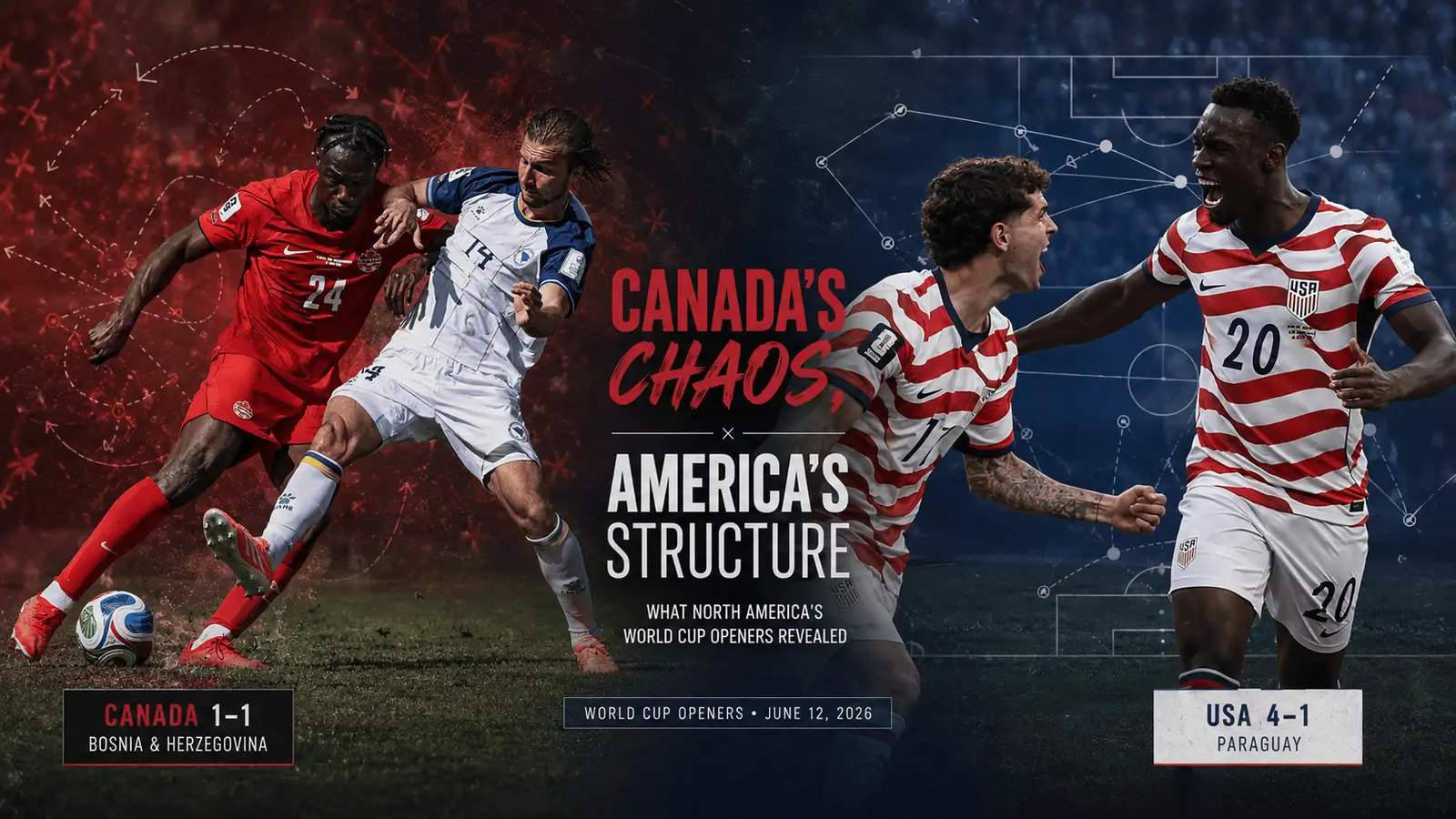
Canada’s Chaos, America’s Structure: What North America’s World Cup Openers Revealed
Introduction
A tactical and editorial package built around the contrast between two North American teams with similar athletic profiles but very different levels of structure: Canada’s speed without clarity under Jesse Marsch, and the United States’ more organised pressing and positional rotation under Mauricio Pochettino. The strongest public angles are Canada’s must-improve preview against Qatar, the USMNT’s 4-1 statement against Paraguay, and the wider question of how coaching turns raw pace into a repeatable football identity.
Post-Match Review
USMNT 4 1 Paraguay: Pochettino’s Press Turned Pace Into Control
The United States’ 4-1 win over Paraguay in their 2026 World Cup Group D match on June 12 was not just a strong result. It was a demonstration of what happens when athleticism is organised into a plan.
The USMNT led 3-0 at half-time, with Folarin Balogun scoring twice, and finished the match with Giovanni Reyna adding a 98th-minute goal from the bench. Paraguay ended with nine shots and only one on target, a telling statistic in a match where their usual defensive resilience and counter-attacking threat were badly disrupted.
This was the clearest sign yet of Mauricio Pochettino’s imprint: not just energy, not just pace, but pressing with purpose.
Paraguay could not build through the first wave
Paraguay arrived with a reputation for defensive stubbornness. In South American qualifying, they had shown they could frustrate elite opponents, including victories over Argentina and Brazil, and their defensive record was among the better ones in the region.
The USMNT made that background look irrelevant for long stretches.
The key was field position. The United States pressed high enough and aggressively enough that Paraguay struggled to move the ball cleanly beyond their defensive third. When Paraguay tried to play out, American pressure closed the first passing options. When they went longer, the USMNT were positioned to compete for the second ball. When the ball was recovered, the next attack came quickly.
That is different from simply “playing fast”. It is speed attached to structure.
The wide channels and half-spaces were decisive
The United States repeatedly found value around the edges of Paraguay’s back three. The spaces between centre-back and wing-back, and the zones where midfield cover failed to arrive quickly enough, became natural targets.
Christian Pulisic remained the tone-setter in attack before being replaced at half-time by Berhalter. Weston McKennie was equally important in a less headline-friendly way: he moved across midfield, supported Sergiño Dest, helped connect the right side, and gave the attack a rhythm that Paraguay struggled to disrupt.
That movement matters. It meant the United States were not relying on one side, one runner or one pattern. They could create strong-side overloads, switch the point of attack, and keep Paraguay’s back line facing its own goal.
The second half revealed depth, not perfection
There was a brief drop in sharpness after the interval, which is not unusual for a team leading 3-0. Paraguay pulled one back, and the United States lost some of the control that had made the first half so convincing.
But the response was encouraging. Pochettino used the bench and positional adjustments to restore order. Berhalter, Tillman, Pepi and Aaronson were part of the rotation picture, while Reyna’s late goal gave the scoreline a symbolic finish: this is no longer a USMNT where every attacking answer has to come from the same two or three players.
Reyna’s role is especially interesting. He is no longer treated as an automatic centrepiece, but his 98th-minute goal underlined the value of having high-level talent available outside the first-choice XI.
A statement, but not a coronation
The performance will naturally raise expectations. The USMNT showed pressing identity, attacking depth and tactical clarity. They also showed that Pochettino can design a match plan to target a specific opponent’s weaknesses.
But one excellent win does not guarantee a deep tournament run.
If the United States win the group, their route could open up before potentially bringing a quarter-final test against a heavyweight such as Germany or France. That is the level where high pressing is examined differently: the opponent’s centre-backs pass better, the midfielders turn out of pressure more cleanly, and mistakes are punished faster.
So the right response is neither hype nor caution for caution’s sake.
The USMNT looked serious. They looked coached. They looked deeper than before. Now the question is whether this version of the team can impose its football when the opponent is not overwhelmed by the first wave.
Team Analysis
Same Speed, Different Sport: Why the USMNT Look Coached and Canada Look Rushed
Canada and the United States are often grouped together in broad football conversations: North American teams, athletic squads, quick forwards, players developed across different club environments, rising expectations.
But their recent performances showed a more important separation.
Both teams have speed. Only one currently looks as though that speed has been fully translated into a football structure.
Canada: more weapons, fewer combinations
Canada’s 1-1 draw with Bosnia was frustrating because it did not look like a team short of ability. It looked like a team short of arrangement.
The front line has different profiles. Jonathan David can finish and arrive from clever positions. Cyle Larin offers experience, penalty-box presence and a reference point. Alphonso Davies, if available, brings elite left-sided carrying power. There are other forward options who can run, combine and attack space.
The problem is that Canada too often compress those different tools into one instruction: go quickly.
That can work in moments. It can create territory, panic and second balls. But over 90 minutes, it also creates repeated problems. Players arrive in the same zone. The final pass is forced. The striker is isolated or misused. The midfield plays forward before the next runner is set. The attack becomes emotional rather than coordinated.
Against Bosnia, that lack of clarity was punished by a team with a much simpler self-image. Bosnia accepted what they were, defended with discipline, used direct moments and found a way to lead before Larin’s late equaliser.
Sometimes football rewards the team that knows exactly what it can do more than the team with the wider menu of options.
The United States: pace with a tactical frame
The USMNT’s 4-1 win over Paraguay showed the opposite version of athletic football.
The United States also played quickly. They pressed quickly, attacked quickly and moved the ball into wide areas quickly. But the difference was that their speed had triggers and direction.
The press forced Paraguay into rushed decisions. The midfield covered the second ball. Weston McKennie’s movement helped connect both sides of the pitch. Christian Pulisic set the attacking tone. Sergiño Dest’s side could be supported, overloaded and used as a route forward. The bench then helped sustain the match once the first-half damage had been done.
That is what coaching does: it turns running into pressure, pressure into territory, territory into chances, and substitutions into continuity.
Marsch and Pochettino are the real comparison
The most revealing contrast is not Canada versus the United States as talent pools. It is Jesse Marsch versus Mauricio Pochettino as organisers of talent.
Marsch’s Canada can still be dangerous because the players are good. But the criticism after the Bosnia draw is that the team’s attacking instructions appear too blunt. If the answer to every attacking problem is more intensity, Canada risk making good players look less intelligent than they are.
Pochettino’s United States, by contrast, looked like a team with layers. The first layer was pressure. The second was midfield rotation. The third was attacking the sides of Paraguay’s back line. The fourth was using the bench without losing the team’s identity.
That does not make the USMNT a finished product, and it does not mean Canada cannot improve quickly. International football can swing on availability, confidence and one clear tactical change.
But the current gap is obvious.
Canada are trying to make chaos productive. The United States are trying to make athleticism repeatable.
That difference may decide how far each team can go.
Controversy and Talking Points
Is Canada’s Chaos on the Players or the Coach? Marsch’s Biggest Question After Bosnia
The most important controversy around Canada’s 1-1 draw with Bosnia is not the scoreline. It is responsibility.
When a team with Canada’s athleticism, forward options and transition threat looks disconnected, the question becomes unavoidable: is this an execution problem, or a coaching problem?
Jesse Marsch’s public-facing challenge is that Canada do not look short of effort. They look short of clarity.
“Play faster” is not a complete attacking plan
Intensity is valuable. In international football, where preparation time is limited and emotional momentum can matter, a coach who can raise a team’s aggression has real value.
But Canada’s problem against Bosnia was not that the players lacked urgency. If anything, they often had too much of it. The attack became hurried. Runs overlapped without coordination. Possession became a race to force the next action.
That is where the criticism of Marsch becomes sharper. If players are already motivated, the coach’s job is not simply to demand more energy. It is to give the energy direction.
Canada need passing routes, spacing rules and clearer forward relationships. Who pins the centre-backs? Who drops between the lines? Who attacks the back post? When does the left side accelerate? When does the midfield slow the game down?
Those are coaching questions.
The Jonathan David debate is really a system debate
Jonathan David’s role has become the clearest example. If he is used as a fixed No. 9, Canada may be asking him to do a job that does not fully match his best qualities. If Larin plays as the reference point, David could be freed into more dangerous arrival zones.
So when Larin came off the bench and scored, it did more than rescue a draw. It strengthened the argument that Canada’s front line may need a different starting structure.
The controversy is not simply “Larin or David”. It is whether Canada are building a shape that lets both players make sense.
VAR talking point: why the Weah yellow-card review matters
The broader tournament also delivered an important rules discussion in the United States match. VAR’s intervention to cancel a yellow card shown to Tim Weah, involving mistaken identity or an incorrect foul assessment, highlighted the expanded scope of video review in this competition.
That matters for supporters because many still think VAR is limited almost entirely to goals, penalties, red cards and identity checks in narrow circumstances. When technology is used quickly and clearly, it can improve trust. But it also raises expectations: fans will ask why similar precision is not available in every league and every competition.
Neymar: sporting absence, commercial shadow
Brazil’s opener against Morocco has another type of talking point: Neymar is confirmed out. From a purely football perspective, Brazil may be better equipped than most teams to absorb the absence of one star. The more complicated question is what Neymar’s presence around the squad still means for attention, sponsors and dressing-room psychology.
That should be framed carefully. It is fair to say Neymar’s absence changes the commercial and emotional framing of Brazil’s tournament. It is not responsible to present sponsor motivation as a proven internal decision unless confirmed by those involved.
The bigger lesson: separate facts from noise
The same applies to debates around injuries, squad decisions and social-media blame. Whether discussing Davies’ availability, Emiliano Martínez’s hand issue, Neymar’s recovery or Wataru Endo-related narratives, football commentary must separate timeline from outrage.
That is the real editorial lesson of this stage of the tournament. The best analysis is not the loudest reaction. It is the one that explains what happened, what is known, what remains interpretation, and what the football actually tells us.