
Portugal’s Star Power Problem and England’s System Statement: World Cup Tactical Review
Introduction
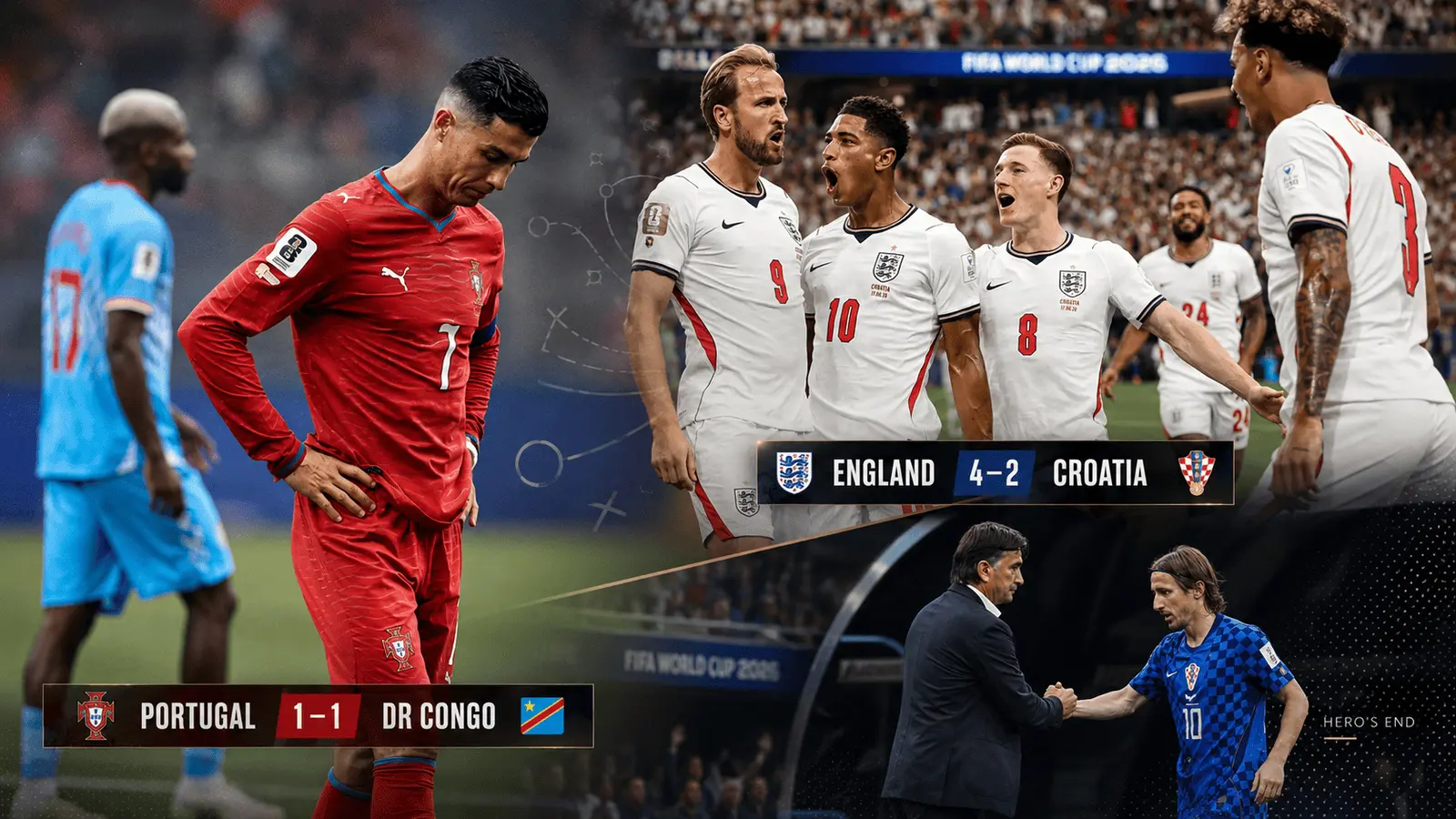
A tournament-focused football analysis package built around one central idea: elite squads do not become elite teams until star power is converted into structure, roles and repeatable chance creation. Portugal’s 1-1 draw with DR Congo and England’s 4-2 win over Croatia provide the clearest contrast: Roberto Martinez’s side looked heavy with talent but light on attacking logic, while Thomas Tuchel’s England showed the benefits of functional selection, set-piece detail and defined roles for Harry Kane, Jude Bellingham and Declan Rice.
Match Preview
What Portugal and England Must Prove Next: A Tactical Preview of Their Tournament Trajectories
Portugal and England are not short of elite names. The difference, at least on the evidence of their latest World Cup outings, is how those names are being used.
Portugal’s 1-1 draw with DR Congo raised questions that will follow Roberto Martinez into the next match: can this team create proper supply for Cristiano Ronaldo, or will it continue to mistake possession for pressure? England’s 4-2 win over Croatia offered the opposite image. Thomas Tuchel’s side looked less concerned with fitting every famous attacker into the same XI and more focused on roles, running power, set-piece design and balance.
That contrast sets up the next major tactical storyline of the tournament.
Portugal’s next test: service, not just possession
Portugal had 75% possession against DR Congo but produced only seven shots, one on target and 0.65 xG. That is the profile of a team controlling the ball without controlling the danger.
The next opponents will have seen the same weaknesses:
- Ronaldo can still be a penalty-box reference point, but he needs runners around him.
- Wide players must do more than hold width; they must attack the box, create cut-backs and compete for second balls.
- Bruno Fernandes, Bernardo Silva and Vitinha need a clearer hierarchy in possession.
- If Rúben Dias is unavailable, Portugal’s centre-back structure can be targeted, especially from short corners and central aerial runs.
This is the difference between passing to a striker and serving a striker. Feeding Ronaldo in crowded zones against three centre-backs is not a plan. It is an abdication of attacking responsibility.
João Félix and Francisco Conceição are now part of the debate
Portugal’s selection conversation will not go away. João Félix offers the kind of link play that could connect Ronaldo to the midfield and wide areas, while Francisco Conceição’s directness gives Portugal something they lacked for long spells: acceleration, width with purpose and the ability to disturb a settled defensive block.
Rafael Leão’s role is under pressure for the same reason. A winger of his profile has to either beat defenders, arrive closer to the striker or attack the second phase. If he stays wide without consistent penetration, Portugal’s centre-forward becomes isolated regardless of who plays there.
DR Congo can keep troubling teams, but must add layers
DR Congo showed they are not a passive underdog. Their three-centre-back structure, physical duels and the Yoane Wissa-Cédric Bakambu partnership gave Portugal genuine problems. Wissa’s equaliser from a short-corner situation was not just a goal; it was a warning to every favourite that tournament football punishes soft concentration.
The question is whether DR Congo can add more complexity. Their directness is useful, but against better-organised opponents they may need more variation in build-up and final-third combinations.
England’s next test: can function beat fame again?
England’s 4-2 win over Croatia strengthened Tuchel’s authority because it validated a bold idea: form, running, defensive work and tactical fit can matter more than reputation.
Anthony Gordon and Noni Madueke starting ahead of other high-profile attacking options will always generate debate. But the logic is visible. Tuchel wants wingers who run without the ball, recover defensively, stretch the pitch and allow Jude Bellingham, Harry Kane and Declan Rice to operate in a stable central structure.
The next challenge is sustainability. Once opponents study England’s set-piece routines and pressing triggers, can Tuchel’s side keep creating high-quality chances? Can the balance survive against teams with greater pace in transition? Can the famous substitutes accept reduced roles if the results keep coming?
Croatia face the hardest kind of transition
Croatia’s issue is not a lack of respect for Luka Modrić. It is the reality of time. At 40, he remains a great football mind, but the physical demands of tournament midfield play are unforgiving. Mateo Kovačić’s introduction on 58 minutes increased Croatia’s tempo, underlining the central question: how quickly can the next midfield generation take ownership?
Martin Baturina, Petar Musa and the wider supporting cast give Croatia a future, but the balance between loyalty to an era and the need for fresh legs is now unavoidable.
The broader tournament lesson
The next matches will test a simple principle: in tournament football, resources are only as useful as the structure that carries them.
Portugal have enough talent to improve quickly, but only if Martinez clarifies roles and builds real support around his striker. England already look closer to a tournament machine, but Tuchel’s model will face stronger tactical resistance as the competition progresses.
One team needs a clearer plan. The other must prove its plan can travel.
Player Performance
Ronaldo Isolated, Bellingham Released: The Player Roles That Defined Portugal and England
Player performance in tournament football is rarely just about the player. It is about role, support, timing and the structure around them.
Portugal’s draw with DR Congo and England’s win over Croatia made that point clear.
Cristiano Ronaldo: still dangerous, but no longer self-sufficient
The debate around Ronaldo often becomes too binary: either he is the problem, or he must be protected from all criticism. The reality is more useful.
Ronaldo has changed. He is no longer the version who could start wide, beat defenders in open grass and create his own shot from almost nothing. His current value is as a penalty-box striker: movement, finishing instinct, aerial presence and the gravity he still creates around defenders.
Portugal did not consistently serve that version of Ronaldo. Too many attacks ended with him surrounded by defenders and too few teammates close enough to profit from second balls or create combinations. When a striker is asked to receive in impossible areas, the system is shifting responsibility rather than creating opportunity.
João Neves: the bright point in a frustrating Portugal display
João Neves gave Portugal the perfect start with his sixth-minute header, arriving centrally to meet Pedro Neto’s delivery and loop the ball into the top-right corner.
Beyond the goal, Neves represents something Portugal need more of: timing, intensity and willingness to attack spaces without overcomplicating the move. In a team full of players who want touches, that kind of direct penalty-box action matters.
His emotional tribute after the goal also added a human dimension to the match, but the football point is just as important: Portugal need midfielders and wide players arriving around Ronaldo, not simply watching him compete alone.
Rafael Leão and Francisco Conceição: two winger profiles, two different impacts
Rafael Leão’s criticism is not about one missed chance or one quiet spell. It is about function.
If Leão stays wide without repeatedly beating his man, attacking the far post or moving closer to Ronaldo, Portugal’s left side becomes decorative rather than damaging. Width only matters if it stretches or breaks the opponent.
Francisco Conceição offered the opposite kind of value. His directness and ability to attack the byline changed the rhythm. Portugal need that kind of vertical threat because sterile possession allows compact defences to rest.
Yoane Wissa: ruthless in the moment that mattered
DR Congo’s equaliser came through Yoane Wissa, whose header from a short-corner sequence punished Portugal’s defensive lapse in first-half stoppage time.
Wissa’s performance mattered because it showed the value of clarity. DR Congo did not need long possession spells to create danger. They needed physical presence, timing and belief in a simple attacking route.
Alongside Cédric Bakambu, Wissa gave DR Congo a front line that could occupy centre-backs and threaten when Portugal’s concentration dipped.
Harry Kane: England’s stabiliser and finisher
Harry Kane’s two goals against Croatia reinforced why he remains central to England.
Kane is not only a finisher. He is a reference point, a set-piece presence, a passer when he drops and a penalty-box authority when England push bodies forward. His retaken penalty after Dominik Livaković left his line early gave England an early platform, and his second goal before half-time underlined his continued tournament value.
England look more balanced when Kane is not asked to do everything alone. The runners around him and the structure behind him make his role cleaner.
Jude Bellingham: freedom built on protection
Bellingham’s second-half goal was not just an individual moment. It was a product of England’s structure.
Declan Rice’s discipline and England’s back-line spacing gave Bellingham licence to operate higher, press defenders, arrive in dangerous zones and play closer to Kane. That is how an elite midfielder becomes a decisive attacking force without leaving the team open behind him.
The comparison with Portugal is unavoidable. Ronaldo lacked close support; Bellingham was released by it.
Luka Modrić: respect and reality can coexist
Luka Modrić should not be judged harshly for being 40. His intelligence, touch and legacy are beyond dispute.
But Croatia’s defeat to England showed the physical cost of relying on him to carry high-tempo midfield minutes. When Mateo Kovačić entered on 58 minutes, Croatia’s rhythm increased. That does not diminish Modrić. It simply points to the next phase of Croatia’s evolution.
The best way to honour a great player is not to pretend time has stopped. It is to find the role that allows him to keep helping the team without asking him to do what his body can no longer do every three days.
The performance lesson
Ronaldo, Bellingham, Kane, Wissa, Neves and Modrić all illustrate the same truth: players are judged through the systems that frame them.
Some are being protected and amplified. Others are being exposed. That is the difference between a star performance and a star being left to solve structural problems alone.
Controversy and Talking Points
Is Ronaldo Really Portugal’s Problem? The Debate Should Start With Martinez’s System
Every Portugal stumble eventually becomes a referendum on Cristiano Ronaldo. That is understandable, but it is also limiting.
After the 1-1 draw with DR Congo, the stronger argument is not that Ronaldo must be blamed or defended at all costs. It is that Roberto Martinez has not yet built a structure convincing enough to make Portugal’s biggest choices work.
The false simplicity of “drop Ronaldo”
There is a legitimate debate about Ronaldo’s role. He is older, less mobile and no longer able to create the same separation across large spaces. But saying “drop him and everything improves” is too easy.
Portugal’s issues continued to look structural. The team did not consistently create high-value service for its striker. It did not flood the box with support. It did not produce enough cut-backs, second-ball pressure or close combinations around the centre-forward.
If the replacement striker is placed in the same isolated conditions, the problem remains.
Passing to Ronaldo is not the same as creating for Ronaldo
This is the key distinction.
A team can pass the ball towards Ronaldo 20 times and still fail to provide him. Real supply means manipulating defenders before the ball arrives: pulling a centre-back wide, attacking the far post, arriving for knockdowns, offering a near combination, or cutting the ball back into space.
Against DR Congo, too many Portugal attacks asked Ronaldo to fight in crowded areas without enough surrounding movement. That may produce a highlight-frame of a striker losing duels, but the tactical failure begins earlier.
Martinez’s selection questions are not going away
The João Félix question is especially difficult for Martinez. Félix offers link play, creativity between the lines and the ability to combine near a centre-forward. If Portugal’s main issue is Ronaldo’s isolation, then leaving a connector unused invites criticism.
The centre-back decisions also matter. With Rúben Dias absent through a training injury, Portugal used a less experienced defensive pairing. DR Congo’s equaliser from a short-corner routine made that vulnerability visible. Tournament opponents will not ignore it.
Leão criticism has a tactical basis
Rafael Leão will attract emotional criticism, but the tactical concern is more specific.
Portugal need their wingers to provide more than width. They need penetration, inside runs, support around Ronaldo and pressure on second balls. If a winger stays wide but does not repeatedly break the line, the centre-forward becomes easier to surround.
That is why Francisco Conceição’s directness stood out. He changed the tempo because he attacked defenders rather than simply occupying a zone.
The late-game discipline issue
Portugal’s late challenges and emotional edge added another negative layer to the performance. In tight tournament matches, frustration can become costly quickly. Whether a challenge produces a yellow, a red or a VAR review, the broader issue is discipline: teams chasing control cannot afford to look emotionally uncontrolled.
That matters because poor discipline often follows poor structure. When players feel the match slipping, desperate actions become more likely.
England’s controversy is different: reputation versus function
England’s debate is almost the mirror image.
Tuchel’s willingness to start functional players such as Anthony Gordon and Noni Madueke ahead of more famous attacking names will continue to provoke argument. But a 4-2 win over Croatia gives the manager power because the roles made sense.
England looked like a team selected for tasks, not headlines. That will not satisfy every fan, especially if high-profile attackers spend more time on the bench. But tournament football often rewards managers brave enough to disappoint reputations in service of the collective.
The real question
The Ronaldo debate will continue because it is loud, emotional and global. But Portugal’s more important question is quieter and more tactical:
Has Martinez built a system where each star knows exactly what he is supposed to do?
Right now, England look closer to answering that question than Portugal. That should worry Portuguese supporters far more than any single player debate.