
World Cup Analysis: Tactics, Star Power and the Fairness Questions Shaping 2026
Introduction
A World Cup-focused football analysis package connecting what happens on the pitch with the conditions around it: tactical structure, star-player usage, squad depth, underdog discipline, and the off-field fairness questions that shape a global tournament.
Match Preview
Ronaldo and Harry Kane Face Their First Big Response Test
The striker pressure has already started
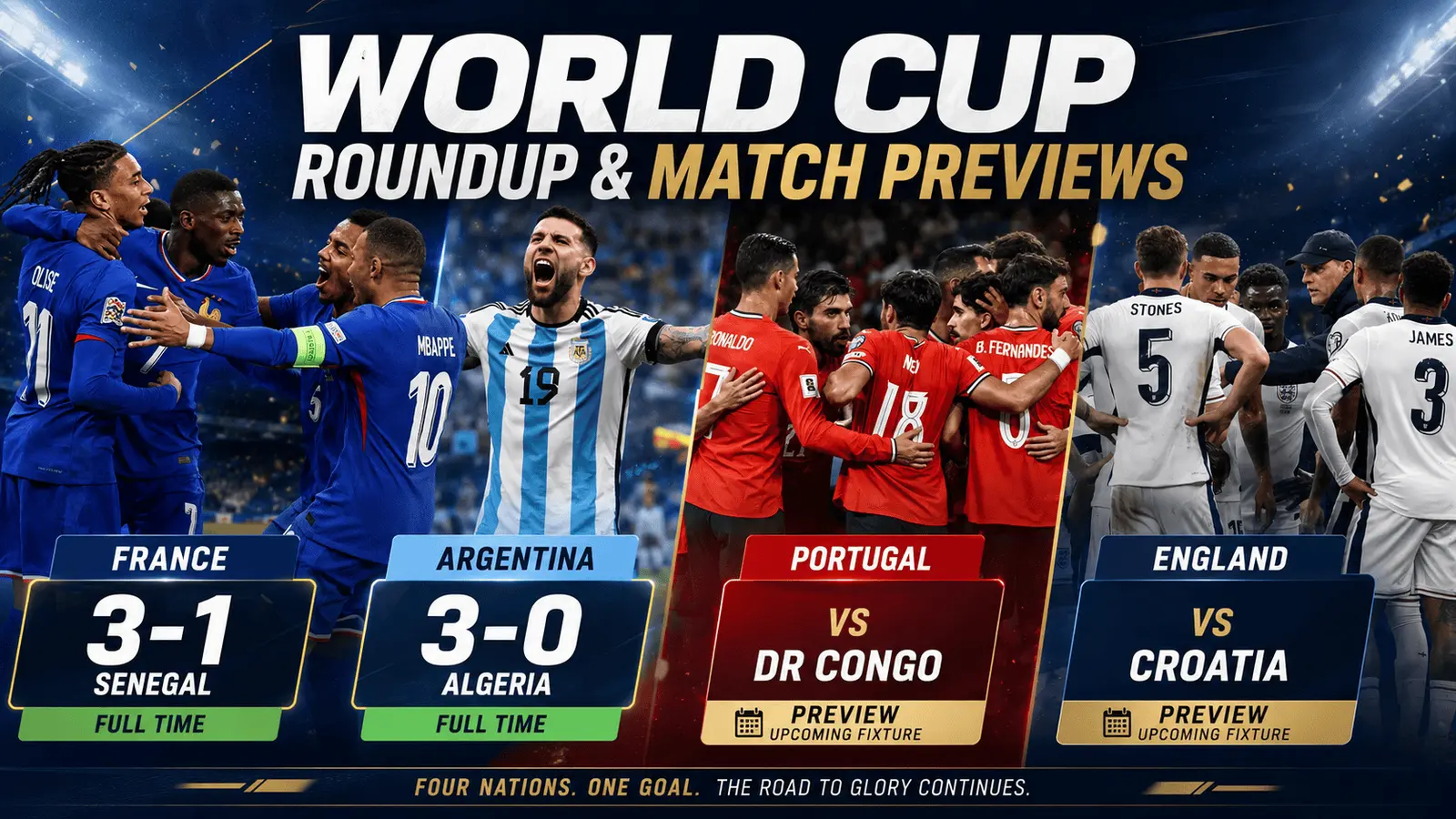
World Cup tournaments create their own momentum very quickly. Once one elite forward delivers, the attention shifts to the next. Lionel Messi has already produced a headline performance for Argentina, Kylian Mbappe remains central to France’s attacking threat, and Erling Haaland made an immediate mark for Norway with goals against Iraq.
That is the context around Cristiano Ronaldo and Harry Kane as Portugal face Congo DR and England meet Croatia. It is not just a question of individual finishing. It is a test of whether two teams with serious ambitions can provide their centre-forwards with the right platform.
Ronaldo: service matters as much as reputation
Ronaldo’s World Cup story is always bigger than a single match, but at this stage of his career the structure around him matters more than ever. Portugal cannot simply rely on his penalty-box instincts and expect the game to solve itself.
The key is supply: early crosses, second-ball pressure, runners around him, and enough width to prevent the centre-backs from defending in comfort. If Portugal move the ball too slowly, Ronaldo can become isolated. If they attack with speed and deliver into dangerous zones, his presence still changes how defenders behave.
Kane: England need more than a target man
Kane’s challenge is different. He is not only a finisher; he is also a connector. England often benefit when he drops off the front line, draws a centre-back out, and opens space for runners beyond him. But that strength can become a weakness if he is asked to do too much of the build-up himself.
Against Croatia, England’s balance will be important. If Kane spends the whole match linking play far from goal, England lose their most reliable penalty-box presence. If the wide players and attacking midfielders run beyond him at the right moments, Kane can become both creator and finisher.
The comparison with Messi, Mbappe and Haaland
The early tournament narrative has underlined a broader truth: elite forwards do not operate in a vacuum. Argentina protect Messi with runners and midfield coverage. France create space for Mbappe by adjusting their defensive line and attacking transitions. Norway ask Haaland to carry a larger share of the attacking burden than he usually does at club level.
Ronaldo and Kane now enter that same conversation. If they score early, the striker race becomes even more intense. If they are quiet, the debate will quickly shift toward age, tactical supply and whether their teams are maximising them.
What to watch
The decisive detail may not be the first shot. It may be the first pattern: how Portugal deliver into Ronaldo, how England create around Kane, and whether either team can avoid turning a world-class striker into a spectator.
Team Analysis
The Support System World Cup: Why Structure Is Beating Star Counting
Stop counting stars. Start reading the structure.
The World Cup often gets sold through individual names, but the football itself keeps pushing back. The early matches have shown that the best teams are not necessarily the ones with the most recognisable players. They are the ones whose roles make sense.
That is why Argentina, France, Spain, Cape Verde and Senegal make such useful case studies. Each side has exposed a different part of the same tactical truth.
Argentina: protect the genius, do not exhaust him
Argentina’s model is the clearest. Lionel Messi is still the attacking reference point, but the team is not built on asking him to play like a 25-year-old. It is built on protecting his energy and freeing his decision-making.
That is where players such as Rodrigo De Paul become vital. His value is not always captured by a highlight clip. He covers, presses, fills space and protects the zones Messi vacates or does not need to occupy. It is the old creative-core logic: a Pirlo needs a Gattuso; a Messi needs runners, cover and tactical discipline around him.
France: depth is a tactical weapon
France’s win over Senegal showed a different kind of support system. Their first-half structure did not fully click, but their squad gave Didier Deschamps enough options to correct it.
Moving Michael Olise into central spaces helped connect the attack. Dropping the defensive line created more room for transition. With Kylian Mbappe used as a central forward and France’s attacking midfielders able to rotate, the team became more dangerous once it stopped trying to force the first-half pattern.
France’s depth is not just insurance. It is a weapon because it allows them to become a different team during the same match.
Spain: possession still needs penetration
Spain’s draw with Cape Verde raised a familiar question: what happens when control does not turn into threat?
Spain were not short of talented footballers, and their late use of Lamine Yamal and Nico Williams showed that explosive wide options were available. But the timing and balance mattered. If width and direct running arrive too late, a disciplined opponent can settle into the match and protect the central areas.
Possession can tire opponents, but it can also become predictable if it lacks vertical speed, one-v-one threat and aggressive occupation of the box.
Cape Verde and Senegal: organisation can close the gap, but depth decides the long game
Cape Verde’s point against Spain was a triumph of discipline. Senegal’s strong first half against France was a triumph of familiarity and structure. Both teams showed that organisation can narrow the gap against more glamorous opponents.
The challenge comes later in the match. When elite teams adjust, the question becomes whether the underdog has equal-quality alternatives from the bench or a second tactical plan. Senegal’s first-half performance deserved respect, but France’s deeper squad allowed the match to tilt after the break.
The new tournament question
The modern World Cup is not asking which team has the best player. It is asking which team has the best ecosystem around its best player.
Argentina have one answer. France have another. Spain are still searching for sharper balance. Cape Verde have reminded everyone that discipline can still embarrass reputation. That is what makes this tournament compelling: the football is not a spreadsheet of names. It is a test of fit.
Player Performance
Messi, Olise and Haaland Show Three Ways a Star Can Change a World Cup Match
Not all star performances look the same
The World Cup has already produced several high-profile individual storylines, but the most interesting point is how different they are.
Lionel Messi is still changing matches through decision-making and threat. Michael Olise’s influence for France came through positioning and connection. Erling Haaland’s performance for Norway highlighted the difference between being a system finisher at club level and a responsibility striker for a national team.
Messi: the three-threat problem
Messi’s hat-trick in Argentina’s 3-0 win over Algeria was not only about finishing. It was about the problem he creates before he shoots.
Even at 38, Messi can still threaten in three ways. If a defender steps in, he can dribble. If the defender holds position, he can pass. If the defender drops too far, he can shoot. His hat-trick included a long-range strike and a rebound finish, but the deeper point was the hesitation he forced from Algeria’s back line.
That is why Argentina’s structure matters. Scaloni’s team does not need Messi to spend the match chasing lost causes. It needs him receiving in zones where one touch can change the game.
Olise: the connector France needed
France’s match against Senegal was a reminder that star-stacked attacks still need connectors. In the first half, France struggled for rhythm. The attacking pieces were there, but the relationships were not clean enough.
When Michael Olise moved into more central areas after the break, France’s attack looked more coherent. His role was not simply to beat a man or shoot on sight. It was to link the front line, improve the angles and help France attack space with better timing.
That kind of performance can be easy to underrate because it does not always dominate the highlight reel. But for a team with pace around him, the player who connects the attack can be as important as the player who finishes it.
Haaland: the national-team version carries more weight
Haaland’s goals for Norway against Iraq, scored in the 29th and 43rd minutes, sharpened another debate: why does the same player look different for club and country?
At Manchester City, Haaland is often viewed through the lens of elite service and penalty-box finishing. For Norway, the burden is broader. He must be more visibly decisive, more direct, and more responsible for turning limited platforms into goals.
That does not make one version more real than the other. It shows how role changes perception. A striker’s apparent “completeness” is often shaped by the tactical world around him.
The lesson
Messi, Olise and Haaland are not interchangeable examples of star power. Messi bends defensive psychology. Olise improves collective rhythm. Haaland converts responsibility into goals.
The World Cup is where these differences become obvious. The biggest names still matter — but only when the role fits the player.
Controversy and Talking Points
World Cup Fairness Is Bigger Than the 90 Minutes
Fairness does not begin at kick-off
Football likes to believe in the purity of the 90 minutes: same pitch, same ball, same laws. But a World Cup is never only the match. It is also visas, travel, hotel costs, ticket prices, training bases, recovery time and whether families and supporters can actually be there.
That is why the off-field debates around this tournament matter. They are not distractions from football. They are part of the football environment.
Cape Verde’s point carried a human cost
Cape Verde’s 0-0 draw with Spain was celebrated as a World Cup moment: a smaller football nation using discipline and organisation to hold a major contender. But the emotional force of that story also came from what surrounded it — the reality that family members of players could not simply appear in the stands to share the moment.
When costs, visa fees and travel barriers become too heavy, the World Cup becomes less global in practice than it is in branding. The teams may qualify, but their communities can still be priced or processed out of the experience.
Iran’s travel arrangement raises a competitive question
The Iran case points to a different kind of fairness. Iran were based in Mexico while playing in the United States, creating repeated cross-border travel demands of roughly 150 kilometres or a comparable distance around match activity. US immigration authorities were reported to have allowed the team to stay after a match before later requiring them to leave and return to Mexico.
If a team’s recovery routine is repeatedly disrupted by administrative arrangements, that is not just inconvenience. It can become a competitive condition. At tournament level, recovery is part of performance.
Ticket pricing changes who the World Cup belongs to
High ticket prices and dynamic pricing are not simply business details. They shape the crowd. They decide which fans can travel, which communities can gather, and whether the tournament feels like a global festival or a premium entertainment product.
Football’s emotional power depends on access. A World Cup without ordinary supporters, migrant communities and families of players loses part of its meaning.
Not every visa case is the same
It is important to separate different types of controversy. A team facing difficult travel logistics is not the same as an individual visa case involving disclosure obligations. In Thomas Partey’s case, the reported issue was a Canadian visa refusal linked to a failure to declare a legal case during the application process. That raises questions of immigration procedure and personal disclosure, not simply sporting unfairness.
Good commentary should be able to hold both ideas at once: tournament systems can be unfair, and visa rules can still involve legitimate administrative requirements.
The standard should be higher
A World Cup host must do more than provide stadiums. It must provide a workable tournament ecosystem for players, staff, families and supporters.
The question is not whether every inconvenience can be eliminated. It is whether the tournament’s structure respects the people who make it global. If the World Cup becomes accessible only to the wealthy, administratively powerful or conveniently located, then the fairness problem is not outside the game. It is built into it.