
World Cup Group Stage Lessons: Almirón Red Card, Brazil’s Vinícius Spark and Scotland’s Pay for Caution
Introduction
A World Cup group-stage analysis package built around two linked themes: how discipline and new anti-discrimination enforcement are changing match management, and how tactical clarity is separating teams that control their group fate from teams still relying too heavily on individual moments.
Match Preview
Scotland’s Brazil Test and Paraguay’s Australia Decider: The Group Stage Margins Are Shrinking
The next games are not just about qualification maths
The danger in a World Cup group stage is believing the table tells the whole story. It rarely does. Scotland go into their final match against Brazil with three points, while Brazil have four points and a superior goal difference. A win or draw would send Scotland through directly; defeat would leave them relying on the wider ranking of third-placed teams.
That is the arithmetic. The football question is whether Scotland can produce a performance bold enough to match the situation.
Against Morocco, Scotland lost 1-0 after I. Saibari’s second-minute goal and spent too long looking like a side trying to keep the damage manageable rather than a team chasing control. The final 15 minutes brought more urgency, but by then the match had already settled into Morocco’s preferred rhythm. Against Brazil, that kind of delayed response is a major risk.
Scotland cannot treat Brazil as a damage-limitation exercise
Brazil’s 3-0 win over Haiti restored some attacking confidence, and all three goals were directly connected to Vinícius. But the result should be read carefully. Haiti offered a different level of resistance from the elite sides Brazil will eventually need to beat, and Brazil still have structural questions around their full-backs, midfield balance and whether their attack has enough variety when Vinícius is tightly controlled.
For Scotland, that creates a narrow but real path. They cannot simply sit deep, wait, and hope the match stays alive. They need earlier pressure, quicker forward transitions and a more assertive role from their central runners. Scott McTominay, in particular, has to influence the emotional and physical temperature of the game rather than drifting through long spells.
If Scotland press too late, Brazil may already have the game where they want it. If Scotland press recklessly, Vinícius and Brazil’s forwards will get space to run into. The balance is difficult, but passive football is the worst option.
Paraguay versus Australia is almost a straight knockout tie
Paraguay’s 1-0 win over Turkey, sealed by Matías Galarza’s second-minute goal, kept them alive. The next meeting with Australia has a clear shape: both teams are on three points, and the winner takes second place directly. A draw would favour Australia for second on goal difference, while Paraguay would still have a strong chance of progressing with four points as one of the best third-placed sides. The loser would have to wait on results elsewhere.
Australia’s issue is timing. Against the United States, they were beaten 2-0 after another early American surge, with Cameron Burgess’ own goal in the 11th minute and Alex Freeman’s goal in the 43rd leaving them chasing the game. The later introduction of more direct attacking options made sense in theory, but by then the match state had already changed.
Against Paraguay, Australia cannot afford to discover their urgency too late. Paraguay are comfortable defending a lead and countering from a compact shape. Give them the first goal, and the game becomes exactly the kind of contest they want.
Brazil still need a stronger test
Brazil’s win over Haiti was encouraging, especially for Vinícius, but it was not a complete answer. Casemiro played the full match and looked more comfortable, but that may say as much about the opponent’s pressure as it does about Brazil’s long-term midfield ceiling. Endrick’s disallowed goal underlined the attacking talent available, while Rayan’s introduction for Raphinha also pointed to a younger, more explosive direction.
The real test comes when Brazil face a side capable of denying easy progression through the wings and forcing their midfield to control uncomfortable phases. Scotland may not be a tournament favourite, but they can still ask sharper questions than Haiti did — if they approach the match with enough ambition.
The group stage is now about nerve
At this stage, qualification scenarios matter. But nerve, structure and discipline matter more. Scotland need to show they can chase a result before the final quarter-hour. Australia need to act earlier rather than wait for a match to turn against them. Paraguay need to keep their discipline after a win overshadowed by a major red-card incident. Brazil need to prove that a Vinícius-led attack can survive a stronger examination.
The table gives each side a route. Their tactical choices will decide whether they take it.
Post-Match Review
World Cup Review: Red Cards, Early Goals and the Teams That Understood the Moment
A group-stage round defined by early control
This set of World Cup group matches had a recurring pattern: early goals changed the emotional structure of games, and the teams best equipped to protect or exploit those moments came away strongest.
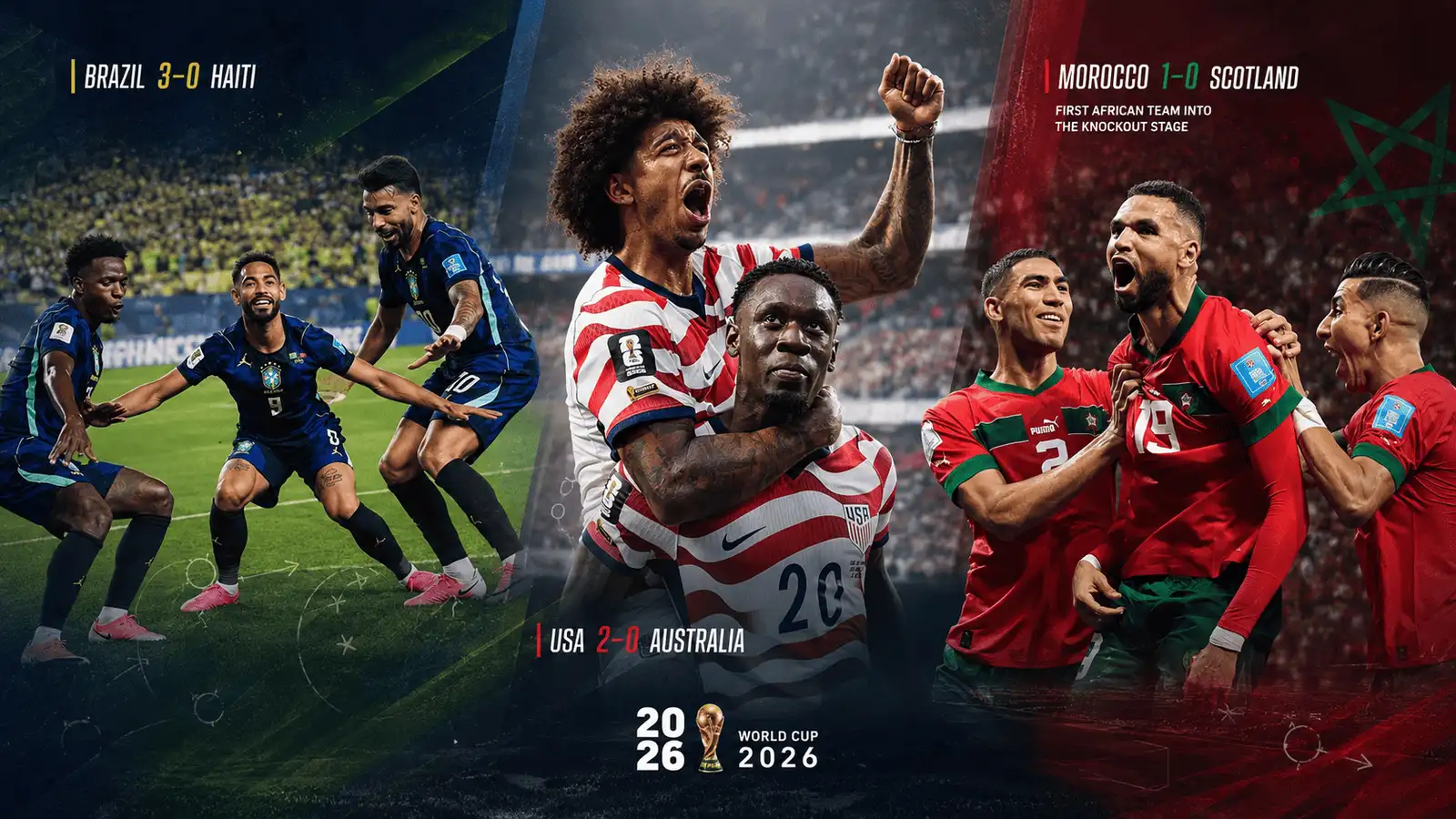
Paraguay beat Turkey 1-0 through Matías Galarza’s second-minute goal. Morocco defeated Scotland 1-0 after I. Saibari struck in the second minute. Brazil beat Haiti 3-0, with Vinícius directly involved in all three goals. The United States defeated Australia 2-0, helped by Cameron Burgess’ 11th-minute own goal and Alex Freeman’s 43rd-minute finish.
The results were important. The lessons behind them were more revealing.
Paraguay won, but the red card became the story
Paraguay’s win over Turkey should have been remembered primarily as a disciplined low-block performance after an early lead. Instead, Miguel Almirón’s red card in first-half stoppage time became the defining incident.
Almirón was dismissed under the newly introduced enforcement approach around covered-mouth communication during confrontations, linked to suspected offensive or discriminatory language. The point is not to publicly declare what he said. The point is that football’s authorities are trying to remove a familiar evidence gap: if a player covers his mouth while confronting an opponent, the act itself can now carry severe consequences.
That makes this incident bigger than Paraguay’s three points. It is a warning to players, coaching staffs and federations that anti-discrimination rules are moving from slogans to punishments with immediate competitive impact.
Turkey’s problem was not just the red card advantage they failed to use
Turkey had a man advantage after Almirón’s dismissal, but they still could not break Paraguay down. That should concern them more than the result itself.
The criticism of Turkey is structural. Arda Güler was used in a role that demanded traditional No. 10 occupation between midfield and attack, but his natural game often involves drifting, dropping and receiving in different lanes. Hakan Çalhanoğlu was positioned deeper, limiting a potential source of higher attacking organization. Kenan Yıldız, placed wide left, struggled to provide the kind of impact Turkey needed.
The outcome was a familiar tournament failure: talented individuals operating near each other without becoming a functioning attacking unit. Turkey are eliminated, and the manner of it raises serious questions about Vincenzo Montella’s planning.
Morocco are past the “dark horse” label
Morocco’s 1-0 win over Scotland confirmed something that has been building for a while: this is not a team surviving on novelty or emotion. Morocco are mature, compact, physically serious and comfortable managing matches after taking the lead.
They now have four points and have advanced. Their recent World Cup identity — including the run that took them past major European opponents on the way to the semi-finals last time — is no longer a one-off reference point. It is part of a broader competitive profile.
Scotland, by contrast, looked too passive for too long. Their late push showed they had more to offer, which only made the preceding caution more damaging.
Brazil won well, but the analysis must stay measured
Brazil’s 3-0 victory over Haiti was built around Vinícius, whose influence touched all three goals. He looked sharp, confident and increasingly leader-like in the national-team shirt.
Still, this was not the night to declare Brazil’s problems solved. Haiti were widely regarded as the group’s weakest opponent, and Brazil’s full-back contribution remains a point to watch. Casemiro’s comfort in midfield was encouraging, but it came in a match where the pressure level was manageable.
Brazil have elite talent and Carlo Ancelotti’s authority on the touchline, but their tournament ceiling will be judged against sides capable of denying rhythm, not only against opponents they can overwhelm through individual quality.
The United States showed a higher floor without Pulisic
The United States’ 2-0 win over Australia was significant because Christian Pulisic was absent and the team still found a route to victory. Weston McKennie’s free role gave the side energy, coverage and connective responsibility, while the American habit of starting quickly again paid off.
The concern is what happens after the opening surge. For the second time, the United States benefited from an early breakthrough and then had spells where control dropped. That may be enough in the group stage. Against stronger opponents, it becomes a vulnerability.
Australia, meanwhile, looked too conservative for too long. Their more direct attacking options arrived after the game had already tilted away from them.
The strongest teams are making cleaner choices
The round’s major lesson is simple: the teams with clear identities are moving forward. Morocco know how to protect a lead. Brazil know where their most dangerous player is. The United States have enough structure to survive without their captain. Paraguay know how to defend a game state.
The teams in trouble are the ones hesitating between plans: Turkey between individual talent and team structure, Scotland between caution and courage, Australia between patience and urgency.
At a World Cup, that hesitation can be fatal.
Team Analysis
Structure Beats Talent: What Turkey, Morocco, Brazil and the USA Revealed About Tournament Football
Tournament football punishes unclear teams
The difference between a good squad list and a good tournament team is structure. The latest World Cup group-stage matches made that painfully clear.
Turkey had gifted players on the pitch against Paraguay, but their 1-0 defeat confirmed a deeper problem. Paraguay’s early goal allowed them to retreat into a compact defensive shell, yet Turkey’s man advantage after Miguel Almirón’s red card still did not produce a convincing attacking solution. The issue was not effort. It was spacing, role definition and attacking rhythm.
Turkey’s attacking pieces did not fit together
Arda Güler, Hakan Çalhanoğlu and Kenan Yıldız are all technically interesting players, but they were not arranged in a way that maximized each other.
Güler was asked to operate like a conventional No. 10, but he is not at his best simply waiting between the lines behind a striker. He wants to move, drop, drift and receive in different zones. Çalhanoğlu, stationed deeper, was removed from areas where his passing could have connected the final third. Yıldız, used from the left, was quiet and unable to stretch Paraguay consistently.
That created a team full of potential contacts but short of actual combinations. Turkey’s elimination reflects more than two bad results; it reflects a failure to turn individual ability into a tournament mechanism.
Morocco’s strength is no longer surprising
Morocco’s win over Scotland was the opposite case. They scored early through I. Saibari and then managed the match with composure. Their defending was organized, their intensity controlled, and their use of energy mature.
That is why the “dark horse” label no longer fits. Morocco now look like a side with a stable competitive identity. They can defend deep without looking desperate, they can absorb pressure without losing shape, and they can still threaten when they enter the opposition half.
Their four-point total has already taken them through, but the more important point is stylistic: Morocco look like a team built for knockout football.
Brazil’s ceiling is high, but the sample is incomplete
Brazil’s 3-0 win over Haiti was driven by Vinícius, who was directly involved in all three goals. That is a powerful attacking foundation. Under Carlo Ancelotti, Brazil also have a manager with the authority to organize elite talent without flattening its creativity.
But Brazil still need a harder examination. The full-back positions did not provide the kind of relentless attacking production once associated with the country’s great wide defenders. Casemiro’s full-match performance was stable, yet the opponent’s level must be considered before drawing broader conclusions.
Brazil look dangerous. They do not yet look fully answered.
The United States are building a reliable floor
The United States’ 2-0 win over Australia showed a different kind of progress. Without Christian Pulisic, they still had enough collective structure to win. Weston McKennie’s free role mattered: he covered ground, connected phases and gave the side a source of personality when its captain was missing.
The warning is control. The USA have won by starting fast, but matches are not only decided in the first 20 minutes. If opponents survive the early pressure, the Americans must prove they can manage the middle and later phases with the same authority.
Australia and Scotland paid for caution
Australia and Scotland were not identical, but they shared a problem: both seemed too willing to let the match come to them. Australia waited before unleashing more direct attacking options against the United States. Scotland waited too long to push with real conviction against Morocco.
In tournament football, caution can be rational. But there is a line between managing risk and surrendering initiative. Both sides walked too close to that line.
The lesson: clarity is a competitive advantage
At this stage of a World Cup, teams do not need to be perfect. They need to be coherent.
Morocco are coherent. The United States are becoming more coherent. Brazil have an obvious attacking reference point, even if questions remain. Paraguay know how to defend a lead.
Turkey, Scotland and Australia have enough talent or physical capacity to compete, but the recent evidence suggests they need cleaner decisions earlier. In tournament football, clarity is not a luxury. It is survival.
Player Performance
Vinícius Leads, McKennie Roams and Güler Miscast: The Players Who Defined the Group Stage Round
Vinícius looked like Brazil’s reference point
Brazil’s 3-0 win over Haiti was the clearest individual statement of the round. Vinícius was directly involved in all three goals and played with the kind of authority Brazil need from him if they are to go deep.
What stood out was not only the end product. It was the confidence of his carries, the willingness to attack defenders, and the sense that Brazil’s attack had a clear emotional and tactical reference point. In the national team, Vinícius appears to be playing with a strong sense of responsibility and freedom.
The caution is obvious: Haiti were not the strongest measure of Brazil’s ceiling. But the performance still matters. Brazil need Vinícius to feel central, not peripheral. In this match, he did.
McKennie gave the USA personality without Pulisic
Christian Pulisic’s absence could have left the United States short of identity. Instead, Weston McKennie helped fill the leadership and connective gap.
Operating with freedom, McKennie gave the USA energy across zones. He was not simply a runner; he was a stabilizer, a pressure outlet and a player willing to take responsibility when the match moved away from the opening surge.
The USA’s 2-0 win over Australia does not mean they are better without Pulisic. It means their floor is higher than it once was. That is an important distinction.
Güler’s quality was trapped in the wrong role
Arda Güler remains one of Turkey’s most gifted players, but his use against Paraguay highlighted a problem. Asking him to function as a fixed, traditional No. 10 does not fully match his natural rhythm.
Güler likes to move into different receiving lanes. He can drop, drift wide and help build play rather than simply waiting behind the striker. When Turkey needed him to be the constant final-third connector, the role looked too narrow for his current profile.
That is not a criticism of his talent. It is a criticism of the fit.
Çalhanoğlu was too far from the areas Turkey needed him
Hakan Çalhanoğlu’s deeper positioning also limited Turkey’s attacking fluency. There are reasons to use him deeper, especially given his club experience and passing range, but in this match Turkey needed more quality closer to Paraguay’s defensive block.
When a team is chasing a compact opponent, it needs passers who can play around and through pressure in advanced zones. Turkey too often looked as if their best organizer was starting from too far away.
Yıldız could not provide the missing spark
Kenan Yıldız struggled to impose himself from the left. Whether that was form, role, service or match context, the effect was the same: Turkey lacked the wide threat needed to stretch Paraguay’s defensive shape.
When central combinations are not working, wide players become essential. Turkey did not get enough from that channel.
Casemiro, Endrick and Brazil’s supporting cast still need context
Casemiro played the full match for Brazil and looked comfortable, but the opponent matters. A strong performance against Haiti should be noted, not overextended. The bigger test is whether he can maintain that comfort against teams that press harder and move the ball faster.
Endrick’s disallowed goal, ruled out for offside, still offered a glimpse of his sharpness. Rayan’s introduction for Raphinha added youthful energy. Matheus Cunha’s performance before being replaced by Endrick was also part of a positive attacking night.
Brazil’s squad depth is real. The challenge is turning that depth into a balanced tournament structure.
Individual form only matters when the role is right
The round’s player lesson is clear: influence depends on context. Vinícius was empowered. McKennie was trusted. Güler was constrained. Çalhanoğlu was distanced from the areas where Turkey needed him most.
At a World Cup, talent rarely disappears. It is either released by the structure or trapped inside it.
Controversy and Talking Points
Almirón’s Covered Mouth Red Card Is Bigger Than Paraguay’s Win — But It Must Be Discussed Carefully
A red card that changes the conversation
Paraguay beat Turkey 1-0, but the match’s lasting significance may be Miguel Almirón’s red card in first-half stoppage time.
The dismissal came under the new enforcement approach around players covering their mouths during confrontations, where suspected offensive or discriminatory language is at issue. The principle is severe: if a player creates an evidence gap by covering his mouth while facing an opponent, he can expose himself to a direct red card.
That is why this incident is bigger than one group-stage result.
Football is trying to close the evidence gap
For years, one of football’s hardest problems has been proving exactly what was said in confrontations. Players cover their mouths. Cameras lose the angle. Audio is unavailable. Opponents report abuse, but the process becomes trapped in uncertainty.
The new approach changes the emphasis. Instead of asking only whether the words can be proved after the fact, it punishes conduct that can prevent those words from being assessed in the first place. In plain terms: if you cover your mouth during a confrontation and the exchange is alleged to involve offensive or discriminatory language, you may face the harshest on-field punishment.
That is a major shift. It gives anti-discrimination rules teeth.
The distinction matters: rule enforcement is not public conviction
This is also where football commentary must be careful. It is legitimate to say Almirón was sent off under the covered-mouth confrontation rule. It is legitimate to say the rule is designed to address suspected abusive or discriminatory exchanges. It is not responsible to publicly state as fact what exact words were used unless the official process establishes them.
Supporting the red card as a regulatory tool is not the same as declaring a player guilty of a specific slur in public discourse.
That distinction protects both the seriousness of anti-discrimination work and the fairness of commentary around individual cases.
Why the rule will divide opinion
Supporters will argue that football had to act. If the sport waits for perfect evidence in situations where evidence is deliberately obscured, the system becomes easy to manipulate. A deterrent rule changes player behaviour immediately: do not cover your mouth in a confrontation, and do not create ambiguity around abusive speech.
Critics will argue that the threshold is too low. They will ask whether a red card can be justified when the public cannot hear the words and when covering the mouth has also been common in ordinary tactical or emotional exchanges.
Both concerns are real. But the direction of travel is clear: football’s authorities are prioritizing deterrence and protection over the old comfort of plausible deniability.
Discipline is now part of tactical preparation
For Paraguay, the incident is a warning even inside a victory. They earned a critical three points, but losing a senior attacker to a preventable disciplinary incident can reshape a tournament.
For every other team, the lesson is even simpler. Rule education is no longer administrative background noise. It is competitive preparation. Players must know that certain behaviours — even before the exact words are publicly established — can carry decisive consequences.
The wider talking points
The round also had other controversies. Ilgiz Tantashev’s handling of Scotland versus Morocco drew criticism for a permissive threshold on tactical fouls, with the match producing only one yellow card. Such debates are familiar: a lenient referee can help rhythm in one match and suffocate a chasing team in another.
There is also a separate, more serious off-field discussion around Achraf Hakimi, who faces legal proceedings over serious allegations. That topic belongs in a different register: cautious, legally precise and without prejudging the outcome.
But the Almirón incident is the defining on-field controversy because it marks a cultural and regulatory line. Football is telling players that the old habits around concealed speech are no longer harmless. The game is changing, and the players who fail to adapt may cost their teams more than a free kick or a booking. They may cost them a tournament.