
World Cup Group Stage Analysis: Japan’s Tactical Leap, Germany’s Unanswered Questions and...
Introduction
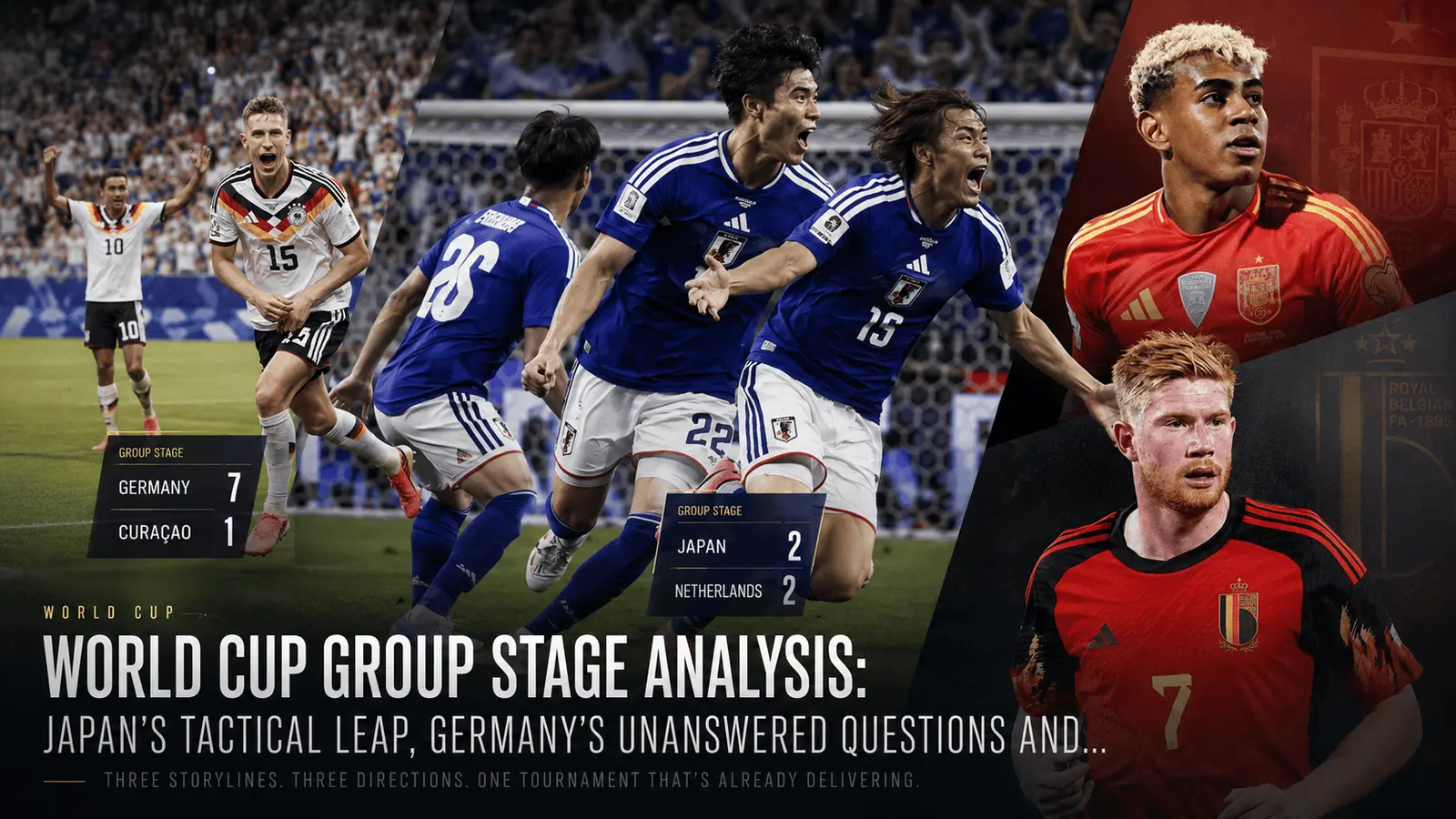
A World Cup-focused football package built around the idea that similar results can carry very different meanings: Germany’s 7-1 win still leaves questions, Sweden’s 5-1 shows the danger of giving elite forwards space, Japan’s 2-2 draw with the Netherlands points to a maturing tactical identity, and Ivory Coast’s late 1-0 win over Ecuador changes the logic of their group.
Match Preview
World Cup Preview: Spain, Belgium, Uruguay and Iran Face Very Different First Round Tests
The next set of World Cup group-stage fixtures offers four very different kinds of test: Spain vs Cape Verde, Belgium vs Egypt, Saudi Arabia vs Uruguay, and Iran vs New Zealand.
On paper, Spain and Belgium will be expected to control their matches. But group-stage football rarely rewards reputation alone. The first round often exposes whether a favourite can turn territorial dominance into goals before the match becomes tense.
Spain vs Cape Verde: control is only useful if it becomes pressure
Spain’s likely challenge is familiar: dominate the ball, compress the pitch, and break down a side that may be comfortable defending deep for long spells.
The key question is not whether Spain can have possession. It is whether their possession can create enough clear chances early enough to prevent the match from becoming a test of patience. Against an organised underdog, the first goal changes everything. Without it, the favourite can start playing against the clock as much as the opponent.
Cape Verde’s route into the match is likely to depend on defensive compactness, set-pieces and transition moments. If they can survive the opening pressure, Spain’s decision-making in the final third becomes the story.
Belgium vs Egypt: the most watchable tactical contrast
Belgium against Egypt may be the most intriguing fixture of the group. Belgium should carry the greater individual quality, but Egypt have the profile to make this more than a simple possession exercise.
The tactical question is whether Belgium can impose their attacking rhythm without leaving counter-attacking space. Egypt’s best chance is to make the game physical, disciplined and uncomfortable, then attack quickly when Belgium’s structure stretches.
For Belgium, this is a match about authority. For Egypt, it is about making a technically superior opponent play in conditions they do not enjoy.
Saudi Arabia vs Uruguay: preparation could matter
Uruguay’s build-up has included an official documentation and travel-related issue that was later resolved. The match itself will show whether the disruption had any practical impact.
That does not mean Uruguay should be downgraded dramatically. But tournament football is sensitive to small margins: slow starts, heavy legs, delayed rhythm, and concentration lapses after the hour mark. If Uruguay look sharp from the opening minutes, the issue becomes background noise. If they look flat, it becomes part of the tactical story.
Saudi Arabia’s opportunity is to turn the game into a tempo contest. If they can keep Uruguay from settling, the favourite may have to win through resilience rather than fluency.
Iran vs New Zealand: rhythm after disruption
Iran’s preparation has been complicated by entry, passport, training-ground and relocation issues. Those factors matter because they affect the invisible parts of football: sleep, recovery, training rhythm, pressing coordination and mental clarity.
Against New Zealand, Iran will need to show that the disruption has not damaged their organisation. If their distances are right and their pressing is synchronised, they can still play to their strengths. If the preparation problems appear in loose passing, slow recovery runs or broken pressure, the match could become far more uncomfortable.
New Zealand’s task is to test those seams early. A disrupted favourite is most vulnerable before it finds rhythm.
The broader theme: group-stage football is about control, not just quality
These fixtures arrive after a first wave of results that showed how quickly group-stage logic changes. Germany won big, but still need a stronger test. Japan drew with the Netherlands and looked tactically mature. Ivory Coast turned a likely stalemate into a win through Amad Diallo’s late intervention.
The lesson is simple: first-round matches are not only about talent. They are about preparation, patience, risk and timing.
Post-Match Review
World Cup Review: Japan’s Tactical Leap, Germany’s Big Score Illusion and Amad’s Late Shock
Four group-stage results produced four very different messages.
Germany beat Curacao 7-1. Sweden defeated Tunisia 5-1. The Netherlands and Japan drew 2-2. Ivory Coast edged Ecuador 1-0 through a late Amad Diallo goal.
The temptation is to sort those matches into simple categories: big teams winning big, underdogs suffering, contenders dropping points. But that misses the more interesting point. The same kind of result can mean very different things depending on how it was created.
Germany 7-1 Curacao: impressive, but not definitive
Germany’s 7-1 win over Curacao was emphatic on the scoreboard. Felix Nmecha, Nico Schlotterbeck, Kai Havertz, Jamal Musiala, Nathaniel Brown and Deniz Undav were all among the German scorers, with Havertz scoring twice, including a penalty. Curacao’s Livano Comenencia scored in the 21st minute, giving the debutants a historic moment even in a heavy defeat.
Yet the match should not be read as proof that Germany have solved everything.
Curacao’s bravery was part of the story. After making it 1-1, they continued to play with ambition rather than retreat completely. That gave Germany space to attack and eventually turned the game into a rout. Germany punished that space ruthlessly, but they were not forced to answer the hardest tournament questions: how stable is the defence under sustained pressure, and how secure is the team when elite opponents deny them easy transition routes?
Manuel Neuer’s return also adds a layer of scrutiny. The debate is not whether he remains an important figure. It is whether the memory of his peak makes every ordinary moment look more severe. Great goalkeepers are judged against their own standards, and Neuer’s standard has always been unusually high.
Sweden 5-1 Tunisia: space plus elite forwards is a dangerous equation
Sweden’s 5-1 win over Tunisia had a different meaning. Yasin Ayari scored early and late, Alexander Isak and Viktor Gyokeres both found the net, and Mattias Svanberg also scored. Tunisia’s goal came through Omar Rekik.
This was less about a favourite simply overpowering a weaker side and more about what happens when a team feels pressure to open up. Once Tunisia were drawn into a more expansive game, Sweden’s forward quality became decisive.
Isak and Gyokeres are dangerous because they can punish space in different ways. If opponents defend deep, Sweden still have questions to answer. But if the game opens up, that strike pairing can turn small structural mistakes into major damage.
Netherlands 2-2 Japan: a draw that says more about Japan than the Netherlands
The Netherlands twice led Japan through Virgil van Dijk and Crysencio Summerville, but Japan responded through Keito Nakamura and Daichi Kamada, with the 89th-minute equalising sequence involving Koki Ogawa’s attacking presence.
For Japan, this was not a lucky point. It looked like a clear tournament model: build a defensive base, accept periods without the ball, then raise the pressure when the match state demands it.
That is the difference between a team merely surviving and a team managing risk. Hajime Moriyasu’s side did not play as a classic underdog waiting for one break. Japan carried threat on both sides: Ritsu Doan on the right, Nakamura on the left, Junya Ito as a late accelerator, and Ogawa as a penalty-box option.
Zion Suzuki’s performance mattered too. With four saves from six shots on target faced, he gave Japan the security needed to keep the plan alive.
For the Netherlands, the draw will feed two debates. The first is Ronald Koeman’s risk management after the lead. The second is more structural: can this Dutch team consistently turn good positions into enough goals? The concern around the centre-forward role will not disappear after a match like this.
Ivory Coast 1-0 Ecuador: Amad changes the group equation
Ivory Coast’s 1-0 win over Ecuador was a very different kind of match. As the game moved late, it seemed to be drifting toward a result both sides might have been able to live with. Then Amad Diallo found the moment.
His late winner should not be framed as anything more complicated than elite competitive instinct. When a forward receives space in a dangerous area, he shoots. That decision changed the match, the mood and the group dynamic.
For Ivory Coast, it brings immediate control. For Ecuador, it raises the hardest post-match question: why did concentration and pressure drop at the moment when the game looked almost settled?
The bigger lesson
Germany and Sweden both won heavily, but their wins did not say the same thing. Japan and Ivory Coast both changed the tone of their groups, but in very different ways. The Netherlands dropped points, yet the bigger concern may be structural rather than psychological.
That is the real story of the opening group-stage wave: scorelines are only the surface. The meaning sits underneath.
Team Analysis
Japan Are No Longer Just a Brave Underdog — Their System Now Looks Tournament Ready
Japan’s 2-2 draw with the Netherlands should be remembered less as a surprise result and more as a tactical statement.
This was not simply an Asian side fighting above its weight. It was a team with a recognisable tournament plan: protect the base, stay in the match, then change the risk level when the scoreline demands it.
The defensive base comes first
Hajime Moriyasu’s approach begins with a clear acceptance of tournament reality. Against elite opponents, 0-0 is not failure. It is a platform.
Japan did not need to dominate the Netherlands from the start to prove progress. Their progress was in the way they managed the match state. They were prepared to absorb, keep distances compact and avoid turning the game into a contest of open-field Dutch athleticism.
That is maturity. It is also why Japan no longer fit the simple “hard-working underdog” label.
The switch after falling behind
The more interesting part of Japan’s plan comes when they fall behind. That is when the side becomes more aggressive, pushes higher and brings its attacking layers into the match.
Keito Nakamura’s 57th-minute equaliser was important not just because it made the score 1-1, but because it validated Japan’s left-sided threat. Ritsu Doan offered balance from the right. Junya Ito’s introduction gave Japan late speed and directness. Koki Ogawa added a different penalty-box profile and helped make the 89th-minute equalising phase possible.
Japan now have more than one route to goal. That matters enormously in tournament football.
Substitutes are part of the plan, not an emergency button
Ito’s role is especially revealing. Some players are more valuable when they start. Others are more damaging when introduced against tired defenders and stretched structures.
For Japan, Ito looks like the latter type. His pace, delivery and ability to attack unsettled defensive lines make him an ideal late-game weapon. Used correctly, he is not a backup option. He is a planned change of temperature.
That is a sign of squad maturity.
Suzuki changes the risk equation
Goalkeeper Zion Suzuki also deserves attention. Against the Netherlands, he conceded twice but made four saves from six shots on target faced, with expected goals on target conceded listed at 2.16.
Those numbers fit the eye test: Japan were not protected by perfection, but they were protected by a goalkeeper who kept the team alive. When the goalkeeper is stable, the entire defensive model has more tolerance for pressure.
Why Europe should take Japan seriously
The Netherlands’ caution after Japan increased the tempo should be read as a compliment. Teams do not manage risk against opponents they do not respect.
Japan are not yet a finished superpower. But they are no longer a team whose best hope is chaos, emotion and one perfect counter-attack. They have structure. They have wide threats. They have late-game options. They have a goalkeeper growing into the level.
Most importantly, they have a plan for strong opponents.
That is what makes the Netherlands draw significant. The result was good. The method was better.
Player Performance
Keito Nakamura, Junya Ito and Zion Suzuki Show Why Japan’s Ceiling Is Rising
Japan’s 2-2 draw with the Netherlands was a system performance first, but systems only work when the right players give them life.
Against a physically powerful Dutch side, Japan’s most encouraging signs came from the way different players solved different problems.
Keito Nakamura: left-sided threat with end product
Keito Nakamura’s 57th-minute goal was the clearest reward for an active performance. He had already been lively in the first half, and his equaliser showed that Japan’s left flank is now more than a supporting lane.
That matters because Japan have often been discussed through individual technical stars or collective discipline. Nakamura adds something more direct: repeated threat from wide areas and the ability to turn pressure into a goal.
Ritsu Doan: balance on the opposite side
Ritsu Doan’s role is important because he prevents Japan from becoming one-sided. With Doan on the right and Nakamura on the left, Japan can stretch opponents horizontally and make defensive shifts harder.
That balance is central to Moriyasu’s model. If opponents overload one side, Japan can escape through the other.
Junya Ito: the late-game accelerator
Junya Ito may be Japan’s most valuable rhythm-changing option. His impact is not just about pace. It is about timing.
When defenders are fresh, Ito is dangerous. When defenders are tired, he can transform the match. That is why his best role may be as a planned second-half weapon rather than a player asked to spend himself from the opening whistle.
Against the Netherlands, his introduction helped Japan move into a more aggressive phase and gave the Dutch back line a different kind of problem.
Koki Ogawa: a new penalty-box profile
Koki Ogawa gives Japan something they have not always had at this level: a forward who can influence the box through aerial presence and direct occupation of central defenders.
The 89th-minute equalising sequence, finished by Daichi Kamada, was tied to that kind of penalty-area pressure. Japan’s attack becomes harder to defend when it is not only about combinations and wide movement, but also about a credible target in the box.
Zion Suzuki: stability under elite pressure
Zion Suzuki conceded twice, but his performance should be viewed in context. He made four saves, faced six shots on target and had expected goals on target conceded of 2.16.
That is the profile of a goalkeeper who kept his team within reach. For Japan, that is crucial. Their tactical plan requires periods of defensive suffering. If the goalkeeper collapses, the plan collapses. Suzuki did not.
The collective meaning
Nakamura brings width and finishing. Doan brings balance. Ito brings late acceleration. Ogawa brings a box presence. Suzuki brings security.
That is why Japan’s ceiling is rising. This is no longer a team dependent on one match-winner or one emotional surge. It is a squad with roles that fit together.
Controversy and Talking Points
Was Koeman Too Conservative? The Netherlands Debate Is Really About Respecting Japan
When the Netherlands draw 2-2 with Japan after twice taking the lead, criticism is inevitable.
Ronald Koeman will be accused of caution. The substitutions will be framed as a coach trying to protect a result rather than kill the match. Supporters will ask why a side with Dutch talent and physical superiority should manage the final phase so carefully.
Those criticisms are understandable. They are also incomplete.
Caution can be weakness — or tournament logic
In club football, a team leading and then retreating often looks like a failure of ambition. In tournament football, the calculation is different.
A group-stage draw against a strong opponent can be acceptable if it protects the broader path. Coaches do not only manage the next attack. They manage points, fatigue, goal difference, suspension risk and psychological damage.
That does not mean Koeman got everything right. But it does mean the word “conservative” needs context.
Japan forced the decision
The more revealing point is that the Netherlands felt they had something to manage.
Japan’s second-half response was not random. They had width through Keito Nakamura and Ritsu Doan, late acceleration through Junya Ito and a box threat through Koki Ogawa. Once Japan raised the tempo, the Dutch had to decide whether to keep the game open or reduce risk.
Choosing control was not only about Dutch caution. It was also an acknowledgement of Japanese danger.
The centre-forward issue makes caution look worse
The biggest Dutch concern may not be Koeman’s personality or one substitution window. It may be the centre-forward problem.
The Netherlands can produce strong defenders, wide players, ball carriers and athletes. But if the team cannot consistently turn pressure into a two-goal cushion, every lead becomes fragile. That is when a coach becomes more conservative, and that is when fans become more frustrated.
A team that trusts its finishing can keep attacking. A team that doubts its ability to finish often starts protecting.
The Van Dijk talking point
Virgil van Dijk’s physical duel with a Japanese defender also became part of the post-match discussion. The incident sits in the grey area that always follows elite centre-back play: positioning, strength, timing and contact can look like experience to one side and a foul to the other.
That is exactly why the debate is difficult. Top defenders do not always dominate through obvious force. Sometimes they win through small details that test the referee’s threshold.
The real conclusion
Koeman may have been cautious. But the Netherlands were cautious against a Japan side that had earned respect.
That is the part of the debate that should not be lost. The match did not just expose Dutch conservatism. It confirmed Japan’s arrival as a team capable of making major football nations rethink their risk.