
World Cup Group Stage Analysis: Mexico’s Control, Korea’s Warning Signs and Canada’s Structural Leap
Introduction
A World Cup group-stage analysis package focused on why the scoreline alone can mislead: Mexico looked controlled rather than spectacular, South Korea lost because one goalkeeper error exposed deeper structural questions, Canada’s shape suddenly made sense, Switzerland’s 4-1 win still left tactical doubts, and several red-card incidents reopened the debate about VAR, player safety and the 48-team tournament format.
Match Preview
Final Group Matches Preview: Mexico Can Rotate, Korea Must Rebuild, Czechia Need More Than Set Pieces
The final round of this group arrives with Mexico in the strongest position. With six points already secured, Mexico have become the first team confirmed through to the knockout stage of this World Cup. That changes the tone of their match against Czechia: it is no longer only about survival, but about management, rotation and preserving tactical control.
For South Korea, the situation is more delicate. They remain on three points after the 1-0 defeat to Mexico, and the final match against South Africa should still leave them well placed if they avoid a damaging result. But qualification alone should not satisfy Hong Myung-bo. The defeat to Mexico exposed a question that will follow Korea into any knockout tie: can they keep asking Son Heung-min to absorb so much front-line work?
Mexico vs Czechia: a rotation opportunity, not a free pass
Javier Aguirre has room to manage his squad. Mexico’s structure has looked mature: they do not need to dominate the ball for long spells to control the emotional rhythm of a match. Against South Korea, they stayed patient, waited for the decisive error and protected the game state after going ahead.
That makes the Czechia match interesting. Mexico could give minutes to players such as Santiago Giménez, Mora, Guillermo Ochoa or Raúl Rangel, but rotation does not have to mean a loss of seriousness. The best tournament teams use matches like this to test alternatives while keeping the same competitive habits.
Czechia, meanwhile, cannot rely on hope. They sit on one point, and a draw against Mexico would leave them dependent on the wider third-place picture. A win would open a much stronger route, potentially as group runners-up or as one of the best third-placed teams. The problem is not simply the table. The problem is performance identity.
Czechia scored early against South Africa through a long-throw routine that led to Michal Sadílek finishing after an exchange with Sojka. But after taking the lead, they again struggled to keep attacking. That pattern now looks less like conservative game management and more like an inability to sustain pressure.
South Korea vs South Africa: result first, structure second
Korea’s final match is about points, but also preparation. Against Mexico, they were not overwhelmed. In fact, the match was balanced for long periods: Korea had 53% first-half possession, and both teams were listed at 0.11 xG at the break. The defeat came from one major goalkeeping error, not a total tactical collapse.
Still, tournament football punishes teams that carry unresolved attacking problems. Son remains dangerous, but Korea need more than long passes into channels and individual bursts. The late use of Oh Hyeon-gyu, Yang Hyun-jun and Cho Gue-sung against Mexico underlined the issue: Korea have centre-forward options, but the structure has not consistently been built around them.
South Africa have shown they can move the ball into the final third and create pressure. Their 83rd-minute penalty against Czechia, converted by Teboho Mokoena, came from sustained possession and a handball decision inside the box. But they still need more quality in the last pass and final action. Against Korea, they may again have spells of pressure; whether they can turn that into enough clear chances is the real question.
The tactical stakes
The final group matches should answer three questions:
- Can Mexico rotate without losing the game-management edge that has made them so convincing?
- Can South Korea reduce Son’s physical burden and introduce a more reliable centre-forward reference point?
- Can Czechia and South Africa turn isolated moments into sustained attacking control?
In a 48-team World Cup, survival routes are wider. But the knockout rounds will narrow the margin immediately. The teams that use the final group match to solve structural problems will carry more than points into the next phase.
Post-Match Review
Group Stage Review: Mexico Look Built for Control, Korea Pay for One Error, Canada Find Their Shape
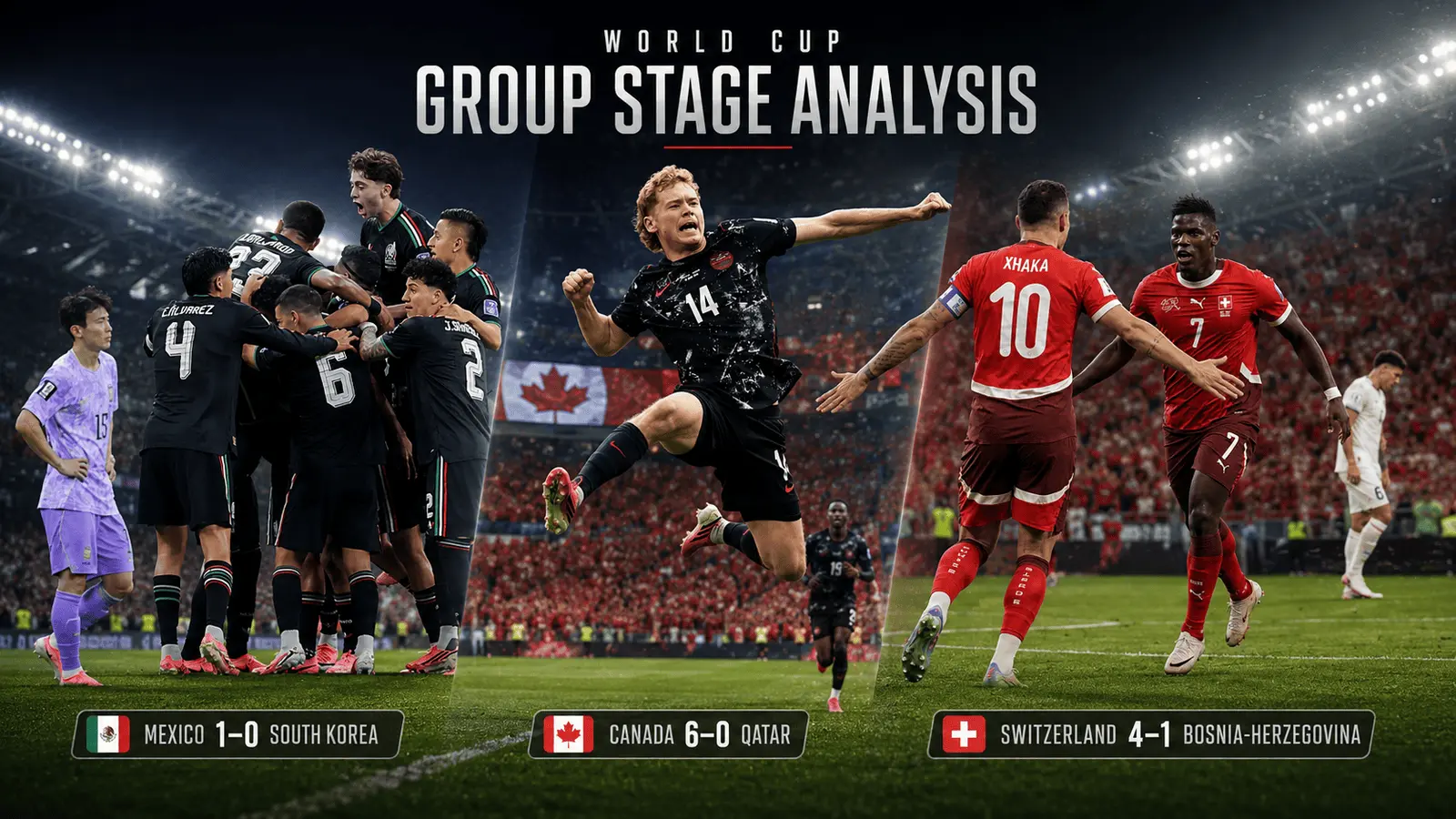
The second round of group matches produced very different scorelines, but the common theme was structure. Mexico beat South Korea 1-0 without needing to overwhelm them. Canada beat Qatar 6-0 and finally looked tactically coherent. Switzerland beat Bosnia and Herzegovina 4-1 but still left questions about attacking variety. Czechia drew 1-1 with South Africa and again showed that taking the lead is not the same as controlling a match.
South Korea 0-1 Mexico: one mistake, larger questions
South Korea’s defeat was not a collapse. For much of the match, they were competitive and measured. The first half was particularly balanced: Korea had 53% possession and both sides were credited with only 0.11 xG.
The decisive moment came when Julián Quiñones delivered a cross and Kim Seung-gyu dropped the ball around eight yards from goal. Luis Romo reacted instantly, volleying over the goalkeeper’s shoulder into an open net. Kim’s official line — one goal conceded, three saves, four shots on goal faced, 1 cross claimed and 2 keeper sweepers — captures the cruelty of the position. A goalkeeper can do several things right and still have the match defined by one mistake.
Mexico deserve credit because they were ready to punish it. Aguirre’s team were clever rather than flamboyant. They managed the tempo, accepted that Korea could have sterile possession, and trusted their ability to turn one mistake into the match’s defining moment.
For Korea, the bigger issue is what happens next. Son Heung-min was taken off just before the hour, with Oh Hyeon-gyu introduced. Hwang Hee-chan also came on at 57 minutes, followed later by Yang Hyun-jun, Eom Ji-sung and Cho Gue-sung. Those changes gave Korea more attacking bodies, but they also made the question obvious: why not build a clearer centre-forward plan earlier?
Canada 6-0 Qatar: the shape finally made sense
Canada’s win over Qatar was emphatic, but the tactical shift mattered more than the size of the scoreline. Cyle Larin occupying the centre-forward role allowed Jonathan David to operate in more natural zones, and David responded with a hat-trick. Tajon Buchanan’s work on the right and inside channels helped pin Qatar’s left side, while Alistair Johnston had the freedom to drive forward repeatedly.
That structure gave Canada layers: a focal point, a second-line attacker, width, and a full-back progression route. It was a major contrast with teams that ask their most gifted forwards to solve every problem alone.
Qatar’s two red cards changed the match dramatically. Homam Ahmed was sent off after VAR changed the initial penalty decision into a free-kick outside the box and a red-card offence. Assim Madibo was later dismissed after a VAR check for serious foul play following a late challenge on Ismaël Koné. Once Qatar were reduced to nine men, the match became almost impossible to manage.
Switzerland 4-1 Bosnia: a big win with small warning signs
Switzerland’s 4-1 win over Bosnia and Herzegovina looks convincing on paper. Johan Manzambi scored twice, Ruben Vargas added another, and Granit Xhaka converted a stoppage-time penalty after Bosnia had briefly scored through Ermin Mahmic.
Yet the scoreline should not hide the concern. Switzerland still lean heavily on Xhaka’s distribution and Dan Ndoye’s attacking involvement. When Bosnia adjusted to restrict Xhaka’s rhythm, Switzerland became less fluent. Manzambi’s late impact was valuable, but knockout-stage teams cannot depend every match on a substitute changing the physical tone.
Bosnia, under Sergej Barbarez, are in a different phase. Their value in this tournament may lie less in the immediate result and more in the willingness to move toward a younger, quicker identity.
Czechia 1-1 South Africa: not just conservative, not dangerous enough
Czechia’s draw with South Africa was another warning. They scored early through a rehearsed long-throw sequence, but again failed to build on a lead. South Africa eventually equalised through Teboho Mokoena’s 83rd-minute penalty after a handball decision against Pavel Šulc.
The easy criticism is that Czechia became too conservative. The sharper reading is more uncomfortable: perhaps they dropped deeper because they lacked the tools to keep attacking. Ladislav Krejčí’s four shots and 0.25 expected goals from left centre-back said something about where their threat was coming from — and where it was not.
The lesson of the round
The table tells one story. The performances tell another.
Mexico look reliable because they manage moments. Canada look improved because the roles now fit the players. Switzerland won big but still need more attacking variety. Korea lost narrowly, but their centre-forward debate cannot be delayed. Czechia and South Africa both remain alive, yet both still need more final-third quality.
That is the real value of this stage of the tournament: the scoreline tells us what happened, but the structure tells us what may happen next.
Team Analysis
Why the Group Stage Is Separating Teams by Structure, Not Just Talent
The most revealing part of the group stage has not been the scorelines. It has been how teams arrive at those scorelines.
Mexico’s 1-0 win over South Korea, Canada’s 6-0 win over Qatar, Switzerland’s 4-1 win over Bosnia and Herzegovina and Czechia’s 1-1 draw with South Africa all showed the same principle: clear structure travels better than isolated talent.
Mexico: control without domination
Mexico do not need to monopolise possession to look in control. Against South Korea, they allowed the game to remain balanced, then punished the one decisive error when Kim Seung-gyu dropped a cross and Luis Romo finished.
That is tournament maturity. Mexico controlled the emotional rhythm: they avoided panic, played with the crowd rather than against it, and understood that not every match has to be won through sustained attacking pressure. With six points and qualification secured, they now have the luxury of managing minutes without abandoning their competitive identity.
South Korea: competitive, but still structurally incomplete
South Korea’s defeat should not be misread as a team falling apart. They were organised for long stretches and did not give Mexico an open field to attack. The issue is what happens when the match state changes.
Once Korea fell behind, the absence of a consistent centre-forward structure became more visible. Son Heung-min can still threaten space, but asking him to battle as the main front-line outlet for long periods risks reducing what makes him special. Korea’s late changes showed that they have options: Oh Hyeon-gyu, Cho Gue-sung and other attacking profiles can alter the shape. The question is whether those options are part of the plan or only emergency responses.
Canada: a simple adjustment with a big effect
Canada’s improvement was the clearest structural leap. Cyle Larin playing as the central striker gave the team a fixed reference point. Jonathan David could then drop into areas where he is more comfortable, rather than being isolated as the only forward target.
That one relationship unlocked others. Tajon Buchanan’s positioning helped stress Qatar’s left side, while Alistair Johnston found repeated space to advance down the right. Canada looked less chaotic because the front line finally had a hierarchy.
The lesson is relevant beyond Canada: a proper centre-forward can improve players who do not even occupy the same zone. By pinning defenders and giving the team a vertical reference, the No. 9 can release second-line attackers.
Switzerland: stable, but predictable
Switzerland’s 4-1 win over Bosnia looked comfortable by the end, but it also revealed why stability can become a ceiling. Granit Xhaka’s passing remains central, and Dan Ndoye is one of the team’s main attacking outlets. That route is effective — but it is also obvious.
When Bosnia adjusted to limit Xhaka’s supply, Switzerland’s tempo slowed. Johan Manzambi’s late impact gave them power and directness, but relying on a substitute surge is not a sustainable tournament plan. Against better-organised opponents, Switzerland will need more from wide areas and cleaner penalty-box execution.
Bosnia: rebuilding has a cost
Bosnia’s defeat should be read through a different lens. Under Sergej Barbarez, this is a team trying to move toward a younger and faster version of itself. That transition will come with pain. Edin Džeko’s legacy remains significant, but the direction of the team appears to be moving toward a different rhythm.
The short-term gap against Switzerland was obvious. The long-term question is whether Bosnia can accept the cost of renewal while building a side with more energy and repeatable patterns.
Czechia: the problem may not be caution
Czechia’s draw with South Africa was another example of a team whose surface problem hides a deeper one. They scored early through a long-throw routine but could not keep creating. Calling that simply conservative may be too generous. The bigger concern is that Czechia may not have the attacking mechanisms to sustain control after going ahead.
South Africa, by contrast, have shown progress in carrying the ball into advanced areas. Their weakness remains the final action: the last pass, the shot selection, the composure.
The wider trend
This tournament is already showing a divide. Some teams have clear roles, even if they are not spectacular. Others have talent but no reliable route from possession to threat.
Mexico and Canada currently look more convincing because their structures protect their players. South Korea and Switzerland have enough quality to advance, but both carry tactical questions. Czechia and South Africa are still alive, but both must prove they can create more than moments.
At World Cup level, talent gets you into matches. Structure decides how long you stay in them.
Player Performance
Player Watch: Kim Seung gyu’s Cruel Error, David’s Hat Trick and the Son Question Korea Cannot Avoid
Individual performances in tournament football are rarely isolated. A mistake, a substitution or a change of role can reveal something much bigger about the team around the player.
Kim Seung-gyu: the goalkeeper’s impossible margin
Kim Seung-gyu’s error against Mexico was the defining moment of South Korea’s 1-0 defeat. The cross from Julián Quiñones was there to be dealt with, but Kim dropped it around eight yards from goal and Luis Romo punished him immediately.
His official line included three saves from four shots on goal faced, one cross claimed and two keeper sweeper actions. But goalkeeper analysis is brutal because one mistake can outweigh several correct decisions. A forward can miss and wait for another chance. A goalkeeper often watches the scoreboard change.
That does not make Kim solely responsible for every Korean concern. It does, however, underline why stability matters more than highlight saves in a tournament environment.
Son Heung-min: still dangerous, but Korea must protect his value
Son remains Korea’s most recognisable attacking weapon. He can still threaten space, and Mexico respected that by refusing to offer too much room behind the defensive line.
But the question is not whether Son can still contribute. The question is whether Korea are using him in the most sustainable way. If he is asked to spend match after match absorbing contact, running channels and acting as the main front-line outlet, Korea risk draining the very qualities they need most.
The final group match should be an opportunity to reduce that burden and give Korea a clearer No. 9 structure.
Lee Kang-in: maturity after an early yellow
Lee Kang-in’s match began badly. In the third minute, he arrived late while stretching for a loose ball ahead of Romo and caught the Mexico midfielder on the back of the ankle. Referee Gustavo Adrián Tejera Capo eventually showed the yellow card.
That could have derailed Lee’s performance emotionally, especially in a match where Mexico were happy to test Korea’s temperament. Instead, he stayed under control. That matters. Lee’s next step for Korea is not only becoming the technical successor to Son, but becoming a player who can guide the mood of the team when the match turns difficult.
Jonathan David and Cyle Larin: Canada’s partnership clicks
Jonathan David’s hat-trick against Qatar will naturally get the headlines, but the more important detail was his role. With Cyle Larin occupying the central striker position, David could drop into more comfortable areas and attack from the second line.
That is a better use of his qualities. Canada did not simply ask David to win every duel alone. They built a structure that gave him a platform.
Buchanan and Johnston: Canada’s right-side engine
Tajon Buchanan’s positioning helped pin and disrupt Qatar’s left side, while Alistair Johnston repeatedly advanced into space on the right. Together, they gave Canada a clean progression route.
That matters because it made Canada’s attack less dependent on improvisation. When a team has a reliable side of the pitch to attack through, the entire shape looks calmer.
Xhaka, Ndoye and the Swiss dependency issue
Granit Xhaka remains Switzerland’s organiser. His passing gives the team rhythm, but it also makes the tactical map too easy to read. Dan Ndoye provides one of the main attacking outlets, yet Switzerland cannot rely on the same route against every opponent.
Johan Manzambi’s two goals against Bosnia showed the value of a powerful substitute who can change the match late. But if Switzerland want to go deeper, they need that variety from the start, not only after the game opens up.
Ladislav Krejčí: Czechia’s threat from the wrong place
Ladislav Krejčí was a major presence against South Africa from the left side of a back three, producing four shots and 0.25 expected goals. That says something positive about his aggression. It also says something worrying about Czechia’s attacking structure.
When a centre-back is one of the most prominent shooting threats, the problem is not just finishing. It is chance creation.
The round’s player lesson
The best individual performances were tied to role clarity. David flourished because Canada gave him the right platform. Lee showed maturity because he managed the emotional context. Kim’s error hurt so much because goalkeeper mistakes carry a different weight. Son’s situation remains the clearest warning: Korea’s best player still has value, but only if the team stops asking him to solve every structural problem alone.
Controversy and Talking Points
Red Cards, VAR and the 48 Team Debate: Why the Group Stage Talking Points Need Nuance
The group stage has already produced the kind of incidents that dominate debate beyond the final whistle: red cards, VAR reversals, serious injury, referee interpretation and the broader question of whether a 48-team World Cup changes the quality of the competition.
Those topics deserve discussion. They also deserve precision.
Qatar’s red cards changed everything against Canada
Canada’s 6-0 win over Qatar was a tactical statement, but the match was also shaped by two dismissals.
The first came in the 33rd minute. Homam Ahmed was initially shown a yellow card after bringing down Tajon Buchanan, with the referee pointing to the penalty spot. After VAR intervention, the foul was judged to have occurred just outside the box. That changed the restart from a penalty to a direct free-kick — and because the offence denied an obvious goalscoring opportunity outside the penalty area, the punishment became a red card.
That sequence can look strange to casual viewers: how can cancelling a penalty make the punishment harsher? The answer lies in the DOGSO framework. Inside the penalty area, a genuine attempt to play the ball can sometimes reduce the card because the attacking team still receives a penalty. Outside the area, there is no penalty compensation, so a clear denial of a goalscoring opportunity can mean red.
The second dismissal came in the 53rd minute, when Assim Madibo was sent off after a VAR check for serious foul play following a late challenge on Ismaël Koné. The injury appeared serious, and the emotional reaction was understandable.
Serious injury does not automatically prove intent
Football must protect players. A challenge that endangers an opponent can deserve a red card even without malicious intent. But that distinction matters.
A severe injury is not the same thing as proof that a player intended harm. The law judges the nature of the challenge, the point of contact, the danger created and the level of force. Supporters often judge the outcome first, especially when the injury is distressing. That emotional response is human, but it can blur the difference between reckless, dangerous and deliberately violent play.
Madibo’s red card can be accepted as a player-safety decision without turning the discussion into a claim about intent unless the evidence supports it.
VAR as a tactical event
VAR is often discussed only as a refereeing tool, but it is also a tactical event. A red card does not simply punish a foul. It changes the space, the pressing capacity, the substitution plan and the emotional state of both teams.
For weaker sides, that effect can be devastating. Qatar were already under pressure against Canada; once reduced to nine men, the tactical choices narrowed dramatically. The match shifted from competition to damage limitation.
The 48-team World Cup debate should not be lazy
The 48-team format naturally invites arguments about quality. When a match becomes one-sided, critics will say expansion has diluted the tournament. When more nations get access to the biggest stage, supporters will say the game is becoming more global and fair.
Both points deserve space. The early evidence should be read carefully. Canada’s 6-0 win over Qatar was not the biggest scoreline of the tournament, with Germany’s 7-1 win over Curaçao already larger. But red cards clearly inflated the Canada-Qatar match state. South Africa, meanwhile, have shown enough ball progression to suggest that “weaker team” does not always mean “no footballing value.”
The real question is not whether every expanded-team match will be elite. It is whether the tournament can balance opportunity with competitive credibility.
Tori Penso and the importance of judging officials by performance
The Czechia-South Africa match also offered a more positive officiating talking point. Tori Penso, an American referee with major tournament experience including the 2023 FIFA Women’s World Cup final, was praised for control, rhythm and communication.
That discussion should stay focused on refereeing quality. The significance of representation is real, but credibility in elite football is built through decisions, positioning, match control and player management.
The right way to talk about controversy
The best football debate separates four things:
- what the referee saw;
- what VAR corrected;
- what the laws require;
- what the emotional consequence looked like.
When those are mixed together, every incident becomes a culture war. When they are separated, supporters can argue more intelligently — and the game becomes easier to understand.