
World Cup Opening Analysis: Mexico’s Structure, South Korea’s Warning Signs and the Next...
Introduction
A World Cup opening-phase analysis package focused on why Mexico’s structure looks sustainable, why South Korea’s comeback win still raises tactical alarms, and how upcoming tests for Japan, Canada and South Korea could expose or validate early tournament trends.
Post-Match Review
Mexico Look Ready, South Korea Look Warned: What the World Cup Openers Revealed
Two wins, two very different messages
Mexico and South Korea both came out of the World Cup’s opening phase with important victories. But the performances told very different stories.
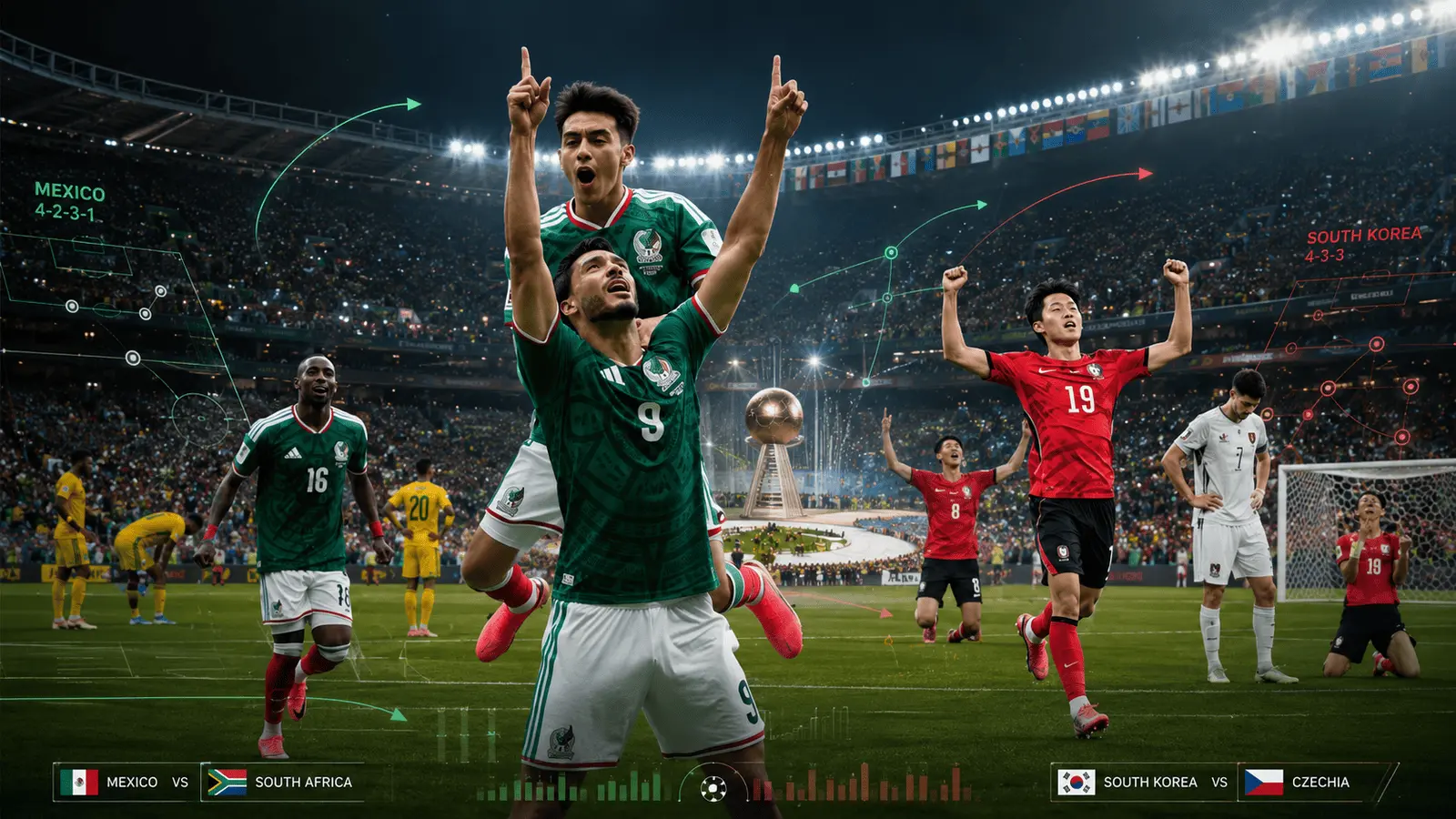
Mexico’s 2-0 win over South Africa in the opening match felt like a team announcing a coherent plan. South Korea’s 2-1 comeback against Czechia showed resilience and attacking depth, but also exposed flaws that will not disappear just because the result was positive.
Mexico: the shape is already visible
Mexico’s win was built on something more reliable than a single player’s inspiration. Julián Quiñones scored early, Raúl Jiménez added the second in the 67th minute, and the broader impression was of a side whose attacking roles made sense.
Jiménez gave Mexico a central reference point. Quiñones offered mobility and flexibility around him. The wide and midfield pieces supported the structure rather than overcrowding it. That is valuable in international football, where coaches rarely get enough time to build club-level automatisms.
The most encouraging sign for Mexico was that the team looked legible. You could see where the ball was meant to go, who was stretching the pitch, who was linking play, and who was protecting the balance behind the attack.
That clarity is why early dark-horse talk around Mexico is not just emotional reaction. It is based on structure.
South Africa: discipline became part of the story
South Africa’s performance carried two separate problems. The first was technical and tactical: Ronwen Williams made two saves but completed only three actions with his feet, underlining the risk of asking him to be a major build-up outlet if opponents press aggressively.
The second was disciplinary. South Africa had Sphephelo Sithole sent off in the 49th minute and Themba Zwane in the 84th, while Mexico’s César Montes was dismissed in stoppage time. A match with three red cards naturally becomes a refereeing talking point, but South Africa’s late-game loss of control will worry their staff as much as any tactical issue.
Tournament football punishes emotional drift. Suspensions, rotation pressure and public criticism can follow quickly.
South Korea: comeback secured, warning signs remain
South Korea’s 2-1 win over Czechia had a dramatic shape: they fell behind, then turned the game around through Hwang In-beom in the 67th minute and Oh Hyeon-Gyu in the 80th.
The comeback matters. So does the concern.
Czechia’s threat through direct play, high balls and dead-ball situations exposed a South Korean weakness that looked structural rather than accidental. The defensive issue was not simply open-play chaos. It was the repeated vulnerability around throw-ins, angled balls, headed contacts and second phases.
That is a dangerous weakness because it is easy for future opponents to copy.
Son at centre-forward remains the debate
Hong Myung-bo’s decision to start Son Heung-min as a central striker will remain a major talking point. Son still has elite timing, intelligence and finishing instincts, but asking him to play as a fixed centre-forward against a physically strong defensive unit risks reducing what makes him special.
Oh Hyeon-Gyu’s introduction around the 69th minute changed the structure. He provided a truer box presence and scored about 11 minutes later. The point is not to reduce South Korea’s attack to one substitution, but the contrast was hard to ignore.
With a natural centre-forward occupying defenders, Son can be freed to attack space rather than wrestle for it.
Early verdict
Mexico’s opening performance looked sustainable because it came from role clarity. South Korea’s win looked valuable but unstable because the same game that delivered three points also showed future opponents where to aim.
That is the difference between a good result and a convincing tournament platform.
Team Analysis
Mexico Have a System; South Korea Have a Problem to Solve
Talent is not the separator — structure is
Mexico and South Korea both have players capable of influencing World Cup matches. The early difference is how that talent is being arranged.
Mexico look like a team with a hierarchy of functions. South Korea look like a team still trying to reconcile star names, midfield technique and the physical demands of tournament football.
That distinction may define how far each side can go.
Why Mexico’s structure travels well
Mexico’s 2-0 win over South Africa worked because the roles were clear.
Raúl Jiménez operated as the central reference point. Julián Quiñones moved around him rather than duplicating his zones. The wide options, including the balance between youth and experience, gave Mexico different ways to attack without turning the front line into a crowd of similar profiles.
That is the mark of a coach imposing order. Javier Aguirre has not simply selected attacking names and asked them to solve the match. He has created a front line with complementary tasks: a fixed striker, a mobile connector, wide competition and a bench option in Santiago Giménez who can still matter later in the tournament.
The midfield picture is just as important. Mexico’s 6, 8 and 10 functions looked defined, with players such as Érik Lira, Álvaro Fidalgo and Roberto Alvarado discussed as part of the connective tissue that made the team flow. The effect is balance: when the attackers rotate, the midfield coverage keeps the structure intact.
South Korea’s issue is not just defending — it is defensive context
South Korea’s problem is more complicated than saying they defended badly. In open play, there were moments of control and improvement. Kim Min-jae remains the key defensive figure, and the back line did not look permanently broken in normal phases.
But dead-ball defending is a different category, and it was deeply concerning against Czechia.
Throw-ins, angled deliveries, headed combinations and loose second balls repeatedly put South Korea under stress. Those situations are not random in a World Cup. Opponents study them, repeat them and build game plans around them.
If South Korea can defend open play but cannot defend restarts, they remain vulnerable to low-cost chances.
The Son question is really a structure question
The debate around Son Heung-min playing centre-forward is not about respect for a star player. It is about tactical function.
Son is most dangerous when he can attack space, arrive from deeper positions, combine off a striker or finish moves with forward momentum. Using him as a central target against physically strong defenders reduces his best qualities.
Oh Hyeon-Gyu’s substitute impact made the argument stronger. A natural striker gives South Korea a penalty-box occupation point, which can then free Son and the technical midfielders around him.
Mexico’s problems look easier to manage
No early tournament performance is perfect. Mexico still have to show that their structure can survive against higher pressing, quicker transitions and better individual defenders.
But their current problems look like calibration issues.
South Korea’s look more foundational: who leads the line, how the box is defended, and whether the team can match opponent profiles rather than simply field its most technical players.
That is why Mexico’s early optimism feels sturdier than South Korea’s early relief.
Player Performance
Jiménez, Quiñones, Son and Oh: The Player Roles That Shaped the World Cup Openers
Roles mattered more than reputations
The first major player lesson of the World Cup opening phase is simple: international football rewards role fit as much as raw quality.
That was visible in Mexico’s front line, South Korea’s substitution pattern and the wider discussion around young players and missing stars.
Raúl Jiménez: more than the second goal
Raúl Jiménez scored Mexico’s second goal in the 67th minute against South Africa, but his broader value was structural.
He gave Mexico a fixed central point. That matters because it allows the rest of the attack to rotate without losing reference. A national team does not always need its centre-forward to dominate every touch; it needs him to make the rest of the system understandable.
Jiménez did that. His emotional reaction after scoring also added a human layer to a performance that was already tactically significant.
Julián Quiñones: the connector Mexico needed
Julián Quiñones scored early and offered the kind of mobility that makes Mexico’s front line harder to mark.
His background makes him an interesting national-team story: once eligible for Colombia but not called up, he eventually committed to Mexico. On the pitch, his value is not just identity or narrative. It is tactical flexibility.
He can move, connect, drift and create space for others. That is why his partnership with a more fixed central striker worked so well.
Gilberto Mora: protect the talent, do not rush the verdict
Gilberto Mora is 18 and made his first World Cup finals appearance for Mexico’s senior national team. He arrived with serious youth-level momentum, including a strong U20 return of five appearances and three goals.
But senior World Cup football is a different world.
If Mora’s immediate influence was limited, that should not become a harsh verdict. Young players often need time to adjust to the speed, contact and decision-making pressure of elite senior tournaments. His story should be followed as a development curve, not judged as a one-match referendum.
Son Heung-min: still elite, but not best used as a target
Son Heung-min remains South Korea’s defining attacking figure, but the Czechia match sharpened the question of where he should play.
Starting him as a central striker asked him to operate in heavy traffic against physical defenders. That role can blunt the qualities that still make him dangerous: timing, finishing, movement into space and second-line acceleration.
The issue is not whether Son can play centrally in moments. It is whether South Korea should make that his main job for long stretches.
Oh Hyeon-Gyu: impact through function
Oh Hyeon-Gyu replaced Son around the 69th minute and scored roughly 11 minutes later. His impact was significant because it changed the shape of South Korea’s attack.
A true centre-forward gives crosses, cut-backs and second balls a clear destination. He also occupies centre-backs in a way that can free the players behind him.
That may be the key to unlocking Son rather than replacing him.
Jonathan David: Canada’s responsibility shift
With Alphonso Davies unavailable, Jonathan David becomes even more important for Canada.
David’s task is not only to finish chances. He may also have to provide the attacking gravity that helps Canada progress without Davies’ left-sided explosiveness. If Canada cannot rely on one elite transition outlet, David’s movement, hold-up play and timing become central to the team’s attacking ceiling.
The player lesson
The opening phase has already reminded us that the best player is not always the best player for a specific job. Mexico benefited from functional clarity. South Korea’s debate exists because their most famous attacker may need a different platform to produce his best football.
Controversy and Talking Points
DOGSO, Red Cards and Son at Striker: The World Cup’s First Real Talking Points
Early controversy is not always bad for a tournament
World Cups need rhythm, but they also produce debate. The opening phase delivered both: goals, tactical lessons and immediate arguments over refereeing standards and coaching decisions.
Two talking points stand out: the red-card environment in Mexico’s 2-0 win over South Africa, and Hong Myung-bo’s decision to use Son Heung-min as a central striker in South Korea’s 2-1 win over Czechia.
Three red cards do not automatically mean poor refereeing
Mexico against South Africa included three dismissals: Sphephelo Sithole in the 49th minute, Themba Zwane in the 84th, and César Montes in stoppage time.
For many viewers, a match with three red cards automatically feels chaotic. But red-card volume is not the same as refereeing failure. If the decisions are consistent with the laws and the match is managed with clarity, strong discipline can actually set a useful tournament tone.
The early assessment of the refereeing was positive, particularly around the application of stricter standards and efficient use of technology. That matters because players adjust quickly. If holding, reckless challenges, delay tactics and denial-of-opportunity fouls are punished early, teams will have to recalibrate.
DOGSO is not just “the last defender”
One of the most common fan misunderstandings is that a DOGSO red card depends simply on whether the fouling player was the last defender.
That is not the law’s core test.
DOGSO — denying an obvious goal-scoring opportunity — depends on factors such as the direction of play, distance to goal, likelihood of control and the position of defenders. A player does not have to be literally the last defender for the foul to be considered a denial of an obvious scoring chance.
That distinction matters because it changes how fans should read red-card decisions. The question is not, “Was there one defender behind him?” The better question is, “Was an obvious chance illegally taken away?”
The Son debate is tactical, not personal
South Korea’s controversy is different but just as important.
Hong Myung-bo started Son Heung-min through the middle, and the decision drew criticism because it appeared to limit Son’s best qualities. Son is still a high-level attacker, but using him as a central target can force him into physical duels instead of giving him space to time runs and finish from more natural zones.
Oh Hyeon-Gyu’s later impact sharpened the debate. When a true striker entered, South Korea gained a clearer penalty-box reference, and Oh eventually scored the winner.
That does not mean the solution is simplistic. It does mean South Korea must decide whether star status or tactical function determines the attacking structure.
The bigger point: authority matters
Referees and coaches face different pressures, but the principle is similar. They must make decisions that stand up beyond emotion.
Firm refereeing can frustrate fans in the moment but improve tournament discipline. A bold tactical selection can be justified if it improves the team, but it becomes vulnerable when the substitute version of the plan immediately looks more coherent.
The opening phase has already shown that the World Cup will not be decided only by talent. It will also be decided by who understands the laws, who adapts fastest, and who puts players in roles that match the match.