
World Cup Preview: Why Route, Referees and Injuries May Matter as Much as Talent
Introduction
A World Cup-focused football package built around the idea that elite tournaments are shaped not only by talent, but by route, refereeing, squad health, travel and governance. The strongest public angle is a strategic preview of the 48-team World Cup, with supporting analysis on the Netherlands’ warning signs, Spain and France’s contrasting risk profiles, Asian teams’ difficult pathways, and the broader fairness debate around visa and entry issues.
Match Preview
World Cup Preview: The 48 Team Era Will Reward More Than Talent
The most important idea heading into this World Cup is simple: the best squad does not always get the cleanest route.
In a 48-team format, the gap between finishing first, second or third in the group can become enormous. A team’s tournament may be shaped before the first knockout whistle by draw mechanics, travel demands, refereeing appointments, injury withdrawals and even off-field administrative issues.
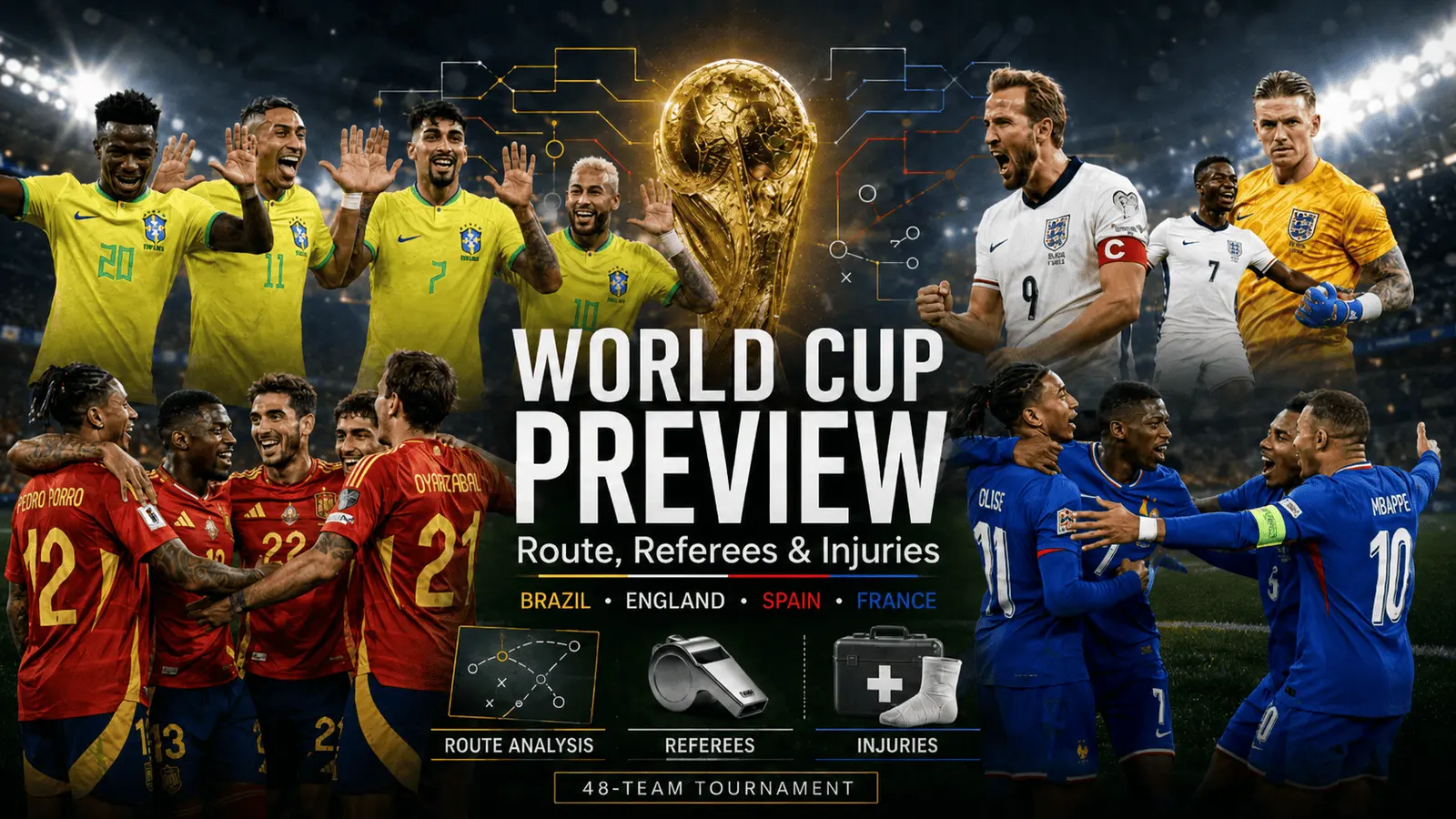
That is why this preview should not be reduced to a traditional list of favourites. Brazil, England, Spain and France may all have the quality to go deep. Japan may have the football to trouble elite opponents. The Netherlands may still carry heavyweight pedigree. But the route matters — and in this format, it may matter more than ever.
Brazil and England: a potential heavyweight collision
One of the most intriguing pathway debates is the possibility of Brazil and England landing on a collision course before the final. If that route materialises, it would reshape the entire tournament narrative.
Brazil’s ceiling remains tied to attacking quality, technical rhythm and the ability to impose tempo against different styles of opposition. England, meanwhile, are likely to be judged by whether their structure can turn individual quality into tournament control. A meeting between them would not simply be a glamour tie; it could become a bracket-defining match.
The key point is not to declare either side a guaranteed finalist. It is that in an expanded World Cup, a single pathway swing can change how we evaluate every contender.
Spain and France: system stability versus talent overload
Spain and France represent two very different models of tournament strength.
Spain’s advantage is continuity. Luis de la Fuente’s familiarity with many of his players gives Spain a clear structural base. That matters in international football, where coaches often have limited time to build automatisms. A familiar system can reduce hesitation, clarify roles and make squad rotation less disruptive.
France are different. Their upside is obvious: attacking depth, elite individual quality and the ability to overwhelm opponents in moments. But their risk profile is also different. The central question is whether attacking talent, defensive responsibility and dressing-room hierarchy can be kept in balance. For France, the danger is not a lack of quality. It is whether the collective remains as convincing as the names on the team sheet.
Japan and the Asian challenge: progress meets the draw
Japan’s case is especially interesting because scepticism around their World Cup outlook does not have to mean scepticism about their football.
They have developed into one of Asia’s strongest and most coherent national teams. The problem is that a difficult route can punish even a well-built side. In the expanded format, Asian teams may benefit from more places at the tournament, but more representation does not automatically mean deeper knockout runs.
The real test is no longer just whether an Asian side can get out of the group. It is whether the pathway after that allows them to build momentum rather than immediately run into a top-tier opponent.
Netherlands: warning signs before the real pressure begins
The Netherlands enter the conversation with a more cautious tone. Jurrien Timber’s withdrawal is significant because his value is not limited to one position. A player with that kind of defensive flexibility gives a coach options: centre-back cover, full-back balance, build-up security and emergency reshaping within a match.
When a multi-role defender is removed from the squad picture, the impact is tactical as well as numerical.
The concern is sharpened by recent warm-up evidence. The Netherlands beat Uzbekistan 2-1, but both Dutch goals came from Cody Gakpo penalties. A separate reserve match ended in a 2-1 defeat. Those results do not define a tournament, but they do feed a fair question: are the Dutch creating enough from open play?
Referees and VAR: not a side issue
World Cup referee appointments should be treated as part of the football discussion, not a footnote.
Different referees manage contact differently. Some allow physical duels to flow; others intervene earlier. VAR habits, fourth-official management and disciplinary thresholds can all influence how a match feels, especially in the early games when teams are trying to read the tournament standard.
Appointments for the opening set of matches — including high-profile officials such as Danny Makkelie — will inevitably attract attention. The right way to discuss this is not through conspiracy, but through game management: how the referee’s threshold affects tempo, pressing, duels and player behaviour.
Off-field conditions could become on-field variables
The most serious non-tactical issue is governance. If visa or entry restrictions affect teams, officials, referees or media obligations, then the problem moves beyond administration. It becomes a competitive fairness issue.
The reported difficulty around Iran’s ability to meet pre-match media requirements because of entry timing is exactly the type of scenario that tests FIFA’s authority. A World Cup is supposed to be a global competition operating under a common sporting framework. If participants cannot access the same preparation conditions, the credibility of that framework becomes part of the story.
What to watch before the tournament opens
The biggest World Cup clues may come before the marquee matches:
- which favourites land on the smoother side of the bracket;
- whether injury-hit squads can replace tactical flexibility, not just names;
- how referees set the contact threshold in the first round of games;
- whether Asian teams can turn expanded access into genuine knockout depth;
- whether off-field governance issues remain contained or become a tournament theme.
This World Cup will still be decided by footballers. But the conditions around them — route, referees, injuries, logistics and pressure — may decide which footballers get the best chance to show their level.
Post-Match Review
Netherlands 2 1 Uzbekistan: A Win That Still Raised World Cup Questions
A 2-1 win should normally calm the mood around a tournament contender. For the Netherlands, the victory over Uzbekistan did the opposite: it kept the questions alive.
The result was positive, but the method was not especially reassuring. Both Dutch goals came from Cody Gakpo penalties — one in the first half and one deep into stoppage time. Penalties still count, of course, and Gakpo’s composure matters. But when a side with the Netherlands’ attacking reputation struggles to produce decisive open-play moments, the performance becomes more complicated than the scoreline.
The open-play issue is the real concern
Warm-up matches should not be overinterpreted. Coaches manage minutes, test structures and protect players. But they do reveal patterns.
For the Netherlands, the current concern is not that they cannot score at all. It is that their attacking rhythm from open play looks less convincing than their tournament ambitions require. A side hoping to control major matches needs more than moments, set pieces and penalties. It needs repeatable chance creation.
That is especially important in knockout football. Opponents become more compact, margins shrink and penalty-box access becomes harder. If the Dutch cannot consistently break lines and create from movement, they may become too dependent on isolated actions.
Timber’s absence reduces tactical flexibility
The injury withdrawal of Jurrien Timber adds another layer to the problem.
Timber’s value lies in versatility. He can help a team adjust its defensive shape, support build-up phases and cover multiple back-line roles. Losing that profile does not simply remove a defender; it removes a set of in-game solutions.
That matters for Ronald Koeman because World Cup matches often demand fast adaptation. A team may need to switch from a back four to a back three, protect a lead, chase a game or solve a pressing trap. Players who can operate across roles are precious in that environment.
A reserve defeat adds to the uneasy mood
The broader Dutch mood was not helped by a separate reserve match ending in a 2-1 defeat. That result should not be treated as a definitive measure of squad strength, but it does reinforce the sense that the Netherlands are not entering the tournament with completely clean momentum.
The issue is not panic. It is evidence.
The Dutch still have quality. They still have a tournament pedigree. They still have players capable of deciding matches. But the current evidence points to a team with questions around attacking fluency, squad elasticity and public confidence.
The verdict
The Netherlands beat Uzbekistan, and that matters. But World Cup preparation is not judged only by wins and losses. It is judged by what the performance says about the problems waiting ahead.
For the Dutch, the message was mixed: Gakpo delivered from the spot, but the team still needs more from open play. With Timber unavailable and tactical flexibility reduced, the Netherlands have work to do before the pressure becomes real.
Team Analysis
World Cup Team Trends: Spain Look Stable, France Look Explosive, Netherlands Look Fragile
World Cup contenders are often grouped together under one label: favourites. But the more useful question is how each favourite is built.
Some teams win through structure. Some win through individual quality. Some need momentum. Some need the draw to open. Heading into this tournament, Spain, France and the Netherlands offer three very different case studies.
Spain: the value of familiarity
Spain’s biggest strength may not be a single superstar. It may be the coach’s knowledge of his players.
Luis de la Fuente’s familiarity with many members of the Spanish pool gives the team a level of continuity that matters in international football. Unlike club coaches, national-team managers do not get months on the training ground. They need players who already understand positional demands, pressing triggers and role expectations.
That is why a so-called familiar selection policy can be more than loyalty. It can be a competitive tool.
Mikel Oyarzabal is a useful example of that logic. In a tournament setting, the value of a player is not always measured by highlight output. It can be measured by trust, timing, tactical obedience and the ability to understand what a coach wants in different match states.
Spain’s risk is different: intensity management. Tournament preparation can be derailed by overtraining, internal tension or avoidable physical stress. If Spain keep their structure intact and manage the squad well, their floor looks high.
France: the ceiling is obvious, the balance is the question
France’s strength is easier to see. Their attacking depth is extraordinary, and Michael Olise’s hat-trick in a 3-1 win over Northern Ireland underlined the level of attacking reserve available.
But France’s question is not whether they have enough talent. It is whether that talent can be organised into a stable tournament team.
Every elite side must solve the same equation: who presses, who tracks, who leads, who sacrifices, and who decides? For France, those questions become especially important because their attacking players can all make a case for influence.
If France get the hierarchy right, they can look devastating. If defensive responsibility becomes uneven or the dressing-room order turns unclear, the same depth that makes them dangerous can become difficult to manage.
Netherlands: quality with shrinking flexibility
The Netherlands remain too strong to dismiss, but their trend line is less comfortable.
Jurrien Timber’s withdrawal removes a defender with rare multi-position value. That matters because tournament football often rewards flexible squads more than fixed elevens. The Dutch have not just lost a player; they have lost a tactical option.
The recent 2-1 win over Uzbekistan also created concern. Both Dutch goals came from Cody Gakpo penalties, which kept the focus on open-play production. If a team cannot consistently create from structured attacks, it becomes easier to frustrate in knockout football.
The Netherlands can still go deep, but they look like a side that needs solutions quickly.
Japan and the problem of the pathway
Japan deserve a separate kind of analysis. Their football has improved, their player pool has deepened, and their tactical level is respected. But World Cup progress is not only about development.
It is also about route.
A difficult bracket can make a strong Japan side look limited simply because the level of opposition escalates too quickly. In the 48-team format, finishing position in the group can have a dramatic impact on the knockout path. That makes Japan one of the most interesting teams to track: good enough to trouble major nations, but potentially exposed by an unforgiving draw.
The bigger lesson
The World Cup is never a pure ranking of talent. It is a test of structure, timing, health, psychology and route.
Spain look stable. France look explosive. The Netherlands look fragile. Japan look dangerous but pathway-dependent. Brazil and England may find their campaigns defined by when — not just whether — they meet elite opposition.
That is the real tournament preview: not who has the best squad on paper, but who gets the conditions that allow their squad to become the best team.
Player Performance
World Cup Player Watch: Olise’s Statement, Gakpo’s Composure and Timber’s Absence
World Cup preparation is full of team narratives, but individual profiles often decide how those narratives develop.
Three names stand out in the current build-up: Michael Olise, Cody Gakpo and Jurrien Timber. Each represents a different type of tournament value.
Michael Olise: France’s attacking depth gets louder
Michael Olise’s hat-trick in France’s 3-1 win over Northern Ireland was more than a friendly headline. It was a reminder of just how deep France’s attacking options run.
For a national team, that kind of performance matters because it changes internal pressure. It gives the manager another credible option. It raises the standard for competitors in the same role. It also gives France a way to alter matches without necessarily changing their whole structure.
Olise’s challenge now is consistency and fit. France do not lack attackers. The question is which players best balance creativity, pressing responsibility and positional discipline. A hat-trick strengthens Olise’s case, but tournament football will ask for more than finishing.
Cody Gakpo: composure counts, but open-play questions remain
Cody Gakpo’s two penalties against Uzbekistan secured a 2-1 Netherlands win. Penalties in warm-up matches are sometimes dismissed too easily, but pressure execution is a real skill.
Gakpo’s calm from the spot is valuable. In tournament football, where knockout ties can swing on one penalty, that composure matters.
The wider Dutch issue is that both goals came from penalties. That places Gakpo in an interesting position: he did his job, but the team around him still has to prove it can create enough from open play. His performance was a positive individual signal inside a more uncertain collective display.
Jurrien Timber: the value of the player who is not there
Sometimes the most important player story is an absence.
Jurrien Timber’s withdrawal is a serious blow for the Netherlands because of his tactical flexibility. He is the type of defender who can help solve multiple problems: covering different defensive roles, supporting build-up and allowing the coach to reshape the back line without burning extra substitutions.
That is exactly the kind of profile that becomes more valuable in a tournament. Squads are stretched. Opponents vary. Match states change quickly. Losing a multi-role defender narrows the coach’s options.
Mikel Oyarzabal: trust as a tournament weapon
Mikel Oyarzabal’s importance to Spain should be understood through trust and system fit. Spain’s strength under Luis de la Fuente is not only technical quality but familiarity. Players who understand the coach’s demands can be decisive even when they are not the loudest names in the tournament.
Oyarzabal fits that idea: a player valued for timing, role clarity and the ability to operate within a collective structure.
Daí Weijun and Wei Shihao: China’s attacking indicators
For China, the key player watch is more practical: can Daí Weijun improve the connection between midfield and attack, and can Wei Shihao offer genuine one-v-one threat from wide areas?
The point is not simply whether either player starts or scores. The real test is whether China can produce higher-quality attacking actions — receiving between lines, carrying past pressure, combining wide and creating moments that unsettle a defence.
The lesson
Player form is not just about goals and assists. Olise shows depth. Gakpo shows composure. Timber’s absence shows the cost of lost flexibility. Oyarzabal shows the value of trust. Daí Weijun and Wei Shihao represent whether China can turn possession into threat.
That is how individual performance becomes tournament structure.
Controversy and Talking Points
World Cup Governance Is Already a Football Issue: Referees, Visas and Competitive Fairness
World Cup controversies usually arrive after the matches begin. This time, some of the most important talking points are already here.
Referee appointments, visa and entry conditions, pre-match media obligations and FIFA’s ability to coordinate with host-country policies are not administrative side issues. They can affect competitive fairness.
Referee appointments shape the game before kick-off
Every World Cup referee brings a different threshold for contact, dissent, advantage and VAR intervention. That matters tactically.
A lenient referee can benefit teams that press aggressively and defend through physical duels. A stricter referee can punish the same approach and turn early bookings into match-defining constraints. VAR interpretation can also alter player behaviour: defenders hesitate, attackers seek contact, and coaches adjust risk.
That is why early appointments — including high-profile names such as Danny Makkelie — are worth discussion. The point is not to suggest bias. The point is that officiating style changes the environment in which football is played.
Visa and entry issues are bigger than logistics
The more serious issue is access.
If teams, officials, referees or accredited personnel face delayed entry, restricted movement or difficulty meeting tournament obligations, the integrity question becomes unavoidable. Preparation is part of competition. Media obligations are part of tournament regulation. If one team cannot fulfil the same schedule as another because of entry restrictions, that is not merely bureaucracy.
The reported situation around Iran’s entry timing and the difficulty of staging a pre-match press conference under FIFA requirements is a clear example of how governance can become a football issue.
FIFA’s responsibility is coordination, not just branding
A World Cup cannot function as a truly global event if participating nations are subject to uneven access conditions. FIFA’s role is not only to award tournaments, sell the spectacle and manage ceremonies. It must also ensure that teams, match officials and tournament staff can operate within a coherent framework.
When host-country policy and tournament requirements collide, the question becomes simple: who guarantees the sporting conditions?
If FIFA cannot answer that convincingly, public trust suffers.
Why this matters to fans
Supporters want the game decided by players, coaches and tactical choices. They accept that referees are part of football. They accept injuries as part of the sport. But they are less forgiving when administrative or political conditions appear to interfere with preparation.
That is why this controversy has weight. It is not about one press conference or one appointment in isolation. It is about whether the World Cup can maintain the sense that all teams are entering the same competition under the same rules.
The right standard for the tournament
The standard should be clear:
- teams must be able to enter early enough to prepare properly;
- officials and referees must be able to carry out their roles without avoidable disruption;
- media obligations should apply consistently;
- referee appointments should be transparent and professionally defended;
- FIFA must show visible authority when tournament rules and host-country systems come into tension.
The World Cup will always produce controversy. That is part of its scale. But the best controversies come from football: selection calls, tactical risks, missed chances, brilliant goals. The tournament should not be defined by preventable doubts over access, process and governance.