
World Cup Tactical Review: Why Possession and Reputation Are Not Enough
Introduction
A World Cup-focused football analysis package built around one central theme: possession, reputation and star power do not automatically equal control. Australia’s win over Turkey, Morocco’s draw with Brazil, Switzerland’s costly draw with Qatar and Scotland’s narrow victory over Haiti all point to a tournament where structure, discipline and game management are challenging traditional assumptions about stronger teams.
Match Preview
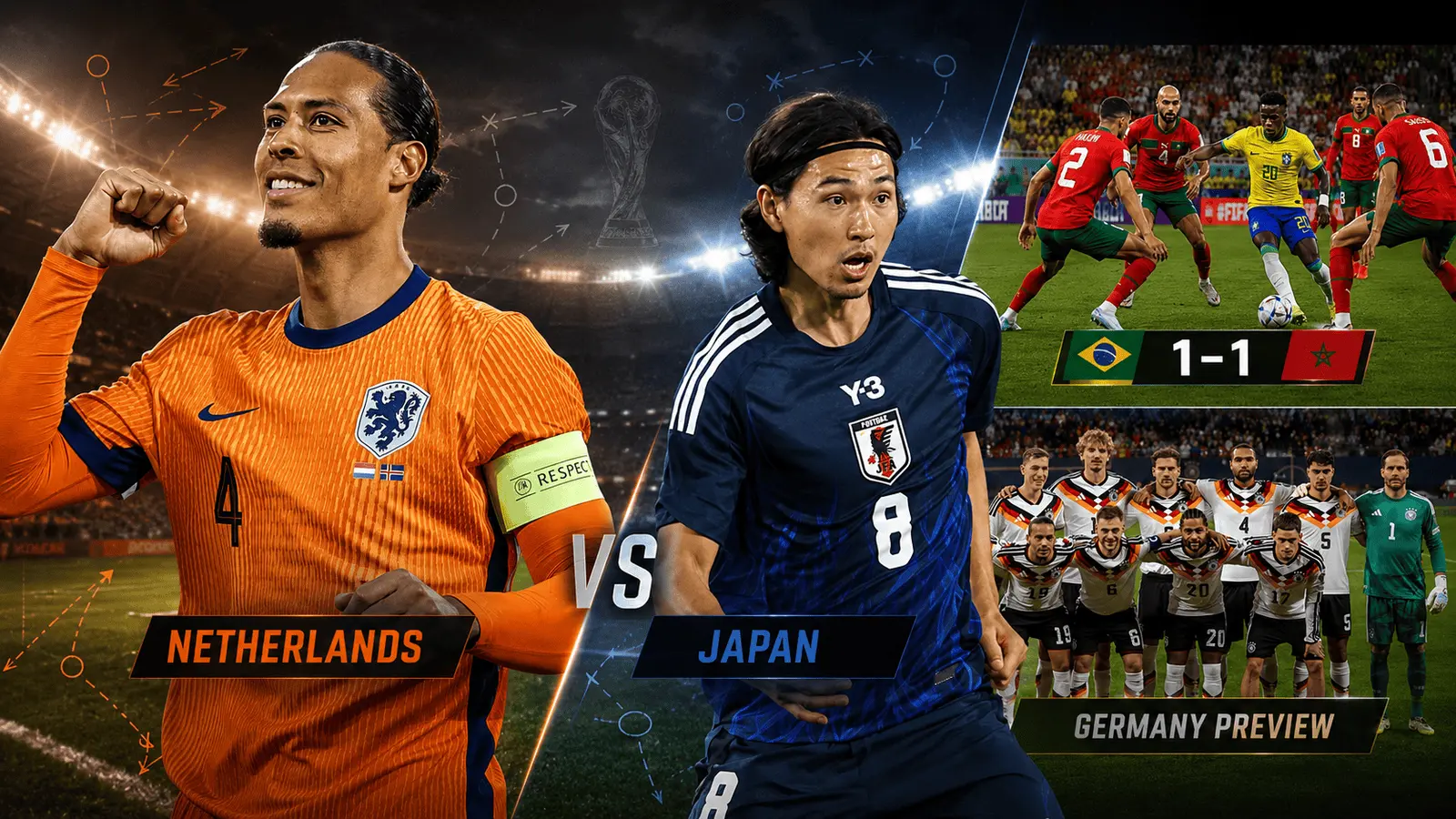
Germany v Curacao and Netherlands v Japan: Two Very Different World Cup Previews
Not every World Cup fixture offers the same kind of intrigue. Some are about whether a favourite can turn superiority into a clean, ruthless performance. Others are about whether two coherent football identities can create a match with genuine tactical depth.
Germany v Curacao and Netherlands v Japan sit on opposite sides of that divide.
Germany’s challenge: avoid making superiority look complicated
Germany enter the Curacao match with the burden that always follows a major football nation: anything short of command will be judged harshly. This is the kind of fixture in which the favourite is expected to dominate territory, possession and chance volume.
But that expectation can become its own trap. If Curacao survive the opening phase, Germany may need patience rather than panic. The key questions are familiar in matches with a clear technical gap:
- Can Germany score early enough to stretch the game?
- If Curacao defend deep, can Germany move the ball quickly enough from side to side?
- Will Germany rely on crosses and shots from distance, or can they create central overloads?
- Can their rest defence prevent counter-attacks when full-backs and midfielders push high?
The match could become one-sided if Germany score early. If they do not, the tone changes. The longer a smaller side stays level, the more every German attack becomes a test of tempo, decision-making and crowd pressure.
Curacao’s route: survive, narrow the pitch, make Germany repeat actions
Curacao’s best scenario is not complicated in theory, but it is difficult in execution: deny central space, protect the penalty area, slow Germany’s rhythm and make the favourite restart attacks over and over again.
Against a stronger opponent, survival is often about emotional discipline as much as tactical discipline. The first 20 minutes matter. The first defensive lapse matters. The first transition opportunity matters. Curacao do not need long spells of possession to influence the match; they need to make Germany uncomfortable with the type of possession they are allowed to have.
Netherlands v Japan: the better tactical watch
Netherlands v Japan may be the more compelling football match.
The appeal is not only name value. Japan have become a serious test for elite opponents because they are organised, technically secure and comfortable attacking at speed after regains. They can press with intelligence, combine through midfield and punish teams that leave space behind their full-backs.
For the Netherlands, the question is whether their structure can control Japan’s rhythm without becoming too passive. Dutch football is usually judged through the lens of spacing, ball progression and wide rotations. Against Japan, those details matter.
This matchup could be decided by three tactical zones:
- The Dutch build-up against Japan’s pressing triggers — if Japan can force rushed passes, they can create transitions.
- The half-spaces behind Japan’s midfield line — the Netherlands will look to receive between pressure and defence.
- Wide defensive recovery — both sides have the tools to attack quickly into channels.
Why these previews matter beyond one night
The wider lesson of this World Cup has already become clear: stronger teams cannot assume that possession equals control. Turkey had huge possession and shot volume against Australia but lost 2-0. Brazil’s reputation and Carlo Ancelotti’s aura did not prevent Morocco from earning a 1-1 draw. Switzerland produced heavy pressure against Qatar but failed to kill the game.
Germany will want to avoid joining that list of favourites who dominate the surface of the match without fully controlling the contest. The Netherlands, meanwhile, face an opponent capable of making the game tactically uncomfortable from the first whistle.
If Germany v Curacao is about authority, Netherlands v Japan is about proof of balance. One may bring the scoreline. The other may bring the better football discussion.
Post-Match Review
World Cup Review: Australia, Morocco and Qatar Expose the Myth of Paper Superiority
The clearest lesson from this World Cup sequence is simple: football is not controlled by reputation. It is controlled by structure, timing, discipline and emotional clarity.
Across several group-stage matches, teams with stronger names, greater possession or heavier chance volume discovered that those advantages do not automatically produce authority. Australia beat Turkey 2-0. Morocco held Brazil 1-1. Switzerland drew 1-1 with Qatar despite major attacking pressure. Scotland beat Haiti 1-0, but the performance left enough warning signs to make the result feel less comfortable than the scoreline.
Australia 2-0 Turkey: the possession trap
Turkey had the ball. Australia had the match.
That is the bluntest way to frame a game in which Turkey reportedly finished with 72% possession and 30 shots, yet Australia scored through Nestory Irankunda in the 27th minute and Connor Metcalfe in the 75th.
The first goal captured Australia’s plan perfectly: quick release, aggressive forward running, calm execution from Irankunda. The second punished a midfield turnover, with Metcalfe driving forward and finishing low into the bottom corner.
Turkey’s problem was not a lack of talent. It was a lack of clean functional relationships. When too many attacking midfielders want similar touches in similar spaces, possession can become decorative. Hakan Calhanoglu, Arda Guler, Kenan Yildiz and Orkun Kokcu give Turkey technical quality, but the team still has to solve spacing, role clarity and vertical threat.
Australia, under Tony Popovic, showed the opposite. They did not need constant possession because their defensive distances, pressing moments and transition routes were coherent. They were willing to let Turkey have the ball in areas that did not hurt them — and then attack the moments that did.
Brazil 1-1 Morocco: Ancelotti’s national-team problem begins
Brazil’s 1-1 draw with Morocco should not be treated only as a Brazilian underperformance. Morocco deserve agency in the story.
This is not a side relying on one isolated upset. Morocco have the profile of a mature international team: athletic, organised, tactically brave and led by players who understand high-level competition. Achraf Hakimi’s role was especially important. He is not merely a full-back in this team; he is a progression outlet, a wide threat, an occasional interior presence and a tactical trigger.
Brazil had enough individual quality to avoid defeat, with Vinicius Junior central to the response. But the broader issue remains: can Carlo Ancelotti translate club-level problem-solving into a national-team environment, where training time is limited and combinations must form quickly?
The midfield question is particularly important. Brazil’s balance with Casemiro and Bruno Guimaraes did not look fully convincing, and the later use of Fabinho was interpreted as a stabilising move rather than an aggressive chase for the win. In a 48-team World Cup format, where third-place qualification can change the risk calculation, that kind of caution may be rational. It will not necessarily satisfy supporters.
Switzerland 1-1 Qatar: failing to kill the game has a cost
Switzerland’s 1-1 draw with Qatar is the classic warning about letting an underdog remain alive.
The Swiss created volume, including an expected-goals figure around 3.75 and 26 shots, but they did not convert dominance into separation. When a favourite leads but fails to score the second goal, the match becomes psychologically unstable. The underdog starts to believe. The favourite starts to manage rather than dominate.
Qatar’s performance was not a model of sustained control, but persistence matters. They stayed in the game long enough to punish Swiss wastefulness and secure a historic point.
For Switzerland, the result is not just two points dropped. It changes the emotional texture of the group. A match that should have been used to build confidence instead becomes a source of pressure.
Scotland 1-0 Haiti: three points, but not full reassurance
Scotland did what they had to do: they beat Haiti 1-0, with John McGinn providing the decisive goal.
But the performance carried warning signs. Haiti’s second-half pressure showed that Scotland could not simply put the game away and cruise. Billy Gilmour’s absence mattered in midfield balance, and Scott McTominay’s work was more combative than controlling.
McTominay still contributed heavily without the ball, including defensive interventions and duels, but Scotland will need more than battle if they face opponents with greater technical control. Against Brazil or Morocco-level opposition, protecting a narrow lead for long stretches becomes a dangerous habit.
The tournament theme: control is not cosmetic
The connecting thread is not that favourites are doomed. It is that visible advantages can be misleading.
Possession can be sterile. Shot volume can hide poor chance quality. Historic reputation can disguise structural uncertainty. Star names can crowd each other rather than elevate the team.
Australia and Morocco looked like teams with a plan. Qatar and Haiti showed the value of staying alive in matches where they were not expected to dictate. Switzerland, Turkey and Brazil all left with different versions of the same question: did they truly control the game, or merely look like they should have?
Player Performance
Hakimi, Irankunda and Vinicius: The Players Who Shaped the World Cup Narrative
The group-stage story has not only been about teams. It has been about the individuals who make tactical ideas believable.
Some players gave their sides control. Some gave them escape routes. Some turned isolated moments into defining match events. Achraf Hakimi, Nestory Irankunda, Vinicius Junior, Connor Metcalfe, John McGinn and Scott McTominay each helped shape the wider tournament conversation in different ways.
Achraf Hakimi: Morocco’s full-back, outlet and leader
Hakimi’s performance against Brazil underlined why Morocco are not simply a stubborn underdog.
His influence is tactical as much as emotional. He can operate as a traditional wide runner, but Morocco also use him as a progression point and a player who can step into more advanced or interior lanes. That flexibility makes Morocco harder to press and harder to contain.
Against Brazil, Hakimi produced attacking involvement while maintaining his leadership role in a disciplined team structure. His expected goals and expected assists figures were modest, but his value was broader than final action. He gave Morocco direction.
Nestory Irankunda: composure in the moment that mattered
Australia’s opening goal against Turkey was a perfect example of transition football executed with calm.
The move developed quickly, with Australia breaking forward before Irankunda received the ball under pressure from goalkeeper Ugurcan Cakir and recovering defenders. The finish was low, hard and composed. For a young attacker, that kind of decision in a high-speed World Cup moment says plenty.
Irankunda’s broader story — from his early development in Australia to spells involving Bayern Munich II, Grasshopper, Watford and the national team — gives the performance an additional human layer. But the football point stands on its own: he did not just run into space; he finished the chance like a player who trusted the moment.
Connor Metcalfe: the punishment for Turkey’s turnover
Metcalfe’s goal in the 75th minute was the tactical review in one action.
Turkey lost the ball in midfield. Australia reacted faster. Metcalfe drove to the edge of the area and finished low into the bottom-right corner. It was the goal that turned an uncomfortable Turkish performance into a major result for Australia.
His role also showed why midfielders who understand transition timing can be just as decisive as more glamorous attacking players.
Vinicius Junior: Brazil’s individual solution
Brazil’s 1-1 draw with Morocco raised structural questions, but Vinicius Junior ensured Brazil avoided defeat.
His equalising goal and man-of-the-match-level influence reflected the reality of modern Brazil: even when the collective framework is not fully convincing, the individual ceiling remains high. That is both a strength and a warning.
Relying on Vinicius to solve games can work in moments. Over a tournament, Brazil still need a clearer midfield platform to make those moments repeatable rather than desperate.
John McGinn and Scott McTominay: Scotland’s mixed midfield picture
John McGinn delivered the decisive moment in Scotland’s 1-0 win over Haiti. His knack for arriving at important times remains one of Scotland’s most valuable qualities.
McTominay’s performance was different. He was active in duels and defensive work, but Scotland still lacked full midfield control, especially as Haiti pushed in the second half. That distinction matters. Work rate and ball-winning help protect a result; tournament progress usually requires more sustained command.
The wider lesson
The players who stood out did so because their actions matched their teams’ needs.
Hakimi gave Morocco structure and ambition. Irankunda gave Australia a clinical transition. Metcalfe turned pressure into punishment. Vinicius rescued Brazil from a difficult night. McGinn gave Scotland the goal they needed.
In a World Cup where possession and reputation are being questioned, individual quality still matters — but it matters most when it fits the plan.
Controversy and Talking Points
Is the 48 Team World Cup Making Favourites More Conservative?
The expanded 48-team World Cup has changed more than the number of matches. It may be changing the psychology of the group stage.
Brazil’s 1-1 draw with Morocco offered a useful example. After Vinicius Junior brought Brazil level, the game moved into a phase where neither side appeared eager to turn the final stretch into chaos. Carlo Ancelotti’s use of Fabinho was read as a stabilising move: control the risk, protect the point, avoid the damaging defeat.
That decision can be criticised. It can also be understood.
A point is not always a failure anymore
In older tournament formats, group-stage strategy was often framed more brutally: win early, secure qualification, avoid calculations. In the expanded format, where third-place routes can remain open, a draw may carry more strategic value than it once did.
That does not mean teams will stop trying to win. It means the cost-benefit calculation changes. If a favourite is level in the second half, facing a dangerous opponent and still positioned to advance, the coach may decide that avoiding defeat is more valuable than chasing a statement.
For supporters, that can feel unsatisfying. Brazil are Brazil. The expectation is not merely survival; it is authority.
The entertainment problem
The controversy is not only tactical. It is about the spectacle.
If more teams believe a draw keeps them alive, late group-stage phases may become more conservative. Coaches are rational. They respond to incentives. If the tournament rewards risk management, we should not be shocked when risk management appears.
That could make some matches more tense but less open. It could also reduce the number of desperate late pushes from favourites who would once have treated a draw as unacceptable.
But caution is not always cowardice
There is another side to the argument. International football is not club football. Managers have less time to build automatisms, less time to correct structural issues, and fewer matches to absorb mistakes.
Ancelotti is one of the greatest club managers of the modern era, but Brazil are not a club side he can train every day. If the midfield balance is not right and Morocco are dangerous in transition, protecting the draw is not irrational.
The real criticism should be sharper: why was Brazil not in clearer control before that decision became necessary?
What this means for the tournament
The 48-team format may give underdogs more reason to stay compact and favourites more reason to avoid panic. That combination can create closer matches, but it can also make reputation-heavy teams look cautious.
The debate will continue throughout the tournament. Is the expanded format creating more meaningful hope for smaller nations? Or is it encouraging stronger teams to treat group-stage football like risk management?
Brazil v Morocco did not answer the question completely. It made the question impossible to ignore.