
Why World Cup Underdogs Are Taking Points From the Giants
Introduction
A tactical and narrative package on the 2026 World Cup’s early group-stage pattern: underdogs are not merely surviving through luck, but using discipline, role clarity, goalkeeping, target-forward play and controlled emotional energy to pull stronger teams into uncomfortable matches.
Match Review
The Next Test for the Favourites: What Spain, Belgium, Uruguay and Iran Must Fix Quickly
The first wave of group-stage matches did more than produce surprising results. It exposed different kinds of discomfort among the stronger sides.
Spain’s 0-0 draw with Cape Verde, Saudi Arabia’s 1-1 draw with Uruguay, Egypt’s 1-1 draw with Belgium and New Zealand’s 2-2 draw with Iran should not be filed under the same lazy label of “shock results”. Each match asked a different question of the favourite. Each answer now has to come quickly.
Spain: possession needs a cutting edge
Spain’s issue is not control. It is what happens after control has been established.
Against Cape Verde, the midfield-heavy structure gave Spain security and rhythm, with Pedri, Gavi, Fabián Ruiz and Rodri forming a technically comfortable core. But comfort is not the same as threat. Too many passing options existed in front of the defensive block; too few actions broke the line behind it.
That is why the next selection question matters. Does Spain continue with the extra midfield connection, or do they add more natural width and direct running earlier? Lamine Yamal’s introduction around the 65-minute mark briefly changed the tone on the right. Dani Olmo’s forward movement offered another route through the inside channels. Nico Williams’ absence from the action also sharpened the debate around whether Spain need more pure wing threat from the start.
The preview question is simple: if Spain face another disciplined low block, will they move the ball quicker into dangerous zones, or simply dominate safer zones again?
Uruguay: fatigue or a deeper control problem?
Uruguay’s 1-1 draw with Saudi Arabia came with a different concern. Their midfield names suggest power, running and control, but the performance did not consistently look that way.
Travel disruption has been cited as part of the context, and the physical impression of the match supported the idea of a side not fully at its sharpest. But Uruguay cannot afford for that to become the whole explanation. If the midfield cannot turn athletic quality into territorial control, the attack becomes more isolated and the defensive line faces more second-phase pressure.
The next game will tell us whether Uruguay’s opening performance was a tired one-off or an early warning.
Belgium: what happens when Doku is surrounded?
Belgium’s draw with Egypt raised a structural attacking question. Jérémy Doku remains the obvious accelerator in the side, but obvious strengths can become obvious targets.
Egypt’s defensive plan around Mohamed Hany showed how a team can make a star winger play into traffic. If Doku receives the ball with two or three defenders already shifting across, Belgium need other sources of progression and creativity.
Kevin De Bruyne can still influence games, but the old version of Belgium could threaten through multiple lanes at once. This version looked easier to read. The next match must show whether Belgium can create a second and third route to goal rather than asking Doku to solve every broken possession.
Iran: this is about more than one draw
Iran’s 2-2 draw with New Zealand felt damaging because of expectation. New Zealand were organised, direct and emotionally free. Iran looked less secure than their reputation suggests.
The problem was not simply conceding twice. It was the looseness that allowed New Zealand to connect through Chris Wood’s target-forward play and the movement around him. When a team known for defensive reliability looks open in basic moments, the concern becomes systemic.
Iran now need a response in structure as much as in scoreline.
The underdogs have set the terms
The next round is compelling because the favourites are no longer playing only against opponents. They are playing against the tactical evidence already laid down: Cape Verde can defend without fouling, Saudi Arabia can survive through goalkeeping and resilience, Egypt can isolate a main threat, and New Zealand can make direct football feel purposeful.
The favourites still have more individual quality. But the opening matches showed that quality only matters if it is delivered at the right speed, in the right areas, and with enough variation.
Player Performance
Five Players Who Defined the Underdog Round: Vozinha, Al Owais, Hany, Salah and Chris Wood
Underdog results are often described collectively: brave defending, team spirit, organisation. All of that matters. But in the opening round, several individual performances gave those collective ideas a face.
Vozinha: the emotional centre of Cape Verde’s clean sheet
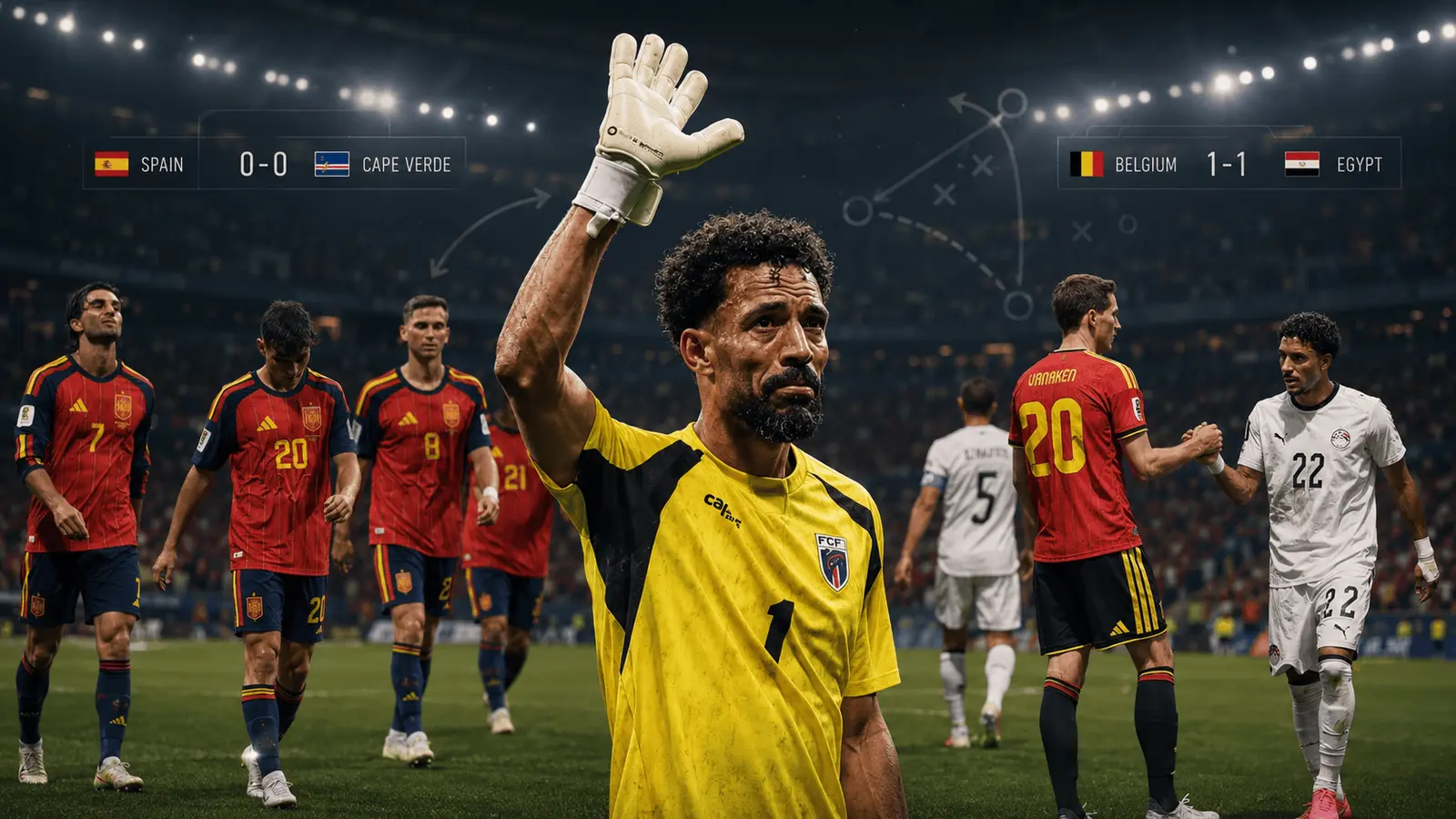
Tears of joy - that's the best way to describe Vozinha. He withstood attacks from a former world champion, a European champion, and a team ranked in the world's top 5.
Cape Verde’s 0-0 draw with Spain was a team defensive achievement, but Vozinha gave it the storybook quality.
At 40, with 87 national-team appearances, he kept a clean sheet against Spain on the World Cup stage. That alone is powerful. Yet the performance should not be reduced to sentiment. A goalkeeper in that kind of match has to manage more than shots: positioning, timing, communication and emotional temperature all matter.
Cape Verde’s defensive discipline meant Vozinha was not abandoned. His value was in completing the structure, not rescuing a broken one every minute.
This is definitely one of the most exciting moments of the 2026 World Cup finals. Those of you who once thought that the expansion of the World Cup would make the games less exciting, have you felt it now?
Mohammed Al-Owais: hero, even with the rebound debate
Mohammed Al-Owais conceded once against Uruguay, but his overall performance was decisive. He recorded nine saves in Saudi Arabia’s 1-1 draw, and without that volume of intervention the match likely takes on a very different tone.
The equaliser came from a second-phase moment after an initial save, which naturally creates debate around goalkeeping responsibility. But not every rebound is a simple error. Shot power, traffic, body shape and reaction time all matter.
The fair conclusion is balanced: Al-Owais was involved in the sequence Uruguay scored from, but he was also the main reason Saudi Arabia stayed alive long enough to take a point.
Mohamed Hany: the right-back who made Belgium predictable
Mohamed Hany’s performance against Belgium deserves more attention than a typical defensive shift.
He finished with 61 touches, 13 defensive interventions and eight duels won. More importantly, he gave Egypt a platform to control Belgium’s most obvious threat zone. Jérémy Doku had plenty of involvement, but rarely the kind of clean, open-field involvement Belgium wanted.
Hany did not defend alone. Egypt’s cover structure mattered. But his concentration and duel management were central to making the plan believable.
Mohamed Salah: low-touch leadership still counts
Salah’s assist in Egypt’s 1-1 draw with Belgium showed that leadership does not always require constant possession.
For Egypt, Salah’s presence changes defensive attention. He can stretch a line, attract concern, create space for others and still deliver the decisive action when the moment arrives. Emam Ashour’s 25-yard goal, set up by Salah, captured that economy of influence.
This is an important version of the ageing superstar: not always the player who takes over every attack, but the one whose timing and status make the team braver.
Chris Wood: the target man who made New Zealand’s attack real
New Zealand’s 2-2 draw with Iran revolved around Chris Wood’s usefulness as a reference point.
He was directly involved in both New Zealand goals, helping create the first and providing the platform before the second. That is the value of a proper target forward for an underdog: he turns pressure clearances into contests, contests into possession, and possession into runners joining the attack.
New Zealand did not need a complicated attacking machine. They needed a first point of contact they could trust. Wood gave them that.
Role clarity wins moments
These five performances were different, but they shared one quality: clarity.
Vozinha gave Cape Verde calm. Al-Owais gave Saudi Arabia survival. Hany gave Egypt a defensive reference. Salah gave Egypt leadership without waste. Wood gave New Zealand an attacking platform.
That is why underdogs can compete. Not because every player is equal on paper, but because the right player in the right role can make the match smaller, clearer and more manageable.
Controversy and Talking Points
Talking Points: Was Spain Too Safe, Was Al Owais to Blame, and Are Expanded World Cups Better Than Expected?
Early World Cup matches are fertile ground for overreaction. A favourite draws and the verdict arrives instantly: arrogance, failure, crisis. An underdog survives and the verdict is just as quick: luck, bus-parking, romance.
The truth is more interesting.
Spain: rotation, caution or a structural mistake?
Spain’s 0-0 draw with Cape Verde raises a fair question: were Spain simply managing the group stage, or did they get the balance wrong?
There may be an argument that Spain did not want to overextend early in the tournament. But even if that is true, the structure still created a football problem. A midfield-heavy setup can control the ball while reducing the number of players who naturally attack the last line.
That is not a moral failure. It is a tactical trade-off. Spain chose security and connection. Against Cape Verde’s disciplined block, they needed more rupture.
Al-Owais: can a goalkeeper be a hero if the goal comes after his save?
The debate around Mohammed Al-Owais is exactly the kind of discussion that splits fans.
Saudi Arabia’s goalkeeper made nine saves in the 1-1 draw with Uruguay. Uruguay’s equaliser came after he saved the initial header and the rebound was finished. Some will call that a goalkeeping flaw. Others will point out that without his earlier work, Saudi Arabia may not have been in position to draw at all.
The second view is more convincing. Goalkeeping analysis should not be reduced to whether a rebound happened. The quality of the shot, the save direction available, bodies in the box and the defensive reaction all matter. Al-Owais was not perfect, but he was central to the point.
Belgium: is this about De Bruyne or the system around him?
Belgium’s draw with Egypt will naturally bring discussion about Kevin De Bruyne’s stage of career. But the sharper question is not whether he can still play. It is whether Belgium’s attack has enough variety when his all-action threat is no longer overwhelming by itself.
If Belgium become too dependent on Jérémy Doku for ball progression, opponents can tilt defensive resources toward him. Egypt did exactly that. Mohamed Hany’s performance was excellent, but Belgium also made the task clearer by not creating enough alternative problems.
Salah: less possession, more meaning
Mohamed Salah’s role for Egypt offers a useful counterpoint. He did not need to dominate the ball to dominate attention.
His assist for Emam Ashour showed the power of selective influence. For ageing elite forwards, the question is not always whether they can still play as they did five years ago. It is whether the team can build a role that preserves their most decisive qualities.
Egypt appear to understand that better than many national teams do with their senior stars.
Expanded World Cup: more mismatch, or more story?
The expanded 48-team format was always going to invite scepticism. Would it dilute quality? Would early group games become cautious? Would stronger teams manage games rather than attack them?
Those concerns are not irrelevant. But the opening matches also show the upside: more nations with a genuine stage, more tactical variety, and more emotional investment from teams that know one point can change a country’s tournament.
Cape Verde’s clean sheet against Spain and New Zealand’s fearless draw with Iran are not filler. They are exactly the kind of stories that make international football feel global.
The best answer to the format debate may not be theoretical. It may be on the pitch: if smaller teams continue to arrive with organisation, identity and courage, the tournament becomes richer, not thinner.