
World Cup Warm Up Lessons: Ronaldo’s Role, Belgium’s Warning Signs and the Heat Factor
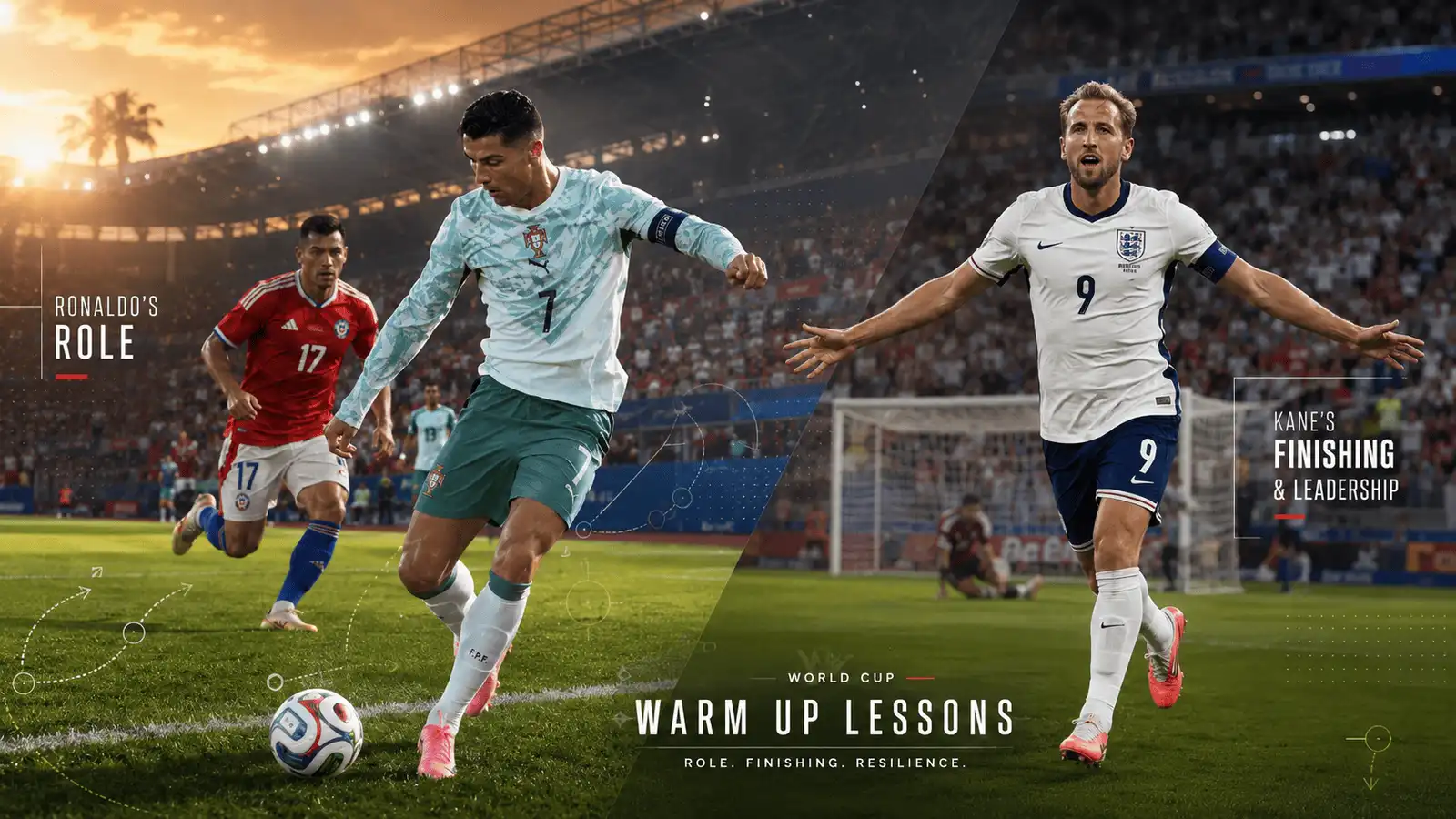
Introduction
A World Cup preparation package focused on what recent friendlies reveal beyond the scoreline: Portugal’s Cristiano Ronaldo dilemma, Belgium’s ageing core, North America’s high-intensity hosts, Germany’s unresolved structure and England’s need to manage heat, rhythm and finishing quality.
Match Preview
World Cup Warm Up Preview: Why the Biggest Clues Are Not Always in the Scoreline
Friendly Results Are Only the Beginning
Warm-up matches are often judged too quickly. A narrow win becomes a crisis, a heavy victory becomes proof of strength, and a defeat is treated as a warning sign. The more useful reading is different: which teams are using friendlies to test roles, protect legs, hide tactical detail and identify problems before the tournament pressure arrives?
That is the broader lesson from the recent run of World Cup preparation matches. Belgium’s 5-0 win over Tunisia looked emphatic, Portugal’s 2-1 victory over Chile reopened the Cristiano Ronaldo role debate, Germany beat the United States 2-1 in Chicago, England edged New Zealand 1-0 in Florida, and Canada’s 1-1 draw with Ireland underlined both their resilience and their limitations.
Portugal: The Ronaldo Question Is Tactical, Not Sentimental
Portugal’s biggest decision is not whether Cristiano Ronaldo still has value. He clearly does. The question is whether his best value now comes as a default 90-minute centrepiece or as a late-game weapon.
Against Chile, Ronaldo played the first half before being replaced at the interval. He had an offside goal and free-kick moments, while Bruno Fernandes later scored from outside the box after an assist from Francisco Conceição. The broader tactical argument is that Portugal’s younger attacking group may move the ball faster when the attack is less fixed around one legendary reference point.
That does not make Ronaldo irrelevant. It may make him more specific. In hot tournament conditions, a 70th-minute Ronaldo entering against tired defenders could be more dangerous than a Ronaldo asked to carry the full attacking rhythm from the start.
Belgium: A 5-0 Win That Still Leaves Questions
Belgium’s 5-0 win over Tunisia was convincing on the scoreboard. Leandro Trossard opened the scoring in the 28th minute, followed by Charles De Ketelaere, Kevin De Bruyne, Dodi Lukébakio and Nicolas Raskin after half-time. Belgium produced 27 shots, 12 on target.
But the wider issue remains unchanged: Belgium are still negotiating the final phase of their golden generation. De Bruyne remains central, Romelu Lukaku still offers a different kind of penalty-box solution, and experienced figures such as Thomas Meunier and Axel Witsel remain part of the conversation. The question is whether Belgium can refresh without losing what made them dangerous.
Rudi Garcia’s arrival in 2025 gives Belgium a coach associated with possession, attacking transitions and collective spirit. The next step is turning a talented but ageing squad into a tournament side that can survive higher-tempo opposition.
Canada and USA: Two North American Hosts, Two Different Problems
Canada under Jesse Marsch look like a team built to press, disrupt and compete. That makes them difficult to play against, but it also raises questions: can a national team sustain a Red Bull-style intensity with limited preparation time and injury-affected players? Alphonso Davies, Moïse Bombito, Alistair Johnston, Marcelo Flores and Stephen Eustáquio have all been noted as carrying fitness concerns or being limited by injury issues.
Jonathan David’s finishing may decide whether Canada become a team that merely refuses to lose or one that wins tight matches.
The United States, meanwhile, showed signs of structure despite losing 2-1 to Germany. Christian Pulisic scored, but the more interesting detail was Mauricio Pochettino’s apparent progress in organising the team. The risk is midfield depth: if Tyler Adams is the only natural holding midfielder available at the required level, the USA’s balance could become fragile in heat and short-turnaround matches.
Germany and England: Winning, But Still Searching
Germany’s win over the USA did not erase their familiar concerns. With players such as Kai Havertz, Leroy Sané, Jamal Musiala, Florian Wirtz, Joshua Kimmich and Felix Nmecha involved, the talent is obvious. The issue is repeatability: Germany still have to turn individual quality into a stable tournament structure.
England’s 1-0 win over New Zealand in Florida came in 33-degree heat. Harry Kane’s header, assisted by Djed Spence, was the kind of efficient finishing that becomes even more valuable when tempo drops and matches become physically draining. Marcus Rashford’s willingness to attack with the ball was another useful sign, but England’s larger challenge may be managing rhythm, heat and squad freshness.
The 48-Team Format May Change the Psychology
The expanded World Cup format adds another layer. With 12 groups and the eight best third-placed teams progressing, the incentive structure changes. For many teams, avoiding defeat may become almost as important as chasing wins.
That could make some group-stage matches more cautious. It could also make game management, substitutions, set pieces and cooling-break communication more important than ever.
The headline from these friendlies is simple: the biggest nations are not short of talent. Their problem is choosing the right version of themselves before the tournament begins.
Post-Match Review
Friendly Review: Belgium Cruise, Portugal Win, USA Show Shape and England Manage the Heat
Results Matter Less Than What They Exposed
A friendly window can mislead if it is treated like a league table. Belgium’s 5-0 win over Tunisia was dominant, Portugal beat Chile 2-1, Germany defeated the United States 2-1 in Chicago, England beat New Zealand 1-0, Scotland won 4-0, Brazil beat Egypt 2-1, Argentina defeated Honduras 2-0, and Canada drew 1-1 with Ireland.
Those results offer a useful snapshot, but the better question is what each match revealed.
Belgium’s Big Win Was Convincing — But Not Definitive
Belgium’s 5-0 victory over Tunisia was the clearest scoreboard statement. The goals came from Leandro Trossard, Charles De Ketelaere, Kevin De Bruyne, Dodi Lukébakio and Nicolas Raskin, with Belgium registering 27 shots and 12 on target.
Yet the performance should not be read as a complete solution. Belgium still need to decide how much responsibility rests on the older core and how quickly players such as Jérémy Doku, De Ketelaere, Lukébakio and Raskin can become more than supporting pieces.
Doku, in particular, stands out because he gives Belgium something that does not depend on slow possession patterns: the ability to beat defenders and create disorder by himself.
Portugal Won, But the Ronaldo Debate Grew Louder
Portugal’s 2-1 win over Chile was less about the result and more about role definition. Ronaldo played the first half, was replaced at half-time, and had moments including an offside goal and free-kick involvement. Bruno Fernandes later scored from outside the box after Francisco Conceição’s assist.
The natural debate is whether Portugal are at their most fluid when the attack is built around faster circulation between Bruno Fernandes, wide runners and flexible forwards. Ronaldo can still decide matches, but his ideal tournament role may now be more targeted than automatic.
USA Lose, But Show Signs of a Plan
Germany’s 2-1 win over the United States featured Christian Pulisic on the scoresheet for the hosts. Still, the USA’s performance should not be judged only by the defeat.
Under Mauricio Pochettino, the team appear to be moving toward clearer organisation. Their use of cooling-break communication, with tactical information delivered during a pause, points toward a modern tournament reality: in high temperatures, every stoppage can become a coaching opportunity.
The main concern remains the holding-midfield zone. Tyler Adams’ importance is magnified because the squad does not appear to have an abundance of natural alternatives in that role.
England’s 1-0 Win Was a Heat-Management Exercise
England’s win over New Zealand took place in Florida in 33-degree conditions. In that context, Harry Kane’s headed goal from Djed Spence’s cross was more than a routine finish. It was a reminder that elite penalty-box details matter when matches are tight and physically draining.
Marcus Rashford’s sharper ball-carrying was another useful sign. England do not need every attacker to peak at once in warm-up matches; they need evidence of options, freshness and tactical fit.
The Bigger Lesson
The recent friendlies did not produce one single tournament favourite. They produced a set of warning signs. Belgium must modernise without losing experience. Portugal must define Ronaldo’s role without turning the debate into a personality contest. The USA and Canada must balance intensity with heat and fitness. Germany must turn names into structure. England must manage physical conditions without losing attacking edge.
That is why these matches matter. Not because of the scorelines alone, but because they show which problems will follow teams into the World Cup if left unsolved.
Team Analysis
World Cup Team Trends: The Contenders With Talent Still Have Structural Problems
Portugal: A Deep Squad With One Defining Decision
Portugal may have one of the deepest attacking pools in international football, but their central question is unusually delicate: how should Cristiano Ronaldo be used?
The issue is not respect. It is rhythm. Portugal’s newer attacking pieces — Bruno Fernandes, Rafael Leão, Francisco Conceição, João Félix, Pedro Neto, Bernardo Silva and others — naturally point toward speed, movement and rotation. Ronaldo still offers penalty-box authority, aerial threat and late-game conviction. The challenge is deciding when that value is maximised.
A late substitute role would be tactically logical. It would also be politically and emotionally difficult.
Belgium: The Golden Generation Is Not Gone, But It Is No Longer Enough
Belgium’s 5-0 win over Tunisia showed attacking quality and depth, but the broader concern remains. Kevin De Bruyne is still central, Romelu Lukaku still has a use, and Thibaut Courtois can raise the team’s floor. But Belgium are no longer a side that can rely on their golden generation to overwhelm tournament opposition by default.
The next phase depends on whether players such as Jérémy Doku, Charles De Ketelaere, Dodi Lukébakio and Nicolas Raskin can carry more responsibility. Doku is the most obvious disruptor: he can break a defensive line without needing the whole system to function perfectly.
The tactical question for Rudi Garcia is how to combine possession, quick counter-attacking and collective discipline without asking the older core to do too much.
Canada: High Pressing Brings Edge — and Risk
Canada’s identity under Jesse Marsch is clear: pressure, energy, verticality and aggression. That can make them uncomfortable opponents, especially in North American conditions.
But high pressing is physically expensive. With key players including Alphonso Davies, Moïse Bombito, Alistair Johnston, Marcelo Flores and Stephen Eustáquio dealing with injury-related limitations, Canada’s ceiling may depend less on ideas than on availability.
Jonathan David’s role is decisive. If Canada press well but do not convert, they can become hard to beat but hard to back as winners.
USA: Pochettino’s Structure Is Taking Shape
The United States’ 2-1 defeat to Germany still carried encouraging signs. Mauricio Pochettino appears to be building clearer organisation, and Christian Pulisic remains the most important attacking reference.
Antonee Robinson’s left-sided drive gives the USA a valuable progression route, especially if he can combine consistently with Pulisic. But the midfield balance depends heavily on Tyler Adams. If he is unavailable or overworked, the team’s defensive transitions become far more vulnerable.
Germany: Talent Without Stability Is Still a Problem
Germany have enough high-profile players to trouble anyone, but the unresolved issue is stability. Leroy Sané can produce decisive moments and still frustrate with decision-making. Kai Havertz has big-game qualities but does not always provide a conventional No. 9 solution. Jamal Musiala’s rhythm after returning needs monitoring, while the midfield mix must balance ball progression with defensive security.
Julian Nagelsmann’s task is not to make Germany talented. They already are. His task is to make them reliable.
England: Heat, Tempo and the Value of Kane
England’s 1-0 win over New Zealand in Florida underlined a different issue: tournament conditions. In 33-degree heat, rhythm control and efficient finishing become essential.
Harry Kane’s headed goal from Djed Spence’s cross was a reminder that England still have one of the best penalty-box problem-solvers in world football. If Marcus Rashford’s directness is returning, England gain another useful option. But the wider challenge is managing energy across a tournament that may punish teams that press too hard for too long.
The Shared Theme
The strongest teams are not simply the teams with the best players. They are the teams that know what their best players are for. The next World Cup may be decided as much by role clarity, substitutions, heat adaptation and game-state management as by star power.
Player Performance
Player Watch: Ronaldo, De Bruyne, Doku, Pulisic and Kane Shape the World Cup Debate
Cristiano Ronaldo: Still Valuable, But How?
Cristiano Ronaldo remains the most sensitive tactical debate around Portugal. His value is not in question: he still brings finishing instinct, aerial threat, experience and authority. The question is whether Portugal’s fastest and most fluid version now comes with Ronaldo starting every major match or entering later to attack tired defenders.
Against Chile, he played the first half and was replaced at half-time. That kind of usage may become more than a friendly experiment. In hot conditions, Portugal may gain more from shorter, sharper Ronaldo minutes than from asking him to dominate a full match rhythm.
Bruno Fernandes: The Accelerator
Bruno Fernandes’ goal against Chile — a right-footed shot from outside the box into the bottom-left corner, assisted by Francisco Conceição — fits the wider argument about Portugal’s attacking pace. Fernandes is at his best when the game moves quickly, when runners give him options and when he can attack the space between midfield and defence.
If Portugal lean into that tempo, Fernandes becomes more than a creator. He becomes the switch that accelerates the whole team.
Rafael Leão: Explosive, But Under Scrutiny
Rafael Leão’s red card against Chile adds another layer to his already intriguing profile. He remains one of Portugal’s most dangerous carriers, capable of changing a match with one direct run. But with his club future and emotional sharpness often discussed publicly, any disciplinary moment becomes magnified.
The safer football reading is this: Leão is too talented to ignore, but Portugal need his aggression to be channelled into decisive attacking actions, not avoidable risk.
Kevin De Bruyne: Belgium’s Brain Still Carries a Heavy Load
Kevin De Bruyne scored in Belgium’s 5-0 win over Tunisia and remains the national team’s most important organiser. But Belgium’s concern is not whether De Bruyne can still produce quality. It is whether he should still be asked to carry so much of the team’s creative burden.
At tournament level, especially against elite midfields, Belgium need others to reduce that load.
Jérémy Doku: The New Variable Belgium Need
Doku may be Belgium’s most important change-of-shape player. He gives them one-v-one disruption, acceleration and the ability to create chances without requiring long spells of perfect possession.
For a team moving beyond its golden generation, that matters. Doku is not just a winger. He may be Belgium’s clearest route toward a less predictable future.
Romelu Lukaku: The Old-Fashioned Solution Still Has a Use
Romelu Lukaku is easy to caricature, but tournament football often rewards specific tools. Against deep blocks or in late pressure phases, Belgium may still need a forward who can occupy centre-backs, attack crosses and provide penalty-area gravity.
He may no longer be the universal answer. He can still be the right answer in certain game states.
Christian Pulisic: The USA Still Need His End Product
Christian Pulisic scored in the USA’s 2-1 defeat to Germany, reinforcing his importance as the team’s attacking reference point. Under Mauricio Pochettino, the USA need structure, but structure still needs a final-third difference-maker.
Pulisic remains that player.
Tyler Adams: The Player the USA Can Least Afford to Lose
Tyler Adams’ importance is tactical rather than glamorous. If he is the only natural holding midfielder trusted at the highest level, the entire USA balance leans heavily on his availability and rhythm.
In a hot, demanding tournament, that is a major squad-management issue.
Harry Kane: Elite Finishing Travels
Harry Kane’s header against New Zealand was a classic striker’s finish: meet the cross, control the angle, redirect the ball and make the goalkeeper’s read harder. In matches where heat slows tempo and chances are fewer, that kind of efficiency can define England’s ceiling.
Kane may not always dominate visually. He still changes the scoreboard with details few forwards master.
Controversy and Talking Points
The Ronaldo Debate Is Really About Portugal’s Identity
This Is Not a Simple ‘Ronaldo Is Finished’ Argument
The loudest version of the Cristiano Ronaldo debate is also the least useful one. Portugal do not need to decide whether Ronaldo has been great. They do not even need to decide whether he can still help them. He can.
The real question is narrower and more tactical: should Portugal still build their full-match attacking rhythm around him?
Why the Debate Exists
Portugal’s current squad has speed, width and technical variety. Bruno Fernandes can accelerate play from midfield. Rafael Leão, Francisco Conceição, Pedro Neto, João Félix and Bernardo Silva offer different forms of movement and creativity. Full-backs such as João Cancelo and Diogo Dalot can also change the attacking shape.
That collection naturally points toward mobility. Ronaldo naturally points toward penalty-box authority. Both are valuable, but they do not always produce the same rhythm.
Against Chile, Ronaldo played the first half before being replaced. He had an offside goal and free-kick involvement, while Bruno Fernandes later scored from outside the box after Francisco Conceição’s assist. One match should not settle the argument, but it does show why the discussion will not disappear.
The Case for Ronaldo as a Late Weapon
The strongest tactical case for changing Ronaldo’s role is not emotional. It is environmental and structural.
Tournament football in heat demands energy management. If Portugal can spend the first hour stretching opponents with quicker circulation and wider running, Ronaldo could then enter when defenders are tired and the match needs a ruthless finisher.
That role would not diminish him. It could sharpen his usefulness.
The Risk Is Not Only Tactical
There is a reason this decision is difficult. Ronaldo is not just another forward. His status affects supporters, opponents, media pressure and possibly the emotional temperature around the squad.
A coach can make the correct tactical decision and still create a political problem. That is what makes this such a high-stakes call.
Portugal Must Choose the Team Over the Symbol
The best version of Portugal may still include Ronaldo. It just may not require Ronaldo to be the starting point for every attacking plan.
If Portugal want to win a major tournament with this generation, they must define roles with clarity rather than nostalgia. Ronaldo can still be decisive. The question is whether Portugal are brave enough to use him at the moment when he can be most decisive, rather than the moment that feels most traditional.