
World Cup Warm Up Watch: Netherlands’ Finishing Problem, Algeria’s Statement and France’s...
Introduction
World Cup warm-up analysis focused on how elite national teams convert talent into results: Netherlands’ finishing problem, Algeria’s upset profile, France’s Mbappe-centred attacking identity and Argentina’s ageing-champion risk.
Match Preview
France vs Ivory Coast Preview: Why Mbappe’s Role Matters More Than the Scoreline
France vs Ivory Coast Preview: Why Mbappe’s Role Matters More Than the Scoreline
France friendlies rarely feel like ordinary friendlies. The squad is too deep, the expectations too high and the World Cup context too close for these matches to be treated as simple fitness exercises.
Against Ivory Coast, the most important storyline is not only whether France win. It is how they use the match to sharpen their attacking hierarchy, especially around Kylian Mbappe.
Mbappe’s national-team comfort zone
The source discussion makes a useful distinction: Mbappe can be surrounded by more noise at club level, where debates about power, results, responsibility and team-building often follow him. With France, the emotional landscape is different. He is not just another elite forward; he is still treated as the central attacking reference point.
That matters tactically. A forward with Mbappe’s profile is at his best when the team creates clear lanes for him to receive early, attack space and force defenders into uncomfortable decisions. In a warm-up setting, France should be judged not only by goals but by whether their possession gives Mbappe the right zones to accelerate from.
Rotation should not mean looseness
PSG-related players may be rested or have reduced involvement after their Champions League commitments. If France rotate, the match becomes a test of system stability: can the side maintain rhythm when major club-level stars are managed carefully?
That is where players such as Jean-Philippe Mateta, Michael Olise, Marcus Thuram, Bradley Barcola or Ousmane Dembele become interesting, depending on selection and minutes. The point is not to predict an exact XI, but to watch how France balance individual quality with shared attacking patterns.
What France need from the match
France do not need to prove that they have talent. They need evidence of repeatable mechanisms:
- Can Mbappe receive in positions where he can face goal rather than constantly play with his back to pressure?
- Can the supporting forwards create width and second runs rather than simply waiting for Mbappe to solve the attack?
- Can midfield progression arrive quickly enough to prevent France from becoming predictable?
- If regular starters are managed, does the defensive structure remain calm?
Ivory Coast as a useful test
Ivory Coast offer the kind of physical, athletic opponent that can make a friendly genuinely valuable. France will not learn much from sterile possession alone. They will learn more if they are forced to protect transitions, compete in duels and build attacks against resistance.
That is why this match matters. France are a World Cup favourite, but favourites need more than names. They need clarity. Mbappe’s role is the headline, but the deeper question is whether France are building a platform that allows their best player to lead without making the attack one-dimensional.
Post-Match Review
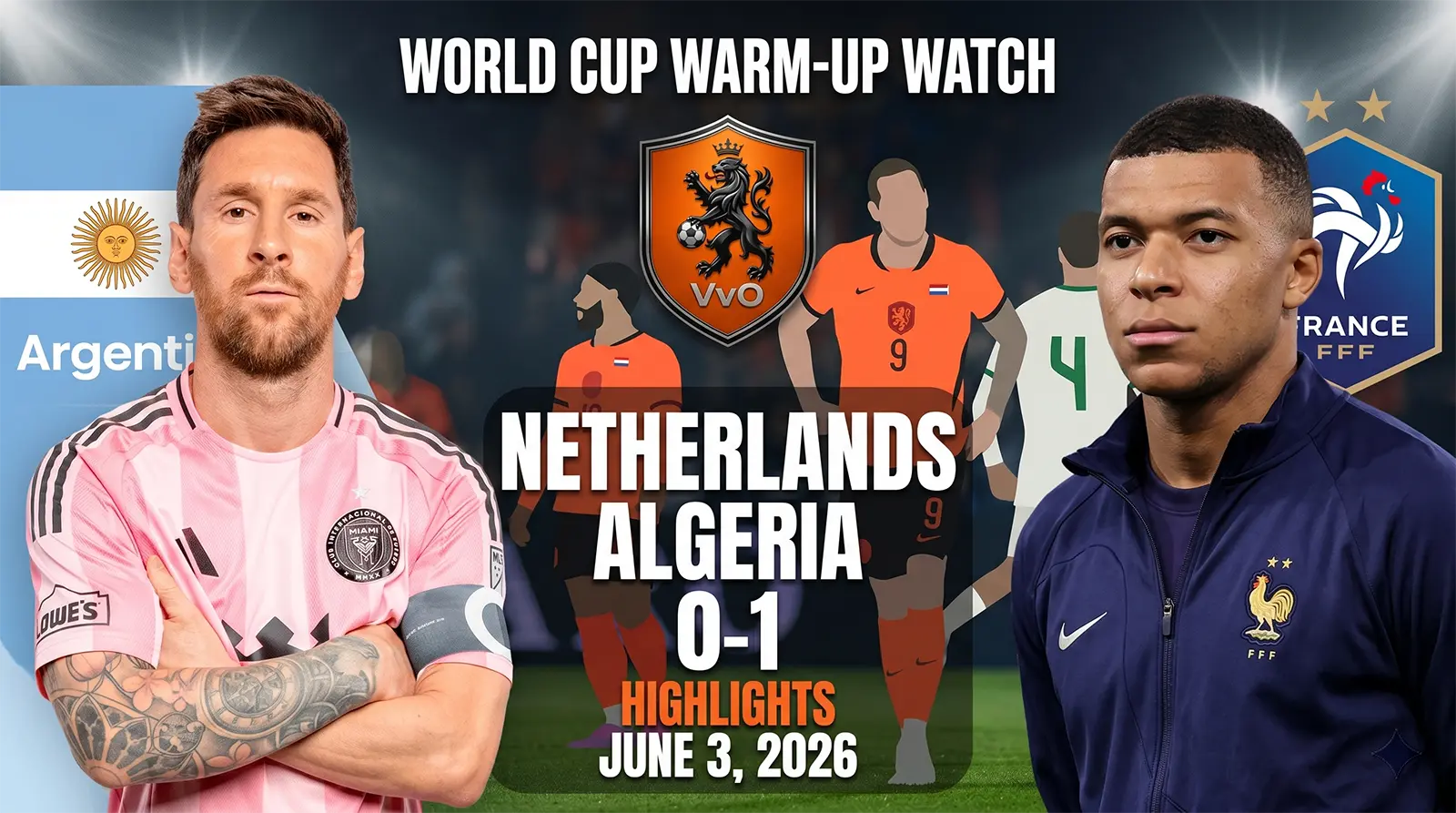
Netherlands 0 1 Algeria Review: A Warning Shot for a Team Still Searching for a Finisher
Netherlands 0-1 Algeria Review: A Warning Shot for a Team Still Searching for a Finisher
The Netherlands’ warm-up defeat to Algeria should not be exaggerated into a crisis, but it should not be dismissed either. Friendlies are not trophies, yet they often reveal structural problems before tournament football makes them expensive.
This match offered a clear contrast: the Netherlands had the stronger platform and produced high-value openings, while Algeria protected the game through goalkeeping, resilience and one decisive attacking moment.
Chance creation without punishment
Central theme from the source: the Netherlands produced an expected-goals figure of 2.1 and had three major scoring chances. That is not the profile of a team that created nothing. It is the profile of a team that failed to finish.
That distinction matters. A side that cannot progress the ball has one kind of problem. A side that repeatedly reaches dangerous areas but cannot score has another. The Dutch issue is closer to the second category, and it is particularly troubling because knockout football often punishes exactly that weakness.
Malen, Depay and the centre-forward dilemma
The source’s most useful attacking observation is the comparison between Donyell Malen and Memphis Depay. Malen was criticised for missing chances, but the analysis also notes that he at least got into scoring positions. Depay’s introduction, by contrast, did not clearly improve the volume of chances.
That creates an uncomfortable selection question for Ronald Koeman: does he prefer the forward who wastes chances but generates them, or the more experienced name who may offer presence without the same movement?
This is not just about one player. It points to a broader Dutch concern since the era of elite penalty-box forwards: the Netherlands can look well-built from midfield backward and still lack the ruthless final touch that defines tournament winners.
Algeria’s upset formula
Algeria’s performance had the classic shape of an underdog result that can translate to tournament football. They did not need to dominate every phase. They needed to survive pressure, trust their goalkeeper and take the moment when it arrived.
Luka Zidane’s clean sheet is a major part of the story. His international route is compelling in itself: the son of Zinedine Zidane, playing in goal rather than midfield, and representing Algeria. That profile brings attention, but the performance gave the story substance.
Anis Hadj Moussa adds another layer. The Feyenoord forward scoring at Feyenoord’s home ground for Algeria is exactly the kind of narrative that makes warm-up matches linger beyond the final whistle.
What the Netherlands should take from it
The Dutch should not panic. They should, however, treat this as a warning. High xG and strong territorial spells are useful, but they do not win matches by themselves. If the Netherlands enter major tournament football without a sharper penalty-box solution, they may again become a side that looks impressive until the moment the match demands one clean finish.
Algeria, meanwhile, leave with something more valuable than a friendly scoreline: evidence that their defensive concentration, goalkeeper performance and front-line individuality can trouble a stronger opponent.
Team Analysis
World Cup Warm Up Trends: France Have Depth, Argentina Have Experience, the Netherlands Have a Finishing Problem
World Cup Warm-Up Trends: France Have Depth, Argentina Have Experience, the Netherlands Have a Finishing Problem
International football can be deceptive. A squad list can look powerful, but tournament football exposes whether that quality fits together under pressure.
The current warm-up cycle offers three different case studies: France, Argentina and the Netherlands. All have talent. All have clear identities. But their problems are not the same.
France: depth still needs a hierarchy
France’s advantage is obvious: they have enough attacking options to rotate and still look dangerous. But depth can create its own problem if the attacking hierarchy becomes blurred.
That is why Kylian Mbappe remains the central figure. The source frames him as more comfortable with France than in some club-level conversations, because the national team still recognises him as the attacking leader. For France, the challenge is to make that leadership functional rather than symbolic.
A Mbappe-centred France should not mean every attack becomes a forced pass to one player. It should mean the structure creates space for him while giving supporting forwards defined jobs: stretch the pitch, attack the far post, combine quickly and protect transitions when attacks break down.
Argentina: experience is both strength and risk
Argentina’s concern is different. Argentina retain a large number of players from the previous final, with the squad profile among the oldest and least changed.
That continuity brings trust. It also brings a physical question. The expanded World Cup format increases the number of teams, adds an extra round of 32 in the knockout stage and creates a more demanding schedule. In North American summer conditions, workload management becomes a tactical issue, not just a medical one.
Lionel Messi remains the emotional and technical centre, but Argentina’s bigger question is collective: can an experienced core survive a longer, hotter, denser tournament without losing intensity at the decisive stage?
Netherlands: the structure is better than the finish
The Netherlands’ defeat to Algeria sharpened a familiar concern. Their midfield and defensive base can be convincing. They can create chances. But the forward line still lacks the certainty of a true tournament No. 9.
That is why the Malen-Depay debate matters. Malen may frustrate by missing chances, yet his movement at least produces them. Depay brings reputation and experience, but if he cannot increase penalty-box threat, the trade-off becomes uncomfortable.
Ronald Koeman’s task is not simply to pick the most famous forward. It is to find the attacking arrangement that turns Dutch possession into goals before a knockout opponent turns one missed chance into an exit.
Algeria: the underdog profile is real
Algeria should not be reduced to a one-match upset. The win over the Netherlands points to a tournament profile that can be dangerous: goalkeeper confidence, defensive patience and enough individual quality in attack to punish a favourite.
That does not automatically make Algeria a deep-run prediction. But it does make them a team stronger opponents will need to treat seriously.
The wider lesson
Warm-up football is useful when we avoid overreacting to scores and instead ask what the matches reveal. France are managing abundance. Argentina are managing time. The Netherlands are managing efficiency. Algeria are building belief.
Those are very different problems — and they may matter more than any single friendly result.
Player Performance
Luka Zidane, Hadj Moussa and Mbappe: Three Player Stories Behind the World Cup Warm Up Narrative
Luka Zidane, Hadj Moussa and Mbappe: Three Player Stories Behind the World Cup Warm-Up Narrative
The best international windows are not only about teams. They are about players whose individual stories reveal something larger.
In this set of warm-up narratives, three names stand out: Luka Zidane, Anis Hadj Moussa and Kylian Mbappe.
Luka Zidane: a famous name, a different path
Luka Zidane’s story attracts attention before he touches the ball. Being Zinedine Zidane’s son guarantees comparison, but his career path is unusual enough to create distance from the obvious narrative.
He is a goalkeeper, not a playmaking midfielder. He represents Algeria, not France. Those two choices give him a different football identity rather than trapping him in a direct comparison with his father.
His clean sheet against the Netherlands matters because it turns the story from biography into performance. Algeria needed their goalkeeper to protect the result, and Zidane gave the match a defining image: a famous surname attached to a very different role.
Anis Hadj Moussa: the local-stage storyline
Anis Hadj Moussa’s goal carries its own symbolism. A Feyenoord player scoring for Algeria at Feyenoord’s home ground is a ready-made football story, but it also points to Algeria’s attacking potential.
For underdog teams, tournament danger often comes from players who do not need many moments to change a match. Hadj Moussa’s contribution fits that pattern: Algeria did not have to control the whole game if they could produce the decisive moment.
Mbappe: authority looks different in a France shirt
Kylian Mbappe’s situation is more complex. He does not need a friendly to prove his quality. What matters is how France use his authority.
The source discussion argues that Mbappe appears more comfortable with the national team because France still treats him as the central attacking figure. That is an important distinction. At club level, his role can become tangled with broader debates about influence and responsibility. With France, the hierarchy is clearer.
That clarity can help him. A player like Mbappe does not simply need the ball; he needs the right kind of collective movement around him. If France’s supporting attackers stretch defences and create second options, Mbappe’s leadership becomes a tactical weapon rather than a burden.
Why these stories matter
Zidane, Hadj Moussa and Mbappe represent three different forms of pressure. Zidane carries a name. Hadj Moussa carries opportunity. Mbappe carries expectation.
Warm-up matches are where those pressures begin to show. Some players use them to win selection arguments. Others use them to redefine public perception. The World Cup conversation is already forming around those details.
Controversy and Talking Points
The Netherlands’ Real Problem Is Not Koeman Alone — It Is the Forward Line He Has to Trust
The Netherlands’ Real Problem Is Not Koeman Alone — It Is the Forward Line He Has to Trust
After a result like Netherlands 0-1 Algeria, the easiest reaction is to turn the manager into the story. Ronald Koeman’s selections, substitutions and attacking structure will naturally be questioned.
Some of that criticism is fair. Coaches are responsible for turning possession into repeatable chances and chances into goals. But the Dutch problem runs deeper than one tactical board.
A coach can create chances, but forwards must finish them
The Netherlands generated enough danger to change the match. The figure of 2.1 expected goals and three major scoring opportunities. That is where the debate becomes complicated.
If a team creates nothing, the coach is the obvious target. If a team creates high-quality chances and still fails to score, responsibility is shared. Structure brought the Netherlands close. Execution let them down.
The Malen-Depay dilemma is real
Donyell Malen’s performance is easy to criticise because missed chances are visible. Yet the source makes a sharper point: Malen at least found the spaces. Memphis Depay’s introduction did not clearly solve the problem if it reduced the team’s ability to generate openings.
That is the selection trap. The forward who misses can look worse than the forward who never arrives. But in tournament football, arriving in the right place is still a valuable skill — provided someone eventually finishes.
Koeman still has responsibility
None of this removes Koeman from scrutiny. If the Netherlands repeatedly look blunt despite good approach play, the coach must find a better combination. That could mean changing the front three, altering the timing of midfield runs or using a more direct penalty-box presence.
But blaming the manager alone risks missing the bigger structural issue: the Netherlands have high-level players in many zones and still lack a guaranteed finisher.
Why this matters before a World Cup
In a group-stage match, wastefulness can be survivable. In a knockout match, it can define a tournament. One underdog save, one missed one-on-one, one counterattack — that is all it takes.
The Algeria result should not cause panic, but it should sharpen the debate. The Netherlands do not simply need better football. They need colder football in the box.