
World Cup Build Up, China’s Rebuild and Madrid Transfer Politics: Football Trends to Watch
Introduction
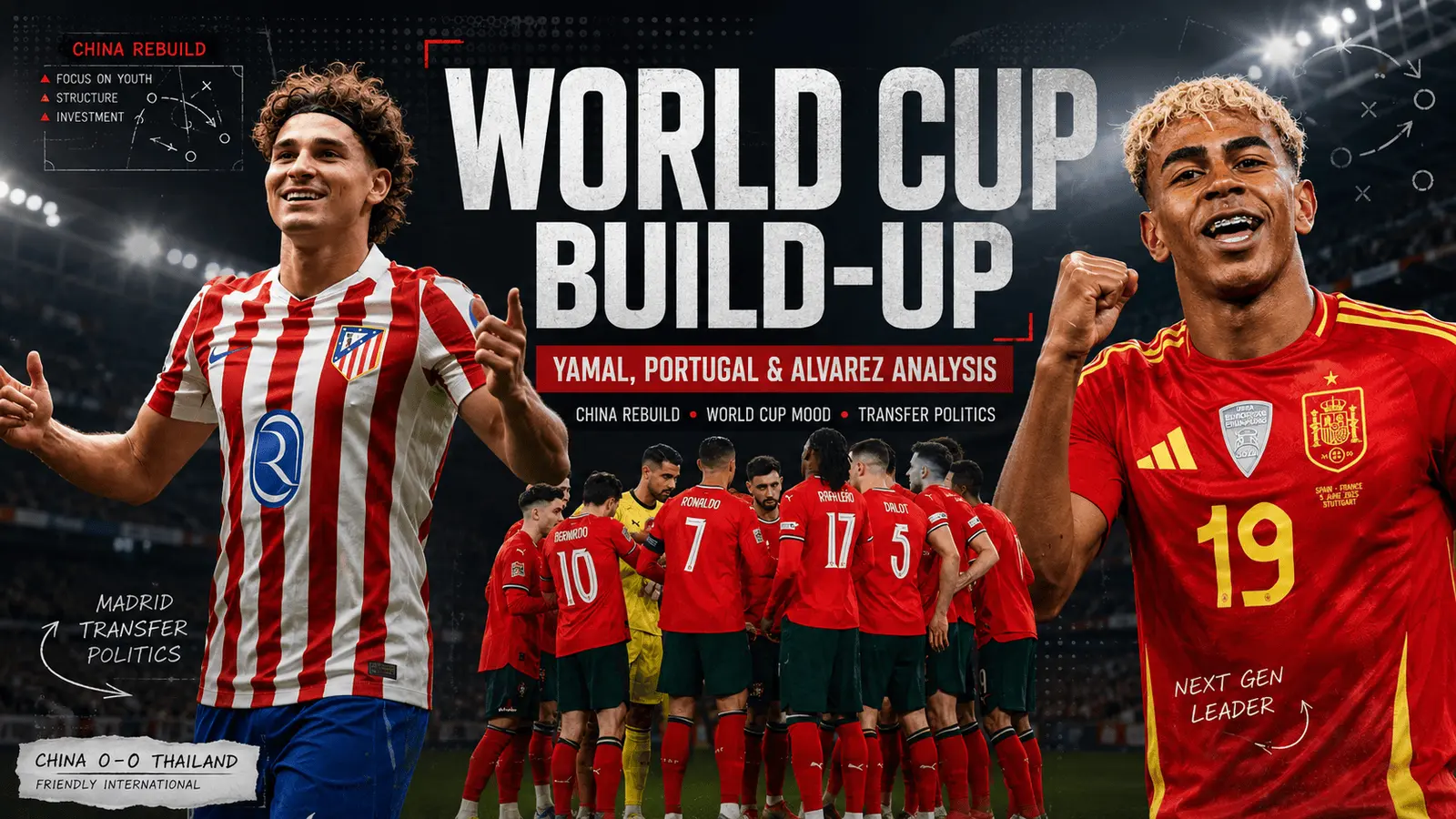
A broad football analysis package built around three linked ideas: national teams cannot be judged only by scorelines, elite clubs use transfer stories as political messaging, and major tournaments are shaped as much by player management and dressing-room emotion as by tactics.
Match Preview
Spain’s Yamal Plan and Portugal’s Emotional Test: The World Cup Questions Already Taking Shape
Spain’s biggest question is not talent — it is timing
Spain do not lack technical quality, but their most delicate early-tournament decision may be how they use Lamine Yamal. The temptation with a young game-breaker is always obvious: start him, feed him, let him decide matches. Tournament football is rarely that simple.
Spain open against Cabo Verde on June 18, then face Saudi Arabia on June 22 and Uruguay on June 27. That schedule creates a classic group-stage management problem. If Spain control the early part of the group, the smartest plan may be gradual exposure rather than immediate maximum workload. Yamal’s value is not only in what he can do in the first match; it is in what he can still do when the tournament becomes a knockout test.
That makes his minutes a tactical and medical discussion at the same time. Spain need width, invention and one-v-one threat, but they also need to protect a player whose long-term ceiling matters far beyond one group-stage night.
Portugal’s challenge goes beyond formation
Portugal’s football questions are familiar: how Roberto Martinez balances attacking talent, how much control the midfield can provide, and whether the side can carry enough defensive security against elite opposition. But this tournament also brings a deeper emotional context following Diogo Jota’s death.
Public tributes and symbolic gestures can help a squad express grief, but they do not automatically turn sadness into performance. That is where management matters. Martinez’s job is not simply to choose a front line or set pressing triggers. He must read the emotional temperature of a group carrying loss, memory and expectation.
Portugal may find unity in remembrance. They may also need time to absorb the weight of it. Both can be true.
The wider lesson
The early World Cup conversation is often reduced to predicted line-ups and star names. Spain and Portugal show why that is too narrow. Spain’s key issue is how to preserve a teenage match-winner for the moments that matter most. Portugal’s is how to compete while carrying something far heavier than ordinary tournament pressure.
Those are not side stories. They are part of the football.
Post-Match Review
China 0 0 Thailand: Why 24 Shots Can Be Progress and a Warning at the Same Time
A familiar frustration, but not an empty one
China’s 0-0 draw with Thailand was easy to frame as failure: 24 shots, no goal, and another night when attacking pressure did not become a result. That frustration is valid. A team can dominate territory and still leave the pitch having failed at the most important task.
But the match also deserves a more careful reading. China’s problem in recent years has often been more basic than finishing: not creating enough, not pinning opponents back, not sustaining pressure long enough to make misses matter. Against Thailand, the old complaint of “not clinical enough” returned precisely because China were again spending meaningful time around the opposition box.
That is not a small distinction.
Pressure needs context
The 24-shot figure should not be treated as proof of a full attacking breakthrough. Thailand’s level, availability and match rhythm matter when judging the quality of China’s dominance. A team can look in control against an opponent who are incomplete or conservative, then discover very different problems against a more aggressive side.
Still, China did enough to make the match feel like a test of finishing rather than merely a test of basic ball progression. Zhang Yuning’s early effort against the post, created from a right-sided delivery, became the moment that could have changed the entire tone of the night. Had that chance gone in, the discussion might have shifted from wastefulness to control.
The rebuild signal
The more encouraging element was not just the shot count. It was the sense of competition. Younger players were discussed not as decorative selections, but as footballers trying to force their way into roles through courage on the ball, forward passing and defensive aggression.
That is the kind of competition China need. Youth alone is not a solution. A younger player only matters if he raises the level of the position.
The verdict
This was not a match to celebrate wildly, and not one to dismiss completely. China showed signs of being able to impose themselves again. They also showed why the final action — the touch, the shot, the decision under pressure — remains the hardest part of rebuilding an attack.
For a developing side, both truths matter.
Team Analysis
China’s Rebuild Should Not Be About Age — It Should Be About Real Competition
Youth is not a strategy by itself
Every rebuilding national team eventually turns toward younger players. That does not automatically make the rebuild meaningful. The real question is whether those players are good enough, brave enough and reliable enough to change the competitive environment inside the squad.
China’s recent performance against Thailand offered a useful snapshot. The draw was frustrating, but the broader conversation around the team was less about age and more about pressure for places. That is the right emphasis.
Competition beats entitlement
The strongest argument for China’s younger options is not that they are young. It is that some of them appear willing to do things the team has often lacked: carry the ball forward from deeper areas, pass vertically, step into duels, and make senior players feel their positions are no longer protected by experience alone.
That is how a squad changes. Not through slogans about generational transition, but through daily pressure. A senior player should keep his place if he remains the better option. A younger player should take it only by making the team harder to play against.
Shao Jiayi’s balance
Shao Jiayi’s approach has been described as relatively stable rather than wildly experimental. In a rebuild, that can be useful. Too much rotation creates noise. Too little competition creates stagnation.
The ideal middle ground is a structure that gives the team enough control to function, while still allowing genuine challengers to emerge. China’s right-sided attacking work and the willingness of some younger defenders and midfielders to play forward were encouraging in that sense.
What must come next
The next step is harder: repeatability. It is one thing to create pressure against an opponent who are willing to sink deeper. It is another to do it against a sharper, more complete and more physically demanding side.
China’s rebuild should therefore be judged less by one result and more by whether the squad keeps producing internal competition. If every position has to be earned, progress becomes possible. If youth becomes a label rather than a standard, the rebuild will stall.
Player Performance
Lamine Yamal’s World Cup Role Is a Test of Spain’s Discipline
The danger of treating talent as unlimited
Lamine Yamal changes the way opponents prepare. He offers width, acceleration, improvisation and the kind of one-v-one threat that can break controlled matches open. For Spain, that is a gift. It is also a responsibility.
Young stars often arrive at major tournaments carrying two expectations at once: be protected for the future and decide matches immediately. Spain’s job is to resist the emotional pull of the second demand when the first one is more sensible.
Minutes matter
Spain’s group-stage schedule — Cabo Verde, Saudi Arabia and Uruguay — gives the coaching staff room to think in phases. If the early matches are under control, Yamal does not have to carry maximum minutes from the start. If the group becomes complicated, his role may naturally expand.
That is why the discussion should not be framed only as “starter or substitute.” Tournament management is more subtle. It is about when he enters, what state the match is in, how much defensive running he must do, and whether his sharpness is being preserved for the rounds where one action can decide everything.
Spain’s tactical upside
When Yamal is on the pitch, Spain can stretch matches horizontally and force defenders into uncomfortable isolation. That can open central spaces for midfield runners and make possession more threatening. Without him, Spain may still control the ball, but the attack risks becoming more predictable.
The ideal plan may therefore be selective aggression: use him when the game state amplifies his strengths, not simply because his name dominates the pre-match conversation.
The mature choice
Managing Yamal carefully would not be a lack of ambition. It would be a sign that Spain understand the difference between having a star and building a tournament campaign.
The best version of Yamal is not necessarily the one who plays every possible minute. It may be the one who is still explosive when the World Cup reaches its decisive stages.
Controversy and Talking Points
Real Madrid, Atletico and Julian Alvarez: Why a €150m Rejection Is More Than Transfer Gossip
The number is only the beginning
A €150 million offer for Julian Alvarez would be a major transfer story in any context. Between Real Madrid and Atletico Madrid, it becomes something more pointed: a test of power, pride and public messaging.
Atletico’s refusal is not only a sporting decision. It is a statement of status. Selling a major forward to a city rival would not be interpreted as ordinary squad planning. It would be read by supporters as a concession in the Madrid power struggle.
Real Madrid’s side of the message
For Real Madrid, the political reading is different. Florentino Perez’s re-election gives every major football move a wider context. Big transfer pushes can reassure supporters that the club remain aggressive, ambitious and prepared to strengthen at the top end of the market.
If a deal fails because Atletico refuse to sell, Madrid can still project intent: the message becomes not “we did not try,” but “the rival would not open the door.” That matters in elite-club politics, where perception often runs alongside squad planning.
Atletico’s leverage
Atletico’s stance is also shaped by their own forward structure. If Alexander Sorloth is a possible departure for around €40 million, Atletico’s appetite for weakening another part of the attack would naturally become more limited. Alvarez is not just an asset; he is a sporting pillar and a symbolic one.
That makes the player’s own position important. In modern transfers, a club’s public refusal can slow a deal, but it rarely ends every discussion if the player pushes strongly. For now, Atletico’s message is clear: the price, the rival and the optics all make this an extraordinarily difficult deal.
The real controversy
The debate is not simply whether Alvarez is “worth” the fee. It is whether this story is a genuine sporting pursuit, a pressure tactic, a fan-facing signal, or all three at once.
That is why this transfer saga has legs. It sits at the intersection of football need, presidential authority and derby politics.