
Knicks Win 2026 NBA Finals: Brunson’s 45 Point Game Defines a Championship
Introduction
A post-Finals NBA editorial package focused on how the Knicks turned resilience, defensive commitment and Jalen Brunson’s fourth-quarter shot-making into a championship identity, while the Spurs were left to confront difficult questions about late-game execution, offensive balance and Victor Wembanyama’s next stage of development.
Player Performance
Jalen Brunson’s 45 Point Closeout Was a Finals MVP Performance in Full
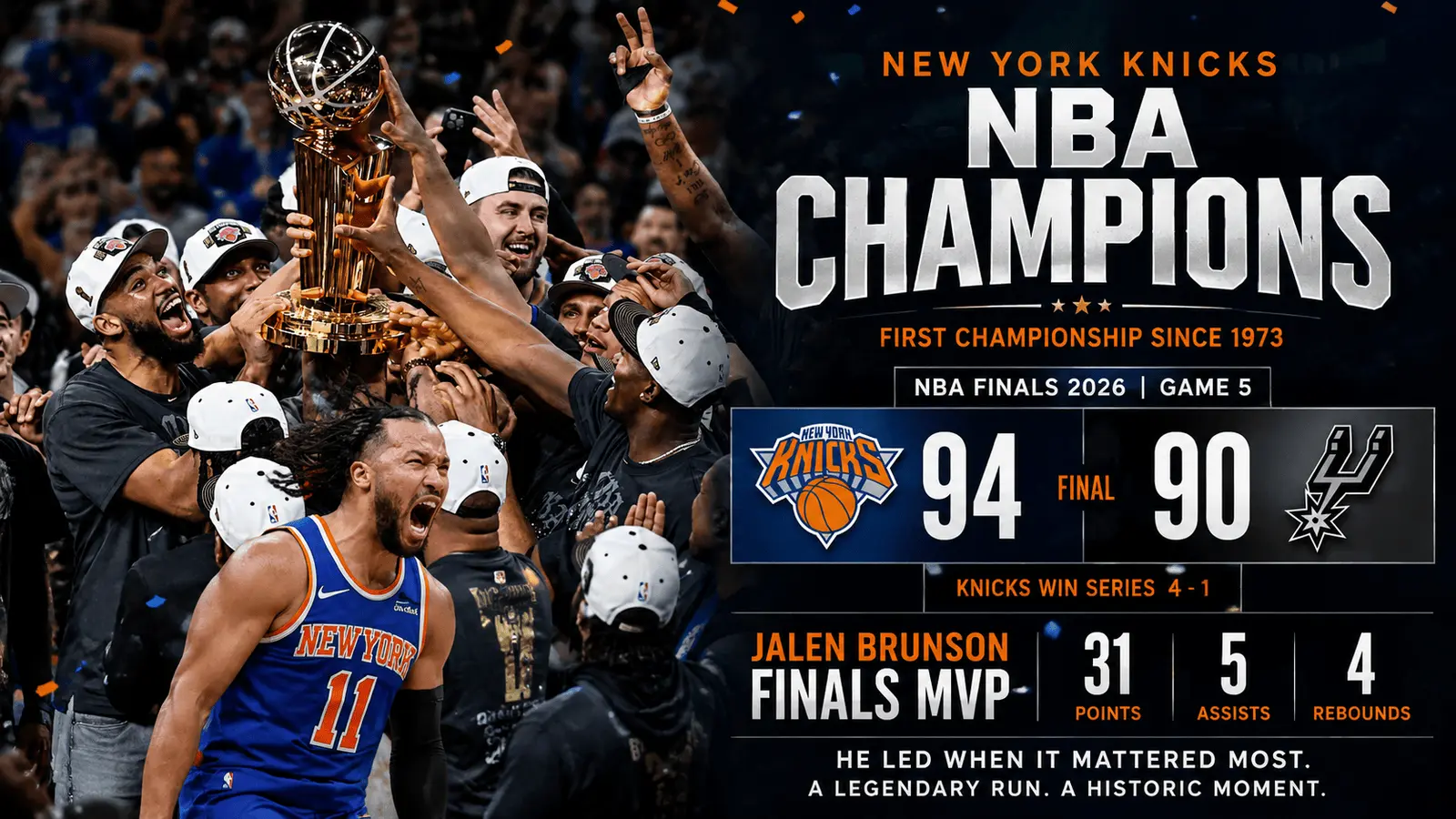
Some Finals MVP performances are statistical coronations. Jalen Brunson’s was more than that. His Game 5 closeout against the Spurs was a complete portrait of a franchise player taking responsibility for an entire team’s season.
Brunson scored 45 points in a game where the Knicks finished with 94. He played more than 41 minutes. He carried the offense while key teammates struggled to score at their usual level. And when the fourth quarter demanded separation, he gave New York the defining stretch of the Finals.
During the Knicks’ 15-2 run, Brunson scored 13 straight points himself. That sequence turned pressure into control and control into a championship.
The value of Brunson’s timing
The most impressive part of Brunson’s performance was not only the volume. It was the timing.
A great Finals closeout game requires more than shot-making. It requires knowing when the opponent is vulnerable, when teammates need a settled possession and when the game is asking for a star to remove doubt. Brunson answered those questions possession by possession.
That is why his 45 points should not be read as isolation heroics detached from the team. The Knicks’ defense and physicality kept the platform stable. Brunson supplied the end product.
Leadership through temperament
Brunson’s rise as a leader has always been tied to his emotional control. In this Finals, that quality mattered. He absorbed contact, pressure and the burden of a long title drought without letting frustration become the story.
That temperament separated him from the noise around the series. While San Antonio had to answer for missed free throws, uncertain shot selection and controversial defensive moments, Brunson kept giving the Knicks the cleanest possible response: the next right play.
A defining contrast with Wembanyama
Victor Wembanyama’s 19-point, 14-rebound Game 5 still showed his immense talent. But his 1-for-6 shooting from three-point range and late free-throw miss gave the Spurs a difficult offseason talking point. His ceiling remains extraordinary, but this series showed the difference between potential and command.
Brunson already has command. He may not possess Wembanyama’s physical gifts, but he controlled the emotional and tactical center of the biggest game of the season.
That is what Finals MVPs do. They do not merely produce. They define the game’s terms. Brunson did that, and New York’s 55-year wait ended because of it.
Controversy and Talking Points
The Wembanyama Debate: Talent, Edge and the Line the Spurs Must Manage
Victor Wembanyama remains one of the NBA’s most important players, but the Finals gave San Antonio a more complicated version of the conversation around him.
His Game 5 line — 19 points and 14 rebounds — was productive. It was not the profile of a player who disappeared. But the details around that performance were far less comfortable: 1-for-6 from three-point range, a key split at the free-throw line, and the lingering frustration of missed free throws in Game 4.
Then there were the talking points around his defensive actions, including concerns over foot placement and borderline contact that went uncalled. Those moments matter because young superstars are shaped not only by what they are allowed to do, but by what their teams teach them to value.
The issue is not talent. It is discipline.
Wembanyama’s skill set is so rare that it can tempt everyone — player, coach and audience — into accepting almost any choice as part of the experiment. But Finals basketball is unforgiving. A difficult three is not automatically a good shot because it comes from a generational talent. A risky defensive contest is not automatically smart because the player has historic reach.
The Spurs’ task is to build a framework where Wembanyama’s freedom does not become randomness.
That means clearer shot selection. It means stronger late-game routines. It means understanding when the best play is a post touch, a roll, a seal, a kick-out, or a simple screen that bends the defense for someone else.
Competitive edge needs boundaries
Every great player needs edge. The concern is when edge starts to blur into avoidable controversy. If Wembanyama is going to become the face of a Spurs contender, San Antonio has to care about how he wins, not only whether he wins.
That is especially true for a franchise long associated with discipline, precision and team culture. The Spurs do not need to dull Wembanyama’s ambition. They need to refine it.
The Finals can still be useful for San Antonio
This series should not be treated as a verdict on Wembanyama’s career. It should be treated as a warning and an opportunity.
The Knicks had the finished product in Jalen Brunson: controlled, ruthless and ready for the fourth quarter. The Spurs had the more spectacular long-term physical talent, but not yet the same late-game clarity.
That gap is fixable. But it will require honesty. Wembanyama does not just need more experience. He needs a sharper understanding of which parts of his game help San Antonio win playoff possessions — and which parts give opponents a way back in.