
Knicks’ 29 Point NBA Finals Comeback Exposes Spurs’ Wembanyama Problem
Introduction
A Finals-focused NBA content package built around New York’s historic comeback over San Antonio, the Spurs’ late-game identity crisis, the Knicks’ defensive adjustments, OG Anunoby’s understated value, and the debate around Victor Wembanyama’s physical edge.
Match Preview
Knicks vs Spurs Preview: Can San Antonio Recover Its System Before the Series Slips Away?
The series has become a test of San Antonio’s identity
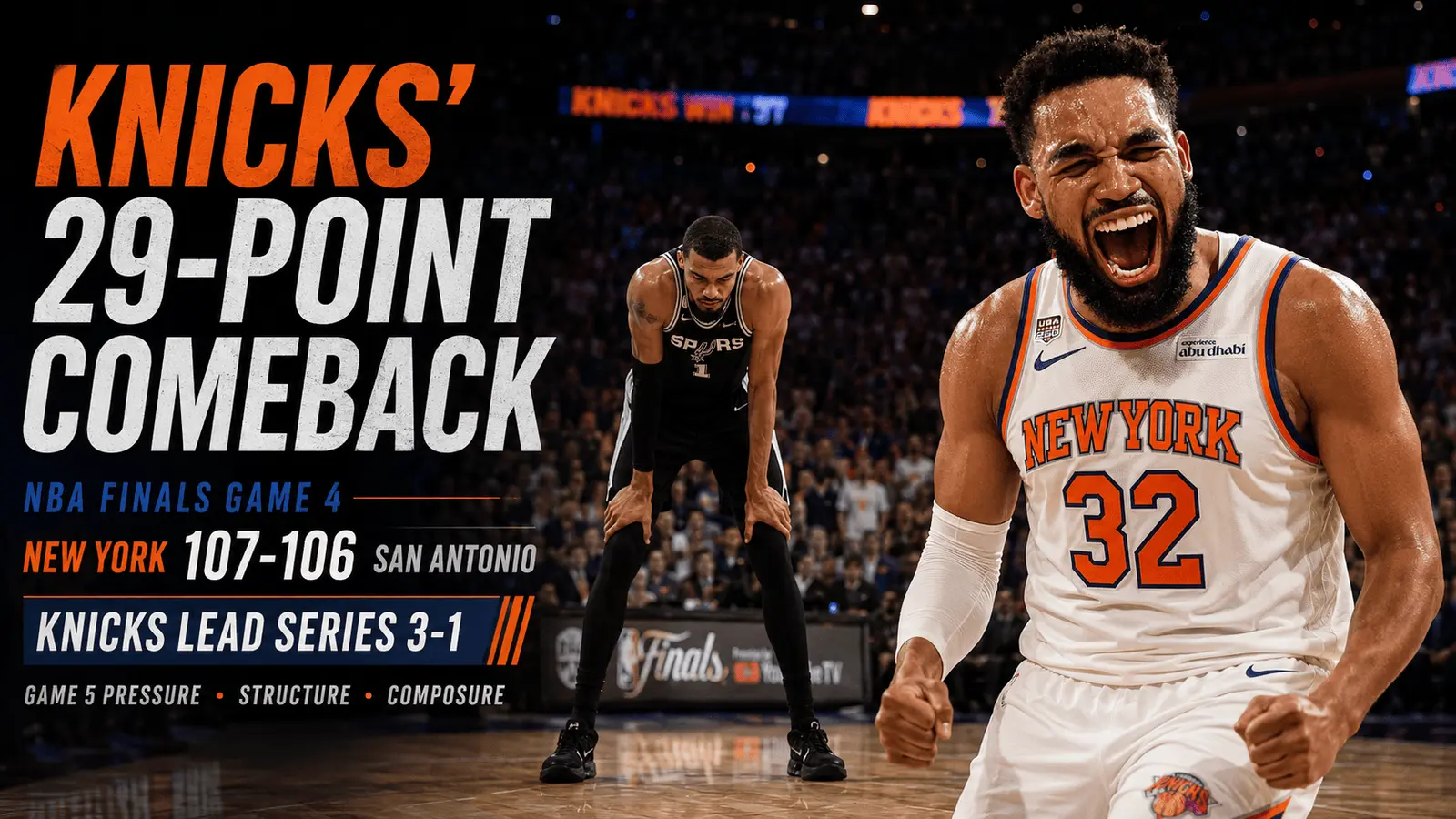
The New York Knicks now lead the San Antonio Spurs 3-1 in the 2026 NBA Finals after a 107-106 comeback that changed the tone of the series. The next game is not simply a survival spot for San Antonio. It is a referendum on whether the Spurs can still play like a coherent team under pressure.
That is the major tactical question entering Game 5. San Antonio built a huge lead in Game 4, but as the game tightened, the offense became increasingly narrow. The Spurs stopped looking like a team built on movement, spacing, timing and trust. Too many late possessions drifted toward one idea: find Victor Wembanyama and hope his talent solves the problem.
Against this Knicks team, that is a dangerous way to live.
New York’s defensive plan is getting clearer
New York does not need to make Wembanyama irrelevant. That is unrealistic. He played 44 minutes in Game 4 and finished with 24 points and 13 rebounds, and his size alone changes how opponents attack and defend.
But the Knicks’ adjustment is more practical: make every Wembanyama touch expensive. Send bodies. Crowd his catch points. Force him to make decisions before he is fully balanced. If San Antonio’s spacing and off-ball movement are not sharp, New York can load up on him without paying a heavy price elsewhere.
That is why the next game may be decided less by Wembanyama’s raw numbers than by what happens around him. Can the Spurs create cleaner early offense? Can their guards and wings punish pressure quickly? Can they avoid reducing late-game possessions to static isolations and late-clock bailouts?
The Brunson-Anunoby balance is driving New York
For the Knicks, the formula is becoming more convincing because it has layers. Jalen Brunson remains the emotional and offensive center of the team. He gives New York a half-court organizer who can turn a broken possession into a good shot, and his composure has been vital in a series with increasing physicality.
OG Anunoby is the quieter force. His value is not built on volume or drama. It is built on low-error basketball: defensive assignments, timely cuts, strong finishes, and the ability to stay calm when the game becomes chaotic. In a Finals series, that kind of player can be the difference between a comeback attempt and an actual comeback.
What San Antonio must change
The Spurs’ path is not complicated in theory, but it is demanding in practice.
They need more ball movement before New York’s defense is set. They need Wembanyama used as a threat in more varied ways, not only as a late-clock emergency option. They need to avoid the kind of rushed decision-making that appeared late in Game 4, especially in possessions where the clock and score demanded patience.
Most of all, they need to stop letting New York simplify the game. If every important possession points toward Wembanyama, the Knicks can defend the pattern. If San Antonio restores movement, pace changes and multiple decision-makers, the series can still become uncomfortable for New York.
The stakes
New York has a chance to close the Finals with one more win. If the series returns to Madison Square Garden for Game 6, the Knicks would have the opportunity to pursue the championship in front of their home crowd.
For San Antonio, the challenge is immediate: survive Game 5 by becoming more than a one-option team again.
Post-Match Review
Knicks’ 29 Point Comeback Was More Than a Collapse — It Was a Spurs Identity Crisis
A Finals game San Antonio controlled — until it didn’t
The San Antonio Spurs had the game in their hands. They led 41-22 after the first quarter, pushed the scoreboard further with a 35-27 second quarter, and entered halftime with the kind of margin that should have forced the New York Knicks into desperation.
Instead, New York turned the game into one of the defining moments of its franchise history.
The Knicks won the third quarter 26-14, trimming the deficit to 15 entering the fourth. From there, the game changed completely. New York completed a 29-point comeback — the first of its kind in Knicks history — and beat San Antonio 107-106 to take a 3-1 lead in the 2026 NBA Finals.
The scoreline was dramatic. The meaning was more serious for San Antonio.
The Spurs stopped looking like the Spurs
The most damaging part of the loss was not merely that San Antonio surrendered a huge lead. It was how it happened.
The Spurs’ late-game offense lost its collective shape. The ball stopped moving with purpose. The weak-side activity faded. The decisions became rushed, predictable and emotionally tense. For a franchise historically associated with poise, spacing and trust, the final stretch looked jarringly disconnected.
That is why this collapse carries a larger tactical warning. When San Antonio’s offense narrowed, New York’s defensive job became simpler. The Knicks could load up on Victor Wembanyama, crowd his touches and force the rest of the Spurs to make quick, high-pressure reads.
A team with a 29-point lead should be able to manage time, possessions and momentum. San Antonio did not.
New York won the chaos by staying calmer
The Knicks’ comeback was not a single burst. It was a slow squeeze.
Brunson gave New York direction. He continued to pressure the defense, kept the Knicks connected offensively, and did not let the physical tone of the game drag him into reckless responses. That mattered because New York needed leadership as much as scoring.
OG Anunoby supplied the stabilizing layer. His impact came through defensive discipline, clean execution and the ability to make the right play without needing the ball to define his night. In a game where San Antonio’s decision-making frayed, Anunoby’s steadiness stood out.
Wembanyama’s numbers were not the whole story
Victor Wembanyama played 44 minutes and posted 24 points and 13 rebounds. Those are respectable Finals numbers under a heavy workload.
But the debate around his performance is not only statistical. It is about how San Antonio used him, where he received the ball, and whether the Spurs’ reliance on him late made their offense easier to guard. When Wembanyama becomes the only obvious answer, his talent can unintentionally shrink the team’s structure around him.
That is not solely his fault. It is a team problem and a usage problem. But in the Finals, the best opponent will punish predictability.
The series now belongs to New York
At 3-1, the Knicks have control. The comeback gives them more than a standings advantage; it gives them psychological leverage. They now know San Antonio can be sped up, narrowed and made uncomfortable even after building a massive lead.
For the Spurs, the response must be structural. More movement. More shared responsibility. Better clock management. Less late-game dependency on one player catching the ball against a loaded defense.
This was not just a blown lead. It was a warning that San Antonio’s Finals ceiling depends on whether it can become a complete team again before the series ends.
Team Analysis
Why the Knicks Made the Spurs’ Offense Look Smaller as the Game Got Bigger
The tactical story: New York simplified San Antonio
The Knicks’ comeback against the Spurs was not just a matter of momentum. It was a tactical narrowing of the game.
When San Antonio had control, the Spurs could play with rhythm. But as the lead shrank, their offense became less varied. The spacing was less threatening, the cutting less consistent, and the ball movement less purposeful. The result was a team that increasingly depended on Victor Wembanyama as the final answer.
That is exactly the kind of game New York wanted to create.
Loading up on Wembanyama only works if the rest of the Spurs freeze
Defending Wembanyama is never simple. His size, reach and touch create problems that cannot be solved by one defender. But playoff defense is not about removing a great player completely. It is about changing the terms of his touches.
New York did that by crowding him and making San Antonio prove it could punish pressure elsewhere. If the ball moved quickly out of traps, the Spurs could have turned that attention into open shots and second-side advantages. Too often, the timing was not sharp enough.
That allowed the Knicks to help aggressively without feeling exposed.
The Spurs’ late-game management failed the moment
One of the most telling themes was decision-making with the lead. A team ahead late must value the clock, the possession and shot quality. San Antonio instead played too many possessions as if it were chasing the game, not protecting it.
That is where the loss felt so un-Spurs-like. The franchise identity has long been associated with collective calm. This version of San Antonio, under Finals pressure, looked rushed and individualized.
New York’s structure survived the pressure
The Knicks were not perfect, but their hierarchy held. Brunson organized. Anunoby stabilized. The defense stayed connected long enough to keep asking San Antonio uncomfortable questions.
That balance matters. New York can win possessions in different ways: Brunson creation, Anunoby execution, defensive pressure, and collective belief once the game becomes tight.
San Antonio, by contrast, allowed its options to collapse into one dominant storyline.
The lesson for the rest of the series
If the Spurs are to extend the Finals, they must restore the team around Wembanyama. That means earlier actions, more movement before the catch, better weak-side spacing, and more trust in secondary decision-makers.
If they cannot do that, New York will continue to make the most talented player on the floor look surrounded — and make the Spurs’ offense look smaller at the exact moment it needs to expand.
Player Performance
OG Anunoby Was the Quiet Difference in the Knicks’ Loudest Finals Win
The third star does not always look like one
In a comeback as dramatic as New York’s 107-106 win over San Antonio, the spotlight naturally moves toward the biggest names. Jalen Brunson is the Knicks’ leader. Victor Wembanyama is the Spurs’ generational centerpiece. Those are the obvious headlines.
But OG Anunoby deserves a central place in the story.
His game is not built to dominate the box-score conversation every night. It is built to survive the moments when teams lose their shape. In Game 4, that made him one of New York’s most important players.
Why Anunoby mattered
Anunoby’s value comes from low volatility. He does not need emotional surges to affect a game. He does not require a high-usage offensive role to remain engaged. He can defend, finish, hold spacing, make the simple pass and stay locked into the next possession.
That skill set becomes more valuable as the stakes rise. Finals games often punish players who need rhythm, touches or comfort. Anunoby’s strength is that he can contribute without the game being designed around him.
For a Knicks team trying to climb out of a 29-point hole, that mattered. Comebacks require star creation, but they also require possessions without mistakes. Anunoby helped provide that floor.
Brunson set the tone
Brunson’s role remains different. He is the Knicks’ offensive compass, the player most responsible for turning pressure into quality shots. His ability to keep attacking without losing emotional control gave New York a center of gravity.
That composure was important in a physical, increasingly tense game. Brunson’s leadership was not just in scoring chances; it was in refusing to let the game become only about confrontation.
Wembanyama’s complicated night
Wembanyama’s 24 points and 13 rebounds in 44 minutes reflect the burden he carried. Yet his performance also exposed the challenge of being used as San Antonio’s late-game escape route. When the offense becomes predictable, even a player with his gifts can be forced into uncomfortable decisions.
The next stage of his development is not simply about being more forceful. It is about where he gets the ball, how early he establishes position, how he balances perimeter skill with interior dominance, and how he channels physicality without letting controversy overtake impact.
The player story of the series
The Finals are now asking different questions of different players.
For Brunson: can he close the job?
For Anunoby: can he keep giving New York the defensive and emotional stability that has become essential?
For Wembanyama: can he turn pressure into controlled dominance rather than a debate about usage, fatigue and edge?
That is why Game 4 should not be remembered only as a Knicks comeback. It should also be remembered as a reminder that in the Finals, the quietest reliable player can be just as valuable as the loudest storyline.
Controversy and Talking Points
Wembanyama’s Edge Is Becoming a Finals Debate — But Toughness Is Not the Same as Maturity
The Finals have found their controversy
Victor Wembanyama is the most discussed player in the Knicks-Spurs Finals, and not only because of his talent.
The league acknowledged a Wembanyama hit to Jalen Brunson’s head area without adding further punishment. That decision has fed a broader conversation about physicality, star treatment and what kind of edge a young franchise player should develop on the biggest stage.
The key distinction is important: toughness is valuable. Recklessness is not.
Physicality can be part of growth
Wembanyama does not need to be delicate. In fact, San Antonio needs him to embrace contact more intelligently. His frame and skill set give him rare advantages, but those advantages are maximized when he establishes deeper position, attacks with balance and forces defenses to collapse on his terms.
Several prominent former players and commentators have publicly pushed a similar theme: he should not spend too much of his game floating on the perimeter. The point is not to remove his skill. It is to make his size hurt opponents more consistently.
That is the productive version of toughness.
The problem with the “dark edge” narrative
The less productive version is turning every confrontation into proof of maturity. A player is not more complete because he gets involved in extra contact, gestures, provocation or retaliation. That can energize a crowd, but it can also distract from the actual basketball question.
For Wembanyama, the question is not whether he can look meaner. It is whether he can make better decisions under pressure while carrying a massive workload.
In Game 4, he played 44 minutes and produced 24 points and 13 rebounds. The issue was not effort. It was whether San Antonio’s late-game structure placed too much on him and whether he responded with the kind of controlled dominance that wins Finals possessions.
The officiating layer
NBA refereeing is increasingly difficult in games played at this speed and size. When players are longer, faster and stronger, contact can look different in real time than it does on replay. That does not remove accountability, but it explains why these moments become so divisive.
Fans want consistency. Teams want clarity. Players want to know where the line is.
In a Finals series, any perceived inconsistency becomes part of the emotional weather of the matchup.
What Wembanyama should take from this
The best answer for Wembanyama is not to retreat from contact. It is to refine it.
Be stronger early in the possession. Get to more dangerous spots. Use the threat of the post to open passing angles. Punish switches without forcing everything. Keep the edge, but make it functional.
That is the difference between a young star becoming harder to play against and a young star becoming easier to talk about for the wrong reasons.