
Spurs vs New York Game 4 Preview: Wembanyama, Two Guard Control and the Officiating...
Introduction
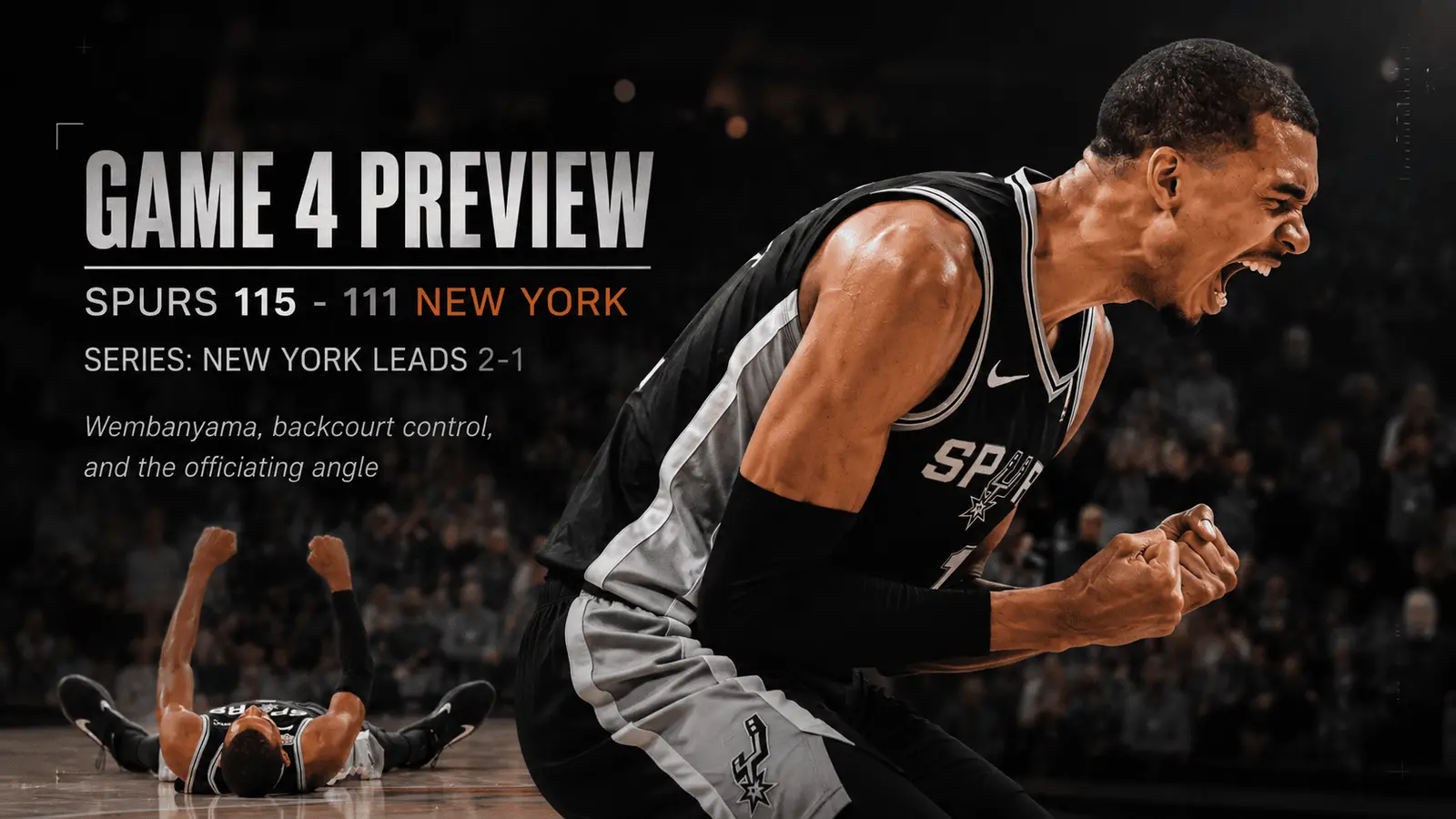
A balanced NBA Finals content package built around Spurs vs New York Game 3: San Antonio’s 115-111 response, Victor Wembanyama’s hard-edged growth, the Fox-Harper two-guard structure, New York’s offensive support problem, and the officiating debate that now shapes the emotional temperature of Game 4.
Match Preview
Spurs vs New York Game 4 Preview: Can New York Move Past the Whistle?
Game 4 is now a test of poise as much as execution
San Antonio’s 115-111 Game 3 win did not erase New York’s series advantage, but it did change the feel of the matchup. New York still leads 2-1, yet Game 4 now carries a different question: was Game 3 a one-game correction, or did the Spurs find a structure that can keep holding up under Finals pressure?
The answer starts with Victor Wembanyama, but it cannot end there. His 32-point performance gave San Antonio the star-level production it needed, and his place as the second-youngest player in Finals history to score 30-plus — behind Magic Johnson — adds historical weight. But the more important basketball point is how San Antonio supported him.
The Fox-Harper backcourt is the Spurs’ stabilizer
The most meaningful adjustment for San Antonio is the growing trust in a two-guard framework built around De’Aaron Fox and Dylan Harper. Fox’s value is not only his burst or scoring threat; it is his ability to organize possessions late, keep the ball moving and reduce the kind of empty trips that can sink a young team in a Finals game.
Harper gives the Spurs another point of pressure. He finished as San Antonio’s leading rebounder with nine boards, and his presence allows the Spurs to avoid turning every possession into a Wembanyama rescue mission. That matters. A young team becomes far harder to guard when its best player is the center of the system rather than the entire system.
New York needs more than Brunson
Jalen Brunson matched Wembanyama with 32 points, but New York’s Game 3 problem was the narrowing of its offense. When Brunson has to carry too much, every controversial call feels heavier and every dry spell becomes more damaging.
Karl-Anthony Towns and Mikal Bridges are the swing pieces. Towns’ offensive output was below what New York needed, while Bridges’ two-point night left New York without enough wing scoring support. That is not a referee problem. That is a spacing, rhythm and responsibility problem.
The whistle will be part of Game 4’s atmosphere
Mike Brown’s post-game frustration over a 24-8 second-half free-throw disparity will follow the series into Game 4. So will the upgraded flagrant foul on Brunson’s closeout against Champagny and the separate uncalled Wembanyama contact on Brunson’s throat.
But New York cannot let the game become only about officiating. The better response is to turn frustration into cleaner execution: earlier offense, more decisive Towns touches, better Bridges involvement, and disciplined defensive contests that do not invite review.
What decides Game 4?
Three themes stand above the rest:
- Can San Antonio keep using Fox and Harper to lower its turnover risk and control tempo?
- Can Wembanyama remain physical without letting the emotional edge become reckless?
- Can New York restore balance around Brunson, especially through Towns and Bridges?
If the Spurs win those questions again, the series becomes far more uncomfortable for New York. If New York answers them, Game 3 may look less like a turning point and more like a warning it properly absorbed.
Post-Match Review
Spurs 115, New York 111: Wembanyama’s Edge and San Antonio’s Structure Change the Series
San Antonio’s win had more than one cause
The simplest version of Game 3 is that Victor Wembanyama delivered and San Antonio survived. The fuller version is more interesting: the Spurs beat New York 115-111 because their young core looked more organized, more resilient and more willing to play through the physical and emotional noise of an NBA Finals game.
Wembanyama’s 32 points were the headline, and deservedly so. He also added three blocks, giving San Antonio the two-way anchor it needs in this series. But the Spurs’ real progress showed in how they functioned around him.
Fox and Harper gave the Spurs a working playoff shape
De’Aaron Fox’s eight assists mattered because they represented control. He gave the Spurs late-possession direction, reduced panic and helped keep the offense from becoming too static. Dylan Harper’s nine rebounds were another important signal: San Antonio’s guards were not just bringing the ball up; they were helping the team survive the possession battle.
That two-guard structure gives the Spurs a way to share pressure. Wembanyama remains the defining matchup, but Fox and Harper make it harder for New York to load up on one action or one side of the floor.
New York’s frustration was real, but incomplete
New York had reasons to be upset. The second-half free-throw count was 24-8 in San Antonio’s favor, and Mike Brown’s post-game comments reflected how strongly that disparity shaped New York’s view of the game.
The Brunson-Champagny play became the night’s flashpoint after Brunson’s foul was upgraded to a flagrant 1. The tension only grew because Wembanyama had a separate contact on Brunson’s throat that went uncalled. For New York, the sense of inconsistency was obvious.
Still, the loss cannot be reduced to the whistle. Brunson scored 32, but New York did not get enough stable support. Towns did not provide the interior scoring punch New York needed, and Bridges’ two points were a major offensive shortfall. In a game decided by four points, that lack of secondary production mattered as much as any officiating debate.
The bigger Spurs story is toughness
San Antonio did not just win a Finals game; it showed signs of becoming a harder team to bully. Wembanyama played with more edge. The guards looked more composed. The team’s collective response to pressure felt different from a group merely riding talent.
That may be the most important takeaway. The Spurs are not yet in control of the series, but they have found a version of themselves that can make New York uncomfortable. Game 4 will tell us whether that version is repeatable.
Team Analysis
The Spurs’ Two Guard Formula Is Turning Wembanyama’s Talent Into a Team Identity
San Antonio is learning how to play around a superstar
A team with Victor Wembanyama will always attract attention through the spectacular. The blocks, the angles, the impossible releases and the sheer mismatch problem dominate the eye. But San Antonio’s Game 3 win over New York was not just a superstar performance. It was a team-structure performance.
The Spurs looked more convincing because they did not ask Wembanyama to solve every possession by himself. De’Aaron Fox and Dylan Harper gave San Antonio multiple handlers, multiple decision points and a steadier way into offense.
Fox brings late-game order
Fox’s eight assists underline his importance. His job in this version of the Spurs is not simply to attack gaps. It is to decide when the game needs speed, when it needs patience and when Wembanyama needs the ball delivered in a cleaner spot.
That kind of guard play is essential in a Finals series. New York’s defense can live with difficult individual shots. It becomes more vulnerable when San Antonio changes sides, protects the ball and forces the defense to guard second and third actions.
Harper is becoming more than a supporting guard
Harper’s nine rebounds were not just a box-score detail. They showed how San Antonio’s backcourt can contribute to the game’s physical layer. If Harper can rebound, initiate and share the floor with Fox without shrinking the spacing, the Spurs have a more flexible foundation.
That flexibility matters because it keeps the offense from collapsing into a predictable Wembanyama-centered pattern. It also helps San Antonio survive the emotional swings of a series where officiating, physicality and crowd reaction are already major factors.
New York’s contrast is revealing
The difference between the teams in Game 3 was not simply that San Antonio had Wembanyama and New York had Brunson. It was that San Antonio’s attack expanded while New York’s narrowed.
Brunson scored 32 and remained New York’s most reliable offensive source. But Towns and Bridges did not give New York enough. When secondary creators fade, every Brunson possession becomes more pressured and every whistle becomes more emotionally loaded.
The Spurs’ identity is hardening
The most promising sign for San Antonio is that its tactical growth and emotional growth are arriving together. Wembanyama is playing with more edge. Fox is giving the group control. Harper is adding two-way involvement. The younger pieces are learning how to survive a game that is not always clean or comfortable.
That is how a talented team starts becoming a playoff team. Game 3 did not complete the transformation, but it made the outline visible.
Player Performance
Victor Wembanyama’s 32 Was More Than a Scoring Night — It Was a Finals Growth Statement
Wembanyama’s number was historic, but his tone mattered more
Victor Wembanyama’s 32-point Game 3 placed him in rare Finals company: the second-youngest player to score 30-plus in an NBA Finals game, behind Magic Johnson. That is the kind of fact that will travel quickly, and it should. But the more important development for San Antonio is not only what Wembanyama scored. It is how he carried himself.
This was a more forceful version of Wembanyama. Not reckless, not merely emotional, but sharper in how he accepted contact and responded to pressure. In a series where New York is trying to test his body and patience, that matters.
The Spurs need him to be difficult, not just brilliant
Wembanyama’s three blocks were a reminder that his defensive influence remains central to everything San Antonio does. His scoring bends matchups, but his rim protection changes decisions before shots even go up.
The next step is psychological. A young star in the Finals has to show that he can absorb targeting, crowd hostility and physical defense without retreating from the contest. Game 3 suggested Wembanyama is beginning to understand that line.
Brunson matched the scoring, but not the support structure
Jalen Brunson also scored 32, and New York had every reason to keep trusting him. The issue is that Brunson’s burden became too heavy when the support scoring thinned out.
Towns and Bridges needed to give New York more. Bridges’ two-point night was especially damaging because it reduced New York’s wing threat and made the offense easier to load against. Brunson can carry long stretches, but against a San Antonio team gaining confidence, New York needs a broader scoring base.
Fox and Harper amplified Wembanyama
De’Aaron Fox’s eight assists and Dylan Harper’s nine rebounds helped turn Wembanyama’s performance into a winning one. That is the difference between a big star line and a complete team result. Fox gave the Spurs late-game control. Harper gave them another ball-handler and a backcourt presence on the glass.
Wembanyama remains the center of the story. But San Antonio’s best version is not Wembanyama alone. It is Wembanyama with enough guard structure to keep the game organized.
A defining Game 4 question
Can Wembanyama stay this assertive without crossing into emotional mistakes? That may be one of Game 4’s decisive questions. The Spurs need his edge. They also need his discipline. If he gives them both again, San Antonio’s Game 3 win may become the start of a real series shift.
Controversy and Talking Points
The Brunson Champagny Flagrant Debate Should Not Hide New York’s Bigger Problem
A controversial call became the emotional center of Game 3
The Jalen Brunson closeout on Champagny’s three-point attempt was always going to be debated. Once the call was upgraded to a flagrant 1, it became more than a single possession. It became the moment that framed New York’s frustration with the officiating.
There is a meaningful distinction between a foul, a dangerous closeout and a flagrant-level act. That is why this play will continue to generate argument. The contact may be enough for a foul. The question is whether the upgrade properly matched the level of danger and intent under the rules.
The Wembanyama-Brunson no-call added to the inconsistency argument
New York’s frustration grew because of the separate sequence in which Wembanyama made contact with Brunson’s throat and was not called for it. When one action is upgraded after review and another physical action goes unpunished, the losing team is naturally going to see inconsistency.
Mike Brown’s comments about the 24-8 second-half free-throw disparity also matter. That number is not just a statistic; it shapes how a team experiences the game. Even if every individual call can be argued, the overall pattern can still affect rhythm, emotion and trust.
But blaming only the whistle is too easy
The strongest analysis has to hold two ideas at once: New York had real officiating grievances, and New York still did not play well enough.
Brunson scored 32, but New York needed a fuller offensive game. Towns did not produce enough to punish San Antonio inside, and Bridges’ two points left the lineup short of a major two-way contribution. If those players do not rebound in Game 4, New York risks turning every close game into a Brunson survival exercise.
San Antonio deserves credit for making the game uncomfortable
The Spurs were not passive beneficiaries of controversy. They played with more force, used Fox and Harper to stabilize possessions, and got a star-level performance from Wembanyama. Their young core looked more willing to embrace the physical nature of the series.
That is why Game 4 is so compelling. If the officiating remains a major storyline, New York must manage its emotions better. If San Antonio’s structure holds, the Spurs can make the series about more than the whistle.
The controversy is real. So is the basketball.