
How Steve Kerr and Stephen Curry Changed the NBA’s Tactical Imagination
Introduction
Evergreen NBA tactical and commentary package focused on how elite coaches and superstar players reshape league-wide style, using Steve Kerr, Stephen Curry, the Warriors' spacing era, and Rick Adelman's offensive legacy as the main editorial angles.
Team Analysis
The Warriors’ Real Legacy Is Tactical, Not Just Historical
The Warriors’ Real Legacy Is Tactical, Not Just Historical
The most useful way to talk about the Steve Kerr-era Warriors is not simply to count achievements. The deeper point is tactical: Golden State helped change what the NBA considers normal.
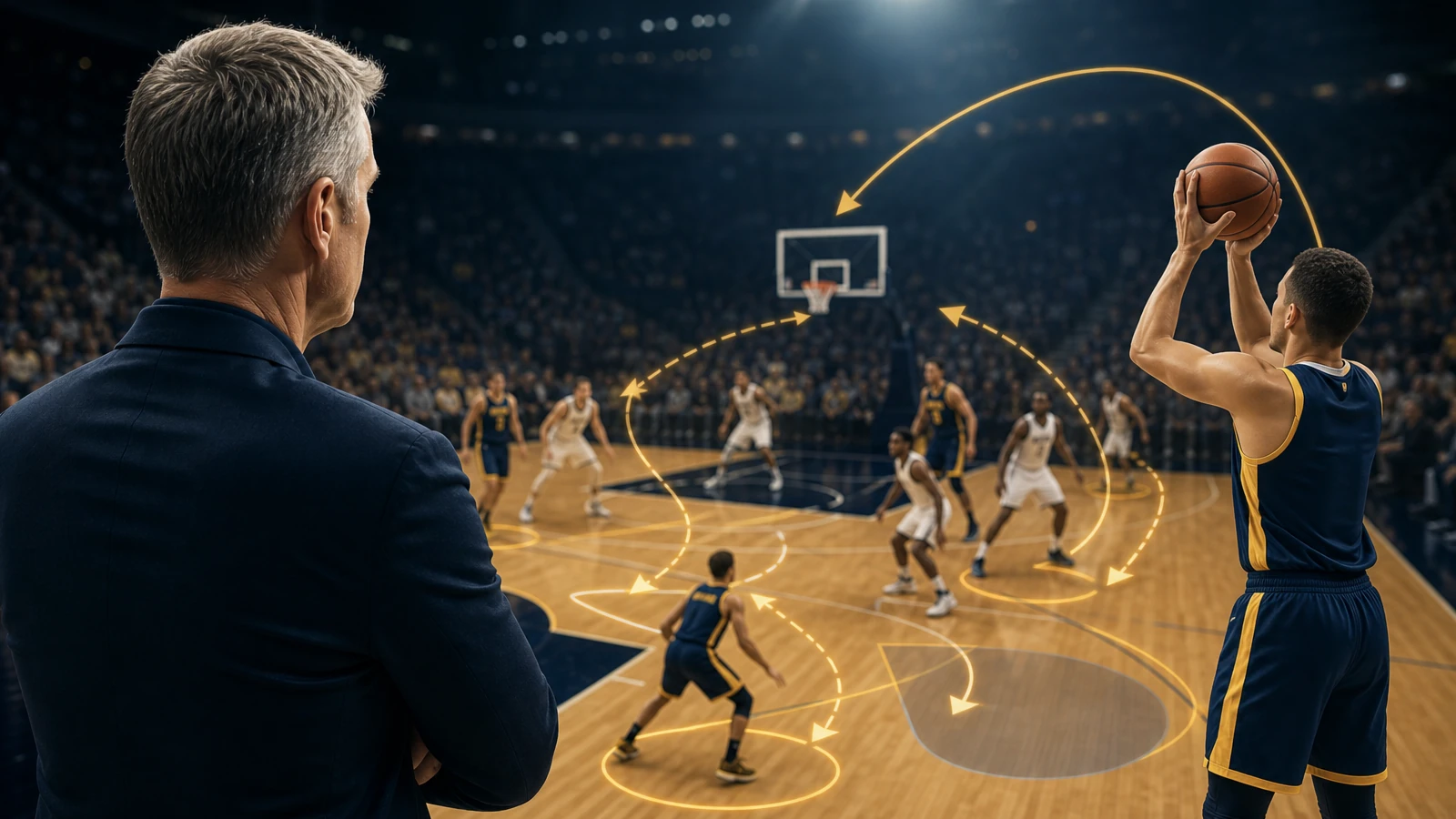
The source frames Kerr and Stephen Curry as a coach-star partnership that shifted the league toward shooting, spacing, tempo and smaller lineups. That matters because the best teams do more than win within an existing style. They force everyone else to adjust.
Why the Kerr-Curry model mattered
The Warriors became a reference point because Curry’s shooting range stretched defensive geometry. Once a defense has to pick up a primary creator far beyond the arc, the whole floor changes. Help positions become longer. Closeouts become more urgent. Traditional big-man coverage becomes harder to maintain.
Kerr’s role, in that reading, was not just to give Curry freedom. It was to build an environment where Curry’s shooting gravity could become a team-wide system: movement, quick decisions, off-ball screening, passing hubs and lineup flexibility.
That is why the Warriors’ influence cannot be reduced to “shoot more threes.” The real lesson was that shooting is most dangerous when connected to spacing, speed and collective decision-making.
Small-ball as a pressure test
The source also links Kerr and Curry to the rise of small-ball thinking. Smaller lineups are not automatically better; they only work when they create enough offensive pressure to justify the defensive trade-offs.
Golden State’s model made that gamble feel viable across the league. If a smaller lineup can spread the floor, force slower defenders into space and punish help coverage, it can change the rhythm of a game. But the trade-off remains real: rebounding, rim protection and physical matchups still matter.
That tension is why the Warriors’ influence is still relevant. Modern NBA teams are constantly balancing shooting against size, pace against control, and skill against physicality.
The league-wide effect
The source’s broader point is that transformative basketball figures change taste. Kerr and Curry helped make deep shooting, five-out spacing and high-skill lineups feel like the future rather than a novelty.
That does not mean the league will remain fixed in one style forever. Every tactical trend creates its own counter-trend. Bigger lineups can return. Defenses can adapt. Physicality can reassert itself in playoff settings.
But the Warriors changed the baseline. Any modern NBA offense now has to answer questions Golden State made unavoidable: How much shooting is enough? Can the center pass or space? Can the stars work without the ball? Can the lineup survive if it sacrifices size for skill?
That is the real legacy. Not simply a team that won, but a team that forced the rest of the NBA to rethink the floor.
Player Performance
Stephen Curry’s Impact Is Bigger Than the Box Score
Stephen Curry’s Impact Is Bigger Than the Box Score
Stephen Curry is often discussed through highlights: deep threes, quick releases, impossible angles. But the source points toward a more important idea: Curry is not just a great shooter; he is one of the players who changed how the NBA thinks.
His influence begins with range. A normal star bends a defense near the lane or inside the arc. Curry bends it from well beyond the three-point line. That single difference reshapes the court.
Shooting gravity as a form of playmaking
Curry’s shooting creates value even when he does not shoot. Defenders track him early. Big men are pulled higher. Help defenders hesitate. Teammates receive cleaner driving lanes because one player’s range changes everyone else’s spacing.
That is why Curry’s game is bigger than box-score production. His presence can create invisible advantages: a late rotation, a miscommunication, a defender refusing to leave him, a passing lane that appears because the defense is stretched too thin.
Why Curry made small-ball more believable
Small-ball basketball needs a reason to exist. If a team gives up size, it must gain something significant in return. Curry provided that reason.
With Curry on the floor, smaller lineups could become faster, more skilled and more difficult to guard in space. The threat of his shooting turned lineup construction into a tactical weapon. Centers had to defend higher. Wings had to navigate screens constantly. Traditional defensive structures became uncomfortable.
That is why Curry’s legacy is not only personal. His skill set changed roster logic around the league.
The next phase of the Curry debate
The source also hints at a modern talking point: has the three-point era improved the sport, or made it more repetitive? Curry is central to that argument because he helped popularize a style that many teams tried to copy.
The fairest answer is that Curry did not make basketball simpler. He made it more demanding. Shooting from range only works at the highest level when paired with conditioning, timing, handle, movement, screening and passing. The problem is not that teams learned from Curry. The problem is when they copy the shot profile without copying the skill ecosystem around it.
Curry’s greatest impact, then, is not the three-point attempt itself. It is the pressure he put on the entire sport to become more skilled, more spaced and more precise.
Controversy and Talking Points
Did the Three Point Revolution Make the NBA Better — or Just Different?
Did the Three-Point Revolution Make the NBA Better — or Just Different?
Few tactical revolutions are universally loved. The NBA’s three-point era is no exception.
The source frames Steve Kerr and Stephen Curry as central figures in a shift toward shooting, spacing and small-ball lineups. That influence is difficult to dispute as a basketball idea: the league became more perimeter-oriented, more spacing-conscious and more willing to build offenses around long-range gravity.
The more interesting question is whether that made the sport better.
The case for the revolution
The pro-three-point argument is straightforward. More spacing creates more driving lanes. More shooting rewards skill. More pace can produce a freer, more dynamic game. A great shooter can now bend a defense as dramatically as a dominant interior scorer once did.
Curry is the clearest symbol of that shift. He did not simply take more threes; he made defenses guard places on the floor they had not been built to protect. Kerr’s Warriors then turned that individual gift into a team architecture.
At its best, the style is beautiful: movement, passing, cutting, relocation and rapid decision-making.
The case against it
The criticism is also understandable. Some fans miss the variety of older NBA basketball: post play, mid-range creation, bruising interior matchups and slower half-court problem-solving.
When teams imitate the three-point model poorly, the game can feel repetitive: early-clock threes, long rebounds, fewer interior touches and less contrast between styles. The issue is not the three-point shot itself. The issue is tactical sameness.
That is the paradox of a successful innovation. Once everyone copies it, the original idea can lose some of its artistry.
The real verdict
The three-point revolution did not make NBA basketball automatically better or worse. It changed the questions teams must answer.
Can you defend in space? Can your bigs survive away from the rim? Can your stars operate without dominating the ball? Can your role players shoot well enough to stay on the floor? Can you punish small lineups physically without ruining your own spacing?
Those are modern NBA questions, and Kerr and Curry helped make them unavoidable.
The league will keep evolving. Counters will emerge. Size may return in new forms. But the sport is not going back to a world where shooting gravity is secondary. That is the permanent part of the revolution.