
Argentina vs Switzerland Preview: Can Messi Solve Another Low Block Test?
Introduction
A World Cup knockout-stage content package led by Argentina vs Switzerland as the immediate preview angle, supported by a review of Argentina's 3-2 comeback against Egypt, tactical lessons from Egypt's low block, Messi's decisive but complicated night, and the refereeing debate that has followed the last-16 tie.
Match Preview
Argentina vs Switzerland Preview: The Egypt Scare Should Shape Scaloni's Plan
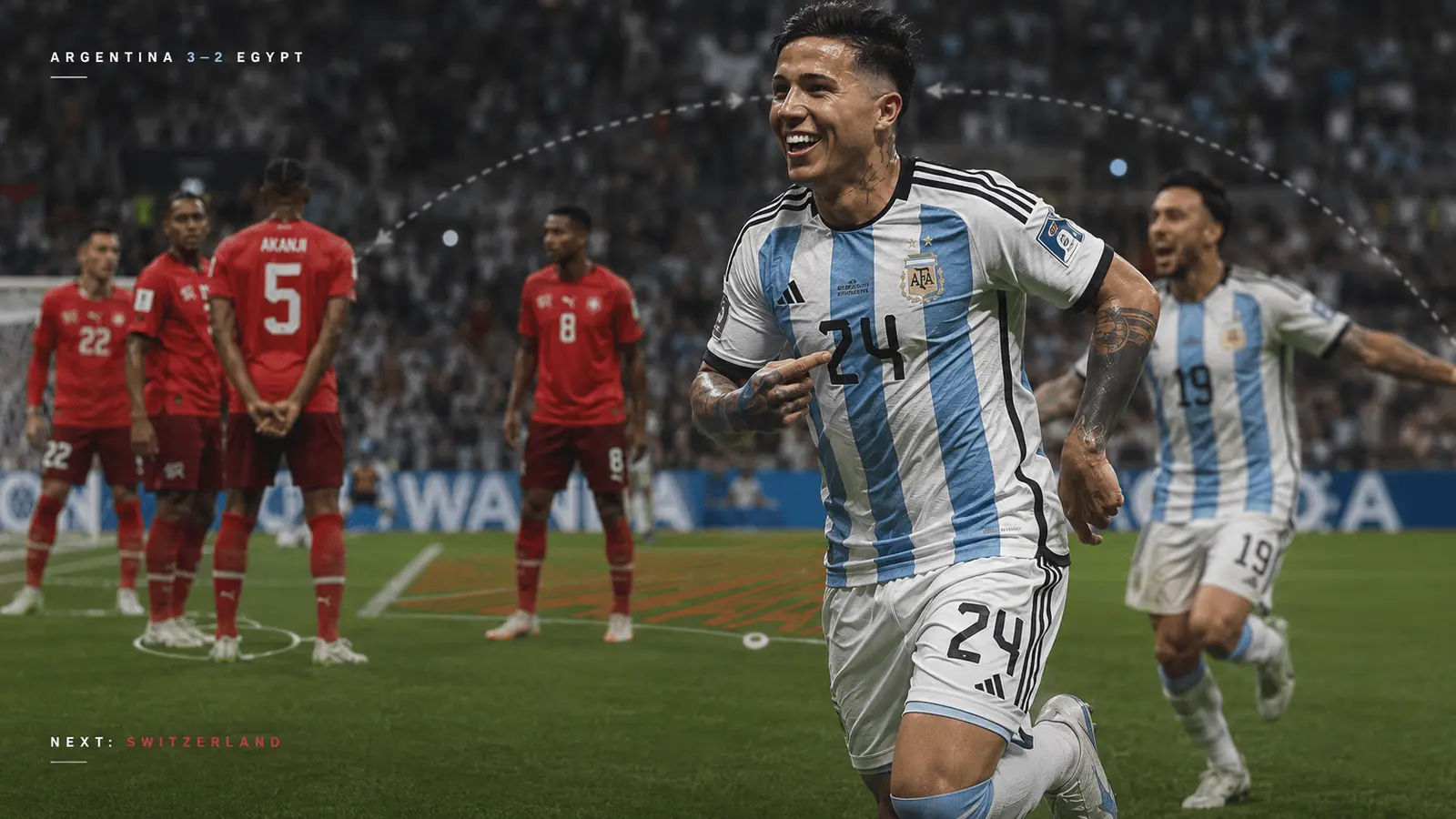
Argentina's 3-2 comeback against Egypt was thrilling, emotional and record-laden. It was also a warning. Egypt led 2-0, defended with discipline, forced Argentina into uncomfortable central traffic and nearly turned a last-16 tie into one of the tournament's defining shocks.
Now Switzerland get their chance to test whether that was a one-off scare or a structural vulnerability.
The quarter-final is scheduled for July 11 in Kansas City, with an evening kick-off in local and U.S. Eastern time. For viewers in UTC and some European time zones, the fixture falls on July 12. The matchup is clear: Argentina vs Switzerland, with the winner moving toward a semi-final against the winner of Norway vs England.
The Switzerland question: can they copy Egypt's template?
Egypt's approach was not simply a passive deep block. Their 5-4-1 gave them numbers around the penalty area, protected the central lane and made life difficult for Argentina's midfield connectors. Messi, Alexis Mac Allister, Rodrigo De Paul and Enzo Fernández were not always able to receive, turn and combine in the zones Argentina prefer.
Switzerland are unlikely to mimic Egypt exactly, but the principles are obvious:
- protect the middle before protecting the wings;
- deny Messi easy central receiving lanes;
- keep the defensive line compact enough to defend cutbacks and second balls;
- break quickly into the spaces Argentina leave when their full-backs and midfielders step forward.
Switzerland reached this stage by holding Colombia 0-0 over 120 minutes and winning the shootout 4-3. That result alone tells Argentina what kind of game may be coming: patient, resistant, mentally stable and comfortable if the match stays tight.
Argentina's biggest concern is still the middle of the pitch
Argentina can survive chaos because they have elite match-winners. But the Egypt match also showed that their defensive structure can be attacked vertically. When the opposition win the ball and play forward quickly, Argentina's centre can become stretched.
That is the area Switzerland must target. If they only defend and clear, Argentina will eventually build pressure. If they defend and counter through the middle with purpose, they can force the game into the same uncomfortable rhythm Egypt created.
For Scaloni, the lesson is not to abandon Argentina's identity. It is to control the transitions better. Argentina cannot assume that Messi, late pressure and emotional momentum will rescue every knockout tie.
Messi remains the solution — but the role matters
Messi's equaliser against Egypt was the kind of moment that changes an entire tournament narrative. He also missed a first-half penalty, which will keep the penalty-taking debate alive if Argentina face another high-pressure spot-kick.
In open play, though, his value remains obvious. Against Egypt, one of the decisive adjustments was Messi drifting away from the most crowded central areas and finding new angles. Switzerland must decide whether to follow him and open spaces elsewhere, or hold their shape and risk giving him time to assess the next pass.
That is the Messi dilemma in 2026: he no longer needs to dominate every sprint to dominate the match. He needs the right pocket of time.
Romero as a hidden attacking weapon
Cristian Romero's attacking contribution against Egypt should not be treated as a novelty. When Argentina face a low block, his willingness to step into advanced areas changes the shape of the attack. A centre-back arriving in the box creates aerial pressure, second-ball chaos and marking uncertainty.
This is particularly important if Switzerland sit deep. If the usual passing lanes to the forwards are blocked, Argentina may again need a defender to disrupt the defensive reference points.
Alvarez or Lautaro: different tools for different phases
Julian Alvarez offers intelligent movement and polished finishing actions. Lautaro Martínez, especially from the bench, can bring a more direct burst of power and penalty-area aggression. The choice is not only about who is the better forward; it is about what kind of match Argentina expect.
If Argentina want early control and pressing coordination, Alvarez has a strong case. If the match becomes a late siege, Lautaro's impact profile may be more valuable.
The wider road: England may wait, but Switzerland come first
There is already obvious narrative pull around a potential Argentina vs England semi-final. The history is enormous: 1986, the Hand of God, 1998, Beckham and Simeone, and decades of World Cup memory.
But Argentina cannot play the quarter-final as if the semi-final is guaranteed. Switzerland have already shown they can survive pressure, extend a match and win the psychological battle from the spot.
Argentina are still the more complete side. But after Egypt, the warning is clear: if Switzerland turn this into a low-block, transition-heavy, high-tension match, Argentina's route to the semi-finals may be far more difficult than the names on the bracket suggest.
Post-Match Review
Argentina 3 2 Egypt Review: Messi's Record Night Came With a Warning
Argentina's 3-2 win over Egypt in the World Cup last 16 had everything a knockout match can hold: a two-goal deficit, a Messi penalty miss, a late equaliser, a final surge, VAR controversy and tears at full time.
It was a comeback worthy of champions. It was also a reminder that champions can be vulnerable.
Egypt led through goals from Yasser Ibrahim and Mostafa Zico. Argentina responded late through Cristian Romero, Lionel Messi and Enzo Fernández. Messi had earlier seen a penalty saved by Mostafa Shoubir, whose performance helped keep Egypt in front for long stretches and turned the game into a genuine test of Argentina's nerve.
Egypt were not just defending — they were defending with a plan
The most impressive part of Egypt's performance was the clarity of their 5-4-1. This was not a team merely sitting in its own box and hoping. Egypt congested the centre, protected the zone around the edge of the penalty area and forced Argentina to play through a crowd.
That mattered because Argentina's best attacking rhythms often start centrally. If Messi, Mac Allister, De Paul and Enzo can combine between lines, Argentina can pull a defence apart. Egypt denied that comfort for long periods.
Their counter-attacking outlet also mattered. Mohamed Salah's role for Egypt is different from the classic club-level image of him as a wide forward attacking space. Here, he had to hold the ball, absorb pressure, delay attacks and give teammates time to join. Whether or not every Egyptian goal action can be directly attributed to him, the broader tactical role was clear: Salah was the release valve.
Messi changed the emotional direction of the match
Messi's penalty miss in the first half could have become the defining image. Instead, his 83rd-minute equaliser became the emotional hinge of the match.
That contrast is why his performance is so interesting. In a static, high-pressure penalty situation, the miss fed a real debate about Argentina's future spot-kick hierarchy. In open play, his reading of space and timing remained decisive. He moved away from congestion, found different angles and helped drag Argentina from panic into belief.
The night also added to a historic individual tournament. Widely used statistical tallies credited Messi with another major step in World Cup scoring and assisting records, but the more important point for Argentina was immediate: when the game became emotionally unstable, he still gave the team a way back.
Romero's forward run changed the structure
Cristian Romero's goal and advanced presence were central to Argentina's late comeback. His importance was not only that he scored. It was that he gave Argentina a different attacking profile.
Against a deep defence, a centre-back stepping into the penalty area forces defenders to make new decisions. They can no longer focus only on Messi, the forwards and cutbacks. They must deal with aerial pressure, second balls and chaotic clearances.
That may become a key weapon for Argentina as the tournament tightens.
The warning: Argentina's central defence can still be attacked
The comeback should not erase the flaws. Egypt showed that Argentina can be hurt when opponents play quickly through central and vertical lanes. The problem is not simply the back line; it is the spaces that open when Argentina commit bodies forward and lose control of the first transition.
Switzerland, England or any other future opponent will study that closely.
A great escape, not a complete performance
Argentina deserve credit for surviving a match that could have broken them. Egypt deserve credit for pushing one of the tournament favourites to the edge.
But this was not a clean statement win. It was a dramatic rescue mission — and in knockout football, rescue missions are both exhilarating and dangerous. Argentina are alive. The question is whether they have learned quickly enough.
Team Analysis
Argentina's Real Problem Is Not Chance Creation — It Is Control
Argentina's attack is still rich enough to solve problems in multiple ways. Lionel Messi can change the rhythm of a match. Julian Alvarez and Lautaro Martínez offer different forward profiles. Enzo Fernández can arrive from midfield. Cristian Romero can become an emergency penalty-box weapon.
The concern is not whether Argentina can create moments. The concern is whether they can control matches well enough to avoid needing miracles.
Egypt exposed the central-transition issue
Egypt's 5-4-1 forced Argentina into congested areas, but the more revealing moments came when Egypt escaped pressure. Argentina's midfield and defensive line can become stretched when the ball is lost and the opponent plays vertically.
That is the danger Switzerland will study. It is also the danger England, should they meet Argentina later, would be built to exploit.
Argentina's structure is at its best when pressure after loss is immediate and coordinated. When that first wave is bypassed, the central lane can look vulnerable.
The attacking structure has useful variety
Argentina are not one-dimensional. That is why they survived Egypt.
Messi still gives them control of tempo and elite decision-making in the final third. Alvarez can press, combine and finish with subtlety. Lautaro offers a more aggressive penalty-area presence, especially when the match opens up. Romero's forward surges create a completely different type of threat.
This variety is valuable because knockout opponents increasingly defend the middle and invite wide circulation. Argentina need ways to break a block that do not rely on one pass from Messi every time.
The Romero solution is useful — but it has a cost
Romero advancing into the box can overwhelm a deep defence. But when a centre-back joins attacks, the rest of the structure must be prepared for the turnover. If Argentina use Romero as a weapon, the midfield cover and opposite-side defensive balance have to be precise.
Otherwise the same tool that helps break a low block can increase exposure in transition.
Scaloni's challenge is balance, not identity
Lionel Scaloni does not need to turn Argentina into a conservative side. Their best football still comes from belief, pressure and technical quality. But knockout football punishes imbalance.
Against Switzerland, Argentina's key tactical priorities should be clear:
- keep the central counter-press compact;
- avoid losing possession with too many players ahead of the ball;
- use Messi's movement to pull Switzerland out without leaving the rest defence exposed;
- vary the attacking threat through Romero, Alvarez and Lautaro rather than forcing every attack through the same central lane.
Argentina's World Cup run is still alive because they can handle emotional chaos. To win the tournament, they may need to create less of it.
Player Performance
Messi's Egypt Performance Was Both Historic and Human
Lionel Messi's night against Egypt cannot be reduced to a single image. If you choose the first-half penalty miss, it looks like vulnerability. If you choose the 83rd-minute equaliser, it looks like inevitability. If you choose the final whistle, with Argentina through after a 3-2 comeback, it looks like one more chapter in a career that keeps refusing to end quietly.
The truth is that all three images matter.
The penalty miss keeps a real debate alive
Mostafa Shoubir's save from Messi's penalty was not a minor footnote. In a knockout tournament, penalties are not just isolated events; they shape future decisions. If Argentina win another penalty in a quarter-final or enter a shootout, the question will return: should Messi remain the automatic taker?
That is not a criticism of his greatness. It is tournament logic. Spot-kicks are static, brutal and psychologically different from open play. A team trying to win a World Cup has to separate legacy from execution.
In open play, Messi still sees what others do not
The more important part of Messi's performance came after Egypt's defensive plan had frustrated Argentina for long stretches. Egypt packed the middle and denied easy receiving lanes. Messi's answer was not simply to force the same action again. He adjusted his positioning, looked for different angles and waited for the match to loosen.
That is where his value remains unique. Messi no longer needs to beat three defenders at full speed to control the story of a match. He can do it by identifying when a defensive block has shifted half a step too far.
His equaliser did not only make it 2-2. It changed Argentina's emotional state.
Shoubir deserves major credit
A proper Messi performance analysis also has to include the goalkeeper who resisted him. Shoubir's penalty save and broader shot-stopping display helped Egypt turn the match into a test of Argentina's patience. Without that performance, the comeback narrative may never have become so dramatic.
The record layer adds weight, but the team layer matters more
Messi's World Cup numbers continue to grow, with major outlets crediting him with another historic scoring and assisting milestone during this tournament. Those records matter because they place the performance in a wider historical frame.
But Argentina's immediate concern is less romantic: how to keep getting the best from Messi without making every solution depend on him.
That is where Romero's forward running, Alvarez's movement, Lautaro's impact and Enzo's late arrival become important. Argentina look healthiest when Messi is the centre of gravity, not the only route to goal.
Against Egypt, Messi was both extraordinary and imperfect. That is exactly why the performance felt real — and why Argentina's next test will be so compelling.