
World Cup Knockout Analysis: Why Clear Systems Are Beating Star Power Alone
Introduction
A World Cup knockout-stage football package built around one central theme: elite teams are not separated by star power alone, but by how clearly they define roles, rhythm and responsibility around those stars.
Match Preview
Argentina vs Egypt Preview: Why Messi’s Side Must Avoid Another Long Night
Argentina vs Egypt: the danger is not talent — it is time
Argentina’s last-16 tie against Egypt is not a match that should be framed as a simple mismatch. Argentina are the defending champions and still possess the tournament’s most influential late-career playmaker in Lionel Messi. But knockout football is rarely decided by reputation alone.
The key issue for Argentina is efficiency. Their previous round required extra time in a 3-2 win over Cabo Verde, and that matters in a tournament setting where recovery, rhythm and emotional control can shape the next match as much as technical quality. Egypt also came through a draining tie, beating Australia on penalties after a 1-1 draw, so both sides arrive with fatigue in the background.
For Argentina, the priority should be obvious: avoid turning this into another 120-minute test.
Egypt’s route makes them dangerous
Egypt’s results so far suggest a team comfortable with suffering. They drew 1-1 with Belgium, beat New Zealand 3-1, drew 1-1 with IR Iran, then advanced past Australia after penalties. In normal and extra time, they have not yet been beaten at this World Cup.
That does not make Egypt a superior side to Argentina. It does make them the kind of opponent that can drag a favourite into the wrong type of match.
Expect Egypt to protect central areas, limit the space between midfield and defence, and look for moments to release Mohamed Salah. Salah gives Egypt more than a counter-attacking outlet; he gives them a belief structure. Against Argentina, that matters. One transition, one loose pass, one defensive hesitation can change the emotional temperature of the match.
Messi remains the solution — but also the dependency question
Argentina’s best football still runs through Messi. That is not nostalgia; it is tactical reality. When he receives between the lines, fixes defenders and chooses the final pass or shot, Argentina become a different team.
But the deeper question is whether Argentina can reduce the burden on him. Lautaro Martínez and Julián Álvarez are not just finishers in this system. They must press, occupy centre-backs, stretch the defensive line and make sure Egypt cannot collapse every passing lane around Messi.
If Argentina score early, the match can open into a controlled knockout performance. If they do not, the game may become exactly what Egypt want: slow, tense and dependent on isolated moments.
The tactical battleground
Argentina’s main task is to move Egypt’s defensive block laterally before trying to punch through it. Too many central combinations too early would allow Egypt to stay compact and wait for the counter. Width, patience and third-man runs will matter.
Egypt, meanwhile, need to resist the temptation to defend too passively. If they spend the entire match on the edge of their own box, Argentina will eventually generate pressure. Their best chance is to defend in a compact shape but still leave Salah connected to the game.
Prediction angle, not prediction certainty
Argentina should be expected to control more of the ball and create the cleaner attacking patterns. But the match is dangerous because Egypt do not need long spells of dominance to threaten. They need discipline, one or two clean transitions and enough emotional resistance to make Argentina feel the clock.
For Argentina, this is a test of whether a great team can win like a mature one: quickly, cleanly and without spending more energy than necessary.
Post-Match Review
Spain 1 0 Portugal Review: Merino’s Late Goal Exposed the Difference Between Talent and Structure
Spain won the detail Portugal could not defend
Portugal 0-1 Spain was not a match of constant attacking flow. It was a knockout game defined by control, caution and long stretches of mutual cancellation. That is precisely why Spain’s winner mattered so much.
Mikel Merino, introduced in the 85th minute, scored in the 90+1st minute after a quick free-kick sequence developed into an attack down the left, with Ferran Torres supplying the decisive pass before Merino finished. In a match with limited space and few clean openings, that was the separation: Spain identified a moment of looseness and turned it into the only goal.
Spain’s structure gave them the final edge
Spain were not dominant in the simplistic sense. Portugal competed, defended and carried threat. But Spain looked more coherent in how they moved the ball and managed the rhythm of the match.
That coherence matters in low-opportunity football. When a game is tight, teams do not need constant superiority; they need one moment when every player understands the next action. Spain had that. Their midfield structure remained stable, their wide players kept asking questions, and their substitutes had a clear tactical purpose.
Rodri being widely recognised in post-match coverage as the standout performer fits the wider picture. Spain’s win was not only about the scorer. It was about the control platform that allowed a late attacking detail to matter.
Portugal’s problem was not a lack of players
Portugal’s exit is difficult to reduce to one player or one moment. Cristiano Ronaldo played the full 90 minutes and recorded three attempts, but this was his final World Cup, and Portugal now face a much bigger structural question: how do they move from reverence for a legend to a functioning next-era attack?
The issue is not simply whether Ronaldo should have played. The issue is whether Portugal built a clear enough hierarchy around him, Vitinha, Bruno Fernandes and the rest of an elite squad. At times, Portugal looked like a team with many decision-makers but no single rhythm.
That is where Spain were different. Their players did not look more talented across every position. They looked more aligned.
Nuno Mendes’ injury changed the tone, but not the whole story
Nuno Mendes leaving the match early in the second half was a significant tactical blow for Portugal. His pace and defensive range had been important in managing Spain’s wide threat, including the challenge posed by Lamine Yamal.
Still, it would be too easy to say the match turned only on that injury. Injuries alter matchups, but they also reveal the strength of a team’s structure. Spain adjusted and kept asking questions. Portugal lost an important outlet and defender, but the deeper issue remained the same: in the decisive phase, Spain had the cleaner collective answer.
A painful ending for Portugal
Ronaldo’s World Cup farewell will inevitably dominate the emotional reaction. But Portugal’s post-match conversation should not stop with sentiment. Roberto Martínez’s departure after the tournament adds another layer to the debate over whether this generation was given the clearest possible tactical framework.
Spain move on because they were sharper in the one moment that mattered. Portugal go home with the harder question: not whether they had enough talent, but whether that talent was ever arranged with enough clarity.
Player Performance
Ronaldo, Messi and the Art of Using a Legend Without Letting Time Beat the Team
Greatness changes shape
Late-career superstardom is one of the hardest problems in international football. The player remains iconic. The dressing room still feels his gravity. Opponents still respect the name. But the body changes, the game changes and the team must decide whether its structure changes too.
Cristiano Ronaldo’s final World Cup ended with Portugal’s 1-0 defeat to Spain. He played the full match and had three attempts, but Portugal’s exit has reopened the question that has followed the team for years: how do you honour a legend without allowing the team’s tactical identity to freeze around him?
That is not the same as blaming Ronaldo for Portugal’s defeat. It is more complicated — and more interesting — than that.
Ronaldo should not be reduced to a scapegoat
Portugal did not lose to Spain because of one player. Spain’s winner came from a late quick set-piece sequence, a sharp pass from Ferran Torres and Mikel Merino’s finish. Portugal had structural issues beyond Ronaldo: rhythm, midfield hierarchy, wide balance after Nuno Mendes’ injury, and the lack of a settled next-era attacking identity.
It is also fair to note that replacing Ronaldo is not as simple as picking a younger forward. A successor must do more than run harder. He must finish, connect, handle pressure and carry the burden of decisive matches. Portugal have options, but the role is not yet unquestionably owned by anyone.
That is why the better debate is not “Was Ronaldo the problem?” It is: “Was Ronaldo used in the best possible way for 2026 Portugal?”
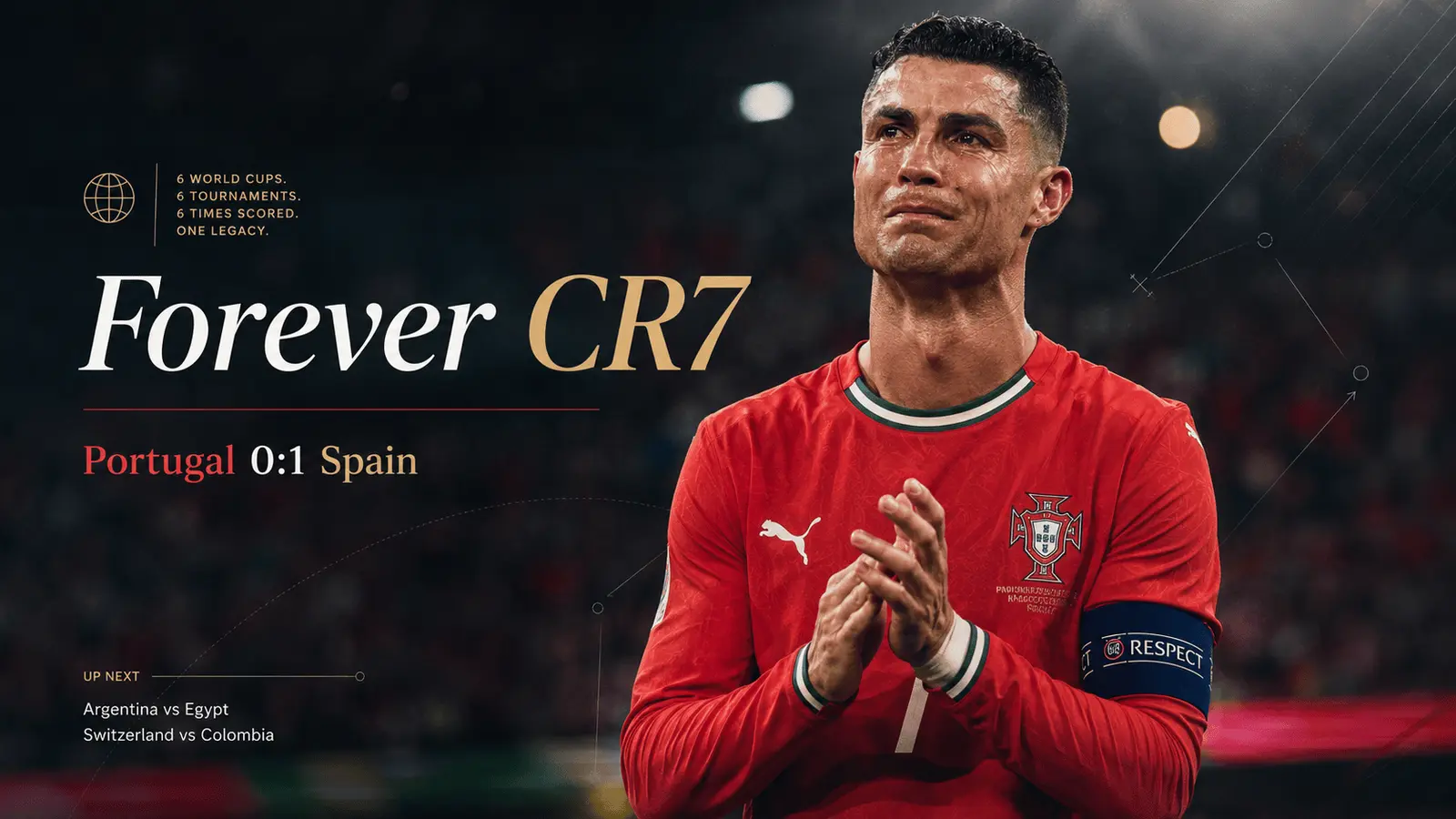
Anyway, he attended World Cup in 6 times and scored in each. He still scored in this World Cup although he is 41+. Cristiano Ronaldo, the forever CR7 ! Pay tribute to the forever CR7 !
Messi shows the other side of the equation
Argentina’s relationship with Lionel Messi is different because the team’s structure openly serves his strengths. The forwards press and stretch. The midfield stabilises. The team accepts that the best route to chance creation still runs through Messi’s left foot and decision-making.
That clarity can be a strength. It can also become a dependency if other attackers do not contribute enough. But Argentina at least know the bargain they are making.
Portugal often looked caught between eras: emotionally attached to Ronaldo, technically rich in midfield, but not fully committed to a single rhythm.
The question for coaches
This is where coaching becomes more than formation. Managing a legendary player late in his career is not simply about courage or sentiment. It is about role design.
Can the player still start and shape the match?
Is he better used as a late penalty-box weapon?
Does the rest of the team press and transition differently when he plays?
Can the coach explain the change without breaking the dressing room?
These are uncomfortable questions, but elite teams must ask them early. If they wait until a knockout defeat, the discussion becomes emotional rather than strategic.
Time is undefeated, but teams can adapt
Ronaldo’s World Cup farewell should not erase what he has meant to Portugal. It should also not prevent Portugal from building something new. The same principle applies to every great player approaching the end of an international cycle.
The objective is not to deny time. It is to design around it.
Argentina are still trying to maximise Messi. Portugal must now decide what comes after Ronaldo. The difference between the two is not greatness. It is clarity.
Controversy and Talking Points
Balogun, Discipline and the Problem With Turning Red Card Debates Into Conspiracy Football
The Balogun case became bigger than one match
Red-card debates are rarely calm in tournament football. They involve emotion, national identity, competitive advantage and a feeling that one decision can reshape an entire bracket.
The controversy around Folarin Balogun is exactly that kind of case. The red-card incident itself was real, but the important distinction is that the punishment was not simply “cancelled.” Public reporting indicates the automatic suspension was deferred for a year, with a fine attached, while Belgium’s challenge was rejected.
That distinction matters. In football, language shapes trust. Saying a red card was erased creates a very different impression from saying a disciplinary sanction was suspended or deferred under a formal process.
Why supporters were angry
Fans understand that dangerous play can be accidental and still punishable. They also understand that disciplinary panels may have discretion. What they struggle with is inconsistency — or even the appearance of inconsistency.
If one player is available after a red-card incident while another in a similar situation is suspended, supporters want to know why. Was the offence judged differently? Was the automatic ban treated under a specific disciplinary provision? Was there a probationary element? Was the fine part of the reasoning?
Those are legitimate questions.
The danger of skipping straight to politics
The problem is that the debate quickly becomes polluted when every procedural decision is framed as political interference or tournament manipulation. There has been public reporting around FIFA, disciplinary decisions and broader dissatisfaction, but claims about formal political pressure or hidden external control require extremely strong evidence.
Without that evidence, the analysis should stay disciplined: explain the rule, explain the decision, explain why it angered opponents, and separate verified facts from fan suspicion.
Football loses credibility when rules feel flexible. Commentary loses credibility when it presents speculation as proof.
How the controversy affected the football conversation
The United States’ 4-1 defeat to Belgium was not only about the controversy. Belgium scored through Charles De Ketelaere twice, Hans Vanaken and Romelu Lukaku, while the United States’ goal came from Malik Tillman. Tactically, Belgium were able to hurt the U.S. in ways that cannot be reduced to disciplinary noise.
But controversy changes the emotional environment around a team. It can create pressure, distraction and a siege mentality. Sometimes that unites a group. Sometimes it tightens them up.
That is why the Balogun debate matters: not because it explains everything, but because it shows how quickly rules, perception and performance become tangled in knockout football.
The standard should be clarity
The solution is not outrage for its own sake. It is transparency. If disciplinary bodies have discretion, they should explain how it is applied. If sanctions can be deferred, supporters should understand the criteria. If appeals are rejected, the reasoning should be accessible.
Tournament football can survive controversial decisions. It struggles when nobody understands them.