
England vs Argentina Preview: The Battle to Control the World Cup Semi Final
Introduction
World Cup semi-final coverage built around a central tactical idea: elite matches are often decided by which team prevents the opposition from playing in its preferred way. England versus Argentina provides the forward-looking main angle, supported by lessons from Spain's system-led victory over France.
Match Preview
England vs Argentina: The Semi Final Battle Is Really About Control
England and Argentina meet in Match 102 of the 2026 FIFA World Cup at Atlanta Stadium, with a place against Spain in the July 19 final at stake. The historical weight is unavoidable, but this semi-final should be understood through tactics rather than mythology.
Both teams needed extra time in their quarter-finals. England defeated Norway 2-1, while Argentina beat Switzerland 3-1. That shared physical burden makes possession less important than the type of work each side is forced to perform.
England must make width count
England’s clearest route is through the wings. Their wide options can attack one-on-one, force Argentina’s midfielders to move toward the touchline and create room for Harry Kane and Jude Bellingham inside.
That does not mean crossing at every opportunity. An effective aerial strategy requires four connected actions: creating a clean delivery, occupying the first contact, controlling the second ball and protecting against the counterattack. Without the final two elements, apparent pressure can quickly become an invitation for Argentina to break.
Kane’s movement will be central. If he drops away from the centre-backs, he can create space for Bellingham to run beyond him. England must first stretch Argentina horizontally, however, or those central areas will remain crowded.
Declan Rice has been cleared to start after returning to full training. His importance extends beyond ball-winning. England need his coverage behind the attacks, his protection of second balls and his ability to stop Argentina from turning a cleared cross into a transition.
Argentina will try to reduce the number of transitions
Argentina’s preferred contest is likely to be more controlled. Lionel Scaloni’s team can slow the game, divide it into shorter phases and avoid the repeated end-to-end attacks that would maximise England’s pace and depth.
Lionel Messi remains dangerous precisely because his influence cannot be measured only by running volume. Argentina can manage his workload before looking for a small number of decisive actions near the penalty area. Julián Álvarez and Lautaro Martínez also give the defending champions routes to goal that do not require Messi to finish every move himself.
Argentina’s challenge will be preventing England from turning the match into a sequence of wide attacks, aerial contests and loose-ball battles. If their midfield is continually dragged toward the flanks, the spaces around the edge of the box could become difficult to control.
The decisive coaching question
Substitutions may matter as much as the starting structure. England possess attacking alternatives capable of raising the tempo, but committing more players forward would expose them to Messi, Álvarez and Martínez in transition. Argentina, meanwhile, must decide when to protect control and when to attack an England defence that has not always appeared secure.
This is not simply a contest between famous attackers. It is a battle to define the shape and speed of the game. England need to make Argentina defend width, height and repeated physical pressure. Argentina need to make England wait, reset and attack against an organised block.
Whichever side first forces the other to abandon its preferred method will have taken the most important step toward the final.
Post-Match Review
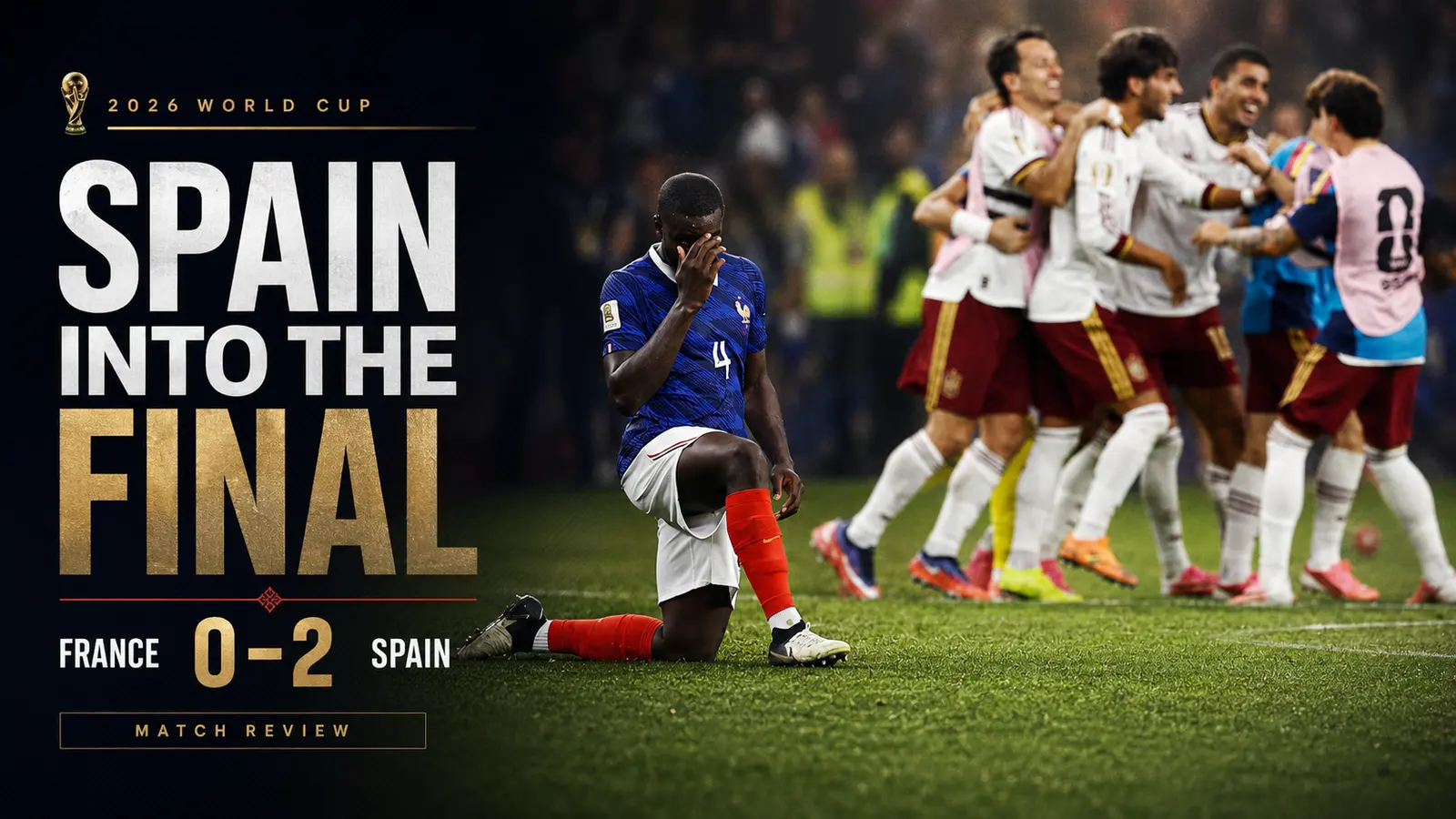
Spain 2 0 France: A Victory Built on Breaking the Supply Line
Spain’s 2-0 semi-final victory over France was not a story of one celebrated attack simply outperforming another. It was a demonstration of how collective structure can make elite forwards appear disconnected from the match.
Mikel Oyarzabal converted a penalty in the 22nd minute before Pedro Porro scored in the 58th from Dani Olmo’s combination play. Those were the defining events on the scoreboard, but Spain’s wider control began with their work against France’s supply lines.
France’s forwards were separated from the game
Michael Olise entered the semi-final with five assists across six tournament appearances. Against Spain, he nominally operated as the central attacking midfielder, with Ousmane Dembélé spending more time on the right.
Spain limited Olise’s ability to receive, turn and distribute forward. Their midfield pressure, wide defensive support and compact spacing made it difficult for France to move cleanly from their deeper players into Kylian Mbappé, Dembélé and Bradley Barcola.
This should not be reduced to Olise having a poor individual match. The broader problem was that France did not establish an effective alternative once their main connector was restricted. Their gifted attackers were left receiving fewer useful passes and facing a defence that had time to organise.
Spain’s possession had a defensive purpose
Spain’s control was about more than keeping the ball. Their most important sequence often began immediately after losing it: nearby players pressed, the midfield protected the next pass and the defensive line compressed the available space.
One recorded recovery metric put Spain’s average time to regain possession after losing it at 11 seconds, compared with 18 for France. The figures support the visual impression of a Spanish side acting collectively while France’s pressure was less consistently connected from front to back.
That difference created a powerful safety mechanism. Even when an individual pass failed, Spain frequently prevented France from transforming the turnover into an open counterattack.
France never found the second solution
Adrien Rabiot was replaced by Manu Koné at half-time, while Olise came off for Rayan Cherki in the 72nd minute. The changes did not produce the structural reset France required.
The central question was not whether any one substitution was wrong. It was why France could not create a second reliable route into attack. They struggled to bypass pressure more directly, release their forwards into space or establish another player as the organiser.
Spain, by contrast, remained connected. Rodri controlled the rhythm, Fabián Ruiz supplied aggression and coverage around him, and the wider defensive structure kept France’s transition threat under restraint.
Pedro Porro’s goal and overall display earned prominent post-match recognition, but the result belonged to Spain’s system. Their greatest success was not merely stopping a collection of star forwards. It was preventing those forwards from functioning as a collective attack.
Team Analysis
Spain’s Real Superpower Is What Happens After They Lose the Ball
The familiar description of Spain as a possession team is accurate but incomplete. Their 2-0 victory over France illustrated that possession only becomes dominant when it is connected to an equally coherent plan for losing the ball.
Spain’s structure worked as a continuous chain. The player nearest the turnover applied immediate pressure. Supporting midfielders blocked forward exits. Wide defenders moved to close nearby receivers, while the back line stepped up to remove the space France’s forwards wanted to attack.
That collective movement is what separated Spain’s pressure from France’s. A high press is not defined by the number of players who sprint toward the ball. It succeeds when the distances behind those players contract at the same time.
France occasionally pressed aggressively from the front, but Spain were often able to find space between the first line of pressure and the midfield or defence. Spain offered fewer such gaps because the players behind the initial challenge moved with it.
The midfield roles complemented one another
Rodri was the reference point for tempo, but Spain did not leave him to control every phase alone. Fabián Ruiz provided forward pressure, interceptions and coverage, helping to repair moments when possession became unstable.
That distinction is important. Rodri’s role was primarily to organise the rhythm and choose the next direction. Fabián’s movement enlarged Spain’s effective midfield territory and reduced the cost of individual errors.
The system also allowed Marc Cucurella and Spain’s other wide defenders to become aggressive without completely abandoning defensive security. When one player stepped forward, another moved into the space behind him. Pressure was therefore supported rather than improvised.
Why this matters for the final
Spain’s opponents in the final will know that simply waiting for a misplaced pass may not be enough. The first turnover must be followed by a clean escape from the counter-press. Otherwise, Spain can recover the ball before the opposition’s forwards have moved into useful positions.
That is Spain’s defining strength: they do not merely dictate what happens while they have possession. They continue dictating the match during the seconds when possession is supposedly up for grabs.
Player Performance
Rodri Controlled France, but the System Made His Control Possible
Rodri’s influence in Spain’s 2-0 victory over France was clear. He received strong post-match ratings and was identified in major match reporting as one of the central reasons Spain controlled the semi-final.
That does not require the more exaggerated conclusion that he has automatically returned to the absolute peak of his career. A midfielder’s recovery and form cannot be measured by the result alone.
The control remains
Rodri’s greatest strength is still his understanding of rhythm. He knows when Spain should circulate the ball, when to draw pressure and when to move possession into a more advanced line. Against France, that control helped prevent the match from becoming the open transition contest their opponents would have preferred.
His positioning also gave Spain a reliable reference after turnovers. By remaining connected to Fabián Ruiz and the defensive line, he helped close the routes France needed to release their forwards.
Look beyond a single rating
A complete assessment should consider four areas: tempo control, the sharpness of forward passing, mobility across defensive spaces and the amount of protection provided by the surrounding system.
Spain’s collective structure reduced Rodri’s exposure. Fabián covered ground around him, the defenders compressed the pitch and nearby players counter-pressed immediately after losing possession. Those mechanisms did not diminish Rodri’s performance, but they did create the conditions in which his intelligence could carry greater influence than raw athletic output.
Control without overstatement
Pedro Porro received the principal post-match recognition after scoring Spain’s second goal and contributing an outstanding display. Rodri’s importance was different and less spectacular: he helped determine where the match was played and how quickly it moved.
That is a powerful sign of progress. Whether he has completely recovered his former range and sharpness requires a larger body of evidence. Against France, however, Spain did not need a heroic individual performance from their midfield leader. They needed clarity, positioning and control—and Rodri supplied all three.
Controversy and Talking Points
A Referee’s Record Around Messi Is Not Evidence of Bias
The appointment of Ismail Elfath for England versus Argentina has produced a familiar pre-match argument: Lionel Messi’s teams have won previous matches in which the American official was involved, so Argentina must somehow possess an advantage.
The argument does not withstand scrutiny.
Reports commonly cite four MLS matches refereed by Elfath after Messi joined Inter Miami. Messi’s team won all four, with the player scoring five goals. A supposed fifth match comes from the 2022 World Cup final, when Elfath was the fourth official rather than the referee.
Those roles cannot responsibly be merged into a single refereeing statistic. More importantly, team results do not establish why those results occurred.
Results are not decisions
Evidence of refereeing bias would require analysis of specific incidents: fouls, disciplinary thresholds, penalty decisions, advantage applications and consistency across comparable challenges. A four-match win sequence offers none of that context.
It is also a small and selective sample involving different opponents and competitive circumstances. A team can win every match handled by a particular referee without receiving favourable treatment.
Scrutiny is legitimate; accusation requires evidence
Elfath’s appointment is notable because the semi-final will be handled by the first all-American officiating team in the history of the men’s World Cup. That makes the officials a legitimate subject of interest and post-match analysis.
It does not justify assuming partiality before the match. Nor should unrelated political or security narratives be attached to refereeing claims without verifiable evidence.
Football’s most useful officiating debates begin with an identifiable decision and examine it against the Laws of the Game. They do not begin with a result sequence and work backward toward a conspiracy.
A history of rivalry
The 2026 semi-final marks the sixth World Cup encounter between England and Argentina. The previous five meetings were: the 1962 group stage (England won 3–1); the 1966 quarter-final (England won 1–0, with Rattin sent off); the 1986 quarter-final (Argentina won 2–1, featuring Maradona’s "Hand of God" and "Goal of the Century"); the 1998 Round of 16 (tied 2–2 after 120 minutes; Beckham was sent off, and Argentina advanced 4–3 on penalties); and the 2002 group stage (England won 1–0 via a Beckham penalty). By FIFA’s official record, the tally stands at three wins for England, one for Argentina, and one draw (which Argentina won on penalties).
Known as the Falkland Islands to the British and the Islas Malvinas to the Argentines—indeed, the two nations fought a war in 1982. The clash between these two teams is destined to be explosive and full of talking points. But the football match should not, however, be viewed as an act of official political retribution. A match is just a match—a matter of honor, not a battle. Let us embrace fair play and keep football pure.