
World Cup Semi Final Preview: England vs Argentina, France vs Spain Tactical Analysis
Introduction
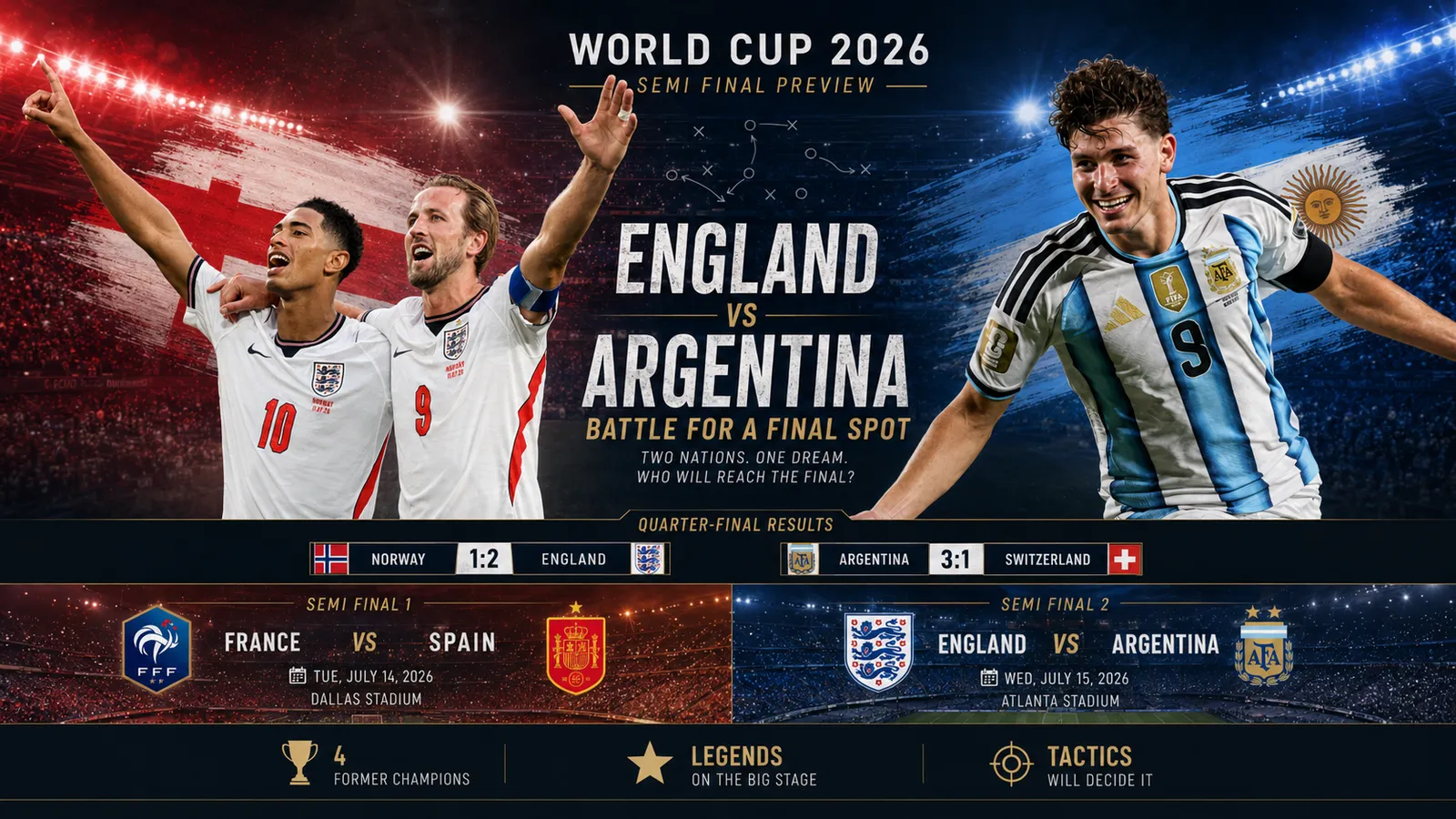
A World Cup semi-final content package built around tactical previews, quarter-final lessons and the key player and refereeing storylines shaping France vs Spain and England vs Argentina.
Match Preview
World Cup Semi Final Preview: England, Argentina, France and Spain Face a Test of Control Under Pressure
The 2026 World Cup has reached a final four that feels heavyweight in every direction: France, Spain, England and Argentina. All four are former World Cup winners, all four sit among the highest-ranked teams in international football, and all four arrive with enough individual quality to turn a tight semi-final on one action.
But this stage is rarely decided by reputation alone. After 100 matches in the first 48-team men’s World Cup, the tournament is down to two semi-finals, a third-place match and the final. The remaining teams have survived different kinds of pressure: France with controlled authority, Spain with possession-based ambition, England through a tense extra-time escape against Norway, and Argentina through another extra-time test against Switzerland.
France vs Spain: Possession Against Width, Patience Against Timing
France face Spain on July 14 at Dallas Stadium. The basic contrast is obvious but still too simple: Spain want control, France can hurt teams with speed, width and individual finishing. The more important question is whether Spain’s possession can create depth and whether France can turn their wide attacks into high-value chances rather than hopeful deliveries.
France’s 2-0 quarter-final win over Morocco was settled by goals from Kylian Mbappé and Ousmane Dembélé. The performance reinforced France’s capacity to attack through wide zones and shift the ball across the pitch, but the semi-final will ask a sharper question: can those routes disrupt Spain’s structure often enough?
Spain’s challenge is not merely to keep the ball. At this level, sterile control can become a defensive comfort blanket for the opponent. Spain must use possession to move France’s defensive block, open lanes between full-back and centre-back, and create chances before France can reset.
For France, the key may be timing. If they press too high and too often, Spain can play through them. If they sit too deep for too long, Spain can build pressure and territory. Their best route may be selective aggression: force Spain wide, protect central spaces, then attack quickly when the ball is regained.
England vs Argentina: Can England Speed Up Before Argentina Squeeze the Game?
England meet Argentina on July 15 at Atlanta Stadium. Both teams came through extra-time quarter-finals on July 11, so the tactical debate cannot be separated from recovery.
England beat Norway 2-1 after extra time in Miami. Andreas Schjelderup gave Norway the lead in the 36th minute, Jude Bellingham equalised in first-half stoppage time, then scored the winner in extra time after Ørjan Nyland failed to hold Morgan Rogers’ shot. England survived, but survival and fluency are not the same thing.
The semi-final question is direct: can England move the ball quickly enough to avoid being trapped by Argentina’s pressure?
England’s best attacking structure should not reduce Harry Kane to a static target or Bellingham to a late-arriving finisher alone. Kane’s value remains his ability to drop, connect and occupy defenders. Bellingham’s value is that he turns those movements into penalty-area threat. If England can use both together — Kane drawing defenders out, Bellingham attacking the space, wide players delivering early and accurately — they become far harder to predict.
If England drift into slow circulation across the back line, Argentina will have opportunities to squeeze passing lanes and attack turnovers. Argentina’s 3-1 extra-time win over Switzerland showed their resilience: Alexis Mac Allister scored early, Dan Ndoye equalised, and late goals from Julián Álvarez and Lautaro Martínez carried Argentina through. They may not need to dominate the ball for long spells if they can make England uncomfortable in the build-up.
The Hidden Factor: Recovery
The quarter-finals were not played in laboratory conditions. England’s match in Miami came in high heat and humidity, while Argentina’s match in Kansas City was also played in hot conditions. Both semi-final venues, Dallas Stadium and Atlanta Stadium, have roof and climate-control capability, but the accumulated load remains relevant.
France have a slightly different rhythm after beating Morocco on July 9, while Spain played on July 10. England and Argentina both played extra time on July 11. That does not decide the semi-finals, but it shapes them. Pressing intensity, substitution timing, concentration in defensive transitions and late-game decision-making may all be affected.
Key Players to Watch
- Jude Bellingham, England: Now central to England’s attacking identity, not just a support act for Kane.
- Harry Kane, England: Still vital as a connector and penalty-area reference point, even when he is not scoring.
- Lionel Messi, Argentina: Level with Mbappé on eight goals in the Golden Boot race and still capable of defining matches through one delivery or pass.
- Kylian Mbappé, France: Also on eight goals and decisive again in the quarter-final despite missing a penalty against Morocco.
- Ousmane Dembélé, France: A major wide threat whose directness can stretch Spain’s defensive structure.
Possible Match Scenarios
England vs Argentina may become a long, risk-managed game in which the first goal changes everything. If England score first, Thomas Tuchel may again look for a more protected defensive shape late on, as England did after Dan Burn replaced Bellingham against Norway and the team dropped into a deeper back-three/back-five structure. If Argentina score first, England will have to prove they can increase tempo without losing balance.
France vs Spain may be decided by who controls the transitions. Spain can dominate possession and still be vulnerable if France win the ball with space ahead. France can defend well and still suffer if Spain turn long passing sequences into central entries rather than harmless circulation.
The final four are all powerful teams. The winners will be the ones who can still look like themselves when the game becomes tired, narrow and tense.
Post-Match Review
Quarter Final Review: Bellingham Saves England, Argentina Survive Switzerland and France Find Control
The 2026 World Cup quarter-finals produced a final four of France, Spain, England and Argentina — a group rich in history, ranking strength and tournament experience. Yet the route into the semi-finals was anything but uniform.
France looked the cleanest of the confirmed quarter-final winners discussed here, beating Morocco 2-0 through goals from Kylian Mbappé and Ousmane Dembélé. England and Argentina, by contrast, both needed extra time. That matters. In tournament football, the emotional benefit of surviving a crisis can be real, but so can the physical cost.
England 2-1 Norway: A Result Better Than the Performance
England’s win over Norway was built on decisive moments rather than sustained control. Norway led through Andreas Schjelderup in the 36th minute. Jude Bellingham equalised in first-half stoppage time, then scored the extra-time winner in the 93rd minute after Ørjan Nyland could not hold Morgan Rogers’ effort.
That scoreline sends England into the semi-final, but it does not erase the warning signs. England still have spells where possession becomes too slow, too horizontal and too easy to read. Against Norway, the crucial difference was not that England overwhelmed the match; it was that they had the individual quality and squad depth to survive it.
Bellingham was the separator. His two goals reflected exactly what he gives this England team: timing, penalty-area instinct and the ability to turn broken or second-phase situations into goals. That changes the attacking structure around Harry Kane. England no longer look like a team that must wait for Kane to finish every major chance. They now have a second dominant attacking reference point arriving from midfield.
The late defensive adjustment also mattered. Dan Burn replaced Bellingham in the 111th minute, after which England defended their lead with a deeper back-three/back-five look. That change protected the box and helped close the game, though it also underlined a broader theme: England’s best tournament quality at the moment may be game management rather than attacking fluency.
Argentina 3-1 Switzerland: Resilience, Substitutions and a Red-Card Swing
Argentina beat Switzerland 3-1 after extra time in Kansas City. Alexis Mac Allister scored in the 10th minute, Dan Ndoye equalised in the 67th, and Argentina eventually pulled away through Julián Álvarez in the 112th minute and Lautaro Martínez in the 120+1st.
This was another reminder of Argentina’s tournament muscle. They do not always need to produce their most sparkling football to survive. Their strength is often in managing difficult phases, finding late solutions and trusting experienced players to make the right decision when the match becomes stretched.
The major turning point came in the second half when Breel Embolo, already booked, received a second yellow after VAR involvement connected to a mistaken-identity process and a simulation decision. The red card changed the match balance at a time when Switzerland had worked their way back into the contest.
For Argentina, the takeaway is positive but not perfect. They advanced, they found late goals and they showed depth. But extra time, heat and the emotional strain of a match that had turned against them will all be part of the semi-final equation against England.
France 2-0 Morocco: Authority Without Drama
France’s 2-0 win over Morocco was the most controlled of these three results. Mbappé scored in the 60th minute and Dembélé followed in the 66th, giving France a six-minute burst that effectively settled the tie.
France’s attack repeatedly carried threat through wide progression and lateral ball movement. Against Spain, that pattern will be tested at a higher level. Spain will try to control territory and rhythm; France will look for the moments when that control leaves space to attack.
What the Quarter-Finals Tell Us About the Semi-Finals
The final four are not identical, even if they all belong among the game’s elite. France arrive with stability and attacking weapons. Spain arrive with a possession identity and the need to turn control into penetration. England arrive with elite match-winners but unresolved tempo issues. Argentina arrive with resilience, experience and a proven ability to survive uncomfortable matches.
The semi-finals should not be reduced to star power. They may be decided by the less glamorous details: who recovers better, who manages substitutions more calmly, who protects the box late, and who avoids the one mistake that turns a balanced match into a chase.
Team Analysis
England’s Semi Final Problem: Winning Ugly Is Useful, But It Cannot Be the Whole Plan
England are in the World Cup semi-finals, and that achievement deserves weight. Tournament football is not a style contest. Surviving difficult matches is part of becoming a champion.
But England’s 2-1 extra-time win over Norway also showed why a team can advance and still leave questions behind. The result was strong. The performance was less convincing.
The Bellingham Upgrade
Jude Bellingham has changed England’s attacking hierarchy. For years, England’s attack has often been interpreted through Harry Kane: his goals, his hold-up play, his passing, his ability to drop between the lines. Kane remains essential, but Bellingham gives England something different.
He turns Kane’s movements into a more dangerous structure. When Kane drops, centre-backs have a decision to make. If they follow him, space opens behind. If they hold position, Kane can receive and connect play. Bellingham’s value is that he attacks the uncertainty. He arrives from midfield with the timing of a forward and the physical authority to finish under pressure.
That is why his two goals against Norway matter beyond the scoreboard. They show that England are no longer built around a single finishing point.
The Slow-Build Problem
The concern is that England still spend too many phases moving the ball without moving the opponent. Slow circulation can be useful if it draws pressure and creates gaps. It becomes a problem when it simply allows the opposition to settle.
Against Argentina, that risk grows. If England’s centre-backs and midfielders move the ball predictably, Argentina can press passing lanes, trap receivers and attack the first loose touch. England do not need to become reckless, but they do need more vertical intention.
The better version of England is clear:
- win the ball higher when possible;
- play forward before the opponent resets;
- use the wings earlier;
- attack the box with more than Kane alone;
- keep enough rest defence behind the ball to prevent counters.
Five at the Back: Solution or Symptom?
England’s late shift against Norway, after Dan Burn replaced Bellingham in the 111th minute, helped protect the lead. With Burn joining the defensive line, England defended in a deeper structure that resembled a back three or back five depending on the phase.
That is a legitimate tournament tool. It adds height, protects the box and reduces central gaps. But it cannot become England’s only reliable way to manage danger. If used too early or too passively, it can stretch the distance between the forwards and the rest of the team, leaving England with no outlet and inviting repeated pressure.
The best teams do not only defend leads; they threaten while defending them.
The Argentina Test
Argentina will not be surprised by England’s strengths. They will know Kane wants to connect play. They will know Bellingham wants to arrive late. They will know England can add defensive height late in the game.
That makes variety essential. England must change speed, change the angle of attack and avoid becoming a team whose patterns are visible five seconds before they happen.
The semi-final is not a referendum on whether England are good. They are clearly good enough to be here. It is a test of whether they can move from survival football to controlled authority before Argentina make the game uncomfortable.
Player Performance
Bellingham, Kane, Mbappé and Messi: The Semi Final Stars Driving the Golden Boot and the Tactical Story
The 2026 World Cup semi-finals arrive with the Golden Boot race still alive and the tournament’s biggest attacking personalities still central to the story.
Kylian Mbappé and Lionel Messi are level on eight goals. Erling Haaland has seven but is out after Norway’s defeat to England. Jude Bellingham and Harry Kane both have six, giving England two live scoring threats rather than one.
That matters because the individual race also reflects team structure.
Jude Bellingham: England’s Second Finishing Point
Bellingham’s performance against Norway was not just dramatic; it was structurally important. His equaliser in first-half stoppage time and extra-time winner confirmed his role as England’s most decisive late-arriving threat.
He is not simply a midfielder who scores. He changes how opponents must defend England. If teams collapse around Kane, Bellingham attacks the space. If they track Bellingham too closely, Kane has more freedom to drop, link and turn.
That duality is England’s biggest attacking upgrade. The risk is predictability: if Kane’s dropping movements and Bellingham’s forward runs become too obvious, elite opponents can crowd the central lanes and force England wide under pressure.
Harry Kane: Still Essential Without Needing to Be the Only Answer
Kane did not score against Norway, but his role should not be judged only through goals. England still need his ability to receive under pressure, connect midfield to attack and occupy defenders.
The key is balance. If Kane drops and no one runs beyond him, England become slow. If Bellingham and the wide players attack the space Kane creates, England become much harder to defend.
The best England version is not Kane or Bellingham. It is Kane plus Bellingham.
Mbappé: A Missed Penalty, Then a Goal Anyway
Mbappé’s quarter-final against Morocco contained a revealing detail: he missed a penalty but still scored in France’s 2-0 win. That is the mark of a player whose influence is not dependent on one clean script.
Against Spain, France will need Mbappé’s ability to threaten behind the defensive line and punish any moment when possession turns into exposure. Spain may control long spells. Mbappé can make one transition feel bigger than ten passing sequences.
Messi: Still Decisive Even Without Scoring
Messi did not score against Switzerland, but he still assisted Mac Allister from a corner. That is why his semi-final role cannot be measured only by open-play explosiveness. Even when the match slows, he remains a set-piece and final-pass threat.
Argentina’s semi-final against England may be tight, physical and cautious. In that kind of game, Messi’s value is obvious: one delivery, one pause, one disguised pass can alter the match.
Haaland and the Lesson of Supply
Haaland’s exit with Norway is a reminder that a great striker still needs a service structure. The issue is not whether Haaland is elite; that question is settled. The issue is whether Norway created enough repeatable routes to find him through crosses, early balls, direct transitions and second-ball situations.
When a team has a striker with that level of penalty-area gravity, failing to feed him consistently is not just a player-performance issue. It is a team-design issue.
The Semi-Final Individual Battle
The Golden Boot race adds drama, but the more important question is how each star fits his team’s method:
- Mbappé gives France transition threat and direct finishing.
- Messi gives Argentina control of moments and set-piece danger.
- Bellingham gives England late runs and penalty-area authority.
- Kane gives England connection, leadership and central reference play.
The semi-finals will be decided by teams, but the teams that reach finals usually give their stars the clearest platform to be decisive.
Controversy and Talking Points
VAR, Second Yellows and the Embolo Red Card: Why Argentina vs Switzerland Became a Rules Debate
Argentina’s 3-1 extra-time win over Switzerland included one of the most important refereeing talking points of the World Cup quarter-finals: Breel Embolo’s second yellow card.
The incident mattered because Switzerland had equalised through Dan Ndoye and had worked their way back into the match. Once Embolo was sent off, the balance changed. Argentina eventually scored twice in extra time through Julián Álvarez and Lautaro Martínez.
But the debate should not be reduced to one angry phrase: “VAR cannot intervene for yellow cards.” In this case, the issue was more specific.
What Happened?
Embolo had already been booked. In the 72nd minute, the referee initially showed a yellow card to Leandro Paredes after an incident. VAR then became involved through a mistaken-identity mechanism. The yellow to Paredes was withdrawn, Embolo was judged to have simulated, and he received a second yellow card. That meant red.
Under the VAR framework used in the 2026 competition, checks connected to a red card resulting from a clearly wrong second yellow and cases of mistaken identity can fall within the permitted intervention area. That does not automatically mean every supporter must agree with the final judgement, but it does mean the procedural question is not as simple as saying VAR had no route into the incident.
The Real Questions
There are three separate debates here:
-
Was simulation the right judgement?
This is the footballing call. It depends on the contact, the player’s movement and the referee’s interpretation. -
Was VAR allowed to get involved?
Because the incident involved mistaken identity and led to a second-yellow red card, the intervention had a rule-based pathway under the competition’s VAR procedures. -
Was the process communicated clearly enough?
This is often where controversy survives. Without full public access to the referee team’s audio and official report, supporters see the outcome but not every step of the decision-making process.
Why It Matters
In a knockout match, a second yellow is not a minor administrative event. It changes the number of players, the emotional state of both teams and the tactical map of the game.
For Switzerland, the red card came after they had restored parity. For Argentina, it opened a route to regain control and eventually use their bench and late-game experience to finish the tie.
That is why VAR debates need precision. If every controversial call is treated as proof of conspiracy or incompetence, the discussion becomes useless. If every technical explanation is used to shut down legitimate criticism, that is no better.
The Embolo incident sits in the uncomfortable middle: there was a procedural basis for intervention, but the final judgement and communication will remain debated unless fuller official material is released.