
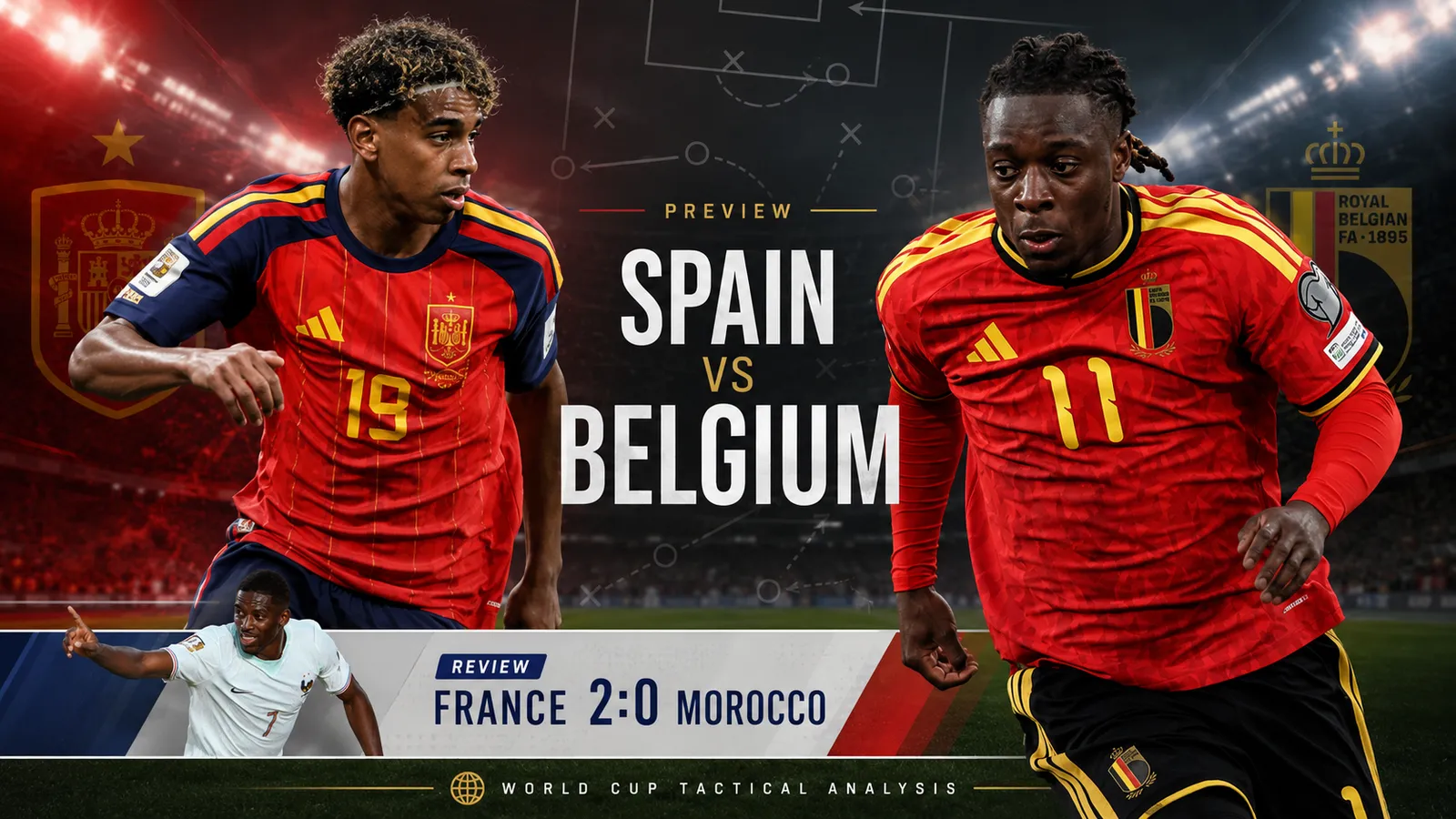
Spain vs Belgium Preview and France 2 0 Morocco Review: World Cup Tactical Analysis
Introduction
A World Cup knockout-stage package built around two connected questions: why France already look like a side capable of controlling elite matches through talent and execution, and whether Belgium can disrupt Spain’s possession machine before the tournament narrows toward the semi-finals.
Match Preview
Spain vs Belgium Preview: Belgium’s Best Chance Is to Make Spain Uncomfortable
Spain against Belgium is not simply a meeting of two big football nations. It is a clash between two different ideas of control.
Spain’s control comes through possession, spacing and collective defensive positioning. Belgium’s best route, by contrast, may come from denying the match any clean rhythm at all.
The quarter-final is scheduled for Friday, July 10, at Los Angeles Stadium in Inglewood. The winner will face France in the semi-final on July 14.
Spain’s Strength Is Defensive Possession
Spain’s clean-sheet run has become one of the major stories of the tournament. Their five matches before this quarter-final all ended without Spain conceding: 0-0 against Cape Verde, 4-0 against Saudi Arabia, 1-0 against Uruguay, 3-0 against Austria and 1-0 against Portugal.
That defensive record is not only about the back line. Spain defend by owning the ball. When they keep possession, they reduce the number of direct attacks their defenders must absorb. When they lose it, their structure usually leaves enough players close to counter-press or delay the transition.
Unai Simon’s World Cup shutout streak reached 609 minutes after the win over Portugal, extending across the 2022 and 2026 tournaments. That matters because it reflects more than individual goalkeeping form. It reflects a national side that has learned how to lower risk through the ball.
The Belgium Reset: More Mobility, Less Nostalgia
Belgium’s 4-1 win over the United States changed the tone around their tournament.
Rudy Garcia made a major call by leaving Kevin De Bruyne, Jeremy Doku and Romelu Lukaku on the bench, using Charles De Ketelaere through the middle and asking Youri Tielemans to lead a more aggressive midfield press. De Ketelaere scored twice in the first half, while Lukaku later came off the bench and scored.
That performance created a new question: was it a genuine Belgian revival, or a tactical solution that worked especially well against one opponent?
Against Spain, the answer will be clearer. Belgium will not be able to rely on Spain gifting them the same spaces. They will have to create discomfort deliberately.
The Key Tactical Battle: Can Belgium Break Spain’s Rhythm?
If Belgium try to out-pass Spain, they are likely to lose the match on Spain’s terms.
Their better path is to make the game uneven:
- press Spain’s midfield receivers before they can turn;
- challenge second balls aggressively;
- attack quickly into wide and half-space channels;
- prevent Lamine Yamal from receiving in comfortable one-v-one situations;
- force Spain’s defenders to run back toward their own goal rather than defend from settled positions.
This is where Amadou Onana’s absence hurts Belgium. The midfielder suffered an ACL injury against the United States and is out for the rest of the tournament. Without his ball-winning presence, Belgium must find another way to add power and resistance in the middle of the pitch.
De Bruyne or No De Bruyne?
The biggest selection debate is Kevin De Bruyne.
His passing range, vision and experience remain obvious assets. But against Spain’s younger, high-rhythm midfield, the question is whether Belgium can afford to slow the game down around him from the start.
Garcia’s decision against the United States showed that Belgium are willing to imagine a version of themselves not built entirely around their old golden-generation reference points. That does not mean De Bruyne has no role. It means his role must serve the game plan, not the memory of what Belgium used to be.
Lukaku as the Late-Game Weapon
Romelu Lukaku may be more dangerous as a substitute than as an automatic starter in this match.
He has already scored three goals at this World Cup, all after coming off the bench. Used late, he changes the physical profile of Belgium’s attack. He can pin centre-backs, compete for direct balls, attack crosses and force Spain to defend a different kind of problem after spending much of the match managing movement and combinations.
That contrast could be Belgium’s most useful late lever.
Spain’s Variable: Nico Williams
Nico Williams remains an important uncertainty because of his recurring groin issue. If available, he gives Spain direct speed on the opposite flank and can help stretch the pitch away from Lamine Yamal.
Without that balance, Spain may still control the ball, but their attacking width could become more predictable. With him, Spain regain a sharper two-wing threat.
Prediction Angle
Spain should be considered the more stable side. Their structure, clean-sheet rhythm and ability to defend with the ball give them a higher floor.
Belgium’s route is narrower but real: make the match faster, rougher and less orderly than Spain want. If they can turn possession into pressure and pressure into transitions, they can make this a quarter-final rather than a procession.
The danger for Belgium is simple: if they do not disrupt Spain early, Spain may slowly remove the oxygen from the game.
Post-Match Review
France 2 0 Morocco Review: Talent Won, but Execution Made the Difference
France’s 2-0 win over Morocco in the World Cup quarter-finals looked, on the surface, like the stronger team doing what was expected. But the match was more revealing than that.
This was not only a victory for talent. It was a victory for talent placed inside a serious structure.
Kylian Mbappe scored in the 60th minute. Ousmane Dembele added the second in the 66th. France advanced to the semi-finals, where they will face the winner of Spain against Belgium.
France Did Not Just Avoid Morocco’s Strength — They Attacked It
One of the clearest tactical themes was France’s willingness to pressure Morocco’s right side, the zone associated with Achraf Hakimi’s influence.
Many teams try to avoid an opponent’s strongest channel. France did the opposite. By pushing the game toward that side and forcing Morocco’s right flank to defend, they reduced one of Morocco’s best attacking outlets at source.
That is classic knockout football from a mature side: do not merely protect against the opponent’s strength; make that strength work backwards.
Mbappe’s Penalty Miss Did Not Define Him
Mbappe had an early penalty saved by Yassine Bounou after Noussair Mazraoui brought him down in the area. The miss could have changed the psychological tone of the match. Instead, Mbappe stayed involved and later gave France the breakthrough.
That matters. In a tournament game, a missed penalty can become a personal storyline that swallows the player. Mbappe did not allow that to happen. His movement, threat and ability to keep demanding decisive moments remained central to France’s attack.
He was later withdrawn after a minor right ankle knock, with reports presenting the substitution as a precaution. His own post-match message was positive, though France will still want to monitor him ahead of the semi-final.
Dembele’s Goal Showed Why Two-Footed Attackers Are So Difficult to Read
Dembele’s 66th-minute goal came after Mbappe set the ball back to him near the edge of the area. The finish was low, struck from a dangerous central zone, and Bounou got a touch without being able to keep it out.
The broader point is technical. Dembele’s two-footedness makes goalkeepers hesitate. Against a predictable shooter, the goalkeeper can cheat a fraction earlier. Against Dembele, the shooting foot and direction can remain unclear until the final action.
That fraction is often enough.
Morocco Were Organised, but Not Disruptive Enough
Morocco did not collapse. Bounou made important saves, including the penalty stop, and the team remained competitive in shape and effort.
But at this level, being organised is not always enough. Morocco struggled to create the kind of midfield disturbance that makes elite opponents uncomfortable. France were allowed too many moments where their attackers could receive, combine or react first to loose balls.
The difference between a well-drilled underdog and a true upset threat is often the ability to make a favourite play badly. Morocco worked hard, but France rarely looked forced into panic.
France’s Real Strength: Stars Who Still Run
The most encouraging sign for France is not just that Mbappe and Dembele scored. It is that France’s attacking talent operated within a collective frame.
The front line pressed, the midfield balance around Manu Kone and Adrien Rabiot gave France stability, and Michael Olise’s inside positioning helped connect the phases. France were not simply waiting for individuals to rescue them. They were building conditions in which individual quality could decide the match.
That is why they are so dangerous.
The Warning for France
There is still a question opponents will try to ask in the semi-final: can France’s midfield and back line handle a team that presses harder, challenges more aggressively and keeps the ball better than Morocco did?
France have looked powerful, but knockout tournaments rarely reward comfort for long. Their biggest test may come when their structure is not merely respected, but actively attacked.
For now, though, the message is clear: when France combine elite forwards with serious work without the ball, they become extremely difficult to beat.
Player Performance
Mbappe, Dembele and De Ketelaere: Three Different Ways to Change a Knockout Match
Elite players do not all influence knockout matches in the same way.
Some dominate through finishing. Some through movement. Some through ambiguity. Across France’s win over Morocco and Belgium’s build-up to Spain, three players stand out for different reasons: Kylian Mbappe, Ousmane Dembele and Charles De Ketelaere.
Mbappe: The Miss Did Not Break the Match
Mbappe’s penalty against Morocco was saved by Yassine Bounou. In a quarter-final, that moment can become heavy. It can shrink a player’s decision-making, invite frustration and turn the crowd’s energy.
Mbappe’s performance after the miss was the more important detail. He stayed threatening, stayed connected to France’s attacking rhythm and later scored the opening goal in the 60th minute.
The best forwards are not defined only by conversion. They are defined by whether they keep arriving in decisive spaces after failure. Mbappe did.
Dembele: Unpredictability Is a Weapon
Dembele’s goal six minutes later came from a central area near the edge of the box after Mbappe’s lay-off. Bounou touched it, but could not keep it out.
Dembele is difficult for defenders and goalkeepers because he does not give the usual clues. With many attackers, body shape points toward the likely shooting foot and likely finish. With Dembele, that information arrives late.
Two-footed players do not merely have more options. They steal reaction time from opponents.
De Ketelaere: Belgium’s Useful Uncertainty
Belgium’s win over the United States placed De Ketelaere at the centre of the conversation. Used through the middle, he scored twice in the first half and gave Belgium a different attacking reference point.
His value is not that he is a classic centre-forward. It is that he is not quite one. He can move between the line and midfield, arrive in the box, connect play and help Belgium defend from the front.
Against Spain, that positional ambiguity may be essential. Spain are comfortable when they can identify reference points and control the spaces around them. De Ketelaere can make those reference points less stable.
Lukaku: The Substitute Who Changes the Physics
Romelu Lukaku remains a major factor, especially from the bench. His three goals at this World Cup have all come as a substitute, including one against the United States.
That pattern gives Belgium a strategic choice. Rather than starting with their most physically imposing forward, they can introduce him when defenders are tired and the match needs a different texture.
Lukaku changes the physics of an attack: more contact, more direct balls, more penalty-area stress.
The Common Thread
Mbappe, Dembele, De Ketelaere and Lukaku all alter matches in different ways. One recovers from pressure and keeps threatening. One hides the finish until the last instant. One blurs positions. One changes the physical battle.
In knockout football, those details matter because the margins are small. Systems create the stage, but players still decide which moments become history.
Controversy and Talking Points
World Cup Refereeing Talking Points: The Real Issue Is Trust, Not Just VAR
Refereeing controversies in knockout football rarely stay contained to one decision.
A red card becomes a debate about consistency. A VAR intervention becomes a debate about authority. A disciplinary ruling becomes a debate about whether the punishment fits the offence.
This World Cup has provided several examples.
Quansah’s Red Card and Two-Match Suspension
England defender Jarell Quansah was sent off against Mexico after VAR intervention for serious foul play. FIFA later imposed a total two-match suspension.
The important distinction is that the debate should not be reduced to whether the red card existed. Serious foul play can justify a red card. The more interesting question is whether the length of the disciplinary punishment feels proportionate and whether fans understand the standard being applied.
When disciplinary decisions arrive without broad public clarity, they invite speculation. That is damaging even when the decision is defensible.
Argentina vs Egypt: VAR and the Meaning of the Same Attacking Phase
The Argentina-Egypt round-of-16 match produced another major talking point.
Egypt had a Mostafa Ziko goal disallowed after VAR identified a foul by Marwan Attia on Lisandro Martinez in the same attacking phase. FIFA refereeing chief Pierluigi Collina later stated that VAR was entitled to correct the missed foul.
A separate incident before Argentina’s stoppage-time winner involved contact between Mohamed Salah and Julian Alvarez. The referee and VAR treated it as normal football contact after the defender played the ball first, and no foul was awarded.
Egypt’s federation still challenged the consistency and fairness of the decisions, which is exactly why explanation matters. Football fans do not only want to know what the decision was. They want to understand why one type of contact cancels a goal and another does not.
VAR Does Not End Debate — It Moves the Debate
VAR was introduced to reduce obvious errors, not to remove interpretation from football. That difference is crucial.
Many decisions still depend on judgment: the threshold for serious foul play, the definition of the same attacking phase, the level of contact required for a foul, or whether a defender has played the ball before contact follows.
When those judgments are not explained well, supporters often fill the gap with suspicion.
The Standard Football Needs
The solution is not to pretend every controversy can disappear. It cannot.
The solution is transparency: clear language, consistent thresholds and timely explanations. If football authorities want fans to trust VAR and disciplinary panels, they must make the reasoning as visible as the technology.
In knockout football, the stakes are too high for silence to do the work.