
France vs Morocco Preview: Tactical Edge, Key Players and Referee Talking Points
Introduction
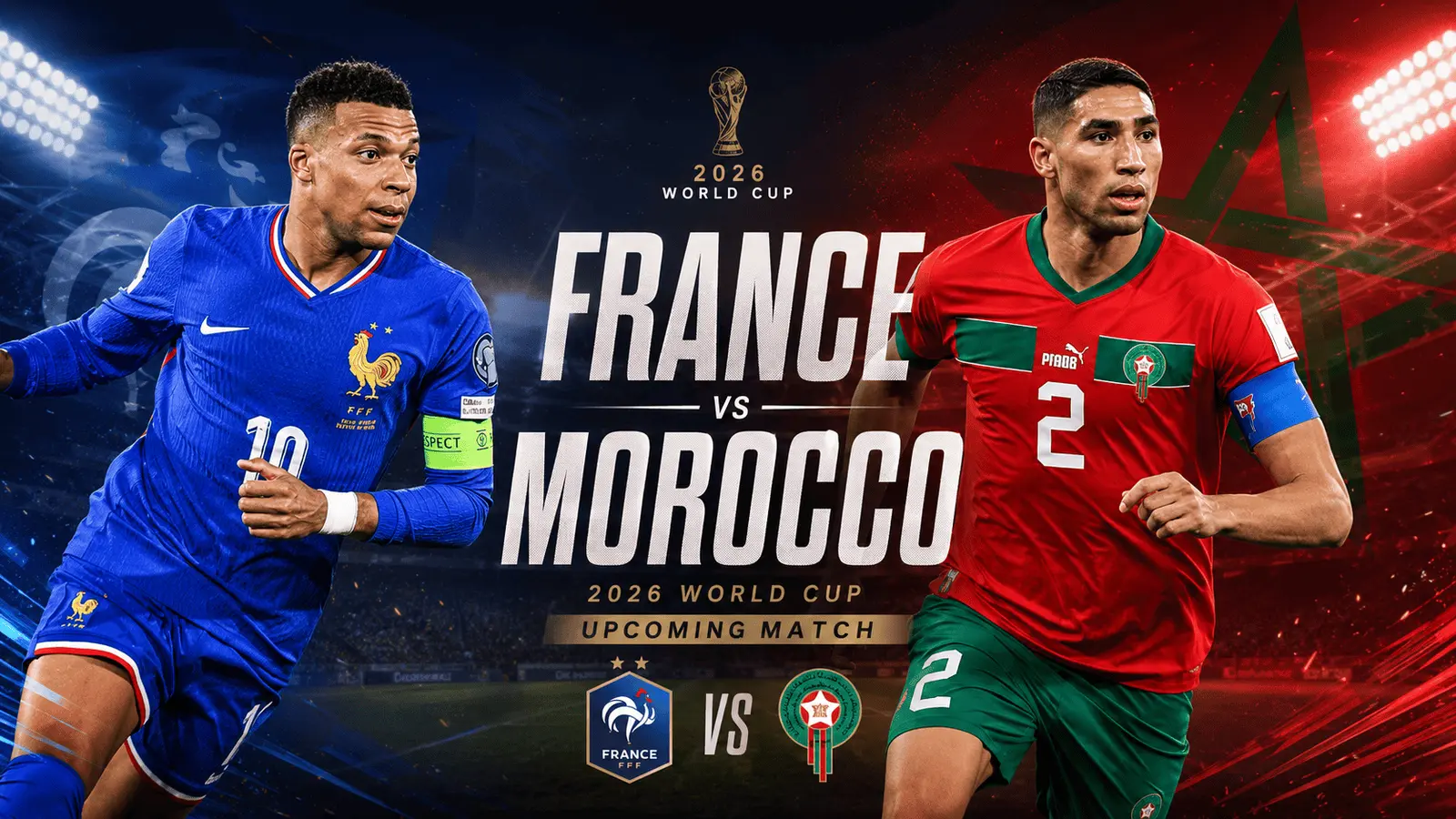
A tactical, measured pre-match package for France vs Morocco in the 2026 FIFA World Cup quarter-finals, focused on why France appear structurally stronger, how Morocco can still make the game uncomfortable, and why the refereeing narrative should not overshadow the football.
Match Preview
France vs Morocco Preview: France’s Depth Meets Morocco’s Search for a Perfect Underdog Plan
France vs Morocco arrives as a 2026 FIFA World Cup quarter-final with two very different questions attached to it.
For France, the question is whether their superior depth, midfield balance and attacking variety can translate into a controlled knockout performance. For Morocco, the question is not whether they have courage or competitive identity — they have proved that often enough — but whether they have enough attacking structure left to hurt an opponent this complete.
The match is scheduled for July 9 at Boston Stadium/Gillette Stadium. Public schedule listings place kick-off around 21:00 UK time, which converts to the early hours of July 10 in Hong Kong and mainland China.
Why France Look the More Stable Side
The strongest argument for France is not simply that they have more famous players. It is that their squad can absorb problems without losing its shape.
France came through a physically demanding last-16 tie against Paraguay, winning 1-0 through a Kylian Mbappé penalty. That match underlined two familiar tournament traits: France can win without flowing, and they have enough individual quality to find a decisive moment even when the game becomes attritional.
Against Morocco, the key may be the platform behind the forwards. N’Golo Kanté and Adrien Rabiot offer coverage, second-ball security and positional balance. Aurélien Tchouaméni has been reported as working back from a muscular/adductor issue, but France’s wider midfield pool means they are not forced to gamble everything on one selection call.
That matters because it changes the job description for France’s creators.
Olise, Mbappé and Dembélé: Three Different Problems for Morocco
Michael Olise has been one of France’s most important creative forces at this tournament, with five assists placing him at the top of the World Cup assist chart. The more interesting point, though, is tactical rather than statistical.
Olise can connect midfield to attack without needing to be dragged constantly into deep defensive labour. That is where the comparison with Antoine Griezmann’s 2022 role becomes useful. Griezmann, in that France side, often operated as a hybrid playmaker-midfielder: linking attacks, covering spaces, helping the team survive without the ball. Olise can still connect play, but with Kanté and Rabiot giving France a stronger protective base, he may be able to spend longer in zones where his final pass matters most.
Then come the two stress points either side of him.
Mbappé remains France’s most direct goal threat, while Ousmane Dembélé provides one-v-one disruption and carries the ability to unbalance a defensive block from the wing. Morocco cannot simply overload one side and hope the other goes quiet. France have different forms of danger: Olise as connector, Mbappé as finisher and depth threat, Dembélé as the dribbler who can turn a settled defensive shape into a scramble.
Morocco’s Problem Is Structural, Not Emotional
Morocco’s 3-0 win over Canada confirmed that they are far beyond the level of a romantic outsider. They are organised, resilient and capable of punishing mistakes. But France present a different kind of examination.
The concern is Morocco’s attacking connection. Ismael Saibari, a forward-line player capable of operating between attacking midfield, wide and central roles, has been reported out of the France match after a hamstring/thigh problem. His absence matters because it removes more than a name from the team sheet. It can affect the first outlet in transition, the player who receives under pressure, and the link between a defensive regain and a meaningful counterattack.
Morocco still have forward options, so it would be wrong to say they have no striker or no route to goal. The more accurate issue is whether they have a stable enough front-line reference point to relieve pressure against a team that can counter-press and sustain attacks.
Chadi Riad’s status has also been discussed in the build-up, with reports around his possible availability or fitness. If Morocco’s defensive unit is not at full rhythm, the challenge grows: France are not a side you want to face with uncertainty in central defensive communication.
The Morocco Upset Path
Morocco’s route to an upset is narrow, but not imaginary.
They need a low-error defensive performance, controlled aggression, and a way to turn France’s attacking width against them. If France’s full-backs push high, there will be spaces to attack. The question is whether Morocco can hit the first pass cleanly enough, support the runner quickly enough, and make France defend facing their own goal.
Set pieces are another obvious path. In knockout football, a team that spends long periods without the ball can still change the match through one delivery, one rebound or one defensive lapse.
The longer the match stays level, the more Morocco can drag France into a mental test. If France score early, however, Morocco may be forced out of their preferred defensive rhythm — and that is when France’s depth and multi-point attack could widen the gap.
The 2022 Reference Point
The 2022 World Cup semi-final, which France won 2-0 against Morocco, remains a useful comparison. Theo Hernández and Randal Kolo Muani scored that day, and the lesson was not only that France had elite starters. It was that France had players outside the most obvious headline group who could decide a knockout match.
That remains one of the biggest differences between these teams: France can lose rhythm and still find a match-winner; Morocco may need their best structure to function almost perfectly.
Prediction Lean
France deserve to be viewed as favourites because their advantages are layered: squad depth, midfield protection, creative variety, transition threat and knockout experience. Morocco’s best chance is to make the match slow, physical and psychologically uncomfortable, then strike through transition or set pieces.
But if France establish control early and keep the match focused on football rather than emotion, the tactical balance points toward a French win.
Team Analysis
France vs Morocco Team Analysis: Why Squad Depth May Decide the Quarter Final
Tournament football often turns on a simple question: what happens when Plan A is damaged?
That is where France look stronger than Morocco ahead of their World Cup quarter-final. France have more than elite individuals; they have redundancy. Morocco have organisation and belief, but their margin for disruption is much smaller.
France’s Advantage Is Built in Layers
France’s squad strength is sometimes reduced to a list of stars, but the more important point is how their pieces support one another.
The midfield base gives France stability. Kanté brings coverage and ball-winning instinct. Rabiot adds balance, height, running power and tactical reliability. Tchouaméni’s availability remains a selection question after recent fitness concerns, but France do not look structurally dependent on one midfielder being rushed back.
That depth has a direct attacking effect. If the midfield protects the centre and manages second balls, France’s creators can operate higher. Olise can look for the final pass. Dembélé can attack his full-back. Mbappé can focus on exploiting space rather than repeatedly dropping to rescue possession.
France’s system is therefore not simply about having better forwards. It is about creating the conditions for those forwards to stay dangerous.
Morocco’s Challenge: Replacing Function, Not Just Personnel
Morocco’s difficulty is different. Their problem is not motivation. It is function.
Saibari’s reported absence weakens Morocco’s front-line connection. In a match where Morocco are likely to spend spells defending deeper, the first outlet after a regain becomes critical. If that first pass does not stick, France can recycle pressure and turn the game into a territorial squeeze.
That is why the absence of a linking forward can be more damaging than the absence of a pure finisher. Morocco need someone who can receive with contact, slow France’s counter-press, bring runners into play and turn defensive effort into attacking territory.
Without that, the game can become exhausting: defend, clear, retreat, defend again.
Where Morocco Can Still Compete
Morocco’s best defensive qualities still matter. They can compress space, fight for second balls and make France attack through traffic. If the refereeing threshold allows physical duels, Morocco may be able to disrupt rhythm and turn the match into a stop-start contest.
They can also target the spaces France leave when attacking. Any side with aggressive wide players and ambitious full-backs will concede some transition space. Morocco’s issue is execution: the regain, the first pass, the runner, the final action. Every step must be cleaner than usual because France recover quickly and defend transitions with athleticism.
The Depth Gap
The late stages of knockout matches magnify benches. If the match is level after an hour, France can change the profile of their attack without abandoning the plan. Morocco may have fewer ways to alter the game if the first tactical idea does not work.
This is why France’s edge feels more stable than a normal favourite’s edge. They can win through control, through individual quality, through a set piece, through a substitute, or through one explosive action from Mbappé or Dembélé. Morocco likely need a narrower script: defensive concentration, low scoreline, transition threat and emotional control.
That does not make an upset impossible. It does make the tactical burden heavier.
Player Performance
Michael Olise and the France Creator Role: A New Version of the Griezmann Blueprint
The most interesting France player debate before the Morocco quarter-final is not whether Kylian Mbappé can score. It is how France are creating the conditions for chances to arrive in the first place.
That brings the focus to Michael Olise.
Olise has led the tournament assist chart with five assists, but his value goes beyond the number. He has become a central part of France’s attacking connection: the player who can receive between lines, combine around the box and find the pass that turns pressure into a clear chance.
The Griezmann Comparison
The obvious comparison is Antoine Griezmann in 2022. Griezmann’s role in that France team was one of the most intelligent tactical adaptations of the tournament. He was not just a No. 10. He was a connector, a presser, a cover midfielder and a chance creator.
The comparison with Olise should not be framed as a simple ranking. It is about role and structure.
Griezmann often had to do more without the ball. He dropped into midfield, helped protect central areas and balanced the side when France were under pressure. Olise, by contrast, may be working in a team where Kanté and Rabiot provide enough protection for him to remain higher for longer.
That changes the creator’s working radius. Instead of constantly moving back to stabilise the team, Olise can spend more time near the zones where he can hurt Morocco: the half-space, the edge of the box and the passing lanes into Mbappé or the far-side runner.
Why Kanté and Rabiot Matter to Olise
Creative players are often judged by assists, key passes and highlight actions. But their output depends heavily on the platform underneath them.
Kanté’s coverage can reduce the fear of losing the ball in central areas. Rabiot’s balance helps France maintain shape when attacks break down. Together, they can give Olise the freedom to take risks in advanced positions.
That is particularly important against Morocco. If Morocco defend deep, France need a player who can find the pass through a compact block. If Morocco jump out to press, France need someone who can exploit the space behind that pressure. Olise gives them both possibilities.
Mbappé and Dembélé Complete the Picture
Olise’s creativity becomes more dangerous because of the players around him.
Mbappé threatens the space behind defenders and turns a half-chance into a shot. Dembélé forces one-v-one panic on the flank. That means Morocco cannot focus only on blocking Olise’s passing lanes. If they step too aggressively toward him, they risk opening space for Mbappé. If they defend too narrow, Dembélé can isolate his marker.
France’s attack is dangerous because its threats are different. Olise sees the pass. Mbappé attacks the finish. Dembélé breaks the defensive shape.
Morocco’s task is to stop all three without losing their own counterattacking outlet. That is the difficulty of facing this France side: the creator is not isolated from the system — he is protected by it.
Controversy and Talking Points
France vs Morocco and the Referee Narrative: The Match Cannot Be Allowed to Become About the Whistle
The loudest pre-match talking point around France vs Morocco may not be tactical. It may be the referee.
Argentine referee Facundo Tello has been confirmed as the main official for the World Cup quarter-final, with an Argentine on-field officiating group including assistants Juan Pablo Belatti and Gabriel Chade, fourth official Darío Herrera and reserve assistant Cristian Navarro.
That appointment arrives in a tournament atmosphere already sensitive to refereeing debate. Argentina’s 3-2 win over Egypt in the last 16, handled by French referee François Letexier, produced anger from Egyptian supporters and debate around VAR involvement, a disallowed Egypt goal and penalty-area incidents involving Mohamed Salah. FIFA refereeing officials later defended the decision-making and VAR process, which is an important part of the context.
The point is not to pretend that refereeing does not matter. It does. A major knockout match can swing on a foul threshold, a penalty decision, a VAR intervention or added-time management.
But there is a difference between scrutiny and suspicion.
Referee Nationality Is Not Analysis by Itself
Football discourse often turns the nationality of an official into a story before a ball is kicked. That is dangerous because it invites fans to interpret every decision through a pre-built theory.
If a referee allows physical contact, one side may feel targeted. If he penalises repeated duels, the other may feel the rhythm has been killed. In a match like France vs Morocco, where Morocco may need aggression and France may rely on technical superiority in tight spaces, the foul threshold will matter.
That should be analysed. It should not become an automatic conspiracy.
The Match Deserves a Football-Led Review
France’s advantages are clear: deeper squad, more attacking routes, stronger midfield protection, and elite forwards who can decide moments. Morocco’s challenge is equally clear: defend compactly, keep the score low, protect transition outlets and find a way to make France uncomfortable.
Those are the football questions that should lead the conversation.
If there is a major decision, it should be reviewed on its own merits: the law, the angle, the VAR protocol, the referee’s positioning, and the consistency of his threshold across the match. That is very different from deciding in advance that the result must be explained by the official.
The Best Outcome Is a Quiet Referee
The best refereeing performance in a match like this is not one that dominates the broadcast. It is one that lets the contest breathe, protects player safety, applies the laws consistently and keeps the post-match conversation on the players.
France vs Morocco has enough tactical tension without the whistle becoming the headline. The teams should decide it. The referee’s job is to make sure they can.