
World Cup Knockout Analysis: Spain Survive Belgium as England, Norway, Argentina and Switzerland are Remains Suspenseful Questions
Introduction
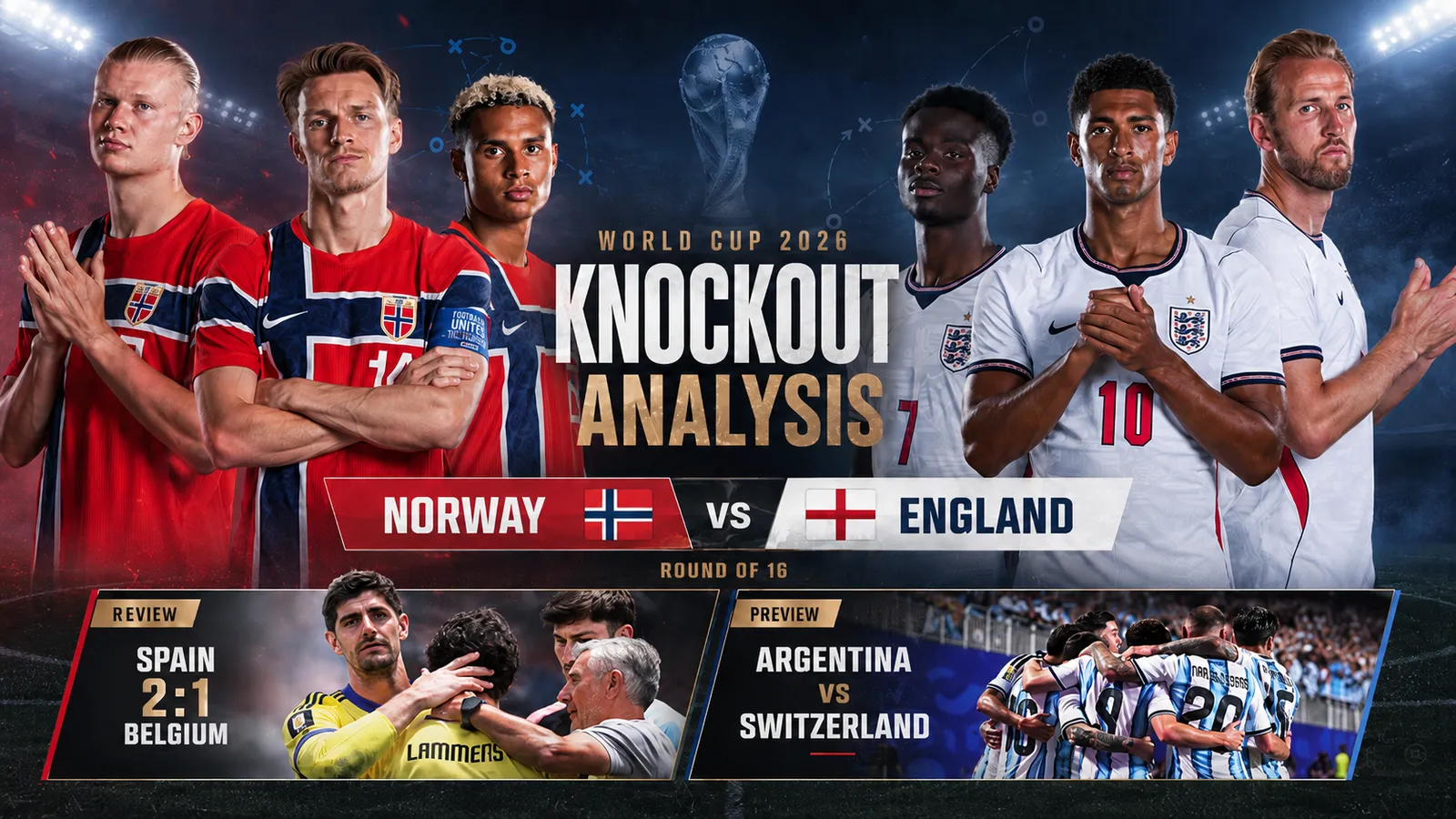
A World Cup knockout-stage content package built around tactical substance rather than simple scorelines: Spain’s uneasy win over Belgium, the semi-final challenge posed by France, England’s problem of controlling Erling Haaland, and Argentina’s need to solve Switzerland’s disciplined defensive structure.
Match Preview
World Cup Knockout Preview: England Must Control Haaland, Argentina Must Solve Switzerland, Spain Must Improve Before France
Knockout football is asking sharper questions now
The World Cup has reached the stage where reputation no longer carries a team through a match. Spain are already into the semi-final after beating Belgium 2-1, but the nature of that victory raised as many tactical questions as it answered. England and Argentina, meanwhile, enter their quarter-finals as bigger football nations on paper, yet both face opponents with clear, dangerous routes into the contest.
The common theme is control. Can England control the supply into Erling Haaland? Can Argentina control the tempo before Switzerland turn the match into a low-event grind? Can Spain control the areas France are most likely to attack?
Spain vs France: Spain cannot keep waiting for the late solution
Spain’s 2-1 win over Belgium delivered drama, but it did not deliver total reassurance. Fabian Ruiz gave Spain the lead after 30 minutes, Charles De Ketelaere equalised with a 41st-minute header, and Mikel Merino came off the bench in the 86th minute before scoring the winner two minutes later.
That was another example of Spain finding a late knockout answer through Merino. It also raised a more uncomfortable question: how often can a team with title ambitions rely on a substitute arriving late to repair a match that has become too narrow?
France will be a different test. They arrive in the semi-final in powerful form, having won all six matches before facing Spain, scored 15 goals and conceded only once. Their knockout run has also been built on control without chaos: clean sheets against Sweden, Paraguay and Morocco.
For Spain, the most urgent issues are clear:
- The left side must offer enough threat to stop opponents overloading Lamine Yamal’s flank.
- The central defence must deal better with aerial pressure and second-phase deliveries.
- Spain need earlier chance creation, not just late-box instinct.
Nico Williams’ role could be decisive. If he gives Spain a genuine left-sided outlet, Yamal will face fewer repeated traps on the right. If Spain remain tilted toward one flank, France have the athleticism and defensive organisation to compress that side and counter into the spaces Spain leave behind.
England vs Norway: stopping Haaland starts before the penalty area
England’s quarter-final against Norway is a classic mismatch on paper and a dangerous match in reality. England have more attacking depth, more ways to build through midfield and a manager in Thomas Tuchel who has encouraged a more proactive structure. But Norway possess the single most obvious match-changing weapon in the tie: Haaland.
The tactical mistake would be to frame the problem as one defender against one striker. Haaland is at his most dangerous when the pass before the pass has already opened the match. England’s priority should be to reduce the quality and frequency of service: press Martin Odegaard’s passing angles, stop clean wide deliveries, protect the centre-backs from isolation and be alert to second balls around the box.
England’s team news matters here. Jarell Quansah is suspended, Jordan Henderson is out with a broken arm, while Declan Rice, Marc Guehi and Reece James returned to full training before the match. Tuchel has indicated that, aside from suspended players, he has a full group available. That gives England options, but the right defensive balance still matters.
In possession, Harry Kane’s movement could be central. When Kane drops away from the centre-backs, he can pull Norway’s defensive line into awkward choices and create lanes for Jude Bellingham, Bukayo Saka and England’s wide runners. If England turn the match into layered attacks rather than hopeful crossing, Norway will have to defend for long spells.
But if the game becomes open and transitional, one Haaland chance can rewrite the mood completely.
Argentina vs Switzerland: Messi against structure
Argentina’s quarter-final with Switzerland has a different feel. This is not a match built around one obvious physical mismatch. It is a contest between Argentina’s star-led problem-solving and Switzerland’s collective resistance.
Switzerland have not trailed during official match time from qualifying through this World Cup run, counting 90 minutes and extra time rather than penalty shootouts. Their last knockout step was a 0-0 draw with Colombia after 120 minutes before a 4-3 win on penalties, with Gregor Kobel saving Cucho Hernandez’s attempt and Ruben Vargas converting the decisive kick.
That tells us what Argentina must avoid: impatience. Switzerland are comfortable in long, tight matches. They can defend deep without looking panicked, keep the scoreline low and gradually move the pressure onto the favourite.
Argentina still have Lionel Messi, and that changes every tactical conversation. Messi has eight goals before the Switzerland match, level with Kylian Mbappe at the top of the scoring chart. He remains the player most capable of slowing a match down with one touch and accelerating it with the next pass.
But Argentina’s dependency on Messi also carries a cost. If too much of the attack leans to his right-sided zones, Switzerland can work to block his connection with the centre-forward, the weak-side runner and the midfield support. Argentina need movement around Messi, not simply possession into Messi.
The likely pattern
England should have enough attacking variety to create chances against Norway, but only if they defend the supply line into Haaland with collective discipline. Argentina may have to accept a patient, low-scoring match against Switzerland. Spain, already through, face the most revealing examination of all: whether they can become more balanced before France punish the flaws Belgium exposed.
Post-Match Review
Spain 2 1 Belgium Review: Merino Saves Spain, but France Will Have Seen the Warning Signs
Spain survive, Belgium exit with respect
Spain’s 2-1 quarter-final win over Belgium had the ingredients of a classic knockout escape: an early foothold, a defensive scare, a late substitute, and a decisive moment that changed the emotional meaning of the match.
Fabian Ruiz put Spain ahead in the 30th minute. Belgium did not collapse. Charles De Ketelaere headed in from Timothy Castagne’s cross in the 41st minute, becoming the first player to score against Spain at this World Cup. Then, with the match drifting toward extra time, Mikel Merino entered in the 86th minute and scored in the 88th after Pau Cubarsi’s low shot was not controlled by substitute goalkeeper Senne Lammens.
Spain go on. Belgium go home. But the story is not as simple as winner strong, loser weak.
Spain’s problem: control without comfort
Spain had enough pressure and technical quality to keep Belgium under strain, but they did not turn that into the kind of authority that would frighten France on its own. Their win came through persistence and late penalty-box instinct rather than overwhelming superiority.
The concern is structural. When Spain’s left side does not consistently threaten, opponents can slide pressure toward Lamine Yamal and ask him to solve too many actions against double coverage. Yamal’s urgency should not be read only as impatience. It was also a symptom of a team whose attacking balance tilted too heavily toward one side.
Nico Williams’ availability and rhythm therefore matter enormously before the semi-final. Spain need width on both sides. They need defenders to hesitate before overloading Yamal. They need the pitch to become wide again.
The aerial warning France will study
De Ketelaere’s header was more than Belgium’s equaliser. It was a tactical message. Spain’s first concession of the tournament came from a moment that exposed their vulnerability to deliveries into the box and sustained pressure after the first defensive action.
Against Belgium, that issue was survivable. Against France, it may not be. France have the athleticism, variety and forward movement to turn one aerial weakness into repeated stress. Spain do not only need to defend the first cross. They need to defend the second phase, the loose ball, the recycled delivery and the runners arriving after the initial clearance.
Belgium’s defeat was not a collapse
Belgium arrived with major disruption. Amadou Onana was absent after suffering an ACL injury in the round of 16 against the United States, and Youri Tielemans was replaced before kick-off after being injured in the warm-up. Thibaut Courtois then had to come off in the second half with a leg muscle problem, with Lammens entering in the 71st minute.
Those are not small details. Belgium had to absorb personnel shocks and still pushed Spain into an uncomfortable match. Their organisation, competitive spirit and willingness to attack in moments made this a respectable exit rather than a surrender.
That is why the emotional weight around Belgium’s older core feels justified. Kevin De Bruyne and Courtois belong to an era that carried enormous expectation. This exit will be read through the lens of a golden generation, but the fairer judgment is that Belgium lost a tight quarter-final while still giving Spain real problems.
Merino: hero and warning sign
Merino has now scored winning goals as a substitute in consecutive knockout matches: against Portugal in the round of 16 and against Belgium in the quarter-final. That speaks to elite timing, focus and box-reading under pressure.
But Spain should not romanticise the pattern too much. A late substitute winner can be a strength. Needing it repeatedly can become a warning. France are less likely to allow Spain repeated rescue windows if they take control earlier.
Spain are alive. They are dangerous. They are technically rich. But after Belgium, they are also carrying visible problems into the semi-final.
Team Analysis
Spain’s Tactical Puzzle Before France: Width, Aerial Defence and the Danger of Living Late
Spain are winning, but not yet convincing enough
A quarter-final win is never something to dismiss. Spain beat Belgium 2-1 and reached the World Cup semi-finals. That matters. But elite tournament analysis has to separate outcome from performance, and Spain’s performance carried warning signs.
The biggest issue is not that Spain struggled at times. Every contender struggles in knockout football. The issue is where those struggles appeared: attacking balance, aerial security and the need for late intervention.
The left-side question is becoming a team problem
Spain’s right side has one of the tournament’s most exciting weapons in Lamine Yamal. But when the left side fails to stretch the opposition with comparable threat, Yamal becomes easier to trap. Belgium could shift bodies toward him, use help from wide and central areas, and force him into lower-percentage actions.
That does not mean Yamal played poorly. It means his workload became structurally too heavy.
Nico Williams changes that equation. If he can start or provide meaningful minutes at full intensity, Spain regain the double-wing threat that forces opponents to defend the full width of the pitch. Without that, France can load up against Yamal while trusting their athletic defenders to recover elsewhere.
The defensive issue is not just one header
Charles De Ketelaere’s equaliser for Belgium was Spain’s first goal conceded in the tournament. The timing and source of the goal matter: a cross into the box, a well-timed header, and a reminder that Spain’s defensive concerns are not only about open-space transitions.
France will look at that and ask whether Spain can defend repeated aerial pressure. Can they win the first duel? Can they control the second ball? Can they stop the next delivery? Can midfielders protect the zone just in front of the centre-backs when the ball is recycled?
That is the kind of defensive chain France are capable of stressing.
Merino gives Spain depth, but he should not become the plan
Mikel Merino’s consecutive knockout winners are a powerful asset. Few squads have a substitute who can enter late, read the rhythm of the match and attack the decisive space inside the penalty area.
But Spain’s coaching staff will know the danger of turning a solution into a habit. If matches are repeatedly unresolved until the final minutes, the margins become thinner. Against France, falling behind or leaving the match open for too long could be more costly than it was against Belgium.
What Spain must change before France
Spain do not need a total reinvention. They need sharper balance.
First, the left side must carry real threat so that Yamal is not asked to beat a crowd every time Spain need acceleration. Second, the midfield must create earlier high-quality openings rather than relying on pressure to eventually produce a loose ball. Third, the defensive unit must treat aerial pressure as a collective phase, not a centre-back duel.
Spain’s semi-final is not a crisis. It is a test of whether a technically gifted side can harden the parts of its game that Belgium exposed.
Player Performance
Mikel Merino Is Spain’s Late Game Specialist — But His Heroics Tell Two Stories
Merino’s role is no longer accidental
Mikel Merino’s World Cup knockout impact has become impossible to ignore. Against Portugal in the round of 16, he came on late and scored the decisive goal in stoppage time. Against Belgium in the quarter-final, he entered in the 86th minute and scored in the 88th to send Spain into the semi-finals.
That pattern is not just luck. Late goals often look chaotic from the outside, but they usually reward players who understand timing, spacing and emotional rhythm. Merino’s value is that he does not enter matches as a passenger. He arrives already reading where the next loose ball, rebound or second phase may appear.
The Belgium winner was about anticipation
Spain’s winner came after Pau Cubarsi’s low shot was not controlled by Senne Lammens. Merino was alive to the rebound and finished the chance that mattered most.
That is a specific skill. Many midfielders arrive late into the box. Fewer arrive in the right lane, at the right speed, with the calm to turn a rebound into a tournament-changing moment.
Merino’s profile gives Spain something different from their starting creators. He offers height, timing, duel strength and a direct relationship with the penalty area. In knockout football, where matches often lose their clean tactical shape after 75 minutes, that matters enormously.
Why the hero story has a second layer
The temptation is to turn Merino’s late goals into pure romance. Spain should enjoy the story, but they should also study what it reveals.
If a substitute repeatedly has to score the winner, it may mean the squad has excellent depth. It may also mean the starting structure is not creating enough separation early enough. Against Belgium, Spain had pressure but not full control. Against France, they may not be able to wait so long.
That is the dual meaning of Merino’s emergence. He is a weapon. He is also a mirror.
Spain need him — but not only him
There is nothing wrong with having a late-game specialist. Great tournament teams often need one. The problem begins only if the late specialist becomes the main attacking plan.
Spain’s next step is to make Merino a finishing layer on top of a more balanced attacking performance. If Nico Williams can restore left-side threat, if Lamine Yamal receives the ball in better one-v-one conditions, and if Spain create earlier from central zones, Merino’s role becomes a luxury.
If those issues remain unresolved, his heroics may keep carrying Spain — until they meet a team that does not leave the door open.
Controversy and Talking Points
World Cup Talking Points: Fine Margins, VAR Anger and the Problem With Turning Every Defeat Into a Verdict
Knockout football is built for overreaction
The World Cup knockout stage does not only decide matches. It decides narratives. One rebound can become destiny. One goalkeeper error can become a career label. One VAR decision can become a national argument. One elimination can become the final judgment on an entire generation.
That is why this stage needs more careful commentary, not less.
Lammens and the danger of one-moment blame
Senne Lammens came on for Thibaut Courtois in the 71st minute after Belgium’s first-choice goalkeeper suffered a leg muscle problem. In the 88th minute, Lammens failed to control Pau Cubarsi’s low shot and Mikel Merino scored the rebound.
It was a decisive moment. It is fair to analyse the technique, the pressure and the difficulty of entering a World Cup quarter-final cold. But it is too easy to reduce Belgium’s exit to one mistake. Belgium had already been forced to absorb significant disruption, including Amadou Onana’s injury absence and Youri Tielemans’ warm-up injury.
A goalkeeper error can decide a match without fully explaining it.
Argentina, Egypt and the limits of referee outrage
Argentina’s earlier 3-2 comeback against Egypt also left controversy in its wake. Egypt had led 2-0 through Yasser Ibrahim and Mostafa Ziko before Cristian Romero, Lionel Messi and Enzo Fernandez scored for Argentina. Messi also had a first-half penalty saved by Mostafa Shobeir, and Egypt had a goal disallowed after VAR review. Egypt’s federation and coach criticised the officiating afterwards, while FIFA refereeing chief Pierluigi Collina denied favouritism.
That is the line football debate must hold. Criticising individual decisions is part of the sport. Turning every disputed decision into a claim of institutional bias requires a much higher burden of proof.
The Belgium generation deserves a fairer ending
Belgium’s elimination will inevitably be linked to the wider story of its golden generation. Kevin De Bruyne, Courtois, Romelu Lukaku and the era that followed Eden Hazard will be judged against the trophies they did not win.
But that framing can become too harsh. Roberto Martinez led Belgium to third place at the 2018 World Cup and the Euro 2020 quarter-finals before the 2022 World Cup group-stage exit ended his tenure. The trophy gap is real, but so is the difficulty of converting a talented generation into international silverware.
Belgium’s 2026 exit was not a humiliation. It was a narrow defeat to Spain in a quarter-final shaped by injuries, resilience and one late rebound.
Better questions produce better football analysis
Instead of asking only who choked, who was robbed or who failed a generation, the better questions are more useful:
- Why did Spain need another late solution?
- Why did Belgium remain competitive despite disruption?
- How should officials communicate controversial VAR decisions?
- When does legacy criticism become lazy shorthand?
Knockout football will always create emotional extremes. The best analysis should not remove that emotion — but it should stop emotion from replacing evidence.