
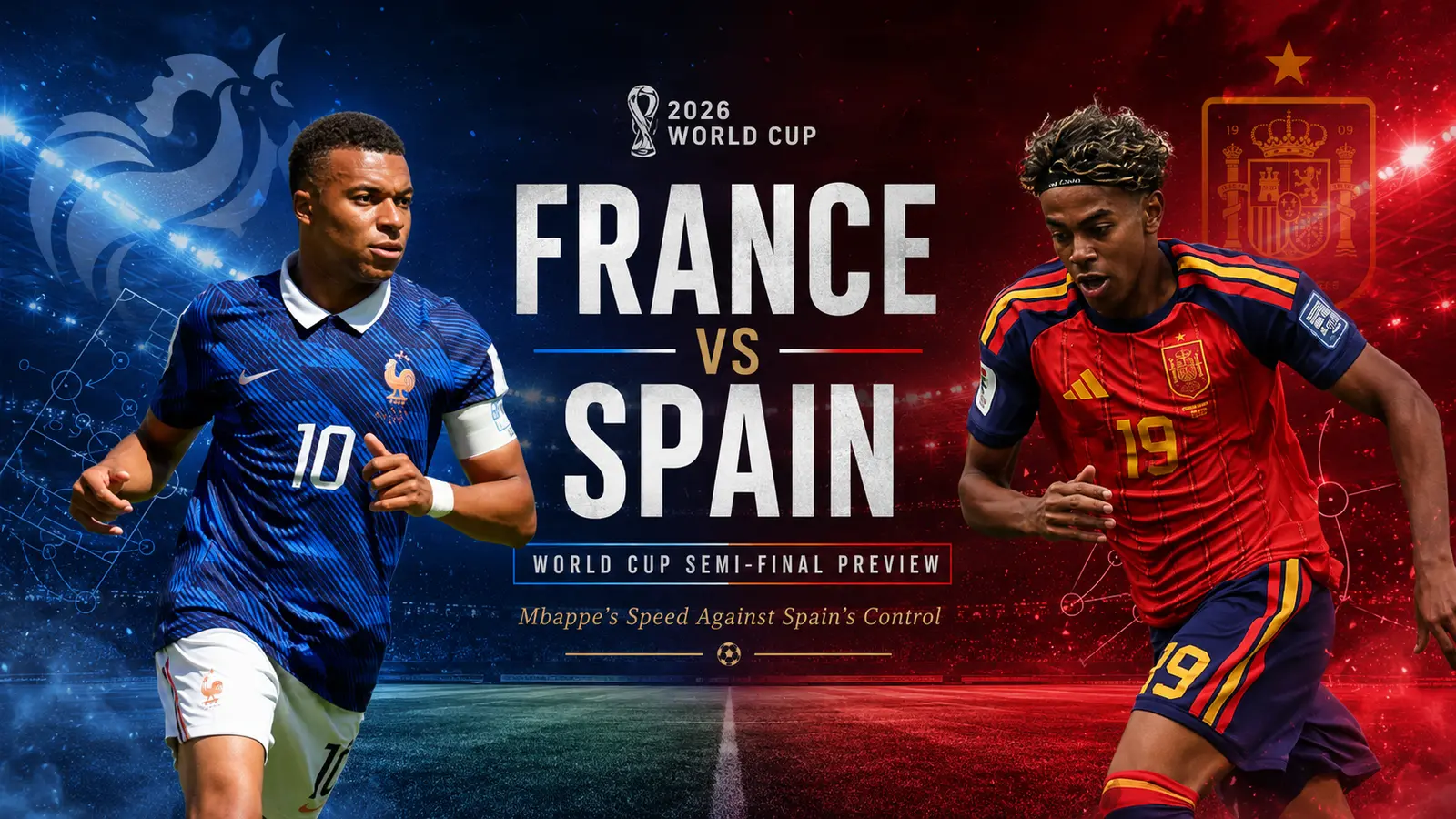
France vs Spain World Cup Semi Final Preview: Mbappe’s Speed Against Spain’s Control
Introduction
A World Cup semi-final preview package built around the rare meeting of the top four teams in the FIFA men’s rankings, with France vs Spain as the primary tactical focus and England vs Argentina as the major historical and emotional subplot.
Match Preview
France vs Spain Preview: Control, Width and the Space Mbappe Wants
France vs Spain has the shape of a modern World Cup semi-final in its purest form: two elite teams, two different footballing logics, and very little margin for a mistake in transition.
The match is scheduled for 14 July 2026 at Dallas Stadium, with kick-off at 19:00 UTC. It is a single-elimination semi-final: if the match is level after 90 minutes, it goes to extra time and then penalties if required.
The broader context is exceptional. France, Argentina, Spain and England entered the semi-final stage as the top four teams in the FIFA men’s world rankings — the first time since the rankings were created in December 1992 that the World Cup last four has been made up entirely of the top four ranked sides.
But rankings only explain expectation. They do not explain the match.
The central tactical question
Spain want the ball, territory and repeated pressure. Their best version comes when the pitch is stretched horizontally: the wingers hold width, the midfielders receive between lines, and the opposition back line is forced to slide from side to side until gaps appear.
France are built to punish the opposite moment. They do not need long spells of possession to look dangerous. If Spain lose the ball with their defensive line high and their rest defence stretched, France have the runners and passers to turn one transition into a decisive attack.
That is why this semi-final should not be reduced to possession percentage. The key numbers will be where Spain lose the ball, how quickly France can play forward, and whether Spain’s counter-press can stop the first pass into space.
Why Spain’s left side matters to Lamine Yamal
Lamine Yamal is one of the most obvious players to watch, but Spain’s right-sided threat depends heavily on what happens on the opposite flank.
If Nico Williams is able to provide genuine width on the left, France must respect both wings. That stretches the back line, opens the half-spaces and gives Yamal more favourable one-v-one or inside-left shooting and passing lanes from the right.
If Spain’s left side cannot pin France back, the match changes. France can shift more defensive attention toward Yamal, compress the right flank and turn Spain’s possession into slower, more horizontal circulation.
Nico Williams has had a right adductor issue during the tournament and remains in the Spain squad. His exact availability and role should be judged only once the official team news is released, but tactically his presence — whether from the start or as a later option — is one of the major variables.
France’s route to danger: Olise, Dembele and Mbappe
France enter the semi-final with a formidable tournament profile: six wins from six, 16 goals scored, two conceded and four clean sheets. Kylian Mbappe has eight goals before the semi-final, while Ousmane Dembele has five. Michael Olise has also been among the tournament’s leading creators, with five assists.
The more important point is structural. France have clarity in their attacking roles.
Mbappe is the central threat: the runner who bends defensive lines and finishes moves. Olise offers connection and final-third delivery. Dembele gives France acceleration, dribbling and another direct route through pressure. That division of responsibility matters in a knockout match, because France do not need every star to do the same job.
Against Spain, Mbappe’s most valuable actions may not be long possessions or repeated touches. They may be the first sprint behind the defensive line, the curved run away from a centre-back, or the movement that forces Spain’s defence to retreat five metres deeper than planned.
Spain’s strength is also their risk
Spain’s tournament has been built on control: five wins, one draw, 11 goals scored, just one conceded and five clean sheets before the semi-final. That defensive record is outstanding, but France pose a different kind of stress.
A high line helps Spain keep the team compact and sustain pressure after losing the ball. It also creates the space France want to attack. The match may be decided by whether Spain’s midfield can close the passing lane quickly enough after turnovers.
Spain do not need to abandon their identity. They need to manage its cost.
The wider semi-final picture: England vs Argentina
The other semi-final, England vs Argentina, carries a different kind of weight. It is scheduled for 15 July 2026 at Atlanta Stadium, also kicking off at 19:00 UTC.
England and Argentina have one of the World Cup’s most charged histories: 1966, 1986, 1998 and 2002 all remain part of the rivalry’s emotional memory. Lionel Messi’s presence adds another layer of global attention around Argentina.
But the two semi-finals should not be treated as the same story. France vs Spain is primarily a tactical clash between possession structure and transition speed. England vs Argentina is also a football match, of course, but its public temperature is intensified by history, symbolism and the way fans remember previous meetings.
What could decide France vs Spain?
Three questions stand out.
First, can Spain create genuine threat on both wings? If they can, Yamal becomes harder to isolate and France must defend the full width of the pitch.
Second, can France hit the first forward pass cleanly after regaining the ball? If Olise, Dembele or another carrier can release Mbappe early, Spain’s high line will be tested immediately.
Third, how does the match change late? Spain have midfielders capable of altering rhythm, while France have wide options who can change the speed of the game. In a semi-final, the first 60 minutes often reveal the plan; the final 30 expose the squad.
France vs Spain is therefore not simply control against chaos. It is control against the possibility of one perfect counterattack. Spain may dominate the ball and still live with danger behind them. France may spend long periods without the ball and still carry the clearest threat on the pitch.
That tension is what makes this semi-final so compelling.
Team Analysis
Why France and Spain Are Built for Different Kinds of Control
France and Spain both arrive as title-level teams, but they do not create danger in the same way.
Spain’s structure is based on possession, width and pressure. They look to stretch the pitch, circulate the ball, lock opponents into their own half and use the wingers to create the space that midfielders and inside forwards can attack.
France are more vertical. They can play through pressure, but their greatest threat comes when the opponent is unbalanced. When France recover the ball and find the first forward pass, their attacking structure quickly becomes a race: can the defensive line turn and recover before Kylian Mbappe, Ousmane Dembele or another runner attacks the space?
Spain’s control depends on both wings
Spain’s best attacking version requires both sides of the pitch to matter.
Lamine Yamal is the obvious right-sided creative force, but he becomes easier to defend if Spain’s left side does not hold width and draw pressure. Nico Williams’ tactical value is therefore larger than a simple goal-or-assist reading. His ability to stay wide, threaten the outside channel and force defenders to shift can create the conditions that make Yamal more dangerous on the far side.
That is the important detail: one winger’s value can be measured by the space he creates for the other.
France’s order makes their speed more dangerous
France’s attacking quality is not just about having fast players. It is about role clarity.
Mbappe is the focal point and final runner. Michael Olise gives France connection between midfield and attack. Dembele provides directness and one-v-one disruption. That balance reduces the risk of too many elite attackers wanting the same ball in the same zone.
In knockout football, that order matters. A counterattack is only dangerous if the first pass, the supporting run and the finishing movement are connected. France have the profiles to make those moments coherent.
The risk profiles are opposite
Spain’s danger is that their strength can expose them. To dominate territory, they must keep the line high and the team compact. That makes counter-pressing essential. If the first wave of pressure fails, France can immediately attack the space behind.
France’s danger is different. If the first forward pass after a regain is blocked, their speed advantage can be neutralised and Spain can keep them pinned deep. France do not need constant possession, but they do need clean exits.
A semi-final of execution, not ideology
This match should not be framed as possession football versus counterattacking football in a simplistic way. Spain can be direct when space opens. France can combine in settled possession. The difference is where each team’s highest-value moments are most likely to come from.
For Spain, the ideal picture is sustained pressure, width on both sides and Yamal receiving in space rather than in traffic.
For France, the ideal picture is a Spain turnover, one sharp forward pass and Mbappe attacking a retreating defence.
Both are forms of control. Spain try to control the game’s rhythm. France try to control its most dangerous moments.
Player Performance
Mbappe, Yamal and the Players Who Can Tilt France vs Spain
France vs Spain naturally pulls attention toward Kylian Mbappe and Lamine Yamal. That is fair: one is France’s central attacking force, the other is Spain’s most magnetic young creator.
But semi-finals are rarely decided by star names alone. They are decided by the conditions built around those stars.
Kylian Mbappe: the runner Spain cannot ignore
Mbappe enters the semi-final with eight goals in the tournament. The number is striking, but his threat is not only in the finish. It is in the way his movement changes the opposition’s defensive line.
Against Spain, his most important work may come without long spells on the ball. If Spain hold a high line, Mbappe’s curved runs, blind-side movements and acceleration into the channel can force defenders to drop earlier than they want. That alone can disrupt Spain’s compact shape.
Michael Olise: the connector, not just the creator
Michael Olise’s five assists before the semi-final underline his creative output, but his role should be read more broadly. France need a player who can receive after a regain, lift his head and choose the right first or second pass into transition.
If Olise finds Mbappe early, Spain’s defensive line is immediately under stress. If Spain block that lane, France may have to build attacks more slowly — a scenario that suits Spain better.
Ousmane Dembele: directness with purpose
Ousmane Dembele has also been a major contributor, with five goals before the semi-final. His value against Spain is not only finishing. It is the uncertainty he creates when receiving wide or between lines.
Dembele can carry the ball through pressure, force defenders to step out and make Spain’s counter-press less comfortable. In a match where one broken pressure sequence can decide everything, that directness matters.
Lamine Yamal: talent, attention and space
Yamal’s tournament output before the semi-final — one goal — does not fully explain his importance. Opponents defend him as a primary threat, and that attention can alter Spain’s entire attacking shape.
The key question is not simply whether Yamal can beat his man. It is whether Spain can give him the right kind of isolation. If he receives with two defenders close and no opposite-side threat stretching France, he will be asked to solve too much in too little space.
Nico Williams: the space-maker
Nico Williams’ fitness is a major pre-match variable after his confirmed right adductor issue earlier in the tournament. His exact role depends on official team news, but tactically he remains one of Spain’s most important profiles.
If he can hold the left touchline and threaten the outside, France cannot overload Yamal’s side as aggressively. Even without a direct goal contribution, that can be decisive.
Mikel Merino: the late-game lever
Mikel Merino has scored twice in the tournament and has found the net in consecutive knockout matches before the semi-final. His profile gives Spain another route if the game becomes tight: arrival from midfield, aerial presence and the ability to attack second balls.
In knockout football, substitutions and late midfield runs often matter as much as the starting pattern.
The performance lens
The best way to judge these players is not only by goals and assists. Watch where Mbappe receives, how quickly Olise releases the ball, whether Dembele beats the first pressure, how often Yamal receives in space, and whether Williams forces France to defend both wings.
The headline duel may be Mbappe versus Yamal. The match may be decided by everyone creating the stage around them.
Controversy and Talking Points
England vs Argentina: History, Emotion and the Danger of Pre Writing the Controversy
England vs Argentina is never just another football match.
The rivalry carries layers of World Cup memory: England’s wins in 1962 and 1966, Argentina’s unforgettable 1986 victory featuring Diego Maradona’s “Hand of God” and his second goal, the 1998 penalty shootout after a 2-2 draw, and England’s 2002 win through David Beckham’s penalty.
Those matches still shape how supporters read the fixture. A hard tackle, a penalty appeal or a refereeing decision can feel bigger in this rivalry than it would in a neutral match.
That emotional weight is part of the spectacle. It is also where the analysis has to be careful.
Messi, Argentina and global attention
Lionel Messi gives Argentina an extraordinary global audience. His presence increases the commercial and emotional gravity of any Argentina match, especially at a World Cup.
That is a legitimate talking point. Football is not separate from television audiences, sponsorship, national identity or global star power.
But there is a line between recognising commercial gravity and claiming competitive manipulation. Suggestions that a team is being carried by a pre-written script, or that a tournament exists to deliver one player’s ending, require evidence. Without verifiable match events, documents or credible reporting, those claims belong to fan emotion rather than football analysis.
History should frame the match, not decide it
England vs Argentina deserves its historical context. The rivalry’s past explains why the match will be watched so intensely and why the reaction to key moments may be unusually sharp.
But history does not tackle, press, defend set pieces or finish chances in the present. The current match still has to be judged on what happens on the pitch.
That means any post-match discussion should start with concrete evidence: the decision in question, the law being applied, the referee’s angle, any available VAR process, and the sequence of play. Only then can a controversy be evaluated seriously.
The responsible way to cover a heated semi-final
The better frame is not “will there be controversy?” It is: if a controversy happens, can we analyse it clearly?
England vs Argentina will bring emotion. That is unavoidable. But responsible football commentary should not pre-load the match with suspicion. It should respect the rivalry, understand the history and still wait for the evidence.